Jesus is not an isolated missionary, nor are we

missionary 101.jpg

“Go and make Christ known to all nations.” The missionary spirit is once again coming to the table. As Christians, we are baptized to come into communion with God who is Father, Son, and Holy Spirit, to live as adopted children of God faithful to the life of the Church. The sacrament of Baptism makes us disciples of the Lord. We can’t forget, nor can we neglect, to make the Lord known to all people by the witness of our lives. Our call is the same as the Prophet Isaiah’s, “Here am I; send me” (Is 6:8). The preaching of the Lord’s Kingdom is not reserved to few; no, the mission to proclaim the presence of the Kingdom is given to all the baptized in all places. Hence, we work doing the new evangelization. Catholics as missionaries in this country needs renewal. We Catholics can’t leave the missionary work to the Mormons, the Jehovah Witnesses, the Evangelicals or the Muslims. If we truly believe that the Lord has given us Himself as the way, the truth and the life, then we ought to share this experience. Moreover, in living the Gospel, following the teaching of the Church, the reception of the sacraments, we care for those live on the margins (think of the corporal works of mercy).


I see in Pope Francis calling us to be attentive to the missionary impulse again as fundamental to our faith and life in the Church. The Pope comes as this missionary notion from his own spiritual formation received as a member of the Society of Jesus. No doubt he thinks of the early founders of the Jesuits, and he likely recalls the Jesuit saint Francis Borgia, the third Jesuit Superior General who spent much energy on missionary vocation of the Jesuits, of translating the faith and the Exercises of Loyola into a more concrete expression. We can say that Pope, like Borgia, knows that the missionary work we are called to perform is a ministry that takes on a variety of aspects: preaching, teaching, sanctifying, interceding, healing, guiding others in the spiritual life, administering and governance.


Pope Francis’ Sunday Angelus address needs to be studied and prayed about. Think about the points highlighted.


This Sunday’s Gospel (Lk 10:1-12.17-20) speaks to us precisely of this: of the fact that Jesus is not an isolated missionary, does not want to fulfill his mission alone, but involves his disciples. Today we see that, in addition to the Twelve Apostles, He calls seventy-two others, and sends them into the villages, two by two, to announce that the Kingdom of God is near. This is very beautiful! Jesus does not want to act alone, He has come to bring to the world the love of God and wants to spread that love with a style of communion and fraternity. For this reason, he forms immediately a community of disciples, which is a missionary community. Iright from the start, He trains them for the mission, to go [on the mission].


Beware, however: the purpose is not to socialize, to spend time together – no, the purpose is to proclaim the Kingdom of God, and this is urgent! There is no time to waste in small talk, no need to wait for the consent of all – there is need only of going out and proclaiming. The peace of Christ is to be brought to everyone, and if some do not receive it, then you go on. To the sick is to be brought healing, because God wants to heal man from all evil. How many missionaries do this! They sow life, health, comfort to the peripheries of the world.


These seventy-two disciples, whom Jesus sent ahead of him, who are they? Whom do they represent? If the Twelve are the Apostles, and therefore also represent the Bishops, their successors, these may represent seventy-two other ordained ministers – priests and deacons – but in a wider sense we can think of other ministries in the Church, catechists and lay faithful who engage in parish missions, those who work with the sick, with the various forms of discomfort and alienation, but always as missionaries of the Gospel, with the urgency of the Kingdom that is at hand.

The Gospel says that those seventy-two returned from their mission full of joy, because they had experienced the power of the Name of Christ against evil. Jesus confirms this: to these disciples He gives the strength to defeat the evil one. He adds, though: “Do not rejoice that the spirits submit to you, but rejoice that your names are written in heaven. (Luke 10:20)” We should not boast as if we were the protagonists: the protagonist is the Lord [and] His grace. Our joy is only this: [in] being His disciples, His friends. 


May Our Lady help us to be good servants of the Gospel.

Pope Francis

Sunday Angelus Address

8 July 20013

Pacis Nuntius: St Benedict as “exemplar and type of absolute beauty”

Why is Saint Benedict so important for us today? Why spend so much energy trying to promote his cause and to recall his influence upon civilization? One answer is: “The kingdom of heaven is at hand.” You may want to read “Translating St Benedict” by Dom Hugh of Douai Abbey (UK) who does a fine job at locating a piece of our interest.

I also think it’s a good day to remember that Europe –and the USA– needs its heavenly patron to get it out of the moral, political and human confusion that is wreaking havoc today. I wonder what life in the USA would be like if we had a “new” Benedict? The Servant of God Pope Paul VI wrote Pacis Nuntius (1964), an Apostolic Letter by which he names Saint Benedict as the principle patron of all of Europe. In this document we read in an abbreviated form why Abbot and Saint Benedict was important not only to the Pope, but to a continent.

In everlasting memory

Paul VI in Montecassino.jpg

Messenger of peace, molder of union, magister of civilization, and above all herald of the religion of Christ and founder of monastic life in the West: these are the proper titles of exaltation given to St. Benedict, Abbot. At the fall of the crumbling Roman Empire, while some regions of Europe seemed to have fallen into darkness and others remained as yet devoid of civilization and spiritual values, he it was who, by constant and assiduous effort, brought to birth the dawn of a new era. It was principally he and his sons, who with the cross, the book and the plow, carried Christian progress to scattered peoples from the Mediterranean to Scandinavia, from Ireland to the plains of Poland (Cf. AAS 39 (1947), p. 453). With the cross; that is, with the law of Christ, he lent consistency and growth to the ordering of public and private life. To this end, it should be remembered that he taught humanity the primacy of divine worship through the “opus Dei”, i.e. through liturgical and ritual prayer. Thus it was that he cemented that spiritual unity in Europe, whereby peoples divided on the level of language, ethnicity and culture felt they constituted the one people of God; a unity that, thanks to the constant efforts of those monks who followed so illustrious a teacher, became the distinctive hallmark of the Middle Ages.

Continue reading Pacis Nuntius: St Benedict as “exemplar and type of absolute beauty”

I acknowledge my transgression

acknowledge my transgression.jpg

Have you ever thought about the scriptural exhortation that “A sacrifice to God is a contrite spirit”? What does it mean? What does it mean for me? Why do I need a contrite (a feeling or showing sorrow and remorse for a sin or shortcoming)  heart to be a person of faith? When I pray the Liturgy of the Hours, or approach the confession box my thoughts and feelings zero-in on contrition, sin and what it all means. Some days I am plagued by the heaviness of sin (separation from God but also living divorced from a good sense of self and relations with others). Here, I am talking about the place of mercy –God’s mercy– for me.


The Responsory for a recent reading in the Office of Readings (Sunday, 14th Sunday through the Year) has us sing: My sins are embedded like arrows in my flesh. Lord, before they wound me, heal me with the medicine of repentance.

A clean heart create for me, O God. Put a steadfast spirit within me. Heal me with the medicine of repentance.


I found myself thinking about what Saint Augustine said about sin in one of his sermons. (The italics is Augustine using Scripture.) Perhaps the following portion of the sermon is of interest for you. The spiritual life, indeed, our whole personhood, needs to consider how we deal with sin in our lives.


Saint Augustine said:

Continue reading I acknowledge my transgression

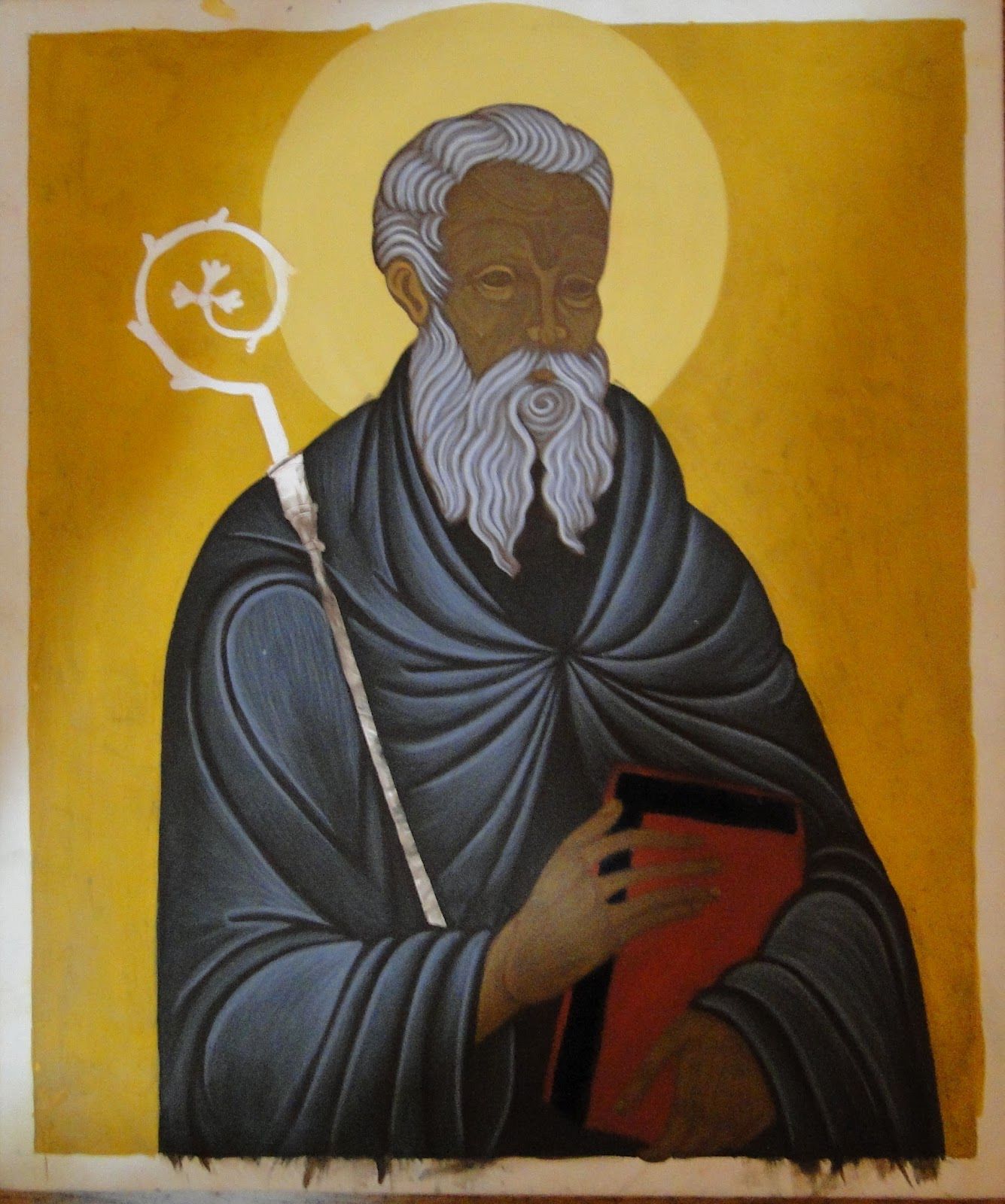
Saint Benedict, the man of blessing

São Bento.jpg

Today is the Feast of Saint Benedict! It was originally the feast of the translation of his relics, but after Monte Cassino was bombed they discovered that his relics were evidently never translated! Pope Paul changed it to the feast of Saint Benedict Patron of Europe. One of the most sensible things he ever did.


The perduring gift to the Church is the Rule of Saint Benedict. It is a beautiful compilation of how to live together seeking the face of God. One part on humility is worth noting. Benedict’s teaching on humility is here.

Father Giussani points out about life in Communion and Liberation:


“Now, we must also say that to live communion is not a small matter; it is all of Christian life, because Christian life is Christ among us who makes us one sole body. And this, I believe, is the heart of the original Benedictine tradition, with which our Movement felt itself to coincide from the beginning. The heart of our Movement is this, and I really believe that it is being disciples of the original Benedictine history that has made our Movement like this. Therefore, it is no small matter; it is the example that has to happen.”


A short review of the importance of Saint Benedict and Benedictines in the life of Communion and Liberation is here.

Blessed feast of Saint Benedict.

Benedicite

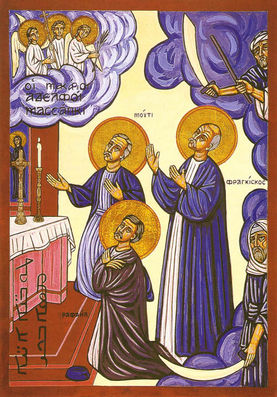
Blessed Massabki Brothers

Blessed Massabki Brothers.jpg


Abdel Mohti, Francis, and Raphael were three Maronite laymen killed inside the Franciscan church in Damascus while they were praying. 


On 9 July 1860, the killers entered the Franciscan church in Damascus where the Brothers were in prayer. The Islamic fanatics gave the Brothers a choice: reject Christianity and accept Islam, or, be killed. The Brothers said: “You may destroy our lives but you cannot destroy our faith in Christ and our souls; we are Christians. In the faith of Christ we live and in the faith of Christ we shall die.” The three holy brothers were killed as were several of the Franciscan friars.


Pope Pius XI beatified the three Massabki  brothers on 7 October 1926.


Blessed Massabki Brothers, pray for Lebanon, the Church in the USA, and each one of us.

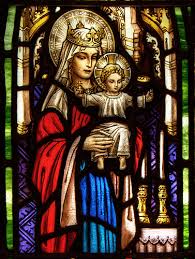
Our Lady of the Atonement

OL Atonement.jpeg

Today, is the feast of Our Lady of the Atonement. Under her patronage do the Franciscan Friars and Sisters of the Atonement live their vocation. I was happy to celebrate with a favorite Atonement Sister today!

The Founder of the Franciscans of the Atonement, the Servant of God Father Paul, said of Mary’s part in the Atonement:


“She is necessarily “of the Atonement” since it was the will of God that she play a necessary part in the atonement or redemption. This is not to say that without her man would have remained unredeemed but that God’s plan gave her a large share in the redemptive work…Mary, although her part is in no way similar in nature to that of her divine Son’s, cooperated with Jesus Christ, as no other creature did, in his work of reconciling man with God. Her claim to this high title rests most solidly on the fact that she consented to become, and became the mother of the Redeemer; that she suffered with Jesus during the passion; and that all graces merited for mankind by Christ have come to us through Mary.

When we, therefore, give to our Blessed Mother the title of Our Lady of the Atonement we mean: Our Lady of Unity. As she sits enthroned, as the great wonder of heaven, wearing a crown of twelve stars, clothed with the sun, the moon her footstool, she presents to the universe the highest possible approach of a creature to intimate and exalted union with God.


More on Fr Paul Wattson and the devotion to Atonement.

Abdallah Zaidan is new bishop for Maronite Eparchy of Our Lady of Lebanon

Zaidan.jpeg

Today, the Holy Father, Pope Francis, has accepted the resignation of Bishop Robert J. Shaheen from the pastoral governance of the Eparchy of Our Lady of Lebanon of Los Angeles, and has appointed as Bishop of the same Eparchy the Reverend Father Abdallah Elias Zaidan, MLM, 50, up until now Rector of Our Lady of Mt. Lebanon-St. Peter Maronite Cathedral in Los Angeles. He was ordained a priest on 20 July 1986.

Bishop Robert Joseph Shaheen was the first native American (born in Danbury, CT) to be nominated bishop for the Maronites in the USA, and the second bishop of of the Eparchy of Our Lady of Lebanon of Los Angeles. He was ordained a priest 1964 and a bishop on 15 February 2001.

Bishop-elect Zaidan will be ordained in Lebanon and later enthroned in the United States.

May God grant Bishop-elect Abdallah many years of faithful service.

Our Lady of Lebanon, intercede for the Eparchy.

Saint Maron, pray for us.

Being a new creation in Christ Jesus is way of life

Christ feeding himself.jpg

The Apostle urges the followers of Jesus Christ to allow His Word and life to penetrate hearts and transform lives: to live as a “new creation.”

As Saint Ephrem of Syria taught, “Blessed the one who draws near with fear and trembling and dread to the spotless Mysteries of the Savior and has realized that he has received in himself eternal life.” 


Hence, wolves changed into sheep; sinners into disciples, zombies into human beings. Now that’s a new creation!


The Holy Eucharist and the Divine Office are graces beyond compare.


“Be zealous for true religion” in a time of theological narcissism requires a different orientation

St Basil at the Liturgy.jpg

I came across a portion of Saint Basil the Great’s Letter 90 addressed to the bishops of the West. I like reading these types of letters because they give a great sense of the history of Christian salvation history. In 2000 years we’ve been exposed to some things more than once. Apparently, Basil is responding to reports of some members of the Church allowing certain influences of society, politics, and unorthodox teaching of the Faith to enter into, to penetrate, the life of the Holy Church. What came to mind was the phrase of Pope Francis a couple of months ago when he warned the Church about theological narcissism. It’s not all about me! There are times when a Christian can be too cozy with the culture in which he or she lives.


Saint Basil isn’t writing today, he inhabits the 4th century. His words, though, are timeless; his description of the currents are applicable today. It makes no sense to me to merely identify the problems of today without saying that the change can’t applied to all others and not be a provocation to my own conversion. Reform is not the responsibility of all others, but conversion of mind and heart is also my own spiritual work before the Divine Majesty.


The zeal for true religion that Basil wants to propose is two fold: the work of God acting in the world today, and our sharing what we have received from Jesus Christ. Zeal for the Kingdom is about God’s work, not my own; it is God’s creation, God’s Church, God’s people –not mine. Basil is rejecting a theological narcissism. Isn’t that what we face today? The faith we’ve been given by the Lord is transferred to the life of the Church, as another “Great” once said, Saint Leo. As the Lord Himself turns toward the Father in prayer, so must our orientation be set on the Trinity.


The doctrines of the Fathers are despised; apostolic traditions are set at nought; the devices of innovators are in vogue in the Churches; now men are rather contrivers of cunning systems than theologians; the wisdom of this world wins the highest prizes and has rejected the glory of the cross. Shepherds are banished, and in their places are introduced grievous wolves hurrying the flock of Christ. Houses of prayer have none to assemble in them; desert places are full of lamenting crowds. The elders lament when they compare the present with the past. The younger are yet more to be shown compassion, for they do not know of what they have been deprived. All this is enough to stir the pity of men who have learned the love of Christ; but, compared with the actual state of things, words fall very far short. If then there be any consolation of love, any fellowship of the Spirit, any bowels of mercy, be stirred to help us. Be zealous for true religion, and rescue us from this storm. Ever be spoken among us with boldness that famous dogma of the Fathers, which destroys the ill-famed heresy of Arius, and builds up the Churches in the sound doctrine wherein the Son is confessed to be of one substance with the Father, and the Holy Ghost is ranked and worshipped as of equal honor, to the end that through your prayer and co-operation the Lord may grant to us that same boldness for the truth and glorying in the confession of the divine and saving Trinity which He has given you.

John XXIII and John Paul II to be canonized

English: US President George W. Bush and his w...

In a meeting with Cardinal Angelo Amato, SDB, Prefect of the Congregation for Saints this morning in Rome, Pope Francis was presented with causes of several persons being studied for beatification and sainthood.

A special Consistory of Cardinals has been called to discuss the proposed canonizations. Notably, the cardinals will discuss the canonizations of Blessed John Paul II and Blessed John XXIII.

In today’s Ordinary Consistory of Cardinals and Bishops of the Congregation for Saints, Pope Francis received the favorable votes for both popes canonization. John XXIII, though without the usual required second miracle. Moreover of note, the Prelates favorably voted on the beatification of Bishop Álvaro del Portillo, the successor of Saint Josémaría Escriva. The former Prelate of Opus Dei died in 1994. The Venerable Servant of God was in his early life as a priest a significant contributor of the work of the Second Vatican Council. Several of recognitions of sanctity were made.
The dares for the special Consistory and canonizations has not yet been set, and the canonization is expected to happen by year’s end.
Enhanced by Zemanta