Spy Wednesday

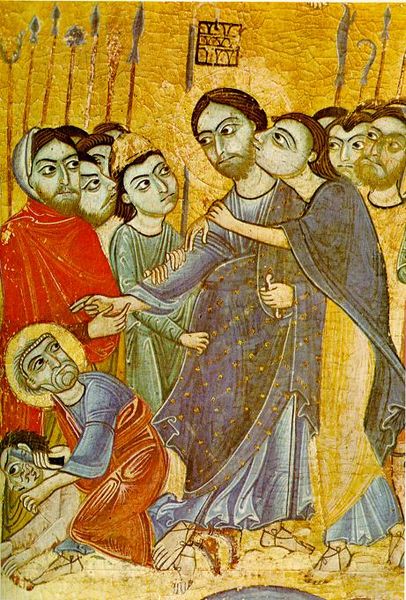
betrayal kiss judas jesusThe day before Holy Thursday is known by Catholics as Spy Wednesday. It is a day of profound aloneness. In the biblical and liturgical narrative of the Paschal Mystery we recall that the Apostle Judas played an essential part in our redemption, that sin and betrayal are at the heart of the Christian mystery of salvation just as grace, love and forgiveness.

The Biblical and theological roots of our faith gives us a striking opportunity to discern, to re-evaluate, re-direct our life. We call this the journey of conversion; we have the sacraments of Confession and Eucharist; we also have the tools of spiritual direction to see where God is leading us, or where we have not lived according to Catholic faith. This ability to think again, to have a metonoia, is a supreme grace because all of us have something of Judas in us.

How many of us think we are doing the right thing when in the final analysis our actions  were not. Judas’s betrayal of Jesus was in this category. The expectation Judas had hoped for was a Messiah who would liberate Israel from Roman rule thus creating a new Jerusalem, a new creation, a new people.  We know he was wrong, and that the devil presents bad things as good. The devil prevailed upon the freewill of Judas but twisting reality in his deception. The Apostle Judas failed to understand, as likely did the others, that Jesus wasn’t interested in earthly power.

The other important aspect of Judas and Spy Wednesday is our awareness of how evil works in the world. It is a reality and not fake. Evil has a real grip on our lives and can redirect our focus from God unto ourselves or materialistic tendencies that ultimately reject God. Pope Benedict spoke of a lack of awareness regarding evil when he said in one of his teachings, “Today there is a certain callousness of the soul towards the power of evil, an insensitivity to all the evil in the world: we do not want to be disturbed by these things, we want to forget, perhaps, we think, it is not important. It is not only insensitivity to evil, but also insensitivity to God.”

Spy Wednesday is an important day in our approach salvation. Hence, it cannot be treated as frivolous or disregard of the betrayal it points to. It is said that Saint Catherine of Siena worried about Judas’s fate but was told by the Lord that mercy was possible even for him.

Sometimes I am surprised how quickly we rush to rule the world with justice. Or, I should say some form of justice that is so harsh and decisive. I wonder if we are aware that our manner of being just is not God’s. For example, man and woman often determine who is and who is not in hell. Ours is a sentimental mercy. It is a common assessment that Judas is in hell. But, is this a matter of our business? Perhaps we ought to take Saint Catherine’s testimony as true. Biblical revelation tells us that only God determines the content of one’s heart. The Church’s teaching is that the Lord gave the power discern who is in communion, or not, with God (“the power of the keys”). I recall the famous line from Cardinal Avery Dulles who said we know hell exists but not the population of hell.

Today, Spy Wednesday, let us pray for those who have betrayed or been betrayed. As difficult as this is, praying for our enemies is exactly what Jesus would do. Let us pray for God’s mercy on Judas. Today, go to confession.

Once an unbeliever, now a Catholic

In a week’s time many people will be baptized, received into full communion with the Catholic Church or receiving the sacraments of Confirmation and Holy Eucharist. Truly an process of discernment on the parts of the persons and the parish staff who take the time to teach the faith, propose a new way of seeing life, and being a good example that it is possible to be a Catholic. The process we use is called the Rite of Christian Initiation of Adults –the RCIA (and there is another process for children of catechetical age but not yet in regular Christian education).

What I have found is that the RCIA not only forms persons in accepting Jesus Christ into their hearts for the first time, but the RCIA also challenges me to live differently and to recommit myself to the salvation offered to me by the Lord. The RCIA has helped me to love the Church, myself, and others in a deeper way. From experience, I can I say with certainty, that a properly organized RCIA process will show the contours of faith and reason by demonstrating a Catholic faith is not decrepit but rooted in Jesus Christ showing the to world how to become authentic apostles. A properly organized RCIA program will give the fullness of the revealed faith and the faith, not chain of opinions or sentimental moralisms.

I think some of the key questions before all of us this Lent is: In what ways has the content of the Catholic faith changed me? Am I familiar with the Lord? Have I developed the capacity with the Gifts of the Holy Spirit to share the good news with others? Am I willing to say that Jesus Christ is Lord, Savior and a priority in my life, today and forever?

A recent article by Catherine Quinn, “I Was a Pagan, Hedonistic, Man-hating Feminist. But Now I am Catholic. This is My Story: How I found happiness in the place I least expected.” Ms Quinn will open a new door for you.

Here’s what I need to remember today: Christ came on behalf of sinners

Do not fall into despair because of your stumblings. I do not mean that you should not feel pain because of them, but that you should not consider them incurable. For it is better to be wounded than to be dead. There is indeed a healer: he who on the cross asked for mercy on those who were crucifying him, who pardoned murderers as he hung on the cross. Christ came on behalf of sinners, to heal the broken-hearted and to bind up their wounds.

Saint Isaac of Syria
daily readings

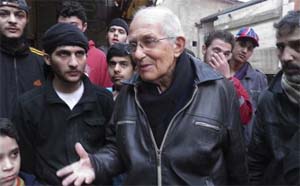
Jesuit priest murdered in Homs Syria

Jesuit Father Alex Bassili, socius to the Provincial of the Jesuits in Middle East Province, reported earlier today, Monday, April 7, 2014, at about 8 am, Jesuit Father Frans van der Lugt was been abducted by armed men, who beat him and then murdered with two bullets in the head, in front of the Jesuit residence in Homs, Syria.

Vatican Radio reports

Father Frans van der Lugt (April 10, 1938-April 7, 2014) was born in the Netherlands and entered the Society of Jesus in 1959.

He was missioned to Syria for the last 50 years working in education as a psychologist and in a project for handicapped people. With the Syrian civil war Father wanted to remain with the local population in the Centre of Homs as a man of peace.

Our Lady, Queen of Peace pray for Father Frans van der Lugt.
Saint Ignatiius, pray for us.

St John Baptist de la Salle

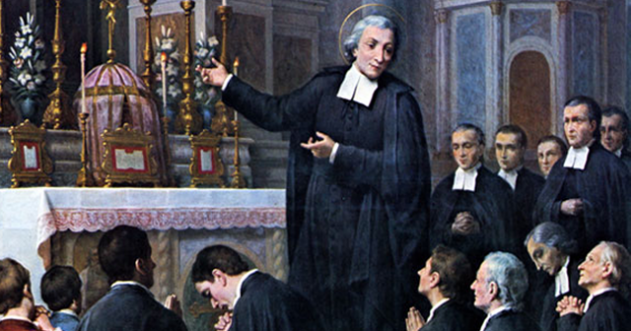
John Baptist de la SalleThe seventeenth-century Frenchman John Baptist de la Salle was drawn to what he discerned as God’s will for him be abandoning all earthly things. He was capable, from a noble family, good looking and yet the entitlements of society were insufficient for his heart. John was ordained at 27 and was offered place among the canons at Rheims which he later gave up.

We believe that Divine Providence shows us the path to walk by putting people and circumstances in our way as pointers to serve Him and Him alone. The events of his era led John Baptist and others to take seriously the work of mercy educating young men, especially the poor.

The charism of educating the poor was so attractive that men who desired to serve the Lord and the Church a brothers and not priests gave way to the founding of a community of religious men called the Brothers of the Christian School (Christian Brothers, or De La Salle Brothers and sometimes the French Christian Brothers). Over time the work was more defined by educating boys of poor families, training teachers and setting up homes and schools for delinquents of the wealthy. It was John’s desire that the men in his care would be become a good Christian men.

De La Salle had lived his final years with chronic asthma and the painful rheumatism giving himself totally to God on Good Friday. He was 68. The Church canonized Father John Baptist de la Salle in 1900 and in 1950, Pope Pius XII named de la Salle patron of schoolteachers.

Lazarus Sunday: no limit to divine mercy

Raising of Lazarus RubevelJesus said: “I am the resurrection and the life; whoever believes in me, even if he dies, will live, and everyone who lives and believes in me will never die” (Jn 11:25)

For the Fifth Sunday of Lent praying the Missal of Paul VI, we are told once again the source of our total fulfillment in this, and in the next life: Jesus’ promise to us of life eternal. (In the Missal of John XXIII it is Passion Sunday.) When all seemed lost after four  days of grave, the Lord gives his dead friend a supreme gift! This grace is not the permanent gift of life as Lazarus was destined to die again but this moment is a clear indication of who Jesus is when He uses the “I am” statement. The great question of all time is “who is Jesus?” Hence, this is the beginning of something that would change everything in the cosmos: resurrection of the body. In Angelus address today Pope Francis said, “As Jesus rose with His own body, but did not return to an earthly life, so we will rise with our bodies that will be transfigured into glorious bodies. He waits for us next to the Father, and the strength of the Holy Spirit, that resuscitated Him, will all raise those who are united to Him.”

The Lazarus event begs us to ask, what does this mean? What is my place in this event of resurrection?

Pope Francis concludes his Angelus remarks, and this is crucial:

The act of Jesus by which He raised Lazarus demonstrates the end to which the power of the Grace of God can arrive, and the end, therefore to which our conversion, our change can arrive. But listen well: there is no other limit to the divine mercy offered to all! There is no other limit to the divine mercy offered to all! Remember this phrase. And we can all say it together: “There is no other limit to the divine mercy offered to all!” Let us say it together: “There is no other limit to the divine mercy offered to all!” The Lord is always ready to take away the tombstone of our sins, which separate us from Him, the light of the living.

Saint Augustine tells us “Among all the miracles done by our Lord Jesus Christ, the resurrection of Lazarus holds a prime place in preaching. But if we consider attentively who did it, our duty is to rejoice rather than to wonder. A man was raised up by him who made humankind. He is the only one of the Father by whom, as you know, all things were made. And if all things were made by him, why is anyone amazed that one was raised by him when so many are daily brought into the world by his power? It is a greater deed to create men and women than to raise them again from the dead. Yet he decided both to create and to raise again; to create all, to resuscitate some.”

The friendship of Lord and the intimacy that this fact manifests for us is itself an indication of the love God has for each of us while showing us that outside forces are not exhausted.

3 new saints from the Americas

This morning we have three new saints! His Holiness canonized three new patrons, to pray for us in heaven. Actually, God makes saints, the Church discerns who the saints are. All three have strong connections to the Americas: Canada and Brazil.

St José de AnchietaSaint José de Anchieta is the newest Jesuit saint. The saint died in 1597. De Anchieta is known as the “Apostle of Brazil” and “Father of Brazilian Literature,” a person in Brazil’s history. Writing to the Society of Jesus, Father Adolfo Nicolás, superior general, said:

The Society must not refuse this invitation offered to present anew this versatile figure who is inspiring and extremely relevant to this day. What does the Lord want to say to us in giving us the gift, in less than a year, of Church recognition of the evangelical value of the lives of our two companions, Peter Faber and José de Anchieta? These are two men who accomplished missions so different and yet so similar in the Jesuit spirit that should animate our mission. Both, with the passion of their lives, invite us to discover that the “restoration,” more than being a mere historical event for us, ought to manifest the ever present “mode of being” of an apostolic body in continuous re-creation.

José de Anchieta, “of medium height, lean, with a strong and decisive spirit, bronzed features, bluish eyes, ample forehead, large nose, thin beard, and with a happy and friendly face,” spent 44 years of his life traversing a good part of the geography of Brazil and carrying the good news of the Gospel to the native peoples.

Read Father Adolfo Nicolás’ whole letter here.

Saint Marie de l’Incarnation (Marie of the Incarnation) is an amazing Ursuline sister who founded the first Ursuline convent in Canada, founded Canada’s first school and is called “Mother of Canada.” The biography of Saint Marie is written by the Ursulines.

Saint François de Laval, was the first bishop of Québec. You can read about him at Center Francois de Laval.

In literature Saints Marie of the Incarnation and François de Laval are found in Willa Cather’s 1931 novel of early Quebec, Shadows on the Rock.

May our three new heavenly companions to show us by their example how to love God in a particular way.

QEII meets Francis

QE2Queen Elizabeth II, 87, with Prince Philip, 92 is today in Rome fulfilling an invitation she had to reschedule in 2013 due to ill health. Last year the Queen was to meet Italy’s President Giorgio Napolitano. Her one day visit to Rome brings her to a private lunch at the presidential Quirinale Palace with the Italian President and then to have tea with Pope Francis.

Her Majesty has meet several Roman Pontiffs, the last in 2010 when Pope Benedict made a pastoral visit the United Kingdom. She has met with popes since John XXIII with the exception of Paul VI. As the British monarch she is able to say she knew two saints: John and John Paul.
One wonders if the Queen and the Pope are meeting as sovereigns or as religious leaders. Elizabeth is the Supreme Governor of the Church of England. Likely a little of both.