Author: Paul Zalonski
Realize what this Mass is
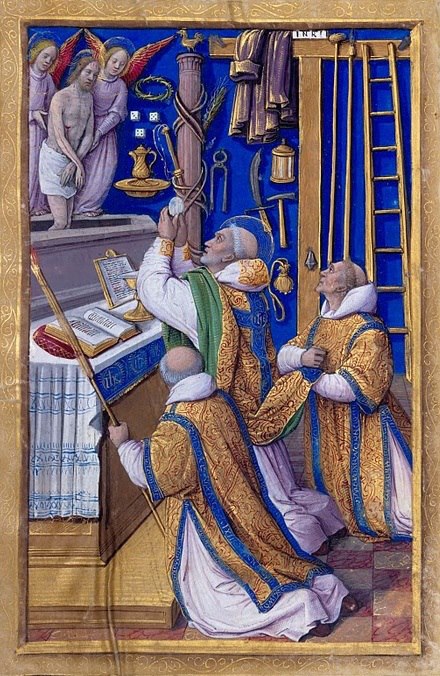 Thomas Merton on attending Mass at Gethsemani monastery on his first visit:
See Who God is! Realize what this Mass is! See Christ here, on the Cross! See His wounds, see His torn hands, see how the King of Glory is crowned with thorns! Do you know what Love is? Here is Love, here on this Cross, here is Love, suffering these nails, these thorns, that scourge loaded with lead, smashed to pieces, bleeding to death because of your sins and bleeding to death because of people that will never know Him, and never think of Him and will never remember His Sacrifice. Learn from Him how to love God and how to love men! Learn of this Cross, this Love, how to give your life away to Him.
See, see Who God is, see the glory of God, going up to Him out of this incomprehensible and infinite Sacrifice in which all history begins and ends, all individual lives begin and end, in which every story is told, and finished, and settled for joy or for sorrow: the one point of reference for all the truths that are outside of God, their center, their focus: Love.
Do you know what Love is? You have never known the meaning of Love, never, you who have always drawn all things to the center of your own nothingness. Here is Love in this chalice full of Blood, Sacrifice, mactation. Do you not know that to love means to be killed for glory of the Beloved? And where is your love? Where is now your Cross, if you say you want to follow Me, if you pretend you love Me?
(The Seven Storey Mountain, pp.323f.)
Paulists to sell DC seminary
 The Paulist Fathers, the US Society of Apostolic Life founded by the Servant of God Isaac Hecker has decided to sell their landmark seminary building in Washington, DC. In many of the major US cities the Paulists could be found: New York Chicago, San Francisco, LA, and etc.
More than a mere gratuitous comment, this is a good example of a religious group contracepting a charism given to the Church by the Holy Spirit for the salvation of souls. Once a vigorous society of preacher, teachers, and pastors of souls, have been greatly reduced.
If interested in more info on the college visit this link.
Sacred Scripture as historical texts reveals Christ Jesus
The 20th and 21st centuries have seen Catholics draw closer to the Bible, the revealed Word of God. During the pontificate of Benedict XVI there was almost an explosion of emphasis on Scripture study, a resurgence of biblical preaching, a serious consideration of what it means to be an evangelical Catholic and lectio divina. In my opinion, it was Benedict XVI who gave critical attention to the sacred Scriptures in the calling of the Synod of Bishops on the Word of God coupled with the concretizing the Church’s programatic direction with the publication of Verbum Domini (2010).
Rome Reports gives a spotlight on a recent initiative of the American Bible Society‘s “The Bible and the World.”
This initiative of the ABS is yet another great example of the place we Catholics need to have for the daily praying with God’s word, and the study of the historical text. As the preparatory commission for the Synod of Bishops on the Word of God stated about the complexity and beauty of the sacred text viz. our salvation in Christ Jesus,
Pastorally speaking, this truth requires an understanding on how to gather, in an analogous way, the various meanings of the Word of God in the faith of the Church, as seen in the Bible. In the Scriptures, Jesus Christ is shown to be the Eternal Word of God, which shines forth in creation, is given a historical character in the message of the prophets, is fully manifested in the Person of Jesus, is echoed in the voice of the apostles and is proclaimed in the Church today. In a general sense, the Word of God is Christ-the-Word, who, through the inspiration of the Holy Spirit, is the key to all interpretation. “The Word of God, who was in the beginning with God, is not, in his fullness, much talk or a multiplicity of words; but a single Word, which embraces a great number of ideas (theoremata), each of which is a part of the Word in its entirety… and if Christ refers us to the Scriptures in testifying to himself, it is not to one book that he sends us to the exclusion of another, but to all, because all speak of him.”Thus, continuity can be seen in diversity.
Father Paolo Molinari dies at 90
 If you follow the process of studying candidates for sainthood you will undoubtedly know the name of Father Paolo Molinari, an Italian Jesuit. He was missioned by the Society of Jesus, since 1957, to shepherd various causes for recognition as blesseds and saints. At his death, the Society said it thinks Father Paolo brought more than 46 causes to beatification or canonization which includes more than 150 persons now honored as blessed or saints.
On May 2, 2014, Father Paolo Molnari met the Lord of the Harvest; Father died in Rome.
Father Paolo Molnari is the man who knew lots about saints. He once described saints as “ordinary people living in a way that ordinary people don’t; doing good beyond what good people do.”
Professionally, Father Molinari served as a professor of theology at the Pontifical Gregorian University and as the president of the Vatican’s College of Postulators; he also advised the Pontiffs on technicalities of the process. Journalists will remember that Molinari was a patient teacher of the Church’s canonization process.
Here is a great–really, exceptional, interview with Father Paolo done by Salt and Light TV (March 27, 2012).
May the Lord receive the soul of Father Paolo by the hands of the saints and blesseds.
Joseph Muzquiz, Servant of God
 You may not know about The Servant of God, Father Joseph Muzquiz, a candidate for sainthood. His cause opened in 2010 in the Archdiocese of Boston. I recommend following the work of seeing if Muzquiz is saint material.
Since 1949, Father Muzquiz has been in the USA having been born in Spain and well-educated in Europe. The reason for his coming to the States was the establishment of Opus Dei ; he was sent by St. Josemaría Escrivá. You may remember a line I use from time to time: saints beget saints. Muzquiz died in 1983 and yet his influence continues to be felt and followed.
There is a website giving pertinent info for Father Joseph Muzquiz which will help you to know this holy and very man better (the site includes a video presentation).
For private devotion here is a prayer:
God, you helped your servant Joseph work with generosity and simplicity. He spread the message of sanctity in secular life to many people, teaching them to find joy and peace in their daily life. Help me to seek first the kingdom of God, by sanctifying my everyday work and dedicating myself generously to the salvation of souls. Glorify your servant Joseph, and through his intercession, grant me the favor I ask of you.
Our Father. Hail Mary. Glory be to the Father.
Really, bishop!

Pope Francis’ prayer intentions for May 2014
 The month of May brings our attention to Mary, the Mother of God. The rosary is said more, the Regina Caeli is sung daily for Eastertide, the crowing of Mary as our mother and queen happens.
All Catholics have a filial devotion to her as Mother. The pope told us that like a good mom, “she helps us to grow, to confront life, to be free.” Indeed, Mary, Our Lady of Help (or health, if you like/need), gives us the first and critical witness of her Son Jesus. With the Holy Father let us go to Mary asking for her help in following her Son more closely and lovingly.
The general intention
That the media may be instruments in the service of truth and peace.
The missionary intention
That Mary, Star of Evangelization, may guide the Church in proclaiming Christ to all nations.
Saint Jeremiah
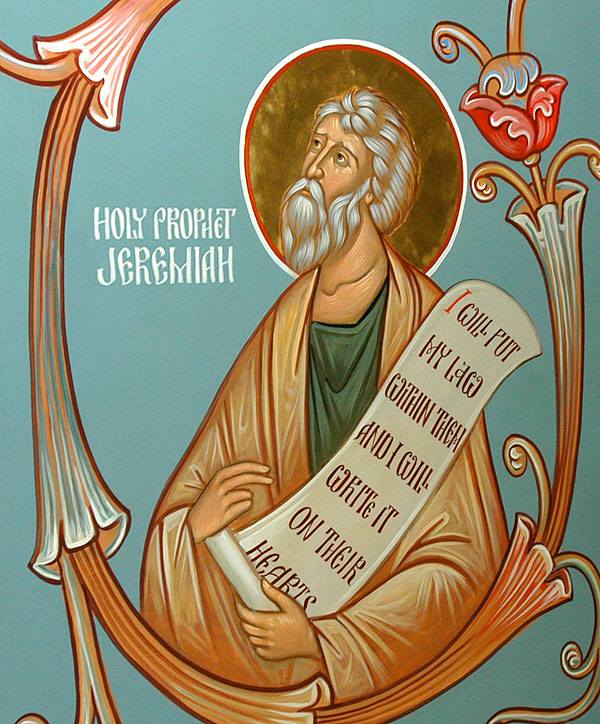
The Catholic Church places the Old Testament prophets, like Jeremiah, for example, as saints. The Roman Martyrology is the Church’s official book listing the saints (the entry is below); typically the OT prophets are not commemorated at the altar.
Saint Jeremiah’s Prayer for Protection
Heal me, O Lord, and I shall be healed. Save me, and I shall be saved, for You are my boast. Behold they say to me,”Where is the word of the Lord? Let it come.” But I have not grown weary in following after You, nor have I desired the day of man. You know the words of my lips are before Your face. Do not be as a stranger to me, and spare me in the evil day. Let those who persecute me be put to shame, but I may not be ashamed. May they , but not I, be terrified. Bring upon them an evil day and crush them with a double destruction.
From the Roman Martyrology (2005), we read,
Commemoratio sancti Ieremiae, prophetae, qui, tempore Ioachim et Sedeciae, regum Iudae, Civitatis Sanctae eversionem populique deportationem monens, multas persecutiones passus est, quam ob rem Ecclesia eum habuit ut Christi patientis figuram. Novum aeternumque insuper Testamentum in ipso Christo Iesu consummandum praenuntiavit, quo Pater omnipotens legem suam in imo filiorum Israel corde scriberet, ut esset ipse iis in Deum et essent illi ei in populum.
A translation:
The Commemmoration of Saint Jeremiah the prophet, who in the days of Joachim and Zedekiah, Kings of Judah, warned of the sack of the Holy City and the expulsion of its people. He suffered such persecution that the Church holds him as a figure of the suffering Christ. He, moreover, prophesied the the new and everlasting testament would be perfected in Christ Jesus Himself in Whom the almighty Father would write His law in the very hearts of the sons of Israel, that He might be their God and they His people.
Czeslaw Milosz on John Paul II
On Sunday the world saw John Paul II canonized by the Church of Rome. Joined in the same Mass and rite was John XXIII. For the most part, the pope most remembered for a variety of historical reasons is John Paul. Czeslaw Milosz wrote this poem in New and Collected Poems: 1931-2001 (2003).
“Ode for the Eightieth Birthday of Pope John Paul II”
We come to you, men of weak faith,
So that you might fortify us with the example of your life
And liberate us from anxiety
About tomorrow and next year. Your twentieth century
Was made famous by the names of powerful tyrants
And by the annihilation of their rapacious states.
You knew it must happen. You taught hope:
For only Christ is the lord and master of history.
Foreigners could not guess from whence came the hidden strength
Of a novice from Wadowice. The prayers and prophecies
Of poets, whom money and progress scorned,
Even though they were the equals of kings, waited for you
So that you, not they, could announce, urbi et orbi,
That the centuries are not absurd but a vast order.
Shepherd given us when the gods depart!
In the fog above the cities the Golden Calf shines,
The defenseless crowds race to offer the sacrifice
Of their own children to the bloody screens of Moloch.
In the air, fear, a lament without words:
Since a desire for faith is not the same as faith.
Then, suddenly, like the clear sound of the bell for matins,
Your sign of dissent, which is like a miracle.
People ask, not comprehending, how it’s possible
That the young of the unbelieving countries
Gather in public squares, shoulder to shoulder,
Waiting for news from two thousand years ago
And throw themselves at the feet of the Vicar
Who embraced with his love the whole human tribe.
You are with us and will be with us henceforth.
When the forces of chaos raise their voice
And the owners of truth lock themselves in churches
And only the doubters remain faithful,
Your portrait in our homes every day remind us
How much one man can accomplish and how sainthood works.