Saint Thomas

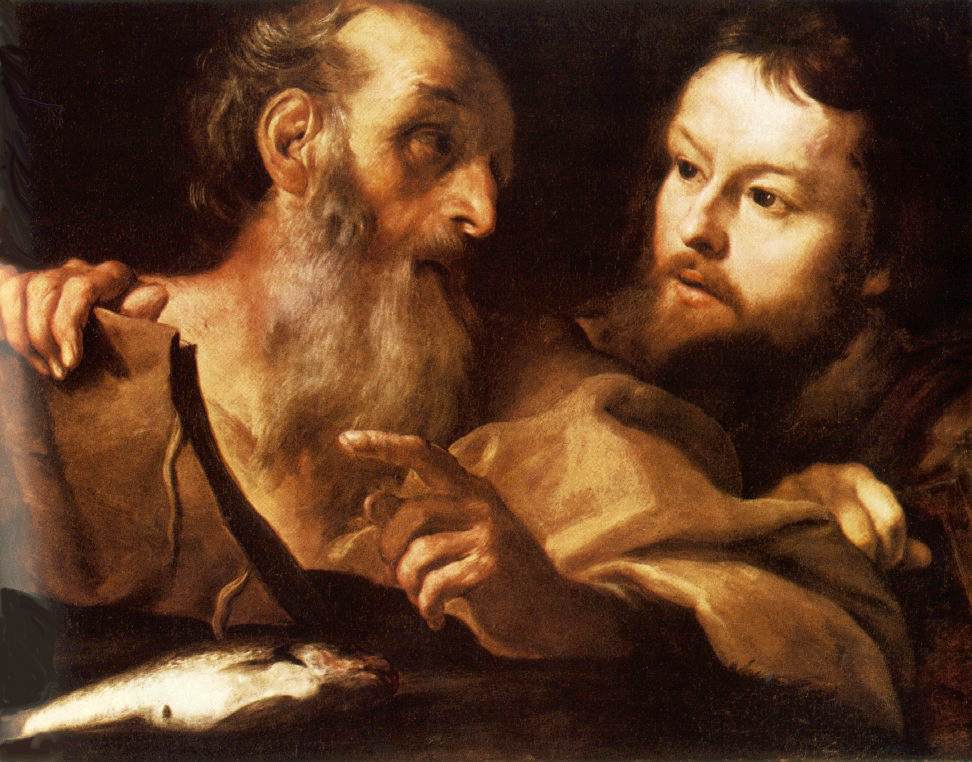
Sts Andrew and Thomas Bernini 1627Although the doors were closed,
Jesus appeared to his disciples.
He took away their fear and granted them peace.
Then He called Thomas and said to him:
“Why did you doubt My resurrection from the dead?
Place your hand in My side;
see My hands and My feet.
Through your lack of faith,
everyone will come to know of My passion and My resurrection,
and they will cry out with you:
My Lord and My God, glory to You!

Through the Apostles we come to know and love the Savior of humanity in ways unimaginable. Thomas, as the text from the Byzantine Liturgy for “Thomas Sunday” suggests, is a keen witness to the resurrection of Jesus from the dead. The miracle of trampling death by death itself requires of man and woman the openness to follow a witness who points, who interrogates, who gives voice to, a wonder never seen and experienced for now. The so-called doubts of Thomas can really be understood from the viewpoint of faith and reason: is it reason that a man be raised from the dead? Is it reasonable to speak about this fact from the eyes of faith? Thomas stands before the Lord and gives the answer in the affirmative. Faith is the capacity to see all of life, the small and the great, the seen and unseen, the common and the miraculous as a way of knowing. Thomas knows because of evidence; he has faith in the Lord Jesus because what the Lord taught is reasonable and recognizable. Blessed are those who believe.

Here is the post from last year.

The Good Priest

vB on priesthoodIn the region of the country in which I live there are some very good priests: attentive to matters of faith and reason, attentive to their spiritual life, eager for apostolic work, work on being truly human and serious about the offering sacrifice as a priest of Jesus Christ. The men I am thinking of are not clowns. They prepare for the sacred Liturgy, want to do good by the Church and the Lord, they see their spiritual director monthly,  and spend time in daily prayer. These priests also read books, visit musea, and like people. Theirs is a real life of prayer, work and study.

On the other hand, I have known lots of priests who seek preferment in civil and ecclesial circles under the guise of “obedience”, develop a personality cult, I know who one is a frequent visitor to sex shops, others are alcoholic, addicted to power, I know one is in prison for drug related charges, others are lazy, economical with the truth, ignorant and ill mannered, superficial and these are their good qualities. Just recently a priest proudly stated that he was leaving his venerable religious order and the exercise of Catholic priesthood and joining the Episcopal Communion. Another priest I know who falls in this category of “bad priest” was recently given a new job of considerable authority and influence in his diocese and who has little integrity, or care for others. This same priest has had charge of men preparing for sacred priesthood, too.

For the record, there is no time when the words “I’m the priest, and this is my parish” are to be uttered and heard. Otherwise, the one who thinks in such way betrays his baptismal and priestly ordination.

The sinful aspects of what I described above are the result of the thoughts, will and affections being disordered by someone other than the Most Trinity — that is, Satan. We too often allow the circumstances of life control the beauty of personhood slowly moving us away from our true self as we are made in God’s image. And in moving away from our true center we move away from God who gave us those beautiful desires to know, love and to serve in this world –that is, to have the hundredfold promised Jesus– to serve under another banner not divine or holy. Hence, the metaphor of the “bad priest.”

So, when you read this phrase, “A good priest is a miracle of grace” it ought to be a striking idea upon which to reflect. Thanks be to God of Balthasar!

Loyola taught us that the three devices of Satan are money, power and fame. He also notes the sin of ingratitude –a big sin for Saint Ignatius.

Those who reflect on this issues with depth and sincerity will notice the ways in which the devil corrupts those who have consecrated their lives to God for the service of the Church. Think of CS Lewis’ book, Screwtape Letters. Recall the agenda of the tempter: the priesthood and sacramentality are messed around with by Satan. Many fall prey, others don’t. And that is why I’m so grateful for priestly vocations lived well.

Well-formed consciences give witness to something greater

These days the use of the word of conscience is bantered around without much substance to my line of thinking. Some really crazy (unreasonable) things are said about conscience and the use of it. Certainty is about reasonable things is not well accepted thinking persons. Additionally, the public forum is beginning to be more belligerent if a course correction is needed because we live in a “culture of nice” that dictates don’t be judgmental. All sorts of media outlets, politicians, talking heads and professors derail the conversation to force a fallacious agenda that allows for all things that indicate “just because.” We easily trot out the word conscience thinking that we know what it means, that our interlocutors know what the word conscience means, and that that the context within which we find ourselves can handle a fully functioning, clear definition that focuses on truth.  Less confusion is needed: clear principles and identifiable conclusions are absolute. The contours of what conscience really is under assault.

This morning I read the following spiritual reflection from a sermon by Saint Augustine on conscience and began to think –not brilliantly of course– that a new level discourse that gets to the heart of the truth and gives proper witness to a life of good conscience is needed. No longer is it acceptable to use conscience in flippant ways that divorce God from every level of our life. In a concrete way it is true to say that without a personal relationship with Jesus Christ a fully formed conscience is impossible. Fuzzy thinking will lead to absurd actions. In positive terms: only with  Jesus is man and woman fully alive and capable of giving witness to freedom. Too much is at stake: personal freedom, life in the Christian community, work in society, the arts, medicine, politics. Faith and reason are expected and valued dialogue partners. 

This is our glory: the witness of our conscience. There are men who rashly judge, who slander, whisper and murmur, who are eager to suspect what they do not see, and eager to spread abroad things they have not even a suspicion of. Against men of this sort, what defense is there save the witness of our own conscience?

My brothers, we do not seek, nor should we seek, our own glory even among those whose approval we desire. What we should seek is their salvation, so that if we walk as we should they will not go astray in following us. They should imitate us if we are imitators of Christ; and if we are not, they should still imitate him. […]

And so, my brothers, our concern should be not only to live as we ought, but also to do so in the sight of men; not only to have a good conscience but also, so far as we can in our weakness, so far as we can govern our frailty, to do nothing which might lead our weak brother into thinking evil of us. Otherwise, as we feed on the good pasture and drink the pure water, we may trample on God’s meadow, and weaker sheep will have to feed on trampled grass and drink from troubled waters.

Pope Francis’ prayer intentions for July

Pope Francis in prayer at MassThe prayer intentions of Pope Francis for July:

The general intention

That sports may always be occasions of human fraternity and growth.

The missionary intention

That the Holy Spirit may support the work of the laity who proclaim the Gospel in the poorest countries.

Having completed the month of June which is dedicated the Sacred Heart of Jesus, we begin July as the month dedicated to the Most Precious Blood of Christ. The deeper we move into summer the more I think it is fitting to recommit ourselves to a daily offering of the whole self to the Lord, leaving nothing out, returning to Him what we have received as a gift: life and freedom. Prayers for the daily offering are found on the Apostleship of Prayer website. Do you belong to the network of people making up the Apostleship of Prayer?

What Christians call love

The distinctive love by which Christians are recognized is not merely the result of an affectionate nature or the acquisition of skills or a suitably nurturing social situation. It is a gift of God which both fulfills and simultaneously surpasses our nature’s desire to be loved and to love.

Christian love (or agape) is the infusion of the divine lovableness and love into the human spirit, repairing the damage which love’s absence has wrought and lifting up the human to the level of the divine. Simultaneously, it is an upgrading of our perception so that we are able to see just how lovable our neighbor is.

This gift enable us to see through the objective failings of other persons to reach the inner core of their being, where everything is beautiful. This not a human quality or skill but a gift of God that is both sign and guarantee that we are already living on a supernatural plane.

Michael Casey, OCSO
Seventy-Four Tools For Good Living

Apostles as earth’s pillars

St Peter & PaulYou can see from the three posts on this feast of Saints Peter and Paul that these blessed witnesses mean something to me, besides the obvious. One of the things to consider is to remember that we all need good formation in the Christian faith. How else to appreciate the roots of the faith but to know how the Church sees the pillars. Here is the Cistercian Father and Saint Aelred of Rielvaux’s (1110-1167), sermon (18; PL 195, 298), for the feast:

“upon this rock I will build my church” The earth moves with all its inhabitants, I even signed his columns” (Sl 75.4). All the Apostles are pillars of the Earth, but first the two whose feast we celebrate. They are the two columns which support the Church through his teaching, his prayer and example of their constancy. It was the Lord himself that strengthened these columns; because initially they were weak, unable to stand and support the other. And here pops up the grand plan of the Lord: they were always strong, one might think that his strength came from themselves. So before they build, the Lord wanted to show what they were capable of, to let everyone know that your strength comes from God. […] Pedro was released on Earth by a simple voice created […]; another column was also very weak: ‘ even though I have been a blasphemer, persecutor and insolent” (1 Tim 1.13). […]

That’s why we praise wholeheartedly these saints, our parents, who have suffered a lot for the Lord and who persevered with so much fortitude. It costs nothing to persevere in joy, happiness and peace; be great is to be stoned, scourged, flogged for Christ (2 Cor 11.25), and persevere with Christ. It’s great to be cursed and blessed as Paul, being chased and endure, be maligned and comfort, be like the garbage in the world and that take glory (1 Cor -13 4.12). […] And what about Peter? Even if he hadn’t endured anything for Christ, we would be happy to celebrate today, having been crucified for Him. […] He knew where he was the one whom she loved, one who wanted […]: its cross was your way to heaven.

Symbols of Unity and Peace: Peter and Paul

Sts Peter and Paul 4th century Roman catacombsThe saints honored today reveal much about who we are as Christians. Remember Paul as the Apostle to the Gentiles, and Peter as first bishop of Antioch before going to Rome to the first bishop there. Have you ever wondered why they go together? The image used here is an early 4th century image of  Peter and Paul together found in the catacombs of Rome. A friend, Fr Dustin Lyon, an orthodox priest friend offered the following detail on the apostles’ connection.

“[On icons] Peter and Paul exchange the kiss of peace. …The kiss of the first pope [bishop of Rome] and the ‘apostle of the people’ symbolizes the unity of the Church… It was a peace they had managed to establish at the Council of Jerusalem in the year 48, even though the former represented the Church of the Law (circumcised Jews) and the latter the Church of Grace (uncircumcised pagans). Yet at Antioch, when Peter avoids the Gentiles, Paul reprimands him, ‘I opposed him to his face, because he stood condemned’ (Galatians 2:11). …They are both represented in all icons in which the apostles are gathered, even events at which Paul was not present.” (Alfredo Tradigo, Icons and Saints of the Eastern Orthodox Church (Los Angeles: The J. Paul Getty Museum, 2004), pg. 267).

The great Augustine, bishop of Hippo teaches:

“This day has been made holy by the passion of the blessed apostles Peter and Paul. We are, therefore, not talking about some obscure martyrs. ‘For their voice has gone forth to all the world, and to the ends of the earth their message.’ (Psalm 19:4) These martyrs realize what they taught: they pursued justice, the confessed the truth, they died for it… Both apostles share the same feast day, but these two were one; and even though they suffered on different days, they were as one. Peter went first, and Paul followed. And so we celebrate this day made holy for us by the apostles’ blood. Let us embrace what they believed, their life, their labors, their sufferings, their preaching and their confession of faith.”

Saints Peter and Paul

The annual liturgical observance of the solemnity of Saints Peter and Paul is an exceptional day for the Christian Church, especially the Catholic and Orthodox Churches. These saints represent for us the founders of the Church in Rome (but in reality the church universal–the church to the nations). Martyrs both; Peter and Paul knew Jesus Christ in very unique ways; both called all of humanity to seek the Lord and to submit to the Lord of the Harvest, the Good Shepherd who cares intimately for each of us.

The sole American metropolitan archbishop –among 23 others– to have received the pallium is His Excellency Archbishop Leonard Paul Blair. Three other archbishops will receive the pallium at another time.

Pope Francis’ is typical of his concern for our encounter with the Lord, and our discernment of how we live what has been given to us (the gospel, tradition, magisterial teaching). He calls you and me to attend to the experience of the apostles in their struggle to follow the Lord faithfully and with conviction. In many ways Francis echoes what Father Carrón of Communion and Liberation taught us in this year’s annual Fraternity Spiritual Exercises (2014) regarding the essential of Christian life: Christ and His mission. “Following” Christ, belonging to Christ is often replaced by our sin and temptation. But as Francis adeptly reminds, we follow the experience of Peter and Paul.

The Holy Father’s homily follows.
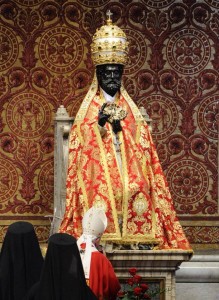
Francis at the statue of St Peter June 29 2014On this Solemnity of Saints Peter and Paul, the principal patrons of Rome, we welcome with joy and gratitude the Delegation sent by the Ecumenical Patriarch, our venerable and beloved brother Bartholomaios, and led by Metropolitan Ioannis.  Let us ask the Lord that this visit too may strengthen our fraternal bonds as we journey toward that full communion between the two sister Churches which we so greatly desire.

“Now I am sure that the Lord has sent his angel and rescued me from the hand of Herod” (Acts 12:11).  When Peter began his ministry to the Christian community of Jerusalem, great fear was still in the air because of Herod’s persecution of members of the Church.  There had been the killing of James, and then the imprisonment of Peter himself, in order to placate the people.  While Peter was imprisoned and in chains, he heard the voice of the angel telling him, “Get up quickly… dress yourself and put on your sandals… Put on your mantle and follow me!” (Acts 12:7-8).  The chains fell from him and the door of the prison opened before him.  Peter realized that the Lord had “rescued him from the hand of Herod”; he realized that the Lord had freed him from fear and from chains.  Yes, the Lord liberates us from every fear and from all that enslaves us, so that we can be truly free.  Today’s liturgical celebration expresses this truth well in the refrain of the Responsorial Psalm: “The Lord has freed me from all my fears”.

The problem for us, then, is fear and looking for refuge in our pastoral responsibilities.

I wonder, dear brother bishops, are we afraid?  What are we afraid of?  And if we are afraid, what forms of refuge do we seek, in our pastoral life, to find security?  Do we look for support from those who wield worldly power?  Or do we let ourselves be deceived by the pride which seeks gratification and recognition, thinking that these will offer us security?  Dear brother Bishops, where do we find our security?

The witness of the Apostle Peter reminds us that our true refuge is trust in God.  Trust in God banishes all fear and sets us free from every form of slavery and all worldly temptation.  Today the Bishop of Rome and other bishops, particularly the metropolitans who have received the pallium, feel challenged by the example of Saint Peter to assess to what extent each of us puts his trust in the Lord.

Peter recovered this trust when Jesus said to him three times: “Feed my sheep” (Jn 21: 15,16,17).  Peter thrice confessed his love for Jesus, thus making up for his threefold denial of Christ during the passion.  Peter still regrets the disappointment which he caused the Lord on the night of his betrayal.  Now that the Lord asks him: “Do you love me?”, Peter does not trust himself and his own strength, but instead entrusts himself to Jesus and his mercy: “Lord, you know everything; you know that I love you” (Jn 21:17).  Precisely at this moment fear, insecurity and cowardice dissipate.

Peter experienced how God’s fidelity is always greater than our acts of infidelity, stronger than our denials.  He realizes that the God’s fidelity dispels our fears and exceeds every human reckoning.  Today Jesus also asks us: “Do you love me?”.  He does so because he knows our fears and our struggles.  Peter shows us the way: we need to trust in the Lord, who “knows everything” that is in us, not counting on our capacity to be faithful, but on his unshakable fidelity.  Jesus never abandons us, for he cannot deny himself (cf. 2 Tim 2:13).  He is faithful. The fidelity which God constantly shows to us pastors, far in excess of our merits, is the source of our confidence and our peace.  The Lord’s fidelity to us keeps kindled within us the desire to serve him and to serve our sisters and brothers in charity.

The love of Jesus must suffice for Peter.  He must no longer yield to the temptation to curiosity, jealousy, as when, seeing John nearby, he asks Jesus: “Lord, what about this man?” (Jn 21:21).  But Jesus, in the face of these temptations, says to him in reply: “What is it to you? Follow me” (Jn 21:22).  This experience of Peter is a message for us too, dear brother archbishops.  Today the Lord repeats to me, to you, and to all pastors: Follow me!  Waste no time in questioning or in useless chattering; do not dwell on secondary things, but look to what is essential and follow me.  Follow me without regard for the difficulties.  Follow me in preaching the Gospel.  Follow me by the witness of a life shaped by the grace you received in baptism and holy orders.  Follow me by speaking of me to those with whom you live, day after day, in your work, your conversations and among your friends.  Follow me by proclaiming the Gospel to all, especially to the least among us, so that no one will fail to hear the word of life which sets us free from every fear and enables us to trust in the faithfulness of God. Follow me!
Our Lady of Perpetual Help

Our Lady of Perpetual Help Polish mosaicIn actual matters of the liturgical calendar June 27 is reserved for the feast of Our Lady of Perpetual Help, but since we observed the feast of the Sacred Heart of Jesus yesterday, the Mother of God’s feast is pushed to today (the day following the Sacred Heart is the feast of the Immaculate Heart of Mary).

Never despair, always ask your mother for help: Mary hearing our pleas brings them to her Son.

The text for our meditation is the second Kontakion for Our Lady of Perpetual Help. Kontakia are poetic texts used during the Byzantine liturgy. The text and image cohere nicely for we remember the words of scripture: Mary is the highest member of our race.

Through the intercession of Mary, may we live according to our baptismal consecration, particularly building up the Mystical Body of Christ.

A merchant of Crete knew of your icon, this precious jewel,
for it was beautiful and famous for many miracles.
He took it from the church,
hid it in his vessel and set out for sea.
O Pure One, you are our most precious treasure;
therefore we go through the sea of life
toward a happy ending, our heavenly city, singing alleluia!