Brew Evangelization –Benedictine styled

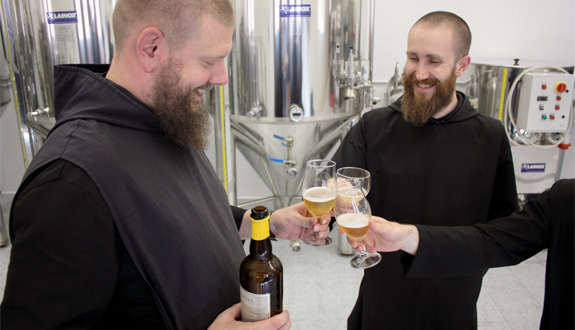
Norcia monksThe idea of sharing anew the beautiful, the true and the good of the Catholic faith with baptized Catholics, with other Christians, and with those justing seeking Someone greater, is popular these days. The words we are using to describe this sharing of faith is the new evangelization. Saint John Paul got the ball rolling again after a hiatus from the time of Blessed Paul VI and the Fathers of the Second Vatican Council with promoting a new way of bring the Lord’s Good News to society again. But for him the new evangelization isn’t about a program as much as it is manner of conversion.

As typical, we see the use of the word “evangelization” used in a variety of ways but without a distinct and concrete definition. In my estimation few have really grasped the concept of it means to be engaged in evangelization. So many want to bolster the numbers of people in the pews, or get parish programs going or some such thing superficial thing. The difficult task is forming in a new way invested Catholics. There are times you get the sense that the “same-old” is being repackaged: it is new wine in old wine skins. The new evangelization becomes in many places more of the ghetto mentality and a perpetuation of an immature Christianity. That’s a long way of saying that we need a more creative approach in sharing the faith in bold ways.

Certainly we don’t need gimmicks. We do, however, need an honest approach that is human connected to the divine.

The Benedictine monks are getting to the heart of what I am aiming at with the new evangelization: beer brewing for the Kingdom of God. Indeed, the brewing of beer (and drinking the beer) can be a de-regulated way of getting to the heart of the faith, getting to the creator and how He is manifested in His creation. Brewing and drinking beer is a very human experience that will penetrate the heart and mind to think a little more deeply about spiritual things and how to live for and with Christ.

Here is an article, “Brew Evangelization.” Read this fine article and the links embedded. One of my interests is to see the Benedictine charism flower again. AND it is beginning to do just that….

Jaroslav Pelikan recalled

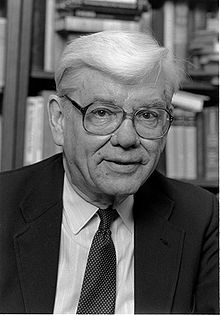
PelikanThe question was asked: Who was Jaroslav Pelikan, and why does his work remain so important for serious Christian scholarship today?

First Things published this essay of Timothy George, “The Legacy of Jaroslav Pelikan”: http://www.firstthings.com/web-exclusives/2015/01/jesus-on-safari

Pelikan was a seminal and inviting thinker. He did his work as a ministry and not merely making his academic career and name known. Faith and reason had a great proponent in JP. Thanks to Timothy George for a fine essay!

Dr George writes: “Jaroslav Pelikan had a love for all things human and humane, and his work still enrichs every person who looks at the world with intellectual curiosity and moral imagination. But his legacy shines especially bright among those who follow Jesus Christ, belong to his church, and see the world through the eyes of the Savior’s love.”

I seem to have been a drawn to what Jaroslav Pelikan did for the Christian faith, particularly my Catholic faith. On a personal note, Dr Pelikan is buried here in New Haven at the famed Grove Street Cemetery. Periodically, I pass by his grave to pray for him. May God grant him mercy!

Sainted Cistercian founders: Robert Molesme, Stephen Harding and Alberic

Holy Fathers of Citteaux

From e hymn for evening Vespers for the holy founders of Citeaux:

“Bold leader of this vast array, Saint Robert, intercede today. God grant us hearts to dream anew, and strength his kingdom to pursue.

Fond lover of that hallowed place, where brothers lived as one by grace, Saint Alberic, pray we may be one heart, one mind, in unity.

Impassioned master in Christ’s school, Saint Stephen, zealot for our rule, bid God we never build on sand, but firm in faith, on rock we stand.”

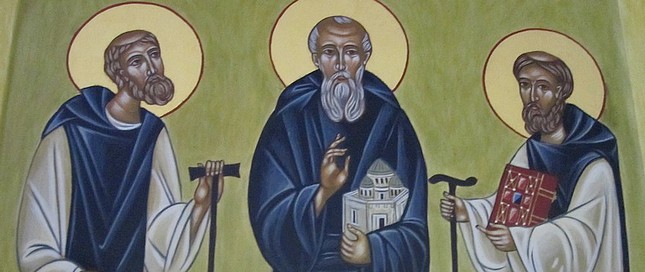
You may be aware that these saints are not honored on the Roman liturgical calendar, but revered by the monks and nuns of the Cistercian and Benedictine monasteries, are the three holy founders of Citeaux (near Dijon, France): Saints Robert Molesme (centered in the image), Stephen Harding and Alberic. They began their reform of Benedictine life in 1098. The Cistercian movement is now venerable but when it was started it was very contentious as you might expect –anytime you ask people to change you run against the tide. Think of the Prophets, or in particular, the Prophet Jonah of yesterday’s reading at Mass. Let us pray for our own conversion, and that of the Church. But also for God’s abundant grace to fall on those who have made profession to the charism of Citeaux –monks, nuns, and the laity.

The early Cistercians, impelled by a burning thirst for authenticity, wished to interpret the Rule (of St. Benedict) in the light of its monastic background and to recover its original simplicity. Their life was marked by a real detachment from the world, a love of solitude and silence, poverty and simplicity, austerity and manual labor, prayer and holy reading, all within a cenobitic framework which laid great stress upon the value of fraternal charity in the common life.

There is an attractive genuinity about this reform, which was not merely an archeologizing return to the past, but a recapturing of the primitive monastic ideal and an attempt, largely successful, to express it in structures suitable to the times.

The school of spirituality which the white monks produced, dominated by St. Bernard, is no less notable for its charming huamanity than for its authentically contemplative orientation.

Monastic Spirituality
Claude Peifer, O.S.B.
Ecumenism is really a thirst for God

The document Unitatis Redintegratio (21 Nov. 1964) of the Second Vatican Council stresses spiritual ecumenism. Sometimes we overlook this aspect. But we can’t but focus on what is the soul of the ecumenical movement; theologians and church leaders have a lot of work to do on this point; I recall that  the saints have kept their eyes on this method, and so we as members of the Body of Christ have to keep focused on daily conversion, a daily turn toward the Lord.

With two noteworthy ecumenical monastic communities this week, Taize and Bose, the Pope spoke of three conditions at the center for Christian unity:

1. there’s no unity without conversion of heart, which includes forgiving and asking for forgiveness.

2. there is no unity without prayer and therefore men and women religious who pray for unity are like ‘an invisible monastery’ bringing together Christians of different denominations from different countries around the world.

3.  there is no unity without holiness of daily life. so the more we put our search for unity into practise in our relations with others, the more we will be modelling our lives on the message of the Gospel.

The Week of Prayer for Christian Unity which concludes today (the feast of the Conversion of St Paul) meditated on the theme, “Give me a drink,” from the narrative of the Samaritan woman meeting Jesus.

In his talk with the monastic communities whose primary work is Christian Unity, His Holiness spoke of the fact that we see in the Savior a “desire for unity” among the disciples, and that same thirst continues today especially with the divisions of the Christian community. The thirst of the Samaritan woman –and therefore each one of us– is a “thirst not only material for water, but above all our thirst for a full life, free from the slavery of evil and death.”

Francis calls us to pray about this fact: “Jesus is the fulfillment of God’s promises because it is he who gives to the Holy Spirit, the ‘living water’ that quenches our restless hearts, hungry for life, love, freedom, peace: thirsty for God.”

St Paul’s Conversion

Conversion of St PaulO glorious St. Paul, who from a persecutor of Christianity, didst become a most ardent apostle of zeal; and who, to make known the Savior Jesus Christ unto the ends of the world, didst suffer with joy imprisonment, scourging, stoning, ship-wrecks and persecutions of every kind, and in the end didst shed thy blood to the last drop, obtain for us the grace to receive, as favors of the Divine Mercy, infirmities, tribulations, and misfortunes of the present life, so that the vicissitudes of this our exile will not render us cold in the service of God, but will render us always more faithful and more fervent.  Amen.

The 25th of January this year is a Sunday so the feast is not commemorated in the NO Liturgy but a clued-in preacher will be able to link the Scripture readings with Paul’s move from persecutor to Apostle of Jesus Christ. The missionary impulse of the Church needs to follow the paradigm we find in Paul: meet the Lord first, know and love the Lord, and then share call to holiness to all nations.

Archbishop Georg Gänswein interview

?????Thanks to Mark de Vries who made translation of a recent interview with Archbishop Georg Gänswein by Christ & Welt (a German publication and made it available on his blog, In Caelo et in Terra.

The interview, “From the Front Row” is indeed an interesting for its frank discussion of Pope Francis petrine ministry and several matters like the Roman  Curia, the pope emeritus, the recent Synod and the like.

The Archbishop is 58, a native of Germany, and the prefect of the Papal Household and secretary to Benedict XVI. He was ordained a bishop on 6 January 2013.

Saint Francis de Sales

St Francis de Sales“Ask for nothing, refuse nothing,” Saint Francis de Sales, 1567-1622.

Saint Francis de Sales, tireless teacher, bishop and Doctor of the Church, pray for us!

Why not read some of his classic texts:

– “Introduction to the Devout Life” –> http://ow.ly/HS4vq
– “Treatise on the Love of God” –> http://ow.ly/HS4zQ
– “The Catholic Controversy” –> http://ow.ly/HS4Cb

A blessed feast day  to all Visitation Sisters and all members of the extended Salesian family!

Saint Marianne Cope

Marrianne CopeToday’s the feast of one of our great American saints, Saint Marianne Cope, a Franciscan sister who spent 35 years ministering to people living with Hansen’s Disease (called leprosy) on the island of Molokai in Hawaii. Cope is part of a small group of American saints.

Saint Marianne (1838-1918) was a close collaborator of the famous Saint Damian DeVeuster of Molokai.

Cope’s venerable body was recently returned to the Diocese of Hawaii.

Bishop Larry Silva said this in a homily:

When Mother Marianne made her famous statement that she was hungry for the work, it was not because she needed more to do.  It was because she knew that her own deep hunger pangs for the true bread of life would be better satisfied if she met the Eucharistic Lord in those she fed, in those she clothed, in those she nursed, and in those least of the least whom she set free from a prison of self-pity, no matter how justified it might be. Who will make the rest of the world as hungry as was our beloved St. Marianne?

More about her inspiring life can be found on her order’s website, the Sisters of St. Francis:  https://sosf.org/st-marianne-cope/

Robert Louis Stevenson wrote a poem:

To the Reverend Sister Marianne,  Matron of the Bishop Home, Kalaupapa. 

To see the infinite pity of this place,
The mangled limb, the devastated face,
The innocent sufferers smiling at the rod,
A fool were tempted to deny his God.
He sees, and shrinks; but if he look again,
Lo, beauty springing from the breasts of pain!
He marks the sisters on the painful shores,
And even a fool is silent and adores.

Saint Agnes and the lambs

pope-francis-blessing-of-lambsOn the feast of Saint Agnes –one of our early female martyrs– lambs are blessed by the pope and the wool harvested by Benedictine nuns to weave a pallium is given to metropolitan archbishops as a sign of communion with the Bishop of Rome on the feast of Ss. Peter and Paul (June 29); a solemn Mass is celebrated each year by the Holy Father with the presence of the Orthodox bishops because it is a key feast day for the Roman Church. Joan Lewis writes today about the event. Here is the opening paragraph:

Just before 9 am Wednesday morning, in keeping with the tradition for the January 21 liturgical memory of St. Agnes, two lambs, blessed earlier in the morning in the Roman basilica named for this saint, were presented to Pope Francis in the atrium of the Santa Marta residence where he lives. The lambs are raised by the Trappist Fathers of the Abbey of the Three Fountains. When their wool is shorn, the [Benedictine] Sisters of St. Cecelia weave it into the palliums that, on the June 29th feast of Sts. Peter and Paul, Apostles, are bestowed on new metropolitan archbishops as signs of their office.

The rest of the blog post is here.

Saint Meinrad

St MeinradToday, the Benedictine liturgical calendar recalls for us the life and martyrdom of Saint Meinrad (+861) –the Apostle for Hospitality. Meinrad was a Swiss hermit. His life can be read here.

Join me in praying for those whose mission it is to offer hospitality (and who are often wounded in doing so), for the monastic community and oblates of the venerable Archabbey of Saint Meinrad in Indiana.

Luigi Giussani: “God was moved by our nothingness, by our betrayal, by our crude, forgetful and treacherous poverty, by our pettiness. For what reason? “I have loved you with an eternal love, therefore I have made you part of me, having pity on your nothingness.The beat of the heart is pity on your nothingness but the reason why is that you might participate in being.”