St. John the Apostle model for Knights and Dames of Holy Sepulchre today

This reflection was written to explore, to renew, and to re-commit my life as a member of the Order of the Holy Sepulchre of Jerusalem in light of the liturgical memorial of St. John the Apostle and Evangelist (whose feast is celebrated by the Latin Church today. It’s also published on one of the Facebook groups of the Order.

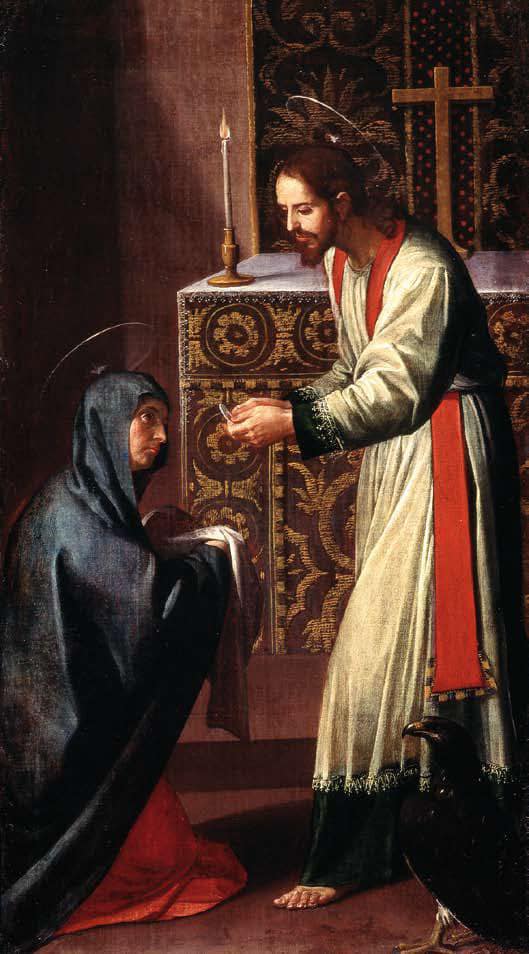
St. John the Evangelist giving Holy Communion to the Blessed Virgin Mary, by the Baroque Spanish painter Alonzo Cano.


The opening collect for the liturgical memorial of St. John the Apostle and Evangelist reads:


O God, who through the blessed Apostle John have unlocked for us the secrets of your Word: Grant, we pray, that we may grasp with proper understanding what he has so marvelously brought to our ears.


The Church’s prayer elicits for me two things: 1.) am I a protagonist in sharing Divine Revelation and Tradition with those in the Church and with those who have fallen away from the practice of Catholic faith, and 2.) has my understanding of the Good News taken firm root in myself so as to be a witness to the noble ideal that the Grand Master spoke of in the Jerusalem Cross (October 2021)?


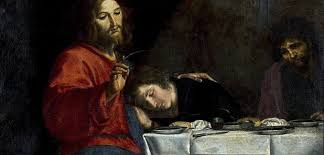
The Apostle who is called the Beloved Disciple knew so well, Jesus Christ is the only way to salvation; as God-Man Jesus is love par excellence. The image of John resting on the breast of Jesus comes to mind. But how does that image impact me? Benedict XVI told us St. John’s work was to demonstrate that “the essential constituent of God is love and hence, that all God’s activity is born from love and impressed with love: all that God does, he does out of love and with love, even if we are not always immediately able to understand that this is love, true love” (Audience, 9 August 2006).


In the same audience the emeritus Pontiff said the “precept to which John refers, Jesus presents his own Person as the reason for and norm of our love: ‘as I have loved you.’ It is in this way that love becomes truly Christian: both in the sense that it must be directed to all without distinction, and above all since it must be carried through to its extreme consequences, having no other bounds than being boundless.”


The feast of St. John the Apostle ought to be one of the points of our reflection today to renew our commitment to know and to live more abundantly a life of conversion, vocation, and mission as knights and dames of the Order of the Holy Sepulchre. The Apostle teaches us to be in love, to act in love, and to be missionary of Love.


Cardinal Filoni wrote in the spirit of “as I have loved you.”: “As an Order that has a constitutive commitment to the Holy Land, we must ceaselessly re-evoke the two aspects of our commitment: the ecclesiological dimension of our work, which delineates the horizon of the commitment itself, and the personal spiritual and charitable dimension, which renders us the protagonists of our work which is never mediocre or mechanical.”


In Thomas à Kempis’ famous late Middle Ages book, The Imitation of Christ, wrote:


“The love of Jesus is noble and generous: it spurs us on to do great things, and excites us to desire always that which is most perfect. Love will tend upwards and is not to be detained by things beneath. Love will be at liberty and free from all worldly affections… for love proceeds from God and cannot rest but in God above all things created. The lover flies, runs and rejoices, he is free and not held. He gives all for all and has all in all, because he rests in one sovereign good above all, from whom all good flows and proceeds” (Thomas à Kempis, The Imitation of Christ, Book III, Chapter V, 3-4).


A fun fact for today’s feast: we bless wine on the feast of St. John the Apostle. The blessing of wine is sign of God’s love for us.


Happy Christmas and Happy Feast.

Living on the edge of eternity

The following reflection was written for members of the Order of the Holy Sepulchre of Jerusalem and published on one of the Facebook groups of the Order.

In a week’s time we will be celebrating the Nativity of our Lord and Savior, Jesus Christ. A fact. An experience of Faith. The Fathers of the Church teach us that the Incarnation means that God Who is incomprehensible and inexpressible lowered Himself in His mercy taking human nature to not only restore what Adam lost, but to offer us the possibility of our participation in His divine nature. This participation is what we call theosis.

Here is something for us to think about as we prepare for the Nativity of the Lord. There’s a Divine promise contained in the event of the Incarnation. The following homily for Advent delieverd by St. Bernard of Clairvaux (1090-1153) notes for us the contours of the promise.

“We know that there are three comings of the Lord. The third lies between the other two. It is invisible, while the other two are visible.“In the first coming he was seen on earth, dwelling among men; he himself testifies that they saw him and hated him. In the final coming all flesh will see the salvation of our God, and they will look on him whom they pierced. The intermediate coming is a hidden one; in it only the elect see the Lord within their own selves, and they are saved. In his first coming our Lord came in our flesh and in our weakness; in this middle coming he comes in spirit and in power; in the final coming he will be seen in glory and majesty.

“In case someone should think that what we say about this middle coming is sheer invention, listen to what our Lord himself says: If anyone loves me, he will keep my word, and my Father will love him, and we will come to him [Jn. 14:23].

“There is another passage of Scripture which reads: He who fears God will do good, but something further has been said about the one who loves, that is, that he will keep God’s word. Where is God’s word to be kept? Obviously in the heart, as the prophet says: I have hidden your words in my heart, so that I may not sin against you.

“Keep God’s word in this way. Let it enter into your very being, let it take possession of your desires and your whole way of life. Feed on goodness, and your soul will delight in its richness. Remember to eat your bread, or your heart will wither away. Fill your soul with richness and strength.

“Because this coming lies between the other two, it is like a road on which we travel from the first coming to the last. In the first, Christ was our redemption; in the last, he will appear as our life; in this middle coming, he is our rest and consolation.

“If you keep the word of God in this way, it will also keep you. The Son with the Father will come to you. The great Prophet who will build the new Jerusalem will come, the one who makes all things new. This coming will fulfill what is written: As we have borne the likeness of the earthly man, we shall also bear the likeness of the heavenly man. Just as Adam’s sin spread through all mankind and took hold of all, so Christ, who created and redeemed all, will glorify all, once he takes possession of all” (Office of Readings, Wednesday, First week of Advent).

St. Bernard’s theological reflection can be said as follows:

~First Coming – Jesus’ birth at Bethlehem;

~Second Coming – Spiritual coming of the Lord to each believer, sacramentally;

~Third Coming – Jesus coming again at the end of the world.

In what ways does what St. Bernard impact our our lives as members of the Order of the Holy Sepulchre? Hopefully, it re-orients how we live the reality of our sacramental life, and to give good witness to the Good News. As Knights and Dames of Holy Sepulchre we may want to consider what we are looking forward to on December 25th and in the Octave that follows.

Advent is a time of waiting for the Messiah: we wait for God to come into our lives, in reality. Christmas teaches us that sentimentality isn’t the goal, but the Infinite God is. The Word made flesh, the Incarnation, is the center of time and energy today.

However busy or distracted you might be in the coming days before Christmas, take note of what St. Bernard says about the coming of the Messiah, and the think about promise it contains for us. It is not merely a theological reflection, it is an experience.

Take courage, live in peace.

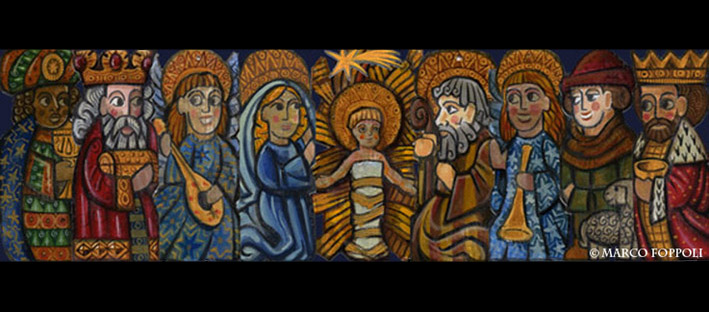
Artwork: The Nativity by Marco Foppoli, a heraldic artist and illustrator living and working in Brescia, Italy.
Archbishop Edwin F. O’Brien to lead the Order of the Holy Sepulchre

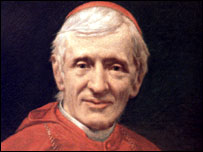
EDWIN F. OBRIEN.jpgIt sounds like this appointment of Archbishop Edwin F. O’Brien, 72, to head the 1000 year old lay group Equestrian Order of the Holy Sepulchre of Jerusalem.

The video of the press conference where Archbishop Edwin O’Brien announces he’s going to head the Order of the Holy Sepulchre.

Up to now he’s been the 15th Diocesan Ordinary of Baltimore; in 2007 Benedict appointed O’Brien to succeed Cardinal William Henry Keeler.

Several articles from Baltimore’s Catholic Review shed some light on Archbishop O’Brien: here, here and his own remarks.
As the Archbishop promised when he took over the Baltimore Archdiocese nearly four years ago, “Whatever I am and all that I have, I give to you” will be the same pledge to the Knights and Dames of the Holy Sepulchre.
Here’s a piece on the playful side of Edwin F. O’Brien.
Enhanced by Zemanta