Advent Vespers 2010 with Pope Benedict XVI

The Pope began Advent 2010 this evening –it’s evening in Rome– in the Vatican Basilica by celebrating First Vespers of Advent in the Presence of the Blessed Sacrament.

“To you, my Lord God, my eyes are turned, my refuge, protect my life”; “Here the Lord comes, and with Him His great saints”; “The Lord will come in glory; every man will see that He is the Savior.” With these words our preparation has begun.

B16 Advent Vespers I 2010.jpg

The Pope’s homily:

With this evening’s celebration, the Lord gives us the grace and joy of opening the new liturgical year beginning with its first stage: Advent, the period that

commemorates the coming of God among us. Every beginning brings a special grace, because it is blessed by the Lord. In this Advent period we will once again experience the closeness of the One who created the world, who guides history and cared for us to the point of becoming a man. This great and fascinating mystery of God with us, moreover of God who becomes one of us, is what we celebrate in the coming weeks journeying towards holy Christmas. During the season of Advent we feel the Church that takes us by the hand and – in the image of the Blessed Virgin Mary – expresses her motherhood allowing us to experience the joyful expectation of the coming of the Lord, who embraces us all in his love that saves and consoles.

While our hearts reach out towards the annual celebration of the birth of Christ, the Church’s liturgy directs our gaze to the final goal: our encounter with the Lord in the splendour of glory. This is why we, in every Eucharist, “announce his death, proclaim his resurrection until he comes again” we hold vigil in prayer. The liturgy does not cease to encourage and support us, putting on our lips, in the days of Advent, the cry with which the whole Bible concludes, the last page of the Revelation of Saint John: “Come, Lord Jesus “(22:20).

Dear brothers and sisters, our coming together this evening to begin the Advent journey is enriched by another important reason: with the entire Church, we want to solemnly celebrate a prayer vigil for unborn life. I wish to express my thanks to all who have taken up this invitation and those who are specifically dedicated to welcoming and safeguarding human life in different situations of fragility, especially in its early days and in its early stages. The beginning of the liturgical year helps us to relive the expectation of God made flesh in the womb of the Virgin Mary, God who makes himself small, He becomes a child, it speaks to us of the coming of a God who is near, who wanted to experience the life of man, from the very beginning, to save it completely, fully. And so the mystery of the Incarnation of the Lord and the beginning of human life are intimately connected and in harmony with each other within the one saving plan of God, the Lord of life of each and every one of us. The Incarnation reveals to us, with intense light and in an amazing way, that every human life has an incomparable, a most elevated dignity.

Man has an unmistakable originality compared to all other living beings that inhabit the earth. He presents himself as a unique and singular entity, endowed with intelligence and free will, as well as being composed of a material reality. He lives simultaneously and inseparably in the spiritual dimension and the corporal dimension. This is also suggested in the text of the First letter to the Thessalonians which was just proclaimed: “May the God of peace himself – St. Paul writes – make you perfectly holy and may you entirely, spirit, soul, and body, be preserved blameless for the coming of our Lord Jesus Christ “(5:23). Therefore, we are spirit, soul and body. We are part of this world, tied to the possibilities and limits of our material condition, at the same time we are open to an infinite horizon, able to converse with God and to welcome Him in us. We operate in earthly realities and through them we can perceive the presence of God and seek Him, truth, goodness and absolute beauty. We savour fragments of life and happiness and we long for total fulfilment.

God loves us so deeply, totally, without distinction, He calls us to friendship with him, He makes us part of a reality beyond all imagination, thought and word; His own divine life. With emotion and gratitude we acknowledge the value of the incomparable dignity of every human person and the great responsibility we have toward all. ” Christ, the final Adam, – says the Second Vatican Council – by the revelation of the mystery of the Father and His love, fully reveals man to man himself and makes his supreme calling clear…. by His incarnation the Son of God has united Himself in some fashion with every man. “(Gaudium et Spes, 22).

Believing in Jesus Christ also means having a new outlook on man, a look of trust and hope. Moreover, experience itself and reason show that the human being is a subject capable of discernment, self-conscious and free, unique and irreplaceable, the summit of all earthly things, that must be recognized in his innate value and always accepted with respect and love. He has the right not to be treated as an object of possession or something to manipulate at will, not to be reduced to a mere instrument for the benefit of others and their interests. The human person is a good in and of himself and his integral development should always be sought. Love for all, if it is sincere, naturally tends to become a preferential attention to the weakest and poorest. In this vein we find the Church’s concern for the unborn, the most fragile, the most threatened by the selfishness of adults and the darkening of consciences. The Church continually reiterates what was declared by the Second Vatican Council against abortion and all violations of unborn life: “from the moment of its conception life must be guarded with the greatest care ” (ibid., n. 51).

There are cultural tendencies that seek to anesthetize consciences with misleading motivations. With regard to the embryo in the womb, science itself highlights its autonomy capable of interaction with the mother, the coordination of biological processes, the continuity of development, the growing complexity of the organism. This is not an accumulation of biological material, but a new living being, dynamic and wonderfully ordered, a new unique human being. So was Jesus in Mary’s womb, so it was for all of us in our mother’s womb. With the ancient Christian writer Tertullian we can say: “he who will be a man is already one” (Apologeticum IX, 8), there is no reason not to consider him a person from conception.

Unfortunately, even after birth, the lives of children continue to be exposed to abandonment, hunger, poverty, disease, abuse, violence or exploitation. The many violations of their rights that are committed in the world sorely hurt the conscience of every man of good will. Before the sad landscape of the injustices committed against human life, before and after birth, I make mine Pope John Paul II’s passionate appeal to the responsibility of each and every individual: ” respect, protect, love and serve life, every human life! Only in this direction will you find justice, development, true freedom, peace and happiness!” (Evangelium vitae, 5). I urge the protagonists of politics, economic and social communications to do everything in their power to promote a culture which respects human life, to provide favorable conditions and support networks for the reception and development of life.

To the Virgin Mary, who welcomed the Son of God made man with faith, with her maternal womb, with loving care, with nurturing support and vibrant with love, we entrust our commitment and prayer in favour of unborn life . We do in the liturgy – which is the place where we live the truth and where truth lives with us – worshiping the divine Eucharist, we contemplate Christ’s body, that body who took flesh from Mary by the Holy Spirit, and from her was born in Bethlehem for our salvation. Ave, verum Corpus, natum de Maria Virgine!

“Show us, O Lord, Your infinite mercy.”

Preparing for Advent: the wreath as a sign that Salvation is at hand


Prophet Isaiah GPiamonte.jpgThe new liturgical year begins tonight at First Vespers for Advent (as a point of comparison, the Church in Milan which follows its own liturgical calendar and set of customs began Advent on November 14th this year [2010]). A new liturgical year refreshes our understanding of good Catholic customs and practices, a renews the emphasis of ongoing conversion and encourages a lively following of God Incarnate — all these things are essential hallmarks of Advent.

The newness the Advent gives to us is seen as a feast for the senses (Catholics are sensual people) known through investment of our best resources and energies: the Church’s vesture changes to purple, silence is observed a little more in the Liturgy, the sacred Scriptures draws out attention to waiting and preparing the way of the Lord (think of the Prophet Isaiah pictured right), the season’s music focuses our hopes and loves on the Kingdom already present but not fully realized and our homes, the “domestic church,” reinforces our seeking God together. As Father U. Michael Lang, CO, said in a recent essay on vestments, “Divine beauty manifests itself in an altogether particular way in the sacred liturgy, also through material things of which man, made of soul and body, has need to come to spiritual realities: the buildings of worship, the furnishings, the vestments, the images, the music, the dignity of ceremonies themselves.”

As one small sign for the daily and weekly journey, our movement in this season of preparation is the Advent wreath — a tangible sign of movement to recognizing more deeply that our Salvation is at hand. The Advent wreath is, however, not a parish church custom as much as it is custom for one’s home (but you can’t persuade too many priests to move the Advent wreath out of the sanctuary these days).

A favorite historian of liturgical customs is Jesuit Father Francis X. Weiser’s 1958 Handbook of Christian Feasts and Customs: The Year of the Lord in Liturgy and Folklore, but I also look to Pius Parsch, Dom Gueranger and the Directory of Popular Piety and the Liturgy (2001) to recall the Advent sensibility given to us by the Church. These authors are particularly helpful in preparing the faithful and especially the children in the Catechesis of the Good Shepherd and other CCD programs about the sacred Liturgy. About the Advent wreath Weiser writes:

The Advent wreath originated a few hundred years ago among the Lutherans of eastern Germany. It probably was suggested by one of the many light symbols which were used in folklore at the end of November and beginning of December… The Christians in medieval times kept many of these lights and fire symbols alive as popular traditions and ancient folklore. In the sixteenth century the custom started of using such lights as a religious symbol of Advent in the houses of the faithful. This practice quickly spread among the Protestants of eastern Germany and was soon accepted by Protestants and Catholics in other parts of the country. Recently it has not only found its way to America, but has been spreading so rapidly that it is already a cherished custom in many homes.

Advent wreath ex.jpg

The Advent wreath is exactly what the word implies, a wreath of evergreens (yew or fir or laurel), made in various sizes. It is either suspended from the ceiling or placed on a table, usually in front of the family shrine. Fastened to the wreath are four candles standing upright, at equal distances. These candles represent the four weeks of Advent.


Daily at a certain time (usually in the evening), the family gathers for a short religious exercise. Every Sunday of Advent one more candle is lit, until all four candles shed their cheerful light to announce the approaching birthday of the Lord. All other lights are extinguished in the room, and only the gentle glow of the live candles illuminates the darkness. After some prayers, which are recited for the grace of a good and holy preparation for Christmas, the family sings one of the traditional Advent hymns or a song in honor of Mary.


The traditional symbolism of the Advent wreath reminds the faithful of the Old Testament, when humanity was “sitting in the darkness and in the shadow of death” (Luke 2:79); when the prophets, illumined by God, announced the Redeemer; and when the hearts of men glowed with the desire for the Messiah. The wreath — an ancient symbol of victory and glory — symbolizes the “fulfillment of time” in the coming of Christ and the glory of His birth.


In some sections of Europe it is customary for persons with the name of John or Joan to have the first right to light the candles on the Advent wreath and Christmas tree, because John the Evangelist starts his Gospel by calling Christ the “Light of the World” and John the Baptist was the first one to see the light of divinity shining about the Lord at His baptism in the Jordan. (pp. 54-55)

Solemn Vigil for All Nascent Human Life, 27 November 2010

First Sunday of Advent.jpgMarking the beginning of Advent for the Roman Church,
the Holy Father invited the world’s dioceses (parishes & religious
institutions) religious communities, ecclesial movements and associations
throughout the world to join him in a Solemn Vigil for All Nascent Human Life (resources here).


On November 27th, First Vespers for the First Sunday of Advent, the
Church will gather together with her pastor in prayer to thank God for the
Incarnation of His Son and for the gift of Life, and to ask for the Lord’s
protection over every human being called into existence.

Christmas Novena, Ninth Oration

O God, Who in Your very nature contain all the riches
of heaven and earth, You loved the poverty of humanity by choosing to become
one of us. You are the descendant of Kings and the Heir of David the Venerable.
You were satisfied to be born in a stable and a humble manger. We beseech You,
through Your Pure Nativity and through the intercession of Your Mother and Saint
Joseph, Your Chosen One, to grant us an appreciation of voluntary poverty.


May
we be satisfied with only that which is necessary for the maintenance of our lives.
Teach us to flee from excessive luxury and the love of abundance all the days
of our lives. Amen.

The Christmas tree points to the Divine Mystery

Vatican Christmas Tree.jpgThe Pope received the bishop and a delegation from Wallonia, from
where this year’s Vatican Square Christmas tree came from, to say thank you for gift on behalf of the Church. He said, “The role
of this tree is similar to that of the shepherds who, watching through the
shades of night, saw how the darkness was illuminated with the message of the
angels. … Standing next to the nativity scene the tree indicates, in its own
particular way, the great mystery present in the poor and simple grotto. It
proclaims the arrival of the Son of God to the inhabitants of Rome, to pilgrims
and to everyone who sees St. Peter’s Square on television. Though this tree
your land, and the faith of the Christian communities in your region, greet the
Christ Child.” (Benedict XVI)

Christmas Novena, Eighth Oration

O King of Great Counsel, You joined Your admirable power
with the prudence of human judgment when You, the Mighty and All-Powerful God,
fled into Egypt from the face of Herod. We beseech You, through Your Pure
Nativity and through the intercession of Your Mother and Saint Joseph, Your
Chosen One, to grant us good judgment in all our actions, that we may think and
act wisely all the days of our lives as we subject ourselves to Your divine
service. Amen.

Christmas Novena, Seventh Oration

O You Who are One person but also have the Nature of
man; You Who have told us what You have heard from the Father; We beseech You,
through Your Pure Nativity and the intercession of Your Mother and Saint
Joseph, Your Chosen One, to grant us an ardent belief in Your teachings and
good acts to harmonize with them. Do not permit us to lose the reward of our
faith because of our own wrong doings. Rather, make our lives fruitful in
beliefs and good works. Amen.

Bethlehem make ready…friends be alert

Adoration of the Magi SBotticelli.jpg

Bethlehem, make ready,

for Eden has been opened for all.

Ephrathah, be alert,

for the Tree of Life has blossomed forth

from the Virgin in the cave.

Her womb has become a spiritual paradise

wherein the Divine Fruit was planted,

and if we eat of it,

we shall live and not die like Adam.

Christ is coming forth to bring back to life

the likeness that had been lost in the beginning.

Bethlehem, make ready, for Eden has been opened for all!

(a Byzantine poetic text for the time before the Nativity of the Lord)

Christmas Novena, Sixth Oration

O Word of God, Who comes from the Mouth of God to be
the Life of all men; You Who became Living Bread and was born in Bethlehem,
“The House of Bread,” to satisfy our hunger; We beseech You, through Your Pure
Nativity and the intercession of Your Mother and Saint Joseph, Your Chosen One,
to grant us a piercing hunger for that Bread which is Your Pure Body and
Blood. May we ever approach Your
altar and receive Your Sacred Mysteries with fitting preparation so that our
Communion may be for us salvation and life everlasting. Amen.

2 beating hearts, hidden but present in Mystery

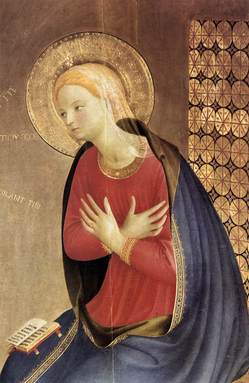
Thumbnail image for Annunciation detail Angelico.jpgWe have all had the occasion by a moment to sense more
intensely the presence of Christ in the Eucharist during the celebration of the
Mass, during Eucharistic adoration, or even in the Tabernacle, when we walk
into a church. There is Christ. He is there whether we sense or experience His
presence
.  But precisely because this is the case, we are sometimes given
to experience that He is present. Such experience is not the source of faith,
but in some way it is its consequence.


But what about the experience of the
Blessed Virgin Mary during Advent? It is reasonable, like the Fathers of the
Church, to see Mary as the original tabernacle. The Word became flesh and
dwells among us.  This being hidden but present among us is first of all
realized during the time of Advent in the home of Nazareth, in the womb of
Mary, under the protection of Saint Joseph.  Mary meditated upon all these
things and kept them in her heart. We can reasonably speculate that she read
scripture during this time, in silence, most likely the words of Isaiah, his
prophesies, and found in them a sense of the meaning of what was happening to
her.


St. Augustine says that she conceived the Word in her heart before she
conceived the Word in her flesh. So that her maternity was accompanied by an
intensification and growth in faith, in contemplation, in the intelligent
perception of mystery
. The Second Vatican Council says that during the time of
her pregnancy the heart of the Incarnate Word beat gently below the heart of
Mary, her immaculate heart. Two immaculate hearts, beating silently and
prayerfully in the night of this world.

(Fr. Thomas J. White, OP, Dominican House of Studies, Washington, DC)