St Mary Magdalen

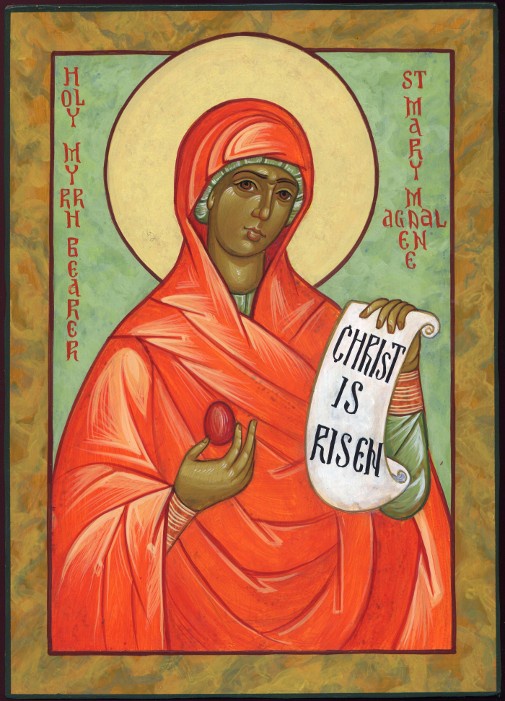
Mary Magdalene 3 aThe entire Church rejoices today on this feast of Saint Mary Magdalen, the first to witness to the Resurrection of the Savior. From Magdala, a region in northern Galilee she is the Apostle to the Apostles (a title given by Aquinas) an an evangelist announcing the joyful message of Easter to the whole world. The Magdalene’s name is mentioned in the Gospels 12 times, more than any of the 12.

Mary’s known for her intensity in adhering to the Lord. From her we learn in a real way what it means to live the attitude of gratitude before God: we can think poignantly of her being released of the seven demons driven out by Jesus. This event of meeting the Lord personally becomes her mission statement for the building up the nascent Body of Christ (the Church) at that time, and for all time.

God’s method of drawing us to Himself if using a woman reputed to have had difficulties with a wholistic and life-giving faith. Hence, one can posit that without Mary’s witness we would never have heard of Jesus Christ’s Resurrection. Theologically she is the key for the soul seeking, more, thirsting for God.

As one Cistercian priest-monk said, “We love Mary Magdalen because of the way in which the boldness of her love for Jesus made her stare death down beyond all human logic or hope.  For her there is no question that the Messiah of Israel, sent to redeem all humankind, and the Beloved of her most intimate heart are one and the same person. She perseveres in weeping at the entrance to the tomb because she perseveres in her love: the presence and actions of Jesus in her own life had taught her that love is indeed stronger than death. Against all odds and logic, in a sort of sublime madness, she clings to her Jesus dead or alive; and she does not reason about a her relative physical strength when she says ironically to the man she thought was the gardener, “Tell me where you laid him, and I will take him away.” Because she loves Jesus so much, she is prepared to carry his body away single-handed.”

On June 3, 2016, Archbishop Arthur Roche (of the Congregation for Worship) wrote: “It is right that the liturgical celebration of this woman has the same level of feast given to the celebration of the apostles in the general Roman calendar and highlights the special mission of this woman who is an example and model for every woman in the church.”

A recent prayer for the Year of Mercy of Pope Francis identifies Saint Mary Magdalen: “Your loving gaze freed Zacchaeus and Matthew from being enslaved by money; the adulteress and Magdalene from seeking happiness only in created things; made Peter weep after his betrayal, and assured paradise to the repentant thief.”

Let us attend to the Magdalen for our journey of faith.

Organic Vinegar –monastic style

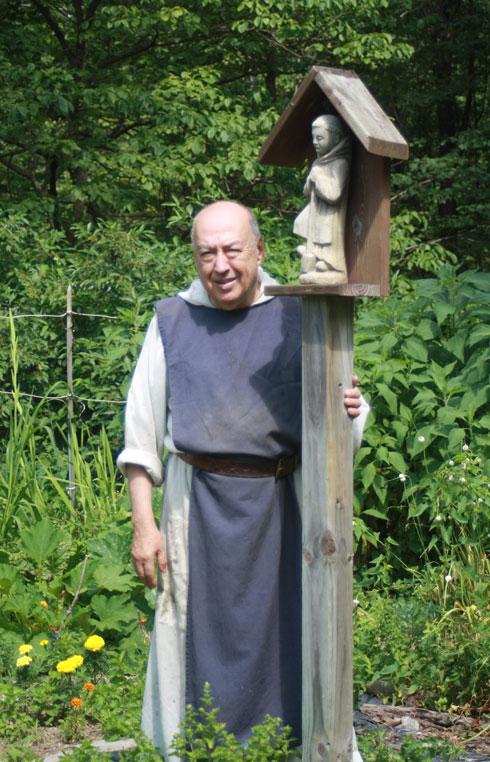
brother-victorOutside Poughkeepsie, NY there is a Benedictine Hermit, Brother Victor-Antione d’Avila Latourrette who lives his vocation with intensity. His residence is called Our Lady of the Resurrection Monastery.
 
You may know Brother Victor from his various books, including “Twelve Months of Monastery Soups”, “From a Monastery Kitchen: The Classic Natural Foods Cookbook” and “Sacred Feasts: From a Monastery Kitchen” among others.
He is quite the monk and son of St Benedict.
 
Here is a nice write-up in yesterday’s Poughkeepsie Journal:
 

By what intention do we judge?

These days are tense.  We are faced with important decisions by which we engage others. At a recent memorial service for the police officers killed in Dallas, Texas, the following was said by our former President.

“At times, it seems like the forces pulling us apart are stronger than the forces binding us together. Argument turns too easily into animosity. … Too often we judge other groups by their worst examples, while judging ourselves by our best intentions.”

George Bush
former President of the USA and former governor of Texas

Our Lady of Mount Carmel

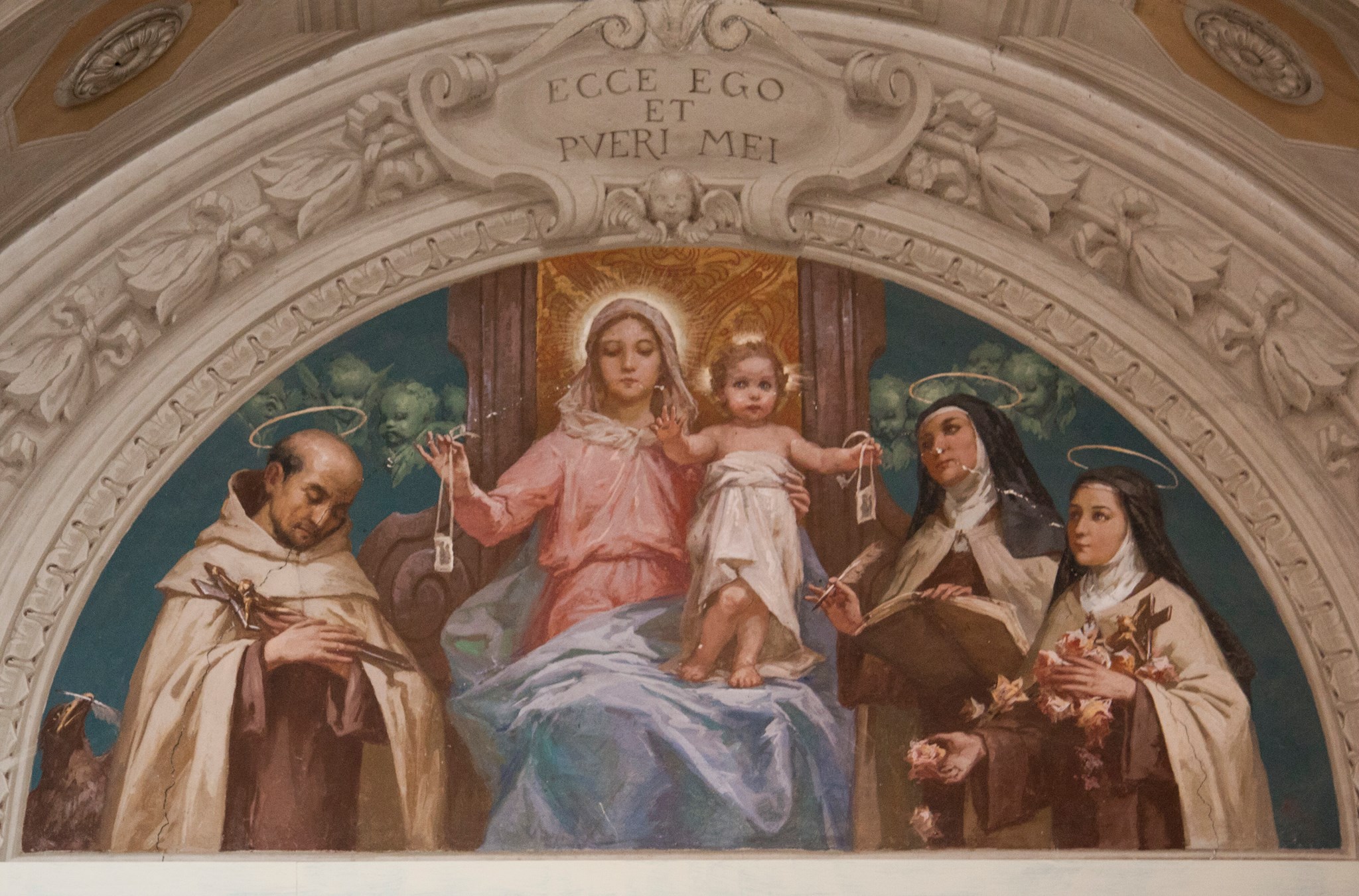
“A man was rushed to a New York City hospital unconscious and dying. The nurse saw the man was wearing a brown scapular of a Our Lady of Mount Carmel and called for the priest. As the prayers were being said for the dying, the man became conscious. ‘Father, I am not a Catholic.’ The man said. The priest asked why he was wearing the scapular. ‘I promised friends I would wear it and say one Hail Mary each day.’ The priest asked the man if he wanted to baptized. The man desired his whole life to become Catholic. He was baptized and received the Last Rites and died in peace.”

Our Lady of Mount Carmel, pray for us!

Dorothy Day and the Benedictines

I found the following file on my computer this morning by accident –I wasn’t looking for it, but I was happy to find it. I’ve been harping on the Benedictine influence upon Dorothy Day and the importance the Rule of Benedict and the influence various monks had Day. For example, we have a good example of Dom Virgil Michel working with Dorothy Day at the Catholic Worker. Another is Brother Victor-Antoine d’Avila Latourrette. Day’s sainthood cause is being studied at the moment and these things matter, in my opinion.

Virgil Michel, O.S.B., and the Benedictine Influence on the CW Movement:

Virgil Michel, Fellow Worker in Christ
by Dorothy Day

To us at the Catholic Worker, Father Virgil was a dear friend and adviser, bringing to us his tremendous strength and knowledge. He first came to visit us at our beginnings on East Fifteenth Street. He was like Peter Maurin in the friendly simple way he would come in and sit down, starting right in on the thought that was uppermost in his mind, telling us of the work he was engaged in at that particular moment and what he was planning for the future. He was at home with everyone, anywhere. He could sit down at a table in a tenement house kitchen, or under an apple tree at the farm, and talk of St. Thomas and today with whoever was at hand. He had such faith in people, faith in their intelligence and spiritual capacities, that he always gave the very best he had generously and openheartedly.

He was interested in everything we were trying to do, and made us feel, at all the Catholic Worker groups, that we were working with him. When he came in it was as though we had seen him just a few weeks before. He was at home at once, he remembered everybody, he listened to everybody.

Orate Frates, January, 1939

St Bonaventure

St BonaventureWe are honoring the memory of St. Bonaventure of Bagnoregio (ca. 1221-1274) today. One of the great scholastic theologians and pastors of the Church. I hope the Thomists won’t get mad!

There are many who make the claim that the best general introduction to the thought of Bonaventure is Sister Ilia Delio’s, Simply Bonaventure (New City Press, 2nd ed.) And I agree. But if you need another resource, consider this encyclopedia entry (2005/2013).

Bonaventure, having joined the new movement of Friars in Paris, his priestly and academic career was centered at the Franciscan School of Theology at the University of Paris from 1248-1257. By this time he garnered the attention of his brothers and churchmen at large. He was elected General Minister of the Order governed his brothers for 17 years. It may be said that after the early days of Francis and the early leadership of the Franciscan movement Bonaventure makes his Order credible and and reliable. Thereafter, Bonaventure was elected to serve the Roman Pontiff as Cardinal-Bishop of Albano and expert at the Second Council of Lyons; At Lyons, he died during the Council.

The scholarship on Saint Bonaventure reveals to us that he emphasized all learning must serve the ultimate goal of human life: communion with God. His work is greatly trinitarian and Chriwstocentric. For him, and for us, Christ is the one and true Master! This is a critical point for knowing today’s saint: learning is not meant for self-aggrandizement but to help a person realize that he or she is on a journey toward union with a loving God –a communio theology. You could say with seriousness that to do otherwise is to reduce theology and learning to absurd levels and miss the point of knowing, loving and serving the Blessed Trinity.

Consider this passage from his treatise, “The Tree of Life”:

“You soul devoted to God,
whoever you are, run
with living desire
to this Fountain of life and light
and with the innermost power of your heart
cry out to him:

‘O inaccessible beauty of the most high God
and the pure brightness of the eternal light,
life vivifying all life,
light illumining every light,
and keeping in perpetual splendor
a thousand times a thousand lights
brilliantly shining
before the throne of your divinity
since the primeval dawn!

O eternal and inaccessible,
clear and sweet stream from the fountain
hidden from the eyes of all mortals,
whose depth is without bottom,
whose height is without limit,
whose breadth cannot be bounded,
whose purity cannot be disturbed.

From this Fountain
flows the stream of the oil of gladness,
which gladdens the city of God,
and the powerful fiery torrent,
the torrent, I say, of the pleasure of God,
from which the guest at the heavenly banquet
drink to joyful inebriation
and sing without ceasing
hymns of jubilation.

Anoint us
with this sacred oil and refresh
with the longed-for waters of this torrent
the thirsting throat of our parched hearts
so that amid shouts of joy and thanksgiving
we may sing to you
a canticle of praise,
proving by experience that
with you is the fountain of life,
and in your light we will see
light (see Ps 36:10).”

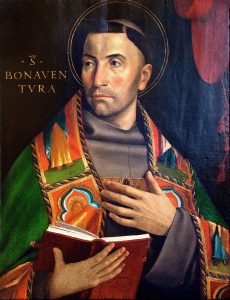
This image of Saint Bonaventure, is depicted by the Veronese painter, Paolo Morando Cavazzola (1486-1522). Few medieval depictions of Bonaventure exist; Bonaventure was not canonized until 1482.
Yielding to public opinion is tragic

In business, in politics, and in fact, in the holy Church of Christ on earth, we are more governed by trends and the opinions of others than seeking the Way, the Truth, and the Life. Dietrich von Hildebrand has something to say about this fact…

“In general, however, the heads of Catholic institutions do not prohibit the teaching of heresies not because they have definitely lost their faith, but because they yield to public opinion and to fashionThey fear to be called ‘reactionaries.’  They shudder at the thought of violating this allegedly holy academic freedom.  Of these St. Augustine says: ‘Who is the hireling who, seeing the approach of the wolf, takes flight?  He who seeks himself and does not seek what is of Jesus Christ; he who does not dare to frankly admonish the sinner (1 Tim. 5:20).  See, someone has sinned, gravely sinned; he should be admonished, excluded from the Church.  But, excluded from the Church, he will become its enemy and will try to ensnare it and harm it where he can.  Now the hireling, the one who seeks himself and not what is of Jesus Christ, will be silent and will not give any admonition, in order not to lose what he seeks, namely the advantages of personal friendship, and in order to avoid the unpleasantness, worry and personal enmity.  The wolf at that moment takes hold of the sheep to throttle them…You are silent O hireling, and do not admonish…Your silence is your flight.  You are silent, you are afraid.  Fear is the flight of the soul. (St. Augustine, Tractatus in Joannem, XLVI, 7-8)’.”

St Kateri Tekakwitha

Statue Kateri Tekakwitha, Cathedral Basilica of St. Francis of Assisi, Santa Fe, NMToday the Church in the USA liturgically remember one of her own, Kateri Tekakwitha, the first Native American woman proposed for canonization. In fact, she is the fourth Native American person to be venerated by the Church. Saint Juan Diego and two other Oaxacan Indians are indigenous peoples accorded the honor of religious veneration.

Kateri Tekakwitha was the daughter of a Christian Algonquin woman captured by Iroquois and married to a non-Christian Mohawk chief. Kateri was orphaned during a smallpox epidemic, which left her with a scarred face and impaired eyesight. She converted and was baptized in 1676 by Jesuit Father Jacques de Lamberville. As a convert at  nineteen, she was renamed Kateri, baptized to honor the great saint,  Catherine of Siena.

Her biography reveals that Kateri was shunned and abused by relatives for her faith who witheld food from her on Sundays and stoned her when she entered the chapel, Kateri then escaped through 200 miles of wilderness to the Christian Native American village of Sault-Sainte-Marie (near Montreal).

As a young girl, Kateri took a vow of chastity in 1679 and held a spirituality and austere lifestyle. Hers was a life of prayer, mortification and works of charity. Tekakwitha’s notable value for chastity, she is often referred to as a lily, (Lily of the Mohwaks) a traditional symbol of purity.

He final words were, “Jesus, Mary, I love you!” After he death her grave became a pilgrimage site and place of miracles for Christian Native Americans and French colonists.

Our saint’s tomb reads: Kateri Tekakwitha -Ownkeonweke Katsitsiio Teonsitsianekaron- The fairest flower that ever bloomed among red people.

As a friend said, may she “who sees through difficulty” intercede for us.

Sts. Louis and Zélia Martin –a sainted couple

Martin familyWe liturgically remember Saints Louis and Zélia Martin, the married couple whose human love cooperated with Divine Grace which generated the beauty of the Little Flower.

As with all holy men and women, saints, they had a lived in a recognition –continual– that God is all and the desire to give all. From this recognition, 5 daughters entered consecrated life; 4 in Carmel and one in the Order of the Visitation.

Pope Francis acknowledged that the Church wants and needs married couples who point to Christ and so canonized Louis and Zélia during the Synod on the Family on 18 October  2015; becoming the first spouses in the church’s history to be canonized as a couple.

The choice of a liturgical memorial on 12 July marks the date of their matrimony in 1858.

May Saints Louis and Zélia help us to integrate our faith in every aspect of family life remembering that the married vocation is to help each other become saints.