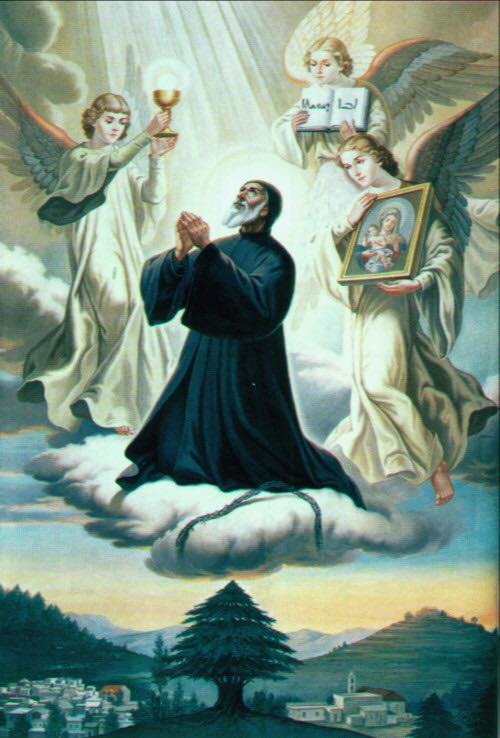
St Sharbel, pray for us.
Listening with the ear of the heart – Lectio Divina
I am firm believer, based on experience AND the witness of Tradition of the Church, and that of Benedict XVI, that Lectio Divina is the prime method of my daily spiritual renewal. It is the daily re-birth of my life in Jesus Christ. My hope is that I can be faithful to the practice. Here is a fine thought on value of Lectio:
The monastic art of the reading (lectio) which is really a kind of listening (“with the ear of the heart”, cf. Rule of Benedict) to what the Word of God is saying to us in the Scriptures. They were also given time and space to immerse themselves in the practice of this art and to share their experience with one another and some of the monks. And all, of course, took place within the daily round of prayer and work which make up the life of the monastery ( or, in the home and workplace, among friends).
St Bonaventure
“An anonymous papal notary composed a eulogy to Bonaventure which gives us a conclusive portrait of this great Saint and excellent theologian. ‘A good, affable, devout and compassionate man, full of virtue, beloved of God and human beings alike…. God in fact had bestowed upon him such grace that all who saw him were pervaded by a love that their hearts could not conceal.’”
Pope Benedict XVI.
St Benedict
Friends, a blessed Feast of St. Benedict!
“Help me, great St. Benedict, to live and die as a faithful child of God, to run in the sweetness of His loving will, and to attain the eternal happiness of heaven. Amen.”
Saint John Paul II expressed his sincere hope: “May every Benedictine community present itself with a well-defined identity, like a “city on a hill”, distinct from the surrounding world, but open and welcoming to the poor, to pilgrims and to all who are searching for a life of greater fidelity to the Gospel!”
Blessed John Henry Newman tells us: “We are told to be like little children; and where shall we find a more striking instance than is here afforded us of that union of simplicity and reverence, that clear perception of the unseen, yet recognition of the mysterious, which is the characteristic of the first years of human existence? To the monk heaven was next door; he formed no plans, he had no cares; the ravens of his father Benedict were ever at his side. He “went forth” in his youth “to his work and to his labour” until the evening of life; if he lived a day longer, he did a day’s work more; whether he lived many days or few, he laboured on to the end of them. He had no wish to see further in advance of his journey than where he was to make his next stage. He ploughed and sowed, he prayed, he meditated, he studied, he wrote, he taught, and then he died and went to heaven. He made his way into the labyrinthine forest, and he cleared just so much of space as his dwelling required, suffering the high solemn trees and the deep pathless thicket to close him in.
(‘The Mission of St Benedict’, The Atlantis, 1858)
Jesus Prayer concerns
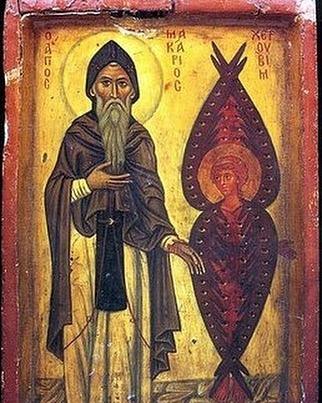
Abba Macarius the Great said, “Concentrate in this name of our Lord Jesus Christ with a contrite heart, the words welling up from your lips and drawing you to them. And do not depict Him with an image in your mind but concentrate on calling to Him: ‘Our Lord Jesus, have mercy on me.’ Do these things in peace and you will see the peace of His Divinity within you; He will run off the darkness of the passions that dwell within you and He will purify the inner person [2 Cor 4:16, Eph 3:16] just as Adam was pure in paradise. This is the blessed Name that John the Evangelist pronounced: ‘Light if the world and unending sweetness, the food of life and the true food'” (Jn 6:48, 6:55, 8:12)
From The Virtues of Abba Macarius the Great
TLM at 10
Today marks the 10th anniversary of the publishing of the motu proprio of Benedict XVI, Summorum pontificum, freeing the Tradition Latin Mass (TLM) for celebration without the interference of clergy who want to kill off this noble expression of divine worship. It is clear that the breaking of its chains has allowed the Mass to change lives.
Instead of getting caught up in the usual concerns of some people, I think it is helpful if we appreciate the theological synthesis of the TLM not only in terms of the liturgical and ascetical discipline in the West, but also of pastoral practice: the salvation of one’s soul and that of the entire cosmos; one’s conversion to Someone Infinite and who can answer the thirst of the heart. Permit yourself to engage in a reflection that sees how the TLM conveys the worship of the Blessed Trinity, gives a theological and a moral tradition –not moralism and how it is allowed the laity with the help of the clergy to build culture.
I will say this, however, that the clergy who are adamant in seeing the diminishment of the TLM are ignorant of the graces poured out by God upon the Church. Why frustrate Beauty, Truth and Goodness? Let us pray for a deepening of the knowledge and grace that is given to us today at 10 years, and for the years to come.
The image is that of The Mass of Saint Gregory the great and miracle of the host, by Carle Van Loo (1705 + 1765), in the Chapel Saint-Grégoire of the royal church of sick, 1764. Museum of the Beautiful, Lyon Arts.
Blessing God
I think if you asked many people what it means to “bless God” an adequate answer would be lacking. Probably for no other reason than it is not a subject we hear preached on at Mass, or study in Catechism class. This is a sad thing to say: we don’t have competent or interested priests and lay catechists doing the work of passing on the revealed religion. Sister Vassa Larin, on the other hand, has provided a brief explanation on the meaning of Blessing God.
“Bless (εὐλόγει) the Lord, O my soul, and let all that is within me bless His holy name. Bless the Lord, O my soul, and forget not all His benefits.” (Ps 102/103: 1-2)
Does God need that I “bless” (εὐ-λόγει, say a good word about) Him? No, of course not. But I need to say “good words” about the Source of Good, the Source of Blessing, lest I forget all His gifts or “benefits,” showered upon me and others every day. I need actively to exercise my God-given capacity for “good words,” even when it is easier to grumble and choose “bad words,” about whatever bad things may cross my path.
The “blessing” (or “good word”) I speak with my mouth, and say in my “soul,” has creative power, because God, my Creator, is the Source of all Blessing. I grow in Him, to be more “like” Him, when I participate or share in His creative energies of “blessing.” Conversely I do damage to my growth, if I choose de-structive, “bad words,” or words that are God-less, outside of God. So let me choose good words today; let me bless, that I may be blessed.
Most Precious Blood of Jesus Christ
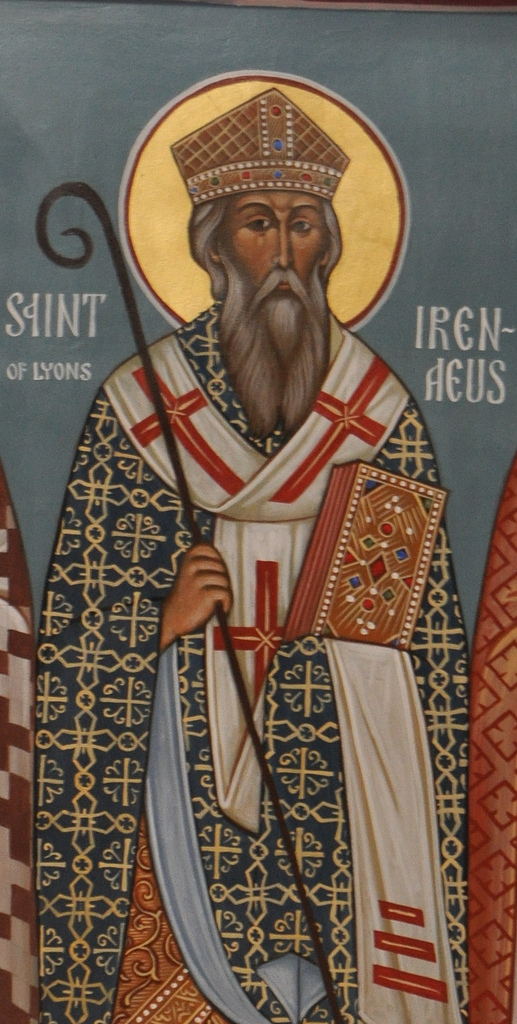
St Irenaeus
St Irenaeus was born c.130 in Smyrna, Asia Minor (today modern Izmir, Turkey) and was martyred in 202 in Lyons, France; his tomb and relics were destroyed by Calvinists in 1562 but his head rests in Saint John’s Church, Lyons, France. Today the western Church liturgically recalls Irenaeus while the Orthodox Church liturgically recalls his memory on August 23.
History tells us that St Irenaeus was a disciple of St Polycarp of Smyrna. In 177, was ordained and later was the Bishop of Lugdunum, Gaul (modern Lyons, France).
His learning and prudence (discretion) identified him as a true “lover of peace” which is what his name implies. You might say that Irenaeus’ enduring legacy speaks to the fact that he worked and wrote against Gnosticism (see his work Against Heresies), basing his arguments on the works of St John the Apostle, whose Gospel is often cited by Gnostics. He is considered the first great Western ecclesiastical writer and theologian, who emphasized the unity of the Old and New Testaments, and of Jesus Christ’s simultaneous human and divine nature, and the value of tradition. The calls Irenaeus a “Father of the Church”. He is clearly among the “greats”.
As one said, “Emerging from the turmoil of the second century, the Church is indebted to Irenaeus for its catholic self-consciousness and its awareness of unity as reflected in the emergence of the canon of Scripture, the interpretation of prophecy, and apostolic succession.”
Milan Lach appointed to Parma Eparchy
Today, the Holy Father appointed Bishop Milan Lach, SJ, as Apostolic Administrator for the Eparchy of Parma (OH). He is currently auxiliary bishop of Prešov of the Byzantines, Slovakia.