Vietnamese monks live Cistercian life, San Bernardino, CA

By David Olson dolson@PE.com
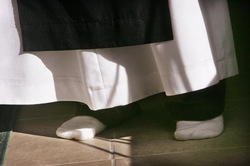

Cist1.jpgLong before dawn in the remote desert south of Barstow, the only light for miles around is a faint glow from a triple-wide trailer.


Inside, several monks chant in Vietnamese. Then there is silence.


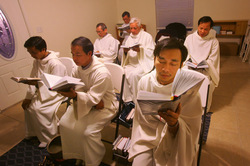
The trailer is home to the first cloistered Catholic monastery in the Inland area. The white-robed monks pray and chant together seven times a day and silently meditate twice. Here in Lucerne Valley, off a dirt road and at the foot of barren mountains, there is little to disturb them.


“There is God in this deserted place,” said Brother Matthew Nguyen. “There are not many people here, but God is here.”


San Bernardino Diocese Bishop Gerald Barnes celebrated the opening of St. Joseph Monastery on Aug. 17, but for now, the two cream-colored trailers, a water pump and solar panels are all that sit on the 80-acre site.


The monks hope to one day erect permanent buildings to house a chapel, retreat center and living quarters.


Peter Pham, a Cistercian monk, delivers food at sunrise outside the St. Joseph Monastery in the Lucerne Valley south of Barstow. Six Vietnamese members of the Cistercians devote their lives to contemplation there. It will also serve as a Catholic retreat.


St. Joseph is the second U.S. outpost of a Vietnamese congregation of Cistercian-order monks, who seclude themselves in monasteries to devote their lives to contemplation. The other opened in June near Sacramento.


There are nearly 7,000 Cistercian monks and nuns worldwide. Most sites are open to the Catholic faithful for retreats, as St. Joseph’s visitors trailer will be in a few months.


The monks and nuns in Cistercian monasteries typically spend little time outside them, except for shopping for groceries and other necessities, and for special events such as ordinations.

Although the number of monks and nuns in U.S. monasteries has declined over the past few decades, experts say the drop has not been as steep as the fall in non-monastic priests and nuns.

Proportionately more people choose a monastic life than before as a reaction to secularism and an increasingly fast-paced U.S. lifestyle, said Sister Patricia Wittberg, a professor of sociology at Indiana University-Purdue University Indianapolis.


There are about 200 Catholic monasteries in the United States, but there is no reliable count of how many people live inside them.
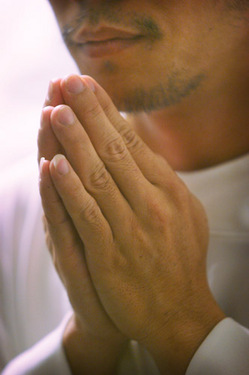

Cist2.jpgLike the parish priests who minister to their congregants and the nuns who serve the poor and sick, Cistercians and their devotion to intensely contemplative lives form a vital part of the Catholic church, said the Rev. Thomas Rausch, a professor of Catholic theology at Loyola Marymount University in Los Angeles.


“It’s a special vocation,” Rausch said. “The church needs people who energize it from within with their prayer.”


The monks of St. Joseph rise each morning at precisely 3:55 a.m.


Twenty minutes later, they gather in the dim light of the trailer’s chapel to chant for a half-hour. Then comes 30 minutes of meditation broken by the ringing of a bell announcing daily Mass.

The rest of the day is dedicated to prayer, meditation, singing, Bible-reading, study and work. They speak to each other as little as possible, said the Rev. Anthony Pham, the monastery’s superior.


“Most of our time is for God,” Pham said, as he ate a breakfast of fried eggs topped with soy sauce.


Pham said that, while he is meditating, he reflects upon God’s love and the meaning of his calling as a monk. Work is an integral part of monastic life. As much of it as possible is manual labor, to leave the monks’ minds free for contemplation.


The monks are now clearing brush, digging trenches for pipes, grading land and performing other tasks to build and adorn their monastery.


Like other monasteries, St. Joseph must be self-supporting, so the monks are discussing possible business ventures.


Other monasteries make products such as beer, fruitcake or cheese, and one in Wisconsin sells toner cartridges under the name Lasermonks.


The St. Joseph monks are thinking of opening an on-site gift shop featuring Vietnamese religious articles that they would also sell online. Or perhaps they’ll make tofu for Vietnamese markets.

The 12-bed retreat center that will open in several months is why the monastery exists. A Vietnamese priest from Santa Ana, who attended a Cistercian boarding school as a boy, contacted the Cistercian order to convey the need for a retreat house geared toward Vietnamese immigrants, Pham said.


Many older Vietnamese Catholics do not speak English and would not feel at home or get the spiritual nourishment they seek if they were to attend a retreat at an English-speaking monastery, he said.


They and many other Catholics yearn for a place to recharge, to take a break from their busy lives to focus on their relationship with God, Pham said.


The retreat guests — visitors who are not Vietnamese will be welcome as well — will participate in the same prayers, singing, meditation and other devotions as the monks, Pham said.

If asked, the monks will guide them, suggesting which Biblical verses to read. But much of the benefit of a retreat will be the example the monks set, Pham said.

Founders of Citeaux.jpg“The way we live has a special effect and impact on other people, in the way that we get closer to God,” Pham said. “When we are closer to God, we love God more.”


Even more than parish priests, the monks forgo worldly goods. Because they rarely leave the monastery, they have few material needs. They do not eat meat, as a way of sacrificing for God.

“If we put too many things in ourselves, we cannot serve other people,” Pham said. “If you’re willing to throw things like the good car, like status in the community away, you come back to only being a human being, nothing more. We try to empty ourselves, so God can pour his graces into us.”


When a permanent monastery is complete, Pham will spend almost all his time there.


Until then, Pham is busier than he would sometimes like. He regularly interrupts the contemplative life of Lucerne Valley to drive to Victorville. There, he fills out forms, applies for permits and talks with county bureaucrats. Even monks can’t avoid San Bernardino County land-use and building codes.


He has a studded ring on his right hand that he rubs while driving, so he can pray the Rosary while on the road.

Thumbnail image for Cist3.jpgAll six monks who live at the monastery spent at least six months at a Benedictine monastery in Pennsylvania to improve their English and acculturate themselves, Pham said. Two more monks are now in Pennsylvania, preparing to move to St. Joseph. The goal is to have 13 monks by the end of 2009.


The monks receive several-thousand dollars a month to support themselves and the monastery. Most money comes from Vietnamese immigrants in Orange County. Further donations, along with revenue from the monks’ forthcoming business, will fund the construction of the permanent monastery.


The trailer chapel where the monks now spend much of their time is spare. The monks sit on white plastic chairs or kneel on a blue-and-white carpet before a crucifix and a wooden altar carved in Orange County by a Vietnamese craftsman. Statues of St. Joseph and Our Lady of La Vang — an apparition of the Virgin Mary in 18th century Vietnam — stand near a plaque commemorating Bishop Barnes’ visit.


Outside, there is little but sand and desert brush. Lucerne Valley was chosen for the monastery because it is remote enough to foster contemplation but within driving distance of the huge Vietnamese community in Orange County.


The land cost $80,000. Pham started paying for it with his $200 monthly stipend, along with donations from Vietnamese families.It was a risk. Pham knew the money wasn’t enough to pay the entire cost of the land. But he trusted in God.


Then a Vietnamese family took him to Florida with them on vacation. By chance, he met a wealthy Vietnamese Catholic there. Pham mentioned the monastery he was building. He didn’t ask the man for money. But by the time he left Florida, the man offered to pay the remaining cost of the land.


“I didn’t know this person, and I didn’t have the money to pay for the land,” Pham said.

“But everything comes together with God.”

—-

THE CISTERCIAN ORDER
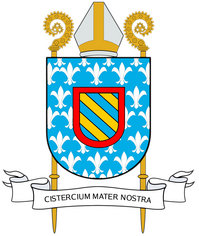


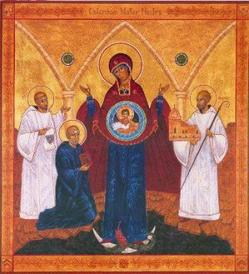
Cistercian arms.jpgThe Cistercian order to which the monks at St. Joseph Monastery in Lucerne Valley belong dates from 1098, when it was founded in Citeaux, France, by St. Robert of Molesme. The English word “Cisterican” comes from “Citeaux.”


Their creed is “Ora et Labora,” or “Prayer and work.” Most of a Cistercian monk’s day is spent in contemplation.


The monks at St. Joseph are called Common Observance Cistercians. Perhaps better known is the Cistercian Order of the Strict Observance, commonly known as Trappists. The Trappists initially had a stricter interpretation of monastic rules, but today differences between the Common and Strict Observance Cistercians are negligible and there are discussions to unite the two orders.


There are nearly 7,000 Cistercian monks and nuns worldwide.


The mother abbey for St. Joseph Monastery, Phuoc Son Abbey, is outside Ho Chi Minh City, Vietnam.


SOURCES: The (Common Observance) Cistercian Abbey of Our Lady of Spring Break, Cistercian Order of the Strict Observance, The Modern Catholic Encyclopedia

A Christmas Carol


The Christ-child lay on Mary’s lap,
Nativity Angelico.jpgHis hair was like a light.
(O weary, weary were the world,
But here is all aright.)

The Christ-child lay on Mary’s breast
His hair was like a star.
(O stern and cunning are the kings,
But here the true hearts are.) 

The Christ-child lay on Mary’s heart,
His hair was like a fire.
(O weary, weary is the world,
But here the world’s desire.)

The Christ-child stood on Mary’s knee,
His hair was like a crown,
And all the flowers looked up at Him,
And all the stars looked down.


G.K.Chesterton 

Father, son and Holy Church

Ruth Gledhill of the Times Online (of London) posted this story today on a very unique circumstance: a father & son who poped and are now Catholic priests. 


In what is believed to be a first, a father and son, both former Anglican clergy, have been ordained as Catholic priests and are now working for the same archdiocese, Birmingham.


Father & Son Poped and ordained.jpgFather Dominic Cosslett, 36, and his father, Father Ron Cosslett, 70, were both ordained by Archbishop Vincent Nichols, pictured above by Peter Jennings. Nichols is the favourite to succeed Cardinal Cormac Murphy-O’Connor as Archbishop of Westminster when he steps down early next year and the latest ordination of Father Dominic on 20 December shows he is continuing in the tradition of true Catholicity to which the British church has so long been witness.


Father Dominic was formerly an Anglican priest at the Church of Christ the King at Lourdes in Coventry. His father, Father Ron Cosslett, aged 70, also a former Anglican priest, was ordained as a Catholic priest by Nichols 3 July 2005. He is now priest-in-charge at St Joseph’s, Darlaston in the West Midlands.


Father Dominic, who is not married, has from a young age felt called to a celibate lifestyle. “Although as an Anglican marriage was open to me the way I live my life is naturally a celibate one,” he told me yesterday. His mother converted five years ago at the same time as his father and his sister and their children followed them over about a year ago.


Father and son concelebrated, celebrating the eucharist at the older Father’s parish, for the first time at Christmas.


“Both of us were in the Catholic tradition of Anglicanism,” said Father Dominic. “Like a lot of us in that tradition, we had always felt the Catholic Church was the rock from which we were hewn. It was always part of our journey, our faith, to seek unity with Rome. We came to the point where we felt we could not exercise our understanding of Catholicism within Anglicanism. It was time for us to go home.”


His father started out in Monmouth, South Wales and then moved to Burslem, one of the Five Towns in the Potteries in the Lichfield diocese. The family returned to Wales and his father’s last Anglican parish was St Paul’s in Swansea.


royal Eng College Valladolid.jpgUnder the guidelines agreed in the Catholic church for the reception of Anglican clergy who wish to become Catholic priests, Father Dominic, who studied theology at Llampeter and trained for the Anglican priesthood at the high church Mirfield College of the Resurrection before being priested in 1997, underwent a shortened training as to be a Catholic priest. He spent a year in the Spain at the
Royal English College at Valladolid and then went to seminary at St Mary’s Oscott.


As an Anglican, he served his curacy in Abergavenny in the Monmouth diocese when his bishop was Dr Rowan Williams, now Archbishop of Canterbury.  He moved to his own parish in the Birmingham diocese when its bishop was Dr John Sentamu, now Archbishop of York. He speaks highly of both men, but neither was enough to make him stay.


“I realised my own journey was to seek unity with Rome. Balanced with that was the awareness that the Anglican Church was going in a very different direction with various decisions it was making. I just felt I could not agree with those decisions. It comes down to authority. As an Anglican, it was sometimes very difficult. One parish might believe one thing, another might believe something else.


“There is an incredible rainbow of thought in the Anglican Church. Perhaps I was looking more for a central authority of teaching that the Catholic Church has. It was something I had always been looking for.”


He recognises his situation, with his father as a priest, might appear unusual to some but for him it feels normal. There is a long tradition in the Anglican church of father-and-son priests. The ministry often runs in families.


Asked whether he believes all Catholic priests should be allowed to marry, he said: “That is not my decision. The teaching of the Church is there. The Holy Father has graciously allowed those who are former Anglicans who are married to become priests.  The teaching remains the same and that is certainly not for me to comment on.”


But he was careful to emphasise that his new path was not a reaction against Anglicanism.

“Becoming a Catholic is not so much about being disatisfied with being an Anglican as about having a positive engagement with the Catholic Church. I am very grateful for my Anglican days. But I realised there is something else in the Catholic Church. That is very much what lay behind my decision.”


Vincent Nichols Arms.jpgArchbishop Nichols, in his words of welcome at the start of the ordination, said: “This situation a unique occasion and a great day in the life of the diocese.  Both a father and his son – after his ordination – will be serving as Catholic priests.”


More than 60 Catholic priests, including Father Dominic’s father, witnessed the ceremony.


Archbishop Nichols continued: “Just as the Angel Gabriel told Mary, ‘The Holy Spirit will come upon you and the power of the Most High will cover you with its shadow’, so also this will manifest for Dominic.


“How else, except through this gift could Dominic ever make Christ present in the life of the Church? It is the same gift given all those centuries ago in Nazareth that is given in Coventry today.


“It is only our unity in the Church which ensures that we are faithful to what we have been given. This Ordination is part of a great Tradition – a great handing on – from one age to the next of his gift of the Holy Spirit in the Sacrament of Holy Orders.


“Indeed, this sense of Tradition is crucial – Apostolic Tradition. The vital question for all of us and for Dominic is where is it to be found?


“We rejoice in the answer during this Ordination Ceremony. It is to be found, with utter reliability, in union with Peter the first Apostle, and in union with his Successor the Bishop of Rome.


“It is this visible unity which gives the Church the sure capacity to be faithful in the Apostolic Tradition; to hand on whole and entire, and to explore and develop its Doctrine in a faithful and secure manner. This unity is a great joy and a pearl of great price.


“So today we thank God for Dominic’s life and ministry as a priest in the Church of England. We rejoice as he steps into the priesthood in this full Communion of the Catholic Church through his ordination in this visible Apostolic Tradition.”

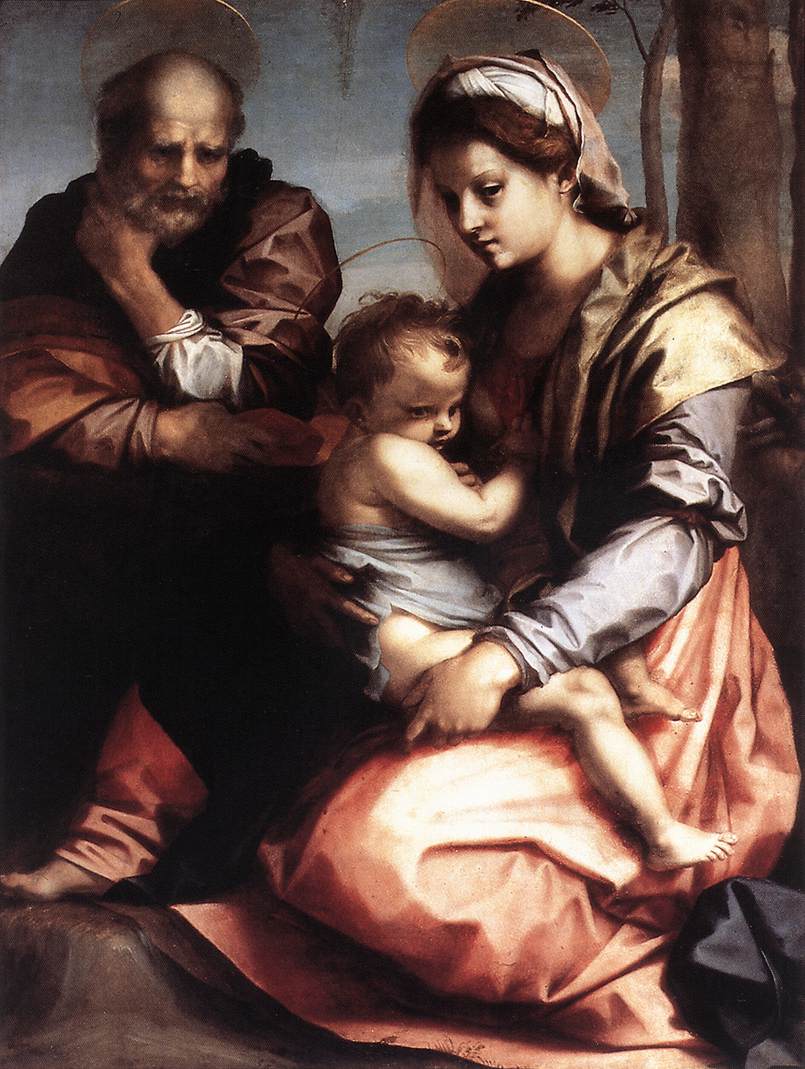
Feast of the Holy Family

Holy Family.jpg


Father in heaven, creator of all, you ordered the earth to bring forth life, and crowned its goodness by creating the family of man.

In history’s moment when all was ready You sent your Son to dwell in time, obedient to the laws of life in our world.

Teach us the sanctity of human love, show us the value of family life, and help us to live in peace with all men that we may share in your life forever.

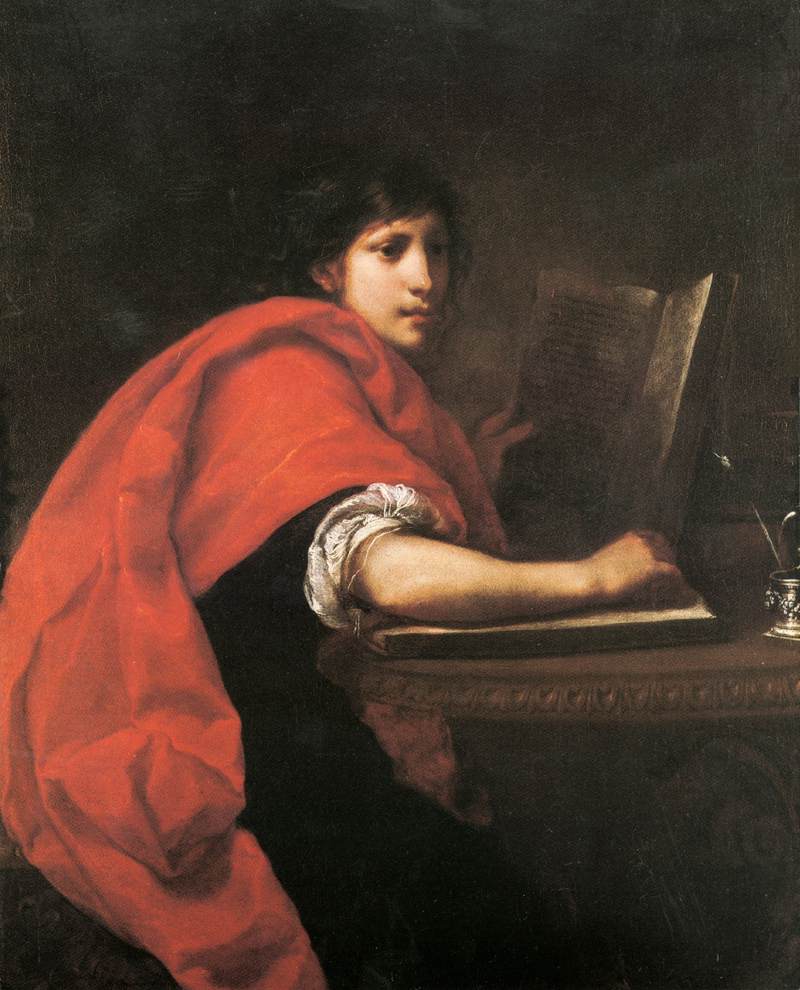
Saint John the Evangelist (the Beloved Disciple)

Saint John, Saint John was Christ’s disciple,
and Evangelist also;
He for the sake of Jesus Christ
Much pains did undergo,
Because he loved our Saviour Christ,
As Holy Scriptures say,
And was belov’d of him also,
And in his bosom lay.

Chorus

Saint John for love of our Saviour
Did undergo much pain
And never ceased during life
To preach Christ Jesus’ name.

Saint John, he at Jerusalem

St John the Evan.jpgDid preach God’s holy word,
And for the same the spiteful pagans
They did him cruel scourge.
Then did he for the same rejoice,
That he was counted worthy
To suffer for the sake of Christ,
And would him not deny.

To Patmos banish’d was Saint John,
As Scripture doth record,
For the testimony of Christ,
And his most holy word.
And as he was in the Spirit
On the Lord’s blessed day,
Our Saviour by an Angel spake,
and unto him did say,

I am Alpha and Omega,
Which was and is to come;
And what thou seest write in a book
Thus said he to Saint John
And send it to the Churches then,
Which are in Asia seven.
And said the Angel to Saint John,
Which came to him from Heaven.

Continue reading Saint John the Evangelist (the Beloved Disciple)

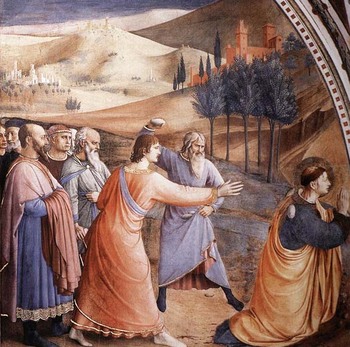
Yesterday, with exultation: In honor of Saint Stephen

Yesterday, with exultation,
Join’d the world in celebration
Of her promised Saviour’s birth;
Yesterday the Angel-nation
Pour’d the strains of jubilation
O’er the Monarch born on earth;


But today o’er death victorious,
By his faith and actions glorious,
by his miracles renown’d,
See the Deacon triumph gaining,
‘Midst the faithless faith sustaining,
First of holy Martyrs found.

Thumbnail image for St Stephen.jpg 

Onward, champion, falter never,
Sure of sure reward for ever,
Holy Stephen, persevere;
Perjured witnesses confounding,
Satan’s synagogue astounding
By thy doctrine true and clear.


Thine own Witness is in Heaven,
True and faithful, to thee given,
Witness of thy blamelessness:
By thy name a crown implying,
Meet it is thou shouldst be dying
For the crown of righteousness.


For the crown that fadeth never
Bear the torturer’s brief endeavour;
Victory waits to end the strife:
Death shall be thy life’s beginning,
And life’s losing be the winning
Of the true and better life.


Fill’d with God’s most Holy Spirit,
See the Heav’n thou shalt inherit,
Stephen, gaze into the skies:
There God’s glory steadfast viewing,
Thence thy victor-strength renewing,
Pant for thy eternal prize.


See, as Jewish foes invade thee,
See how Jesus stands to aid thee,
Stands at God’s right hand on high:
Tell how open’d Heav’n is shown thee,
Tell how Jesus waits to own thee,
Tell it with thy latest cry.


As the dying martyr kneeleth,
For his murderers he appealeth,
For their madness griefing sore;
Then in Christ he sleepeth sweetly,
And with Christ he reigneth meetly,
Martyr first-fruits, evermore.


Words: “Heri mundus exultavit,” Adam of S. Victor (d. 1192). Translation by John Mason Neale; Music: “Heri Mundus Exultavit,” by Walter Macfarren; Meter: 887 887. Hymns Ancient and Modern. London: William Clowes and Sons, Ltd., 1922, #64, p. 64-5.

Nativity

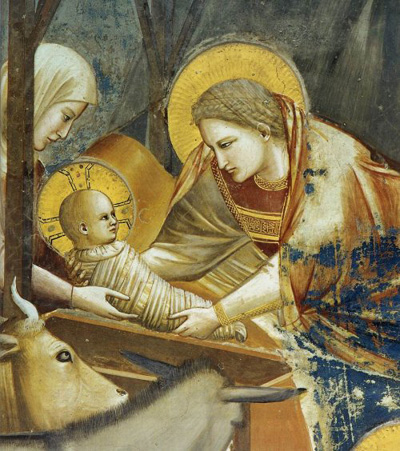
nativity Giotto detail.jpgImmensity cloistered in thy dear womb, Now leaves His well-belov’d imprisonment, There He hath made Himself to His intent Weak enough, now into the world to come; But O, for thee, for Him, hath the inn no room? Yet lay Him in this stall, and from the Orient, Stars and wise men will travel to prevent; The effect of Herod’s jealous general doom.

Seest thou, my soul, with thy faith’s eyes, how He which fills all place, yet none holds Him, doth lie? Was not His pity towards thee wondrous high, That would have need to be pitied by thee?


Kiss Him, and with Him into Egypt go, With His kind mother, who partakes thy woe.


John Donne (1572- 1631)


Magnum nomen Domini Emmanuel


Birth of Christ.jpg


Evangelizo vobis gaudium magnum: natus est vobis hodie Salvator, Christus Dominus.


I proclaim to you good news of great joy: today a Savior is born for us, Christ the Lord.


God, who gladden us by the yearly expectation of our redemption, grant that we may merit to see Your Only Begotten, our Lord, Christ Jesus, whom we in joy are now receiving as the Redeemer also see in safety when He is coming as the Judge.


Hodie Christus natus est. Hodie Salvator apparuit. Hodie in terra canunt Angeli, lætantur Archangeli. Hodie exsultant iusti dicentes: Gloria in excelsis Deo! Alleluia.


Today the Savior has appeared: today the Angels sing, the Archangels rejoice: today the just rejoice, saying: Glory to God in the highest, and on earth peace and good will towards men: Alleluia.


Nativity of Mary Pietro Cavallini.jpgT
oday, the twenty-fifth day of December

Unknown ages from the time when God created the heavens and the earth; And then formed man and woman in his own image.

Several thousand years after the flood; When God made the rainbow shine forth as a sign of the covenant.

Twenty-one centuries from the time of Abraham and Sarah;

Thirteen centuries after Moses led the people of Israel out of Egypt.

Eleven hundred years from the time of Ruth and the Judges;

One thousand years from the anointing of David as king;

In the sixty-fifth week according to the prophecy of Daniel.

In the one hundred and ninety-fourth Olympiad; The seven hundred and fifty-second year from the foundation of the city of Rome.

The forty-second year of the reign of Octavian Augustus; The whole world being at peace,

Jesus Christ, eternal God and Son of the eternal Father,
Desiring to sanctify the world by his most merciful coming,
Being conceived by the Holy Spirit,
And nine months having passed since his conception,
Was born in Bethlehem of Judea of the Virgin Mary.

Today is the nativity of our Lord Jesus Christ according to the flesh.

Amen.


Fr. Julián Carrón speaks of Christmas & Hope


Jeremiah Duccio.jpgI was struck by the readings that the Ambrosian Liturgy proposes for Monday of the third week of Advent. How must the members of the ancient people of Israel been disconcerted at the words of the prophet Jeremiah: “It will devour your harvests and your bread; it will devour your sons and daughters; it will devour your flocks and herds; it will devour the fortified cities in which you placed your trust” (Jer 5:17). He was telling them that another nation was going to conquer the kingdom in which they had put their trust. “Then, if they say: ‘Why has the Lord our God done these things?’, you will answer: ‘Just as you have abandoned the Lord and served foreign gods in your country, so will you serve foreigners in a country that is not yours'” (Jer 5:19).

It is as if this were said for us; today we see signs that make everyone afraid, it seems that what has supported our history is unable to withstand the test of our times: one day the economy, finance and work, the next day politics and the judiciary, then the family, the beginning of life and its natural end. So, like ancient Israel before a frightening situation, we, too, ask ourselves: “Why is all this happening?” It is because we, too, have been so presumptuous as to think that we can still get along after cutting the roots that supported the foundations of our civilization. In recent centuries, our culture has believed it could build a future for itself while abandoning God. Now we see where this presumption is leading us.


Now, what does the Lord do in the face of all we have brought upon ourselves? The prophet Zechariah tells us, speaking to his people Israel: “Look, I am going to send you my servant Branch” (Zc 3:8). Notice the name. It is as if before the crisis of a world, our world – the prophets would describe it with an image dear to them, that of a dried-up trunk – a sign of hope were springing up. The enormity of a dried up trunk cannot prevent the sprouting of a humble, fragile branch in which lies the hope for the future.


St Benedict3.jpgBut there is one drawback: we, too, when we see this branch appearing -like those before that child in Nazareth–can be scandalized and say: “How can something so ephemeral be the answer to our need for liberation?” Can salvation come from something so small as faith in Jesus? It seems impossible that all our hope can rest on belonging to this frail sign. The promise that only from this can everything be rebuilt seems scandalous. Yet men like St. Benedict and St. Francis started from that. They began to live while belonging to that branch that had grown through time and space–the Church, and in this way became protagonists of a people and of history.

Benedict did not face the end of the Roman Empire with anger, pointing the finger at the immorality of his contemporaries, but rather witnessed to the people of his time a fullness of life, a satisfaction and a fullness that became an attraction for many. This became the dawn of a new world, small as it was (almost a nonentity compared with the whole, a whole that was in total collapse), but a real world. That new beginning was so concrete that the work of Benedict and Francis has lasted through the centuries, has transformed Europe, and humanized it.

“He has revealed himself. He personally,” said Benedict XVI, speaking of the God-with-us. Fr. Giussani told us, “That man of two thousand years ago is hidden under the tent, under the appearance of a new humanity,” in a real sign that arouses the inkling of that life that we are all waiting for so as not to succumb to the evil in us and to the signs of the nothingness which is advancing. This is the hope that Christmas announces to us, and that makes us cry out: “Come, Lord Jesus!”

Julian Carron3.jpg(Father) Julián Carrón

President of the Fraternity of Communion & Liberation


Letter to the editor of the Italian daily La Repubblica,
published December 23, 2008