As you heard in the Epiphany Proclamation Lent begins with Ash Wednesday on February 25th. The Holy Father, with the following letter, is giving us a plan on how to fruitfully observe Lent.
 At the beginning of Lent, which constitutes an itinerary of more intense spiritual training, the Liturgy sets before us again three penitential practices that are very dear to the biblical and Christian tradition – prayer, almsgiving, fasting – to prepare us to better celebrate Easter and thus experience God’s power that, as we shall hear in the Paschal Vigil, “dispels all evil, washes guilt away, restores lost innocence, brings mourners joy, casts out hatred, brings us peace and humbles earthly pride” (Paschal Præconium). For this year’s Lenten Message, I wish to focus my reflections especially on the value and meaning of fasting. Indeed, Lent recalls the forty days of our Lord’s fasting in the desert, which He undertook before entering into His public ministry. We read in the Gospel: “Jesus was led up by the Spirit into the wilderness to be tempted by the devil. He fasted for forty days and forty nights, and afterwards he was hungry” (Mt 4,1-2). Like Moses, who fasted before receiving the tablets of the Law (cf. Ex 34,28) and Elijah’s fast before meeting the Lord on Mount Horeb (cf. 1 Kings 19,8), Jesus, too, through prayer and fasting, prepared Himself for the mission that lay before Him, marked at the start by a serious battle with the tempter.
We might wonder what value and meaning there is for us Christians in depriving ourselves of something that in itself is good and useful for our bodily sustenance. The Sacred Scriptures and the entire Christian tradition teach that fasting is a great help to avoid sin and all that leads to it. For this reason, the history of salvation is replete with occasions that invite fasting. In the very first pages of Sacred Scripture, the Lord commands man to abstain from partaking of the prohibited fruit: “You may freely eat of every tree of the garden; but of the tree of the knowledge of good and evil you shall not eat, for in the day that you eat of it you shall die” (Gn 2, 16-17). Commenting on the divine injunction, Saint Basil observes that “fasting was ordained in Paradise,” and “the first commandment in this sense was delivered to Adam.” He thus concludes: ” ‘You shall not eat’ is a law of fasting and abstinence” (cf. Sermo de jejunio: PG 31, 163, 98). Since all of us are weighed down by sin and its consequences, fasting is proposed to us as an instrument to restore friendship with God. Such was the case with Ezra, who, in preparation for the journey from exile back to the Promised Land, calls upon the assembled people to fast so that “we might humble ourselves before our God” (8,21). The Almighty heard their prayer and assured them of His favor and protection. In the same way, the people of Nineveh, responding to Jonah’s call to repentance, proclaimed a fast, as a sign of their sincerity, saying: “Who knows, God may yet repent and turn from his fierce anger, so that we perish not?” (3,9). In this instance, too, God saw their works and spared them.
In the New Testament, Jesus brings to light the profound motive for fasting, condemning the attitude of the Pharisees, who scrupulously observed the prescriptions of the law, but whose hearts were far from God. True fasting, as the divine Master repeats elsewhere, is rather to do the will of the Heavenly Father, who “sees in secret, and will reward you” (Mt 6,18). He Himself sets the example, answering Satan, at the end of the forty days spent in the desert that “man shall not live by bread alone, but by every word that proceeds from the mouth of God” (Mt 4,4). The true fast is thus directed to eating the “true food,” which is to do the Father’s will (cf. Jn 4,34). If, therefore, Adam disobeyed the Lord’s command “of the tree of the knowledge of good and evil you shall not eat,” the believer, through fasting, intends to submit himself humbly to God, trusting in His goodness and mercy.
The practice of fasting is very present in the first Christian community (cf. Acts 13,3; 14,22; 27,21; 2 Cor 6,5). The Church Fathers, too, speak of the force of fasting to bridle sin, especially the lusts of the “old Adam,” and open in the heart of the believer a path to God. Moreover, fasting is a practice that is encountered frequently and recommended by the saints of every age. Saint Peter Chrysologus writes: “Fasting is the soul of prayer, mercy is the lifeblood of fasting. So if you pray, fast; if you fast, show mercy; if you want your petition to be heard, hear the petition of others. If you do not close your ear to others, you open God’s ear to yourself” (Sermo 43: PL 52, 320. 322).
In our own day, fasting seems to have lost something of its spiritual meaning, and has taken on, in a culture characterized by the search for material well-being, a therapeutic value for the care of one’s body. Fasting certainly bring benefits to physical well-being, but for believers, it is, in the first place, a “therapy” to heal all that prevents them from conformity to the will of God. In the Apostolic Constitution Pænitemini of 1966, the Servant of God Paul VI saw the need to present fasting within the call of every Christian to “no longer live for himself, but for Him who loves him and gave himself for him … he will also have to live for his brethren” (cf. Ch. I). Lent could be a propitious time to present again the norms contained in the Apostolic Constitution, so that the authentic and perennial significance of this long held practice may be rediscovered, and thus assist us to mortify our egoism and open our heart to love of God and neighbor, the first and greatest Commandment of the new Law and compendium of the entire Gospel (cf. Mt 22, 34-40).
The faithful practice of fasting contributes, moreover, to conferring unity to the whole person, body and soul, helping to avoid sin and grow in intimacy with the Lord. Saint Augustine, who knew all too well his own negative impulses, defining them as “twisted and tangled knottiness” (Confessions, II, 10.18), writes: “I will certainly impose privation, but it is so that he will forgive me, to be pleasing in his eyes, that I may enjoy his delightfulness” (Sermo 400, 3, 3: PL 40, 708). Denying material food, which nourishes our body, nurtures an interior disposition to listen to Christ and be fed by His saving word. Through fasting and praying, we allow Him to come and satisfy the deepest hunger that we experience in the depths of our being: the hunger and thirst for God.
At the same time, fasting is an aid to open our eyes to the situation in which so many of our brothers and sisters live. In his First Letter, Saint John admonishes: “If anyone has the world’s goods, and sees his brother in need, yet shuts up his bowels of compassion from him – how does the love of God abide in him?” (3,17). Voluntary fasting enables us to grow in the spirit of the Good Samaritan, who bends low and goes to the help of his suffering brother (cf. Encyclical Deus caritas est, 15). By freely embracing an act of self-denial for the sake of another, we make a statement that our brother or sister in need is not a stranger. It is precisely to keep alive this welcoming and attentive attitude towards our brothers and sisters that I encourage the parishes and every other community to intensify in Lent the custom of private and communal fasts, joined to the reading of the Word of God, prayer and almsgiving. From the beginning, this has been the hallmark of the Christian community, in which special collections were taken up (cf. 2 Cor 8-9; Rm 15, 25-27), the faithful being invited to give to the poor what had been set aside from their fast (Didascalia Ap., V, 20,18). This practice needs to be rediscovered and encouraged again in our day, especially during the liturgical season of Lent.
From what I have said thus far, it seems abundantly clear that fasting represents an important ascetical practice, a spiritual arm to do battle against every possible disordered attachment to ourselves. Freely chosen detachment from the pleasure of food and other material goods helps the disciple of Christ to control the appetites of nature, weakened by original sin, whose negative effects impact the entire human person. Quite opportunely, an ancient hymn of the Lenten liturgy exhorts: “Utamur ergo parcius, / verbis cibis et potibus, / somno, iocis et arctius / perstemus in custodia – Let us use sparingly words, food and drink, sleep and amusements. May we be more alert in the custody of our senses.”
Dear brothers and sisters, it is good to see how the ultimate goal of fasting is to help each one of us, as the Servant of God Pope John Paul II wrote, to make the complete gift of self to God (cf. Encyclical Veritatis splendor, 21). May every family and Christian community use well this time of Lent, therefore, in order to cast aside all that distracts the spirit and grow in whatever nourishes the soul, moving it to love of God and neighbor. I am thinking especially of a greater commitment to prayer, lectio divina, recourse to the Sacrament of Reconciliation and active participation in the Eucharist, especially the Holy Sunday Mass. With this interior disposition, let us enter the penitential spirit of Lent. May the Blessed Virgin Mary, Causa nostrae laetitiae, accompany and support us in the effort to free our heart from slavery to sin, making it evermore a “living tabernacle of God.”
With these wishes, while assuring every believer and ecclesial community of my prayer for a
 fruitful Lenten journey, I cordially impart to all of you my Apostolic Blessing.
From the Vatican, 11 December 2008.
BENEDICTUS PP. XVI
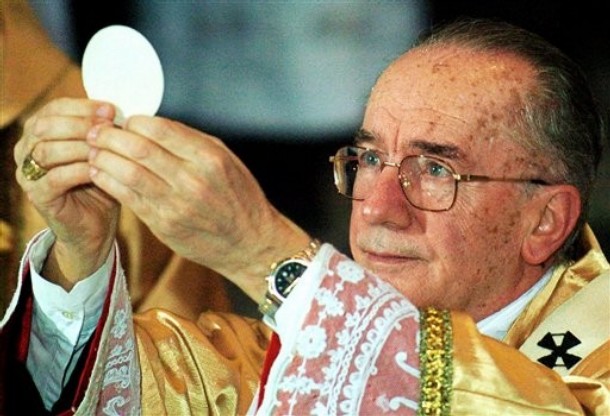 concern for priests, Claudio Cardinal Hummes wrote in 2007 to the world’s bishops asking for help in establishing in their dioceses places of eucharistic adoration and the development of a spiritual work that looks to women to assist in flourishing of holiness in the priesthood. That letter bears greater attention and so I have linked it here.