God our Father, you chose Saint Josemaría to proclaim the universal call sanctity and apostolate in the Church. By his example and prayers grant that in faithfully carrying out our daily work in the Spirit of Christ, we may be formed in the likeness of your Son, and together with the most Blessed Virgin Mary, serve the work of redemption with an ardent love.
Ark of the Covenant to revealed
The
head of the Ethiopian Orthodox Church, Abuna Pauolos, is set to unveil the Ark
of the Covenant. The Ark of the Covenant has been in the guardianship of the
Ethiopian Orthodox Church in a chapel in the Church of Our Lady, Mary of Zion.
But with many religious icons and relics the Ark has been claimed by a number of
people over the years, some credible and many not so believable. There is no reason I know of to doubt the authenticity of the Ark that’s with the Patriarch.
We don’t hear
much of the Ark of Covenant today except for intro Scripture classes; however,
it should be noted that the Ark is a unit of learning in the Catechesis of the
Good Shepherd (a catechetical program for little people developed around a
Montessori method). The relevance of the Ark, you will remember, is that it was
God’s command that the Ark be built to contain the tablets of the Decalogue
(the 10 Commandment), Aaron’s rod and manna. On the theological level the Ark
is emblematic of the Covenant God had with His people (Israel). Today, a
theology of Covenant continues but not in tablets or an Ark but in a
Person–Jesus Christ. Catholics honor and follow the 10 Commandments; we honor the
Ark but we worship neither. We adore, worship, and give glory to a God who
became a flesh and blood person, a man in all things like you and me except
sin; the Son of God who opened the doors of salvation for us. Catholics
believe, therefore, our salvation is not in the Commandments but from Christ
who lived, died, and resurrected. As I mentioned the Commandments are followed
and we revere the Ark so long as we recognize that they point to their fulfillment in Jesus. So learn about the Ark and pass this theology onto your
friends and family.
Year of the Priest internet links
The Year of the Priest, Annus Sacerdotalis –Congregation for the Clergy
Caritas in Veritate (Love in Truth): the Pope’s next encyclical
It’s expected that on June 29th the Pope will
publish his latest encyclical, Caritas in Veritate (Love in Truth).
Last week he said: “As you know, my encyclical on the
vast theme of economics and labor will soon be published. It will highlight
what, for us Christians, are the objectives to be pursued and the values to be
promoted and tirelessly defended, with the purpose of realising a truly free
and human coexistence in solidarity.”
Pope Benedict’s two previous encyclicals are Deus Caritas
Est (God is Love, 2005) and Spe Salvi (Saved by Hope, 2007).
It’s time to get excited because the Pope’s words are always germane.
St Dominic’s Monastery: 1st anniv in Linden, VA
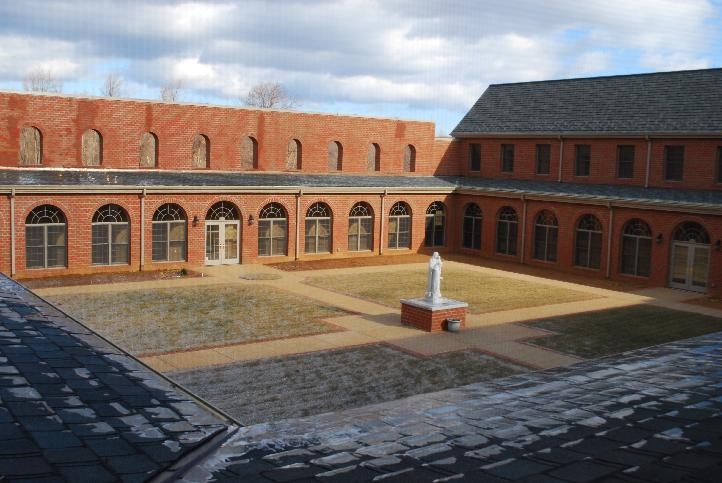
Today, June 24, is the first anniversary of the dedication of Saint Dominic’s
Monastery new monastery in Linden, Virginia.
What an amazing year!
This summer four young women will enter the Monastery as postulants. As
envisioned, the Monastery is acting as a magnet attracting young women to
devote their lives to God. The life follows the traditional form of Second Order Dominican nuns with the night Office, the grill, silence, sacrifice and prayer. The nuns rarely leave the cloister and are completely focussed on Christ.
I would like to encourage everyone to send Sister Mary Paul (the
prioress) and the nuns at Saint Dominic’s Monastery an anniversary card and, if
possible, to include an anniversary gift – a check to support the formation of
their new members.
Cards can be mailed to:
Sister Mary Paul, O.P.
Saint Dominic’s Monastery
2636 Monastery Road
Linden, VA 22642
My friends Fathers Gabriel and Jordan as well as the laywoman Julie tell me the life of the monastery is going extremely well and the need for assistance is also great. So, I think the life of these Dominican nuns is VERY worth a sacrificial gift. Don’t you?
Nativity of Saint John the Baptist
Elizabeth the wife of Zachary gave birth to a great man, John the Baptist,
the Precursor of the Lord.
God, Who has made this day honorable to us by the birth of blessed John, pour
forth upon Thy people the grace of spiritual joys, and direct the souls of all
Thy faithful into the way of eternal salvation.
Father Henry Tim Vakoc, US Army Major, RIP
The Lord called Father H. Tim Vakoc, US Army Major, to himself on June 20th.
Remembered in Rome by Archbishop Dolan
Archbishop Timothy Dolan is serious: he’s praying for ALL the people of the Archdiocese of New York (and others) when he’s in the Eternal City next week to receive the pallium from the Pope. He’s the link between us and our Roman sainted forefathers and mothers; likewise, he’s the link between the archdiocese and the Holy Father. Spiritual closeness is a cool thing in the Catholic Church.
FuturePriests.com: Praying & Tweeting for priestly vocations
A fascinating initiative was launched the other day for the Year of the Priest on Twitter by Utrecht’s Archbishop Willem Jacobus Eijk. Follow the Archbishop at FuturePriests.com.
Eucharistic identity: Christ present
As a sacrament, the Eucharist has a double aspect: it is
both a sign and the reality signified by it, both a remembering of the past and
a making-really-present: “When the Church celebrates the Eucharist, she
commemorates Christ’s Passover, and it is made present: the sacrifice Christ offered once for all on the Cross remains ever present” (Catechism
of the Catholic Church,1364).
Here the three meanings of “present” come together: Christ
in the Eucharist is 1) present, not absent, but really here; 2) present, not
past, but happening now; and 3) presented as a gift (a “present”), really
given; offered, not withheld. Christ is “present in many ways to his
Church” (CCC, 1373) but “[t]he mode of Christ’s presence under the Eucharistic species [forms, appearances] is unique. It raises the Eucharist above all the sacraments as ‘the perfection of the spiritual life and the end to which all the sacraments tend’ [St. Thomas Aquinas]. In the most blessed sacrament of the Eucharist ‘the body and blood, together with the soul and divinity, of our Lord Jesus Christ and, therefore, the whole Christ is truly, really, and substantially contained.’ ‘…[I]t is presence in the fullest sense…Christ, God and man, makes himself wholly and entirely present'” (CCC 1374). (from Peter J. Kreeft, Catholic Christianity, 2001)