Carl Anderson addressed the Rimini Meeting ’09

The Rimini
Meeting
, mentioned here before, invited Carl Anderson, the
Supreme Knight of the Knights of Columbus to address the more than 700,000
attendees on August 28, 2009. In his address he spoke about the common,
practical spirituality of the Knights as influencing works of Charity. Knowing
that “Christ plays in ten thousand places, Lovely in limbs, and lovely in
eyes not his”, Anderson advocated a life of charity that spurs all people –at least it ought to– to build a civilization of love based on real, lasting hope.
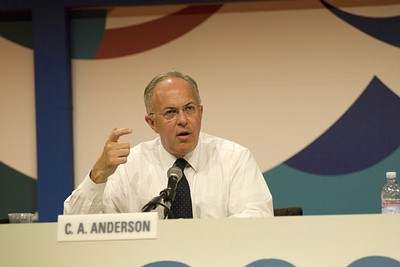
CAnderson RM 09.jpg

The point for
Catholics is not to set up another group of “do-gooder” structure no
matter of the brilliance of the idea which has no grounding in the dignity of
man and woman and/or with some vague understanding of Christianity, but to form
a companionship, friends who are rooted in Christ Jesus. Only then can we
truly, actually care for another. Many can argue rightly that people who have
no faith or don’t share faith in Christ can build a loving and caring society.
True and there are bountiful examples of this being done all around the world.
But for those who claim to be Christians, substance over sentiment is what
drives. I don’t do something and meet Christ. Rather, I have met Christ and
therefore I live differently with myself and with my brothers and sisters
around me. Otherwise we have beige Catholicism and we don’t need more of that
stuff.

In my opinion, Carl Anderson touches on this point: our Christian lives
are not sustained by a something but a someone: Christ who sacrificed himself
for us on the cross and then rose from the dead. This is the hope Christians
have. If we forget this point then we Catholics are no different than the Elks
lodge and that may be OK for some but I think being Catholic means something
more: that we come to know our God is a personal way through helping others.
Ask yourself: How am I different after I’ve done something for my neighbor? Has
my life in Christ changed, or not? Mr. Anderson draws on sacred Scripture &
Theology as well as the works of Popes John Paul II and Benedict XVI. Particularly
re-read Deus caritas
est
.

Carl Anderson’s talk can be read here

Dolan’s 4 step recipe for priestly vocations

Speaking to the Serra Club dinner, renown for fostering vocations to
the priesthood, diocesan and religious orders, Archbishop Timothy Dolan
outlined 4 priorities:

Dolan & Estban 09.jpg

1.
Emphasize the vocation of marriage and family:”Taking care of the first crisis
will take care of the second,” said Archbishop Dolan. “Vocations to the
priesthood and religious life come from lifelong, life-giving faithful
marriages.”

2. Re-create a culture
of vocations: “There were no good old days in the Church. Every era in Church
history has its horrors and difficulties. We need to recapture the
climate/tenor/tone/ambiance in the Church where a boy or man isn’t afraid to
publicly say, ‘I want to be a priest,’ and where his family, relatives,
neighbors, parish, priest, sisters, teachers and even non-Catholics are
robustly supportive.”

3. The laity need to not be afraid to ask their priests
to help them be holy: “For a faithful Catholic, a priest is essential for
growth in holiness because he gives us the sacraments, and without the
sacraments we can’t be holy. When you ask us to help you be holy, we realize
that we must be holy, and you remind us that there is something unique in the
Church that only a priest can do.”

4. Priests must be reminded that they are here to help the laity
get to heaven: “A priest is an icon of the beyond, the eternal, the transcendent.
Heaven gives us hope and meaning in life.”

Pope Benedict XVI’s prayer intentions, September 2009

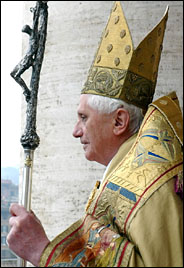
Urbi & Orbi 2005.jpgThe general intention

That the Word of God may be better known, accepted,
and lived as the source of freedom and joy.


The missionary intention
That by trusting the Holy Spirit,
Christians in Laos, Cambodia, and Myanmar may, amid great difficulties,
courageously proclaim the Gospel to their brothers and sisters.


NB: I am particularly grateful for the unexpected prayer intention for peoples in southeast asia–the Pope must’ve been reading my mind; we have 4 men from Myanmar studying here at the seminary: 2 priests & seminarians. I encourage you to lift up your voice to God with me for these Christians in Laos, Cambodia and Myanmar.

New Haven natives preparing for priesthood

Baptist 041.jpgOver the years New Haven area Catholics have nurtured the vocations of many men to the priesthood or religious life. In the coming days I am hoping to write more about those who have said “yes” to the Lord in His call to religious life and priesthood. But for the moment let me note here those from the New Haven area that are studying for a religious order or a diocese:

Ken Dagliere, Archdiocese of Hartford, Holy Apostles Seminary, Cromwell, CT
James Onofrio, Archdiocese of Hartford, Neumann House, St Joseph Seminary, Yonkers, NY
Gabriel Scasino, Conventual Franciscans, Forestville, MD
Paul Zalonski, Diocese of Bridgeport, St Joseph Seminary, Yonkers, NY
In the last few years Capuchin Father Charles Sammons and Fathers John Lavorgna and David Manna (priests for the Archdiocese of Hartford) were ordained priests and all from the greater New Haven area.
If there are others let me know.

Blessed Jeanne Jugan

Today is the liturgical memorial of Blessed Jeanne Jugan (Sister Mary of the Cross), a relatively unknown sister here in the USA unless you you’ve met them begging for money to sustain their life and work. She is soon to be canonized by Pope Benedict XVI on October 11th.

Blessed Jeanne Jugan.jpg

The congregation of sisters founded by Blessed Jeanne, The Little Sisters of the Poor, are an exceptional group of women who dedicated themselves to doing small things for the poor for the sake of the Gospel: be humble, i.e., be little in order to be close to the humble and making the poor happy is everything. It was the spirituality of Saint John the Baptist: I must decrease and He must increase. Jugan was very much influenced by Saint John Eudes because in him she saw a path that corresponded to her heart: we must be other Christs on earth and to go to Jesus through Mary. Jugan called together women to serve poor elderly women, a work of charity that Jeanne had done for her own conversion since she was a young woman. Not only did Jeanne address the physical needs of the women she served, but she also attended to the spiritual ones too. The Little Sisters take a 4th vow of being hospitable: showing mercy to our poor brothers and sisters.
Here in Connecticut the Little Sisters of the Poor are located in Enfield but there was a time that they had a house in New Haven. Sadly, the New Haven community closed when the health care politics got to be too much for the sisters to handle.
When I am visiting the local Catholic cemetery I make it a point to visit the graves of the Little Sisters who died in New Haven. For me it is a way being grateful for the work and witness of the sisters in New Haven.
Watch the video clip of a recent first vows profession ceremony…
Among the recent books about Blessed Jeanne are:

Saints Margaret Clitherow, Anne Line and Margaret Ward

We beseech Thee, O Lord our God, grant us to revere with unceasing devotion the glorious victories of Thy holy Martyrs Saints Margaret Clitherow, Anne Line and Margaret Ward; may we at least honor with our lowly homage those whose praises we cannot sing worthily.

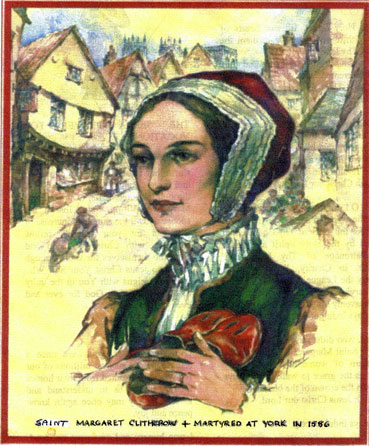
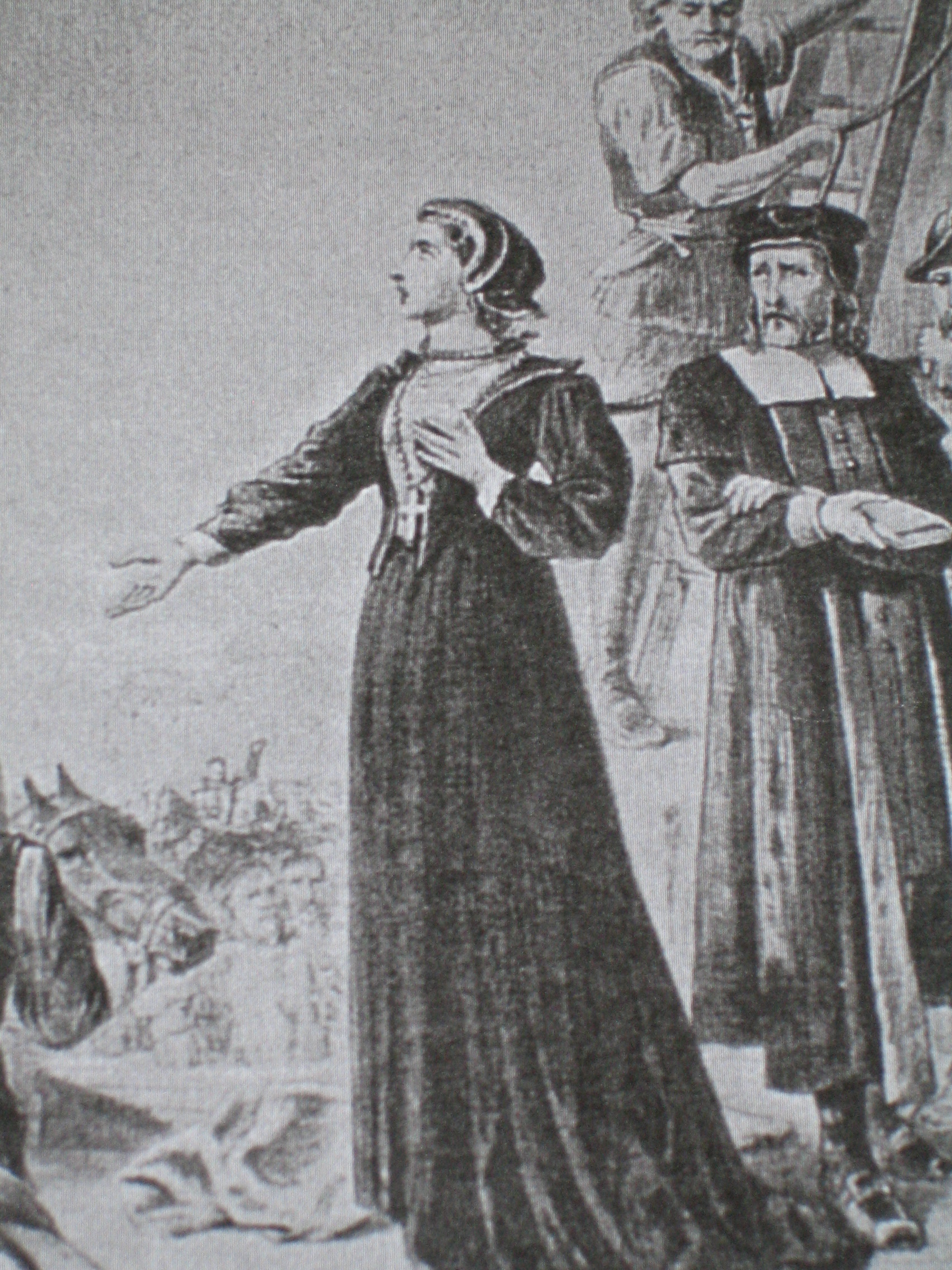
St Margaret Clitherow.jpgSaint Margaret Middleton was born in York in 1556, lived there all her life, and died there on 25 March 1586. At 15, she married a butcher, John Clitherow, and three years later became a Catholic. Imprisoned for her
non-attendance at church, she taught herself to read and later ran a small school for her own and her neighbours’ children. Her husband remained Protestant, but allowed her to hide priests in their house. In 1586, the secret hiding places were discovered, and Margaret was put on trial. She refused to plead, for which the punishment was being crushed to death.

St Ann Line.jpeg

Saint Anne Height was born at Dunmow (Essex) around 1565, and was hanged at Tyburn on 27 February 1601. In her teens, she became a Catholic and was disinherited, and in 1585 married Roger Line, also a disinherited convert, who was subsequently imprisoned then exiled for his faith, leaving her destitute. She taught and embroidered, and also kept house for priests. After a large number of people had been seen gathering at her house for Mass, she was arrested, tried and condemned to death. 

St Margaret Ward.jpgSaint Margaret Ward was born at Congleton (Cheshire), but entered into the service of a family in London. She was arrested after assisting a priest escape from prison, but refused under severe torture to reveal his hiding place or to renounce her faith. She was tried at the Old Bailey, and executed on this day in 1588. All three are remembered for their resourcefulness, for their loyalty, for their outstanding courage, and for the service they rendered the Church during dangerous times in aiding the ministry of priests. (Liturgy Office, Bishops of England and Wales) 

For more on these 3 English Martyrs see this entry.

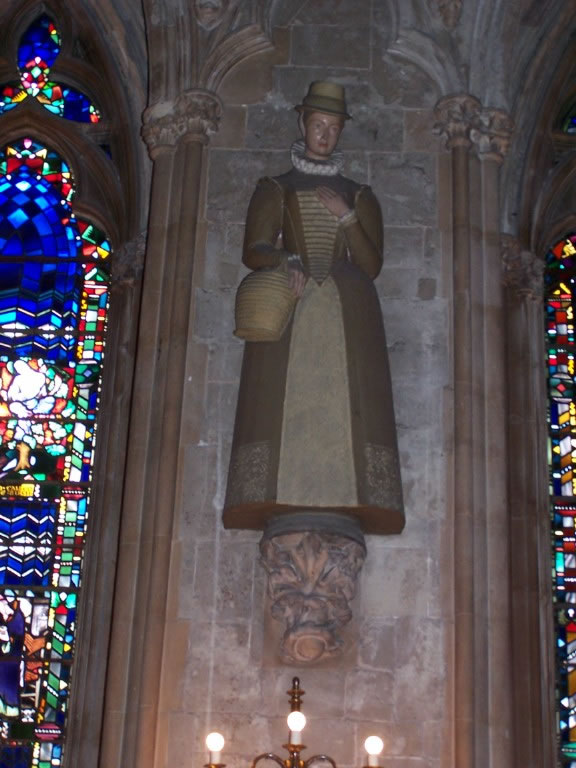
In the Diocese of Bridgeport, those who prepare for the major seminary at Saint John Fisher Seminary, Stamford, call to mind the martyrdom of these women saints daily as their statues surround the altar.

May Saints Margaret, Anne and Margaret, pray for us!!!

Beheading of Saint John the Baptist

Martyrdom St John Baptist ASpinello.jpgBlessed is the man who endures temptation: for when he has been tried, he will receive the crown of life which God has promised to those who love Him.

We beseech Thee, O Lord, may the holy festival of Saint John the Baptist, Thy Precursor and Martyr, obtain for us help unto salvation.

Avery Dulles’ NEW book due: Evangelization for the Third Millennium

Evangelization for the 3rd Millennium.jpgCardinal Avery Dulles is still producing intellectual stimulation. Due to be released next week is Evangelization for the Third Millennium (Paulist Press), the final work that he had already in progress during what became the Cardinal’s final months.

In her Preface to this anthology, Cardinal Dulles’ longtime colleague, administrative & research assistant and former student, Sister Ann-Marie Kirmse, says that Dulles’ work explores the theme of evangelization based on the seminal work of Pope Paul VI and later on the work Pope John Paul II on the same topic.
Avery Cardinal Dulles, SJ, died on December 12, 2008. 

Covenant with the Jewish people to be clarified in Adult Catechism

A recognitio from the Holy See following a vote from the US Bishops, was received allowing for a clarification that all the covenants God made with the Jewish people are fulfilled in Jesus Christ.

Don’t think this is change is revisionist theology or fancy foot work on the part of the Holy See or the US Bishops. Rather, it is standard theology and it is what the Church has consistently taught for a very, very long time. The editors of the Adult Catechism slipped up by being a bit imprecise in their work, shall we say. Of course, the statement announcing the clarification notes that the Adult Catechism is a catechetical work and not a theological text. True enough, we know…but this rationalization is a bit much. Does that mean we have to check each and every fact in the second printing of the AC, too? The Bishops’ Conference statement is here.