To live without reservation: what Francis may be pointing to

Some have called Liliana Cavani’s Francesco (1989; DVD 1998) a gritty alternative to Franco
Zeffirelli’s
Brother Sun, Sister Moon. And I agree. Zeffirelli, while a brilliant filmmaker, can ruin a
saint. And whatever may be said of Cavani’s work,
Francesco is neither a saccharine nor romantic portrayal of
the 13th century’s radical saint, Francis of Assisi. His sincerity is strikingly beautiful. This movie is based on
Herman Hesse’s book
Francis of Assisi. Cavani’s film won three awards and was nominated for a fourth. The
legendary actor/boxer/dog lover and practicing Catholic, Mickey Rourke, played
Saint Francis. And as a side bar, he credits his Catholic faith to saving his life.
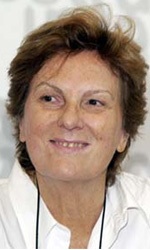
Liliana Cavani.jpg

Liliana
Cavani, born in 1933 in Capri, is the director of many television and cinematic
productions.  Her religious
tendencies are basically unknown to me but I did hear that she leans or leaned
toward a communist ideology. But I can’t help wondering what really inspired
Cavani to direct a film on such a figure as Francis of Assisi. Certainly it
can’t be the wacky-ness that often surrounds the figure of Francis!

Francesco is an interpretation of the person of the 13th century Umbrian saint, Francis of Assisi. He died in 1226 and founded what is
today called the Franciscans 800 years ago. What the Franciscans looked like in
the 13th century isn’t what they are today. The movie is a series of
flashbacks with various friends telling the story of the man who led them to
Christ. Cavani brings out several central questions that all of us have to
answer viz. our Christian faith: To whom do I belong? Do I belong to these
people, or do I belong to Christ? How do I know and why?

The period in which
the real Francis lived was a chaotic time in secular as well as ecclesial
history. His world was faced with civil strife, wars, disease, extreme poverty
in many sectors, illiteracy not to mention heretical movements tearing the
fabric of faith to pieces. And, let’s also not underestimate the wounds of the
Church faced as a result of heresy: lack of true community, negligence of the
human body, despair, lack of reasonable understanding of the faith and Truth
and no reasonable response to the human reality. Hence, the notion of Francis
rebuilding the Lord’s Church took on significant importance for many people.

Why
Francesco? It has little to do
with the fact that his October 4th feast day is next Sunday. But it
has everything to do with the fact that in our School of Community (Communion
& Liberation’s weekly catechetic meeting) we are reading Father Giussani’
chapter on poverty in volume 2 of Is It Possible to Live This Way?  There we are confronting the real, and
truly theological reality, of possessing without possession. Giussani is
raising the concern of restraining the possibility of grace in our lives but
how we live our lives. So many of us can’t face life in the manner in which it
is given. We create escape mechanisms to mask the real life issues: pain, love,
sorrow, faith, hurt, joy, lack of happiness, etc. Francis gave his whole life
away to another person. He confused his parents and siblings; his friends and
civil authorities were shocked. All could not understand Francis turning on end
what was conventually known as “normal.” He found something wonderful among the
poor that became a contradistinction to the bourgeois normativity of Umbrian
society. Renouncing self and possessions and following Christ crucified became
his “normal.” As Saint Clare says in the movie, God spoke to him again and His
love made Francis’ body identical to the Beloved’s.
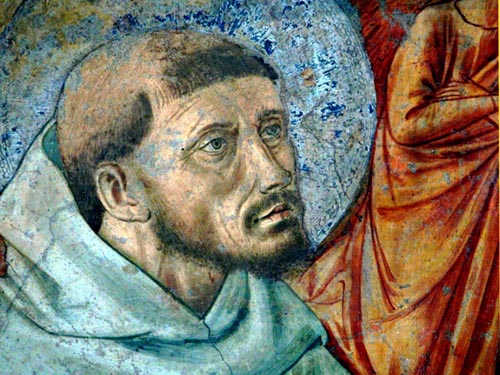
St Francis detail.jpg

Cavani deals with poverty
in a gritty manner–it is terrifically human. And she never moralizes poverty or
religious conviction. Even when the pope asks Francis “and what are you
criticizing me for” and Francis says “nothing” we can’t believe our ears. Two
men come back to Francis’ family and friends looking to explain what they
experienced and thinking that the men would point out the ugliness of poverty
and extreme raw life of Francis, they said, “there’s something beautiful
there.” You then realize that
Francis isn’t following “poverty”; he’s following someone; he’s closely
adhering to beauty. But it is not ordinary beauty–it is the beauty of believing that he promises of Christ are true.

Why Francis? Because he points to Christ. His faith,
courage and thinking he could live like Christ is what Giussani wants to
suggest is the reason for our life. Giussani asks, quid animo satis? (what can
satisfy the soul?) It has to be the Gospel at it’s word or all is rubbish. Francis, by the way, is the only person the Church calls an
alter
Christus
among the saints.

Saint Vincent de Paul

St Vincent de Paul3.jpg

Well done, good and faithful servant; because you have been faithful over a few things, I will place you over many things, enter into the joy of the Lord.
O God, Who did endow blessed Vincent with apostolic power for preaching the Gospel to the poor and for promoting the honor of the priesthood; we beseech You, grant that we who venerate his holy life may be inspired by the example of his virtues.

Vincent was always a favorite saint of mine. His sons, the Vincentian fathers, operated the parish and grammar school (with the CSFN sisters) where I went. His life, his radical conversion to God, his work among the poor and his work in the formation of men for priesthood sets the bar for my own life. The collect that the Church sets on our lips (see above) is a good reminder of how we ought to live our own lives. May his witness continue for years to come. Read about the Vincentians here.

Sacred Heart University’s new chapel is a sanctuary for the pilgrim people of God

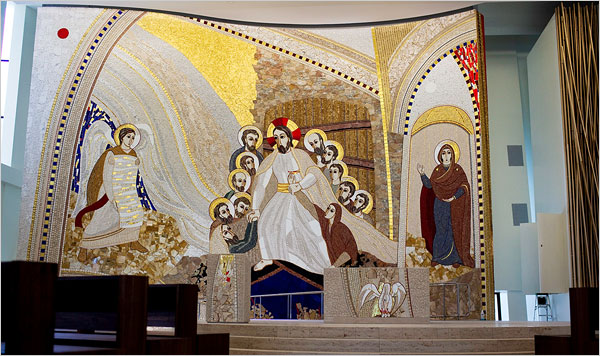
SH Chapel.jpgSacred Heart University in Fairfield, CT enters into rites dedicating the Chapel of the Holy Spirit, today. Rarely do we have the opportunity to newly construct a marvelous work of art given for God’s greater glory and His worship such as Sacred Heart’s Chapel of the Holy Spirit. Having Father Rupnik‘s commission in Connecticut gives us a special link to the work of the Church in calling us to deeper union with God. Rupnik’s mosaic work had its first world dramatic epiphany in Apostolic Palace’s Mother of the Redeemer Chapel (Vatican City State) due to Pope John Paul being struck to the beauty wrought by Rupnik and his colleagues at the Centro Aletti. Today, we are struck by the same beauty drawn more deeply into the mystery, into radical holiness by another dramatic manifestation of the mosaics.

I previously mentioned Rupnik’s work in the USA.

The NY Times features the liturgical art of the chapel.
On the new chapel organ for the chapel.
The progression of building the chapel
I have to note that Sacred Heart’s mosaics are not the first for the artist in the USA: Father Rupnik’s first work was installed in the Holy Family Chapel at the central office of the Knights of Columbus, New Haven, CT. And like today’s ceremonies of dedication, the mosaics in New Haven were blessed for liturgical use by Bishop Lori, the same who is doing consecration today.

The response to God’s word is telling

First comes the word of God that addresses me, touches
me, calls me into question, wounds and judges me, but also heals and frees me.
Both prayer and silence can only be an answer to God’s word and may not precede
it
.


Thus Benedict requires that prayer should be frequent, but short. In it the
monastic is to respond to the word of God and express his or her readiness to
follow God’s demands with deeds. Thus we find in Benedict’s Rule no teaching on
mystical prayer, but very sober instruction to open one’s daily life to God
again and again in every situation
.


What is crucial is not our doing, but
living before God
, in God’s presence, listening to God’s word that addresses us
and shows us the way. In prayer the monastic responds that she or he has heard
God’s word and is now ready to follow it.


Benedict of Nursia His Message for
Today
Anselm Grun OSB

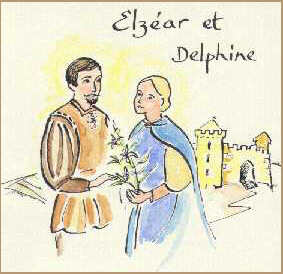
Saint Elzéar and Blessed Delphina

How beautiful in splendor is the chaste generation! Immortal is its memory because it is acknowledged both by God and by men.


St Elzear Blessed Delphine.jpg

Heavenly Father, You have given us Saint Elzéar and Blessed Delphina as shining examples of virtue in holy wedded life. As we venerate their pious achievements on earth, so may we arrive at blessed fellowship with them in heaven.

Saint Elzéar and Blessed Delphina are one of the very few married couples recognized by the Church for sainted holiness; they certainly are the only husband and wife team raised to the altar who were members of the Third Order Franciscans (today we say they are Secular Franciscans). As Third Order Franciscans, Saint Elzéar and Blessed Delphina observed a life of penance and obligation to pray the Divine Office. Their married life was characterized as resolutely chaste as they both vowed perpetual virginity, proving that marriage is more than sexual expression.

Dedicated to the Corporal and Spiritual Works of Mercy, the hagiographies indicate that each night 12 poor people dined with them. Saint Elzéar was religiously devoted and cared for the poor; known to be modest and generous; conforming himself to Christ he bore insults cheerfully. It was reported that he cured several people from leprosy. Delphina, together with her husband, cared for the poor and the sick; after Elzéar’s death she disposed of her wealth and is remembered for faithfully following Christ and thus living a moral life. One such example of living a morally upright life is her influence in converting the king of Sicily’s court to Christ.

Elzéar was canonized in 1369 by his godchild Pope Urban V (of whom he said would be the supreme pontiff) and Delphina was beatified in 1694 by Pope Innocent XII.

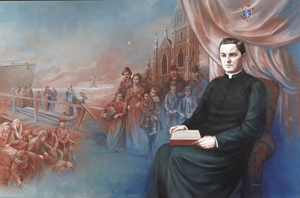
McGivney’s cause for beatification takes another step

The cause for beatification and eventual sainthood of Father Michael J. McGivney, founder of the Knights of Columbus, took
another step on September 22, 2009, with the submission of a supplemental report on
a potential miracle attributed to the priest’s intercession.

McGivney Cappuccio.jpg

The Knights of
Columbus announced today that officials from a supplemental tribunal of the
Archdiocese of Hartford -of which Fr. McGivney was a parish priest- formally
sent a new report to the Vatican’s Congregation for the Causes of Saints
through Dr. Andrea Ambrosi, the current postulator of McGivney’s cause. The
information gathered by the tribunal included testimonies from witnesses to the
supposed miracle as well as the statements of several medical doctors about the
circumstances surrounding the reported miracle. Dominican Father Gabriel B. O’Donnell,
the current vice-postulator and former postulator, has worked on the cause for a number
of years with the assistance of a variety people, not least was Millie Millea, the
former secretary at the McGivney Guild.

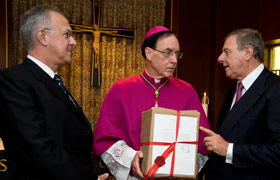
In the context praying Sext (midday
prayer), the brief ceremony in which the new report was signed and presented to
Archbishop Henry J. Mansell was attended by Supreme Knight Carl Anderson, other
Supreme Officers and other Knights of Columbus officials, three relatives of
Father McGivney and a number of archdiocesan officials.

Presentation of McGivney materials.jpg

The submission of the
new report “marks an important step forward. The Vatican’s Congregation for the
Causes of Saints will now have valuable additional testimony that clarifies and
adds significantly to the original submission,” Supreme Knight Carl Anderson
said.

“Father McGivney’s beatification would be an important event,” Anderson
added, “not only for Knights of Columbus, but for the many thousands of parish
priests who quietly do the Lord’s work in parishes each day and regard him as
an outstanding example for priests everywhere.  In this ‘Year for Priests’
it is an especially appropriate step forward.” When beatified, McGivney will be
the first US diocesan priest beatified.

The cause for Father McGivney’s
sainthood was opened by Hartford Archbishop Daniel A. Cronin in December 1997. In 2000, the cause was presented to the Congregation for the Causes of Saints;  Pope Benedict XVI declared
him “Venerable Servant of God” on March 15, 2008.

Father McGivney founded the
Knights of Columbus in 1882 and died on August 14, 1890 at the age of 38. At the time of
the founding of the Knights of Columbus he was a curate at Saint Mary’s Church
(New Haven, CT).

For pictures of the event see this link.

[this articled was first published at CNA and edited for
clarity] 

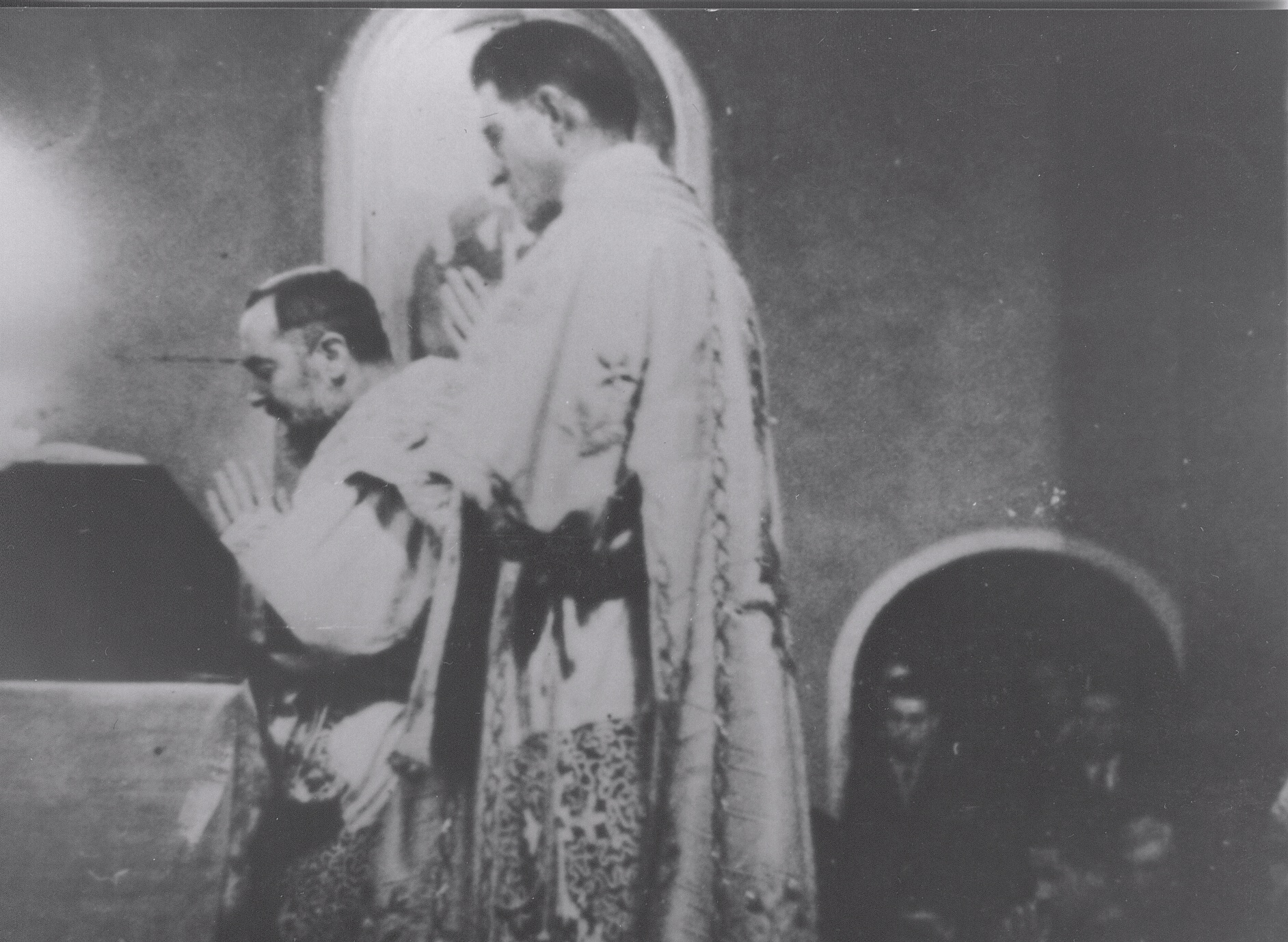
Saint Pio of Pietrelcina

St Pio at Mass.jpeg

“…the legacy he left is holiness”


God our Father, in Saint Pio of Pietrelcina You gave a light to Your faithful people. You made him a pastor of the Church to feed Your sheep with his word and to teach them by his example. Help us by his prayers to keep the faith he taught and follow the way of life he showed us.


The Vatican biography may be read here.

See more on Saint Pio here.

When thinking about Padre Pio’s influence on the spiritual life it can be noted that he advocated 3 things:

1. Pray. And don’t be overcome.

2. Conform yourself to Christ crucified.

3. Attend to the sacraments, especially the sacrament of Confession.

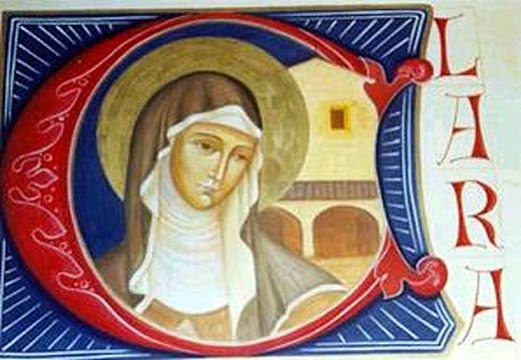
Finding the Body of Saint Clare

St Clare of Assisi.jpgThis day a brilliant star rises, for today Saint Clare, the poor handmaid of the Lord, is glorified in heaven.

Lord, we recall the memory of Saint Clare the virgin. Through her merits, and following her example, may we be strengthened in our hope and charity as we await the glorious resurrection and the enjoyment of eternal communion with you.

Let me take the opportunity to promote the Capuchin Poor Clare vocation…something good happening here.