O Wine of Virgins and Lily of Purity, Who by a touch
of Your hand heals the body and cleanses the soul; Who by dwelling in the womb
of Your Mother has made her the purest of the pure and most admirable among
virgins; We beseech You, through Your Pure Nativity and through the intercession
of Your Mother and Saint Joseph, Your Chosen One, to grant us to be pure in
soul and body and clean in act clean and thought, that we may serve You with a
clean heart and pure body all the days of our lives. Amen.
Pope says John Paul lived a life of heroic virtue & makes others saints
 Pope Benedict recognized John Paul II as living a life of heroic virtue upon the recommendation of the Congregation for Saints. There are various steps the Church takes when she investigates someone for possible canonization. This is the second of four of the steps, next being “beatification.” The Church will now refer to John Paul as the “Venerable Servant of God …” but there is no public ceremonial for bestowing this title as there is when a person is beatified or canonized.
Also, in an extraordinary move, the Pope recognized the the heroic virtue of Pope Pius XII!

The Holy Father also acknowledged that God has made a new saint for the Church: Blessed Mary Mackillop. Blessed Mary was an Australian sister, foundress and educator born in 1842 and died in 1909. In the face of great hardship encountered as the result of a nasty bishop, she was excommunicated for about year but Mother Mary of the Cross was virtuous throughout the ordeal. The bishop, an alcoholic received Mother Mary back into full communion on his deathbed. John Paul beatified Mother Mary in 1995 and she has wide acclaim. She is Australia’s first saint.
A canonized saint in the Catholic Church is a declaration of moral certitude and therefore an infallible statement of the Church, that that person does enjoy, as far as it’s humanly possible to say, beatitude with the Blessed Trinity. Hence, a saint is “made.”
A Wiki article on Mary Mackillop is found here.
Also, made a saint is Blessed Andre Bessett!!!
Archbishop of Canterbury to deliver annual Schmemann Lecture at St. Vladimir’s Seminary
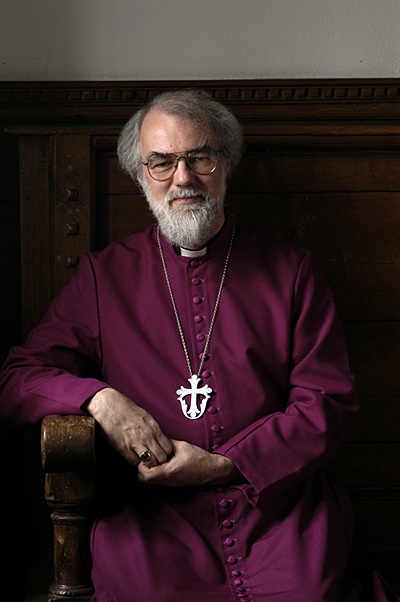 The Most Reverend Rowan Williams, Archbishop of Canterbury will be lecturing in Yonkers, NY, on Saturday, 30 January 2010, 12:30 p.m.
Saint Vladimir’s Orthodox Theological Seminary is hosting the event at which the archbishop will speak and receive an honorary doctorate.
The Archbishop will speak on the topic “Theology and the Contemplative
Calling: The Image of Humanity in the Philokalia.”
Calling: The Image of Humanity in the Philokalia.”
Dr. Williams is the 104th Archbishop of Canterbury, elected, confirmed and enthroned in 2002.
For more information visit the seminary website
Christmas Novena, Third Oration
O Admirable Leader Who gains the obedience of Your
people not by the severity of Your judgment but by the sweetness of Your love
and Your welcome sojourn among us. We beseech You, through Your Pure Nativity
and through the intercession of Your Mother and Saint Joseph, Your Chosen One,
to teach us complete obedience to Your holy commandments and to submit to our
superiors, not for fear of punishment but by a willing surrender of mind and
heart, with gladness of heart and spirit. Amen.
Christmas Novena, Second Oration
O Hope of the Patriarchs and longing of the Gentiles,
in Your Nativity You have granted us hope. The joy of this hope has called
together the Shepherds, the Magi and all believers in Your Holy Name, and led
them to adore You with all the acclaim of their hearts. We beseech You, through
Your Pure Nativity and through the intercession of Your Virgin Mother and Saint
Joseph, Your Chosen One, to keep us, by Your grace, from attachment to earthly
goods. Teach us not to depend only on ourselves and the weak ones of this
world, but to rely only on Your Fatherly direction and Your Divine Providence.
Attract our hearts and minds to reflect on Your heavenly riches and to aspire and
long for them above. Amen.
The Greater Antiphons (aka ‘O Antiphons’) of Advent

Advent slightly shifts its focus beginning tomorrow (December 17) when the antiphons for Vespers known
as the Greater Antiphons, but more commonly known as the O Antiphons, are sung.
These biblical texts are sung as the verse introducing the
Magnificat song at Vespers. Most people know these Great Antiphons as the hymn
called “O Come, O Come Emmanuel” (Veni, Veni, Emmánuël). Each verse of the hymn is a reworded
version of the O Antiphons, with the last being the first verse. Rather unfortunately too many priests and church musicians/choir leaders have little understanding of why one would hold off from signing “O Come, O Come Emmanuel” at Mass until this time of Advent, and even then, why one would spread the verses out over the days ahead. (I wonder if we can get our act together to respect the Liturgy and its history to allow the flourishing of the theology to dig more deeply into our hearts and minds.)
Each O Antiphon
addresses Jesus with a title which comes from the prophecies of Isaiah that
anticipate the coming of the Messiah. The first letters of the titles in the
original Latin in reverse order spell “Ero Cras,” meaning “Tomorrow, I will
come.”
December 17 – O Sapiéntia: O Wisdom Who camest out of the mouth of the
Most High, reaching from end to end and ordering all things mightily and
sweetly: come and teach us the way of prudence.
December 18 – O Adonái: O
Adonai, and Leader of the house of Israel, Who didst appear to Moses in the
flame of the burning bush, and didst give unto him the law on Sinai: come and
with an outstretched arm redeem us.
December 19 – O Radix Jesse: O Root of
Jesse, Who standest for an ensign of the people, before Whom kings shall keep
silence, and unto Whom the Gentiles shall make their supplication: come to
deliver us, and tarry not.
December 20 – O Clavis David: O Key of David, and
Sceptre of the house of Israel, Who openest and no man shutteth, Who shuttest
and no man openeth: come and bring forth from his prison-house, the captive
that sitteth in darkness and in the shadow of death.
December 21 – O Óriens: O
Dawn of the East, Brightness of the light eternal, and Sun of justice: come and
enlighten them that sit in darkness and in the shadow of death.
December 22 – O
Rex Gentium: O King of the Gentiles and the Desired of them, Thou Corner-stone
that makest both one: come and deliver man, whom Thou didst form out of the
dust of the earth.
December 23 – O Emmánuël: O Emmanuel, our King and Lawgiver,
the Expected of the nations and their Savior: come to save us, O Lord our God.
THE most significant Advent antiphon
In my opinion, the best antiphon beside the O Antiphons (which begin tomorrow at Vespers), and I am merely echoing the informed opinions of liturgical scholars, is the Rorate caeli (Rain down you heavens) antiphon in the Advent season. It is the expectation of Israel seen through the eyes of the prophet Isaiah (45:8). The whole purpose of the Incarnation is spoken of here:
Drop down dew, ye heavens, from above, and let the clouds rain the Just One.
Be not angry, O Lord, and remember no longer our iniquity: behold the city of Thy sanctuary is become a desert, Sion is made a desert. Jerusalem is desolate, the house of our holiness and of Thy glory, where our fathers praised Thee.
Drop down dew, ye heavens, from above, and let the clouds rain the Just One.
We have sinned, and we are as one unclean, and we have all fallen as a leaf; and our iniquities, like the wind, have taken us away thou hast hid Thy face from us, and hast crushed us by the hand of our iniquity
Drop down dew, ye heavens, from above, and let the clouds rain the Just One.
See, O Lord, the affliction of Thy people, and send him whom thou hast promised to send. Send forth the Lamb, the ruler of the earth, from the rock of the desert to the mount of the daughter of Sion, that he himself may take off the yoke of our captivity.
Drop down dew, ye heavens, from above, and let the clouds rain the Just One.
Be comforted, be comforted, my people; thy salvation shall speedily come. Why wilt thou waste away in sadness? why hath sorrow seized thee? I will save thee; fear not: for I am the Lord thy God, the Holy One of Israel, thy Redeemer.
Drop down dew, ye heavens, from above, and let the clouds rain the Just One.
Christmas Novena, First Oration
O
Beautiful One in splendor, fairer than the children of this world, in Your
inexplicable love for us, You became a man to show us the invisible beauty of
Your Divinity in the splendor of Your visible body, which You have taken from
the Virgin Mary. By this, You have attracted us to Your Divine Love, You,
Beloved of the Father and Only Delight of His Heart.
We beseech You, through
Your Pure Nativity and through the intercession of Your Virgin Mother and Saint
Joseph, Your Chosen One, to enkindle Your love in our hearts and enlighten our
minds with the rays of Your heavenly grace, that we may love You with our whole
heart and mind. May we love everyone in You and for You, You, Who alone
are worthy of the love of all hearts. Amen.
Your Pure Nativity and through the intercession of Your Virgin Mother and Saint
Joseph, Your Chosen One, to enkindle Your love in our hearts and enlighten our
minds with the rays of Your heavenly grace, that we may love You with our whole
heart and mind. May we love everyone in You and for You, You, Who alone
are worthy of the love of all hearts. Amen.
Blessed Sebastian Maggi
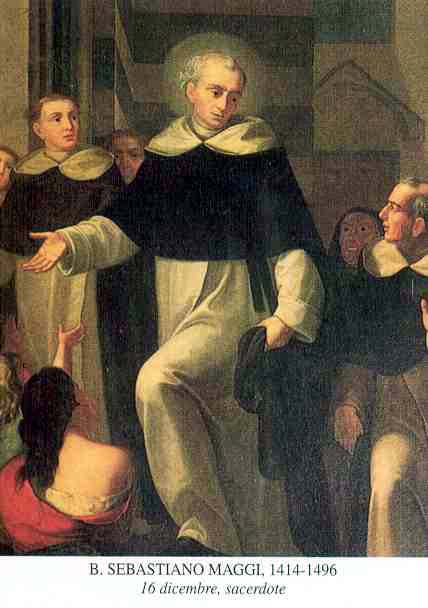
Strengthened by holy intercession, O Sebastian, Confessor of
the Lord, those here present , that we who are burdened the weight of our
offenses. Maybe relieved by the glory of thy blessedness, and may thy guidance
attain eternal rewards.
God of faithfulness, you made Blessed Sebastian and
outstanding example of evangelical perfection and truth. By following his
example may we enter the path to perfect charity and deepen the life of the
spirit through penance and so obtain your glory and eternal life.
More on Blessed Sebastian Maggi may be found here.
Motu Proprio: Variations to the Code of Canon Law, canons canons 1008, 1009, 1086, 1117 & 1124 –Omnium in mentem
Vatican
City, 15 December 2009 (VIS) – Made public today was Benedict XVI’s Motu
Proprio, “Omnium in mentem”. The document is dated 26 October 2009
and contains two variations to the Code of Canon Law (CIC), variations which
have long been the object of study by dicasteries of the Roman Curia and by
national episcopal conferences.
The document published today contains five
articles modifying canons 1008, 1009, 1086, 1117 and 1124. According to an
explanatory note by Archbishop Francesco Coccopalmerio, president of the
Pontifical Council for Legislative Texts, these variations “concern two
separate questions: adapting the text of the canons that define the ministerial
function of deacons to the relative text in the Catechism of the Catholic Church (1581), and suppressing a subordinate clause in three canons concerning
marriage, which experience has shown to be inappropriate”.
The variation
to the text of canon 1008 will now limit itself to affirming that “those
who receive the Sacrament of Orders are destined to serve the People of God
with a new and specific title”, while canon 1009 “will be given an
additional third paragraph in which it is specified that the minister
constituted into the Order of the episcopate or the priesthood receives the mission
and power to act in the person of Christ the Head, while deacons receive the
faculty to serve the People of God in the diaconates of the liturgy, of the
Word and of charity”.
Archbishop Coccopalmerio’s note then goes on to
explain that the other changes contained in the Motu Proprio all concern the
elimination of the clause “actus formalis defectionis ab Ecclesia
Catholica” contained in canons 1086 para. 1, 1117 and 1124. This clause,
“following much study, was held to be unnecessary and inappropriate”,
he writes.
“From the time the Code of Canon Law came into effect in the
year 1983 until the moment of the coming into effect of this Motu Proprio,
Catholics who had abandoned the Catholic Church by means of a formal act were
not obliged to follow the canonical form of celebration for the validity of
marriage (canon 1117), nor were they bound by the impediment concerning
marriage to the non-baptised (canon 1086 para. 1), nor did they suffer the
prohibition on marrying non-Catholic Christians (canon 1124). The
abovementioned clause contained in these three canons represented an exception
… to another more general norm of ecclesiastical legislation according to
which all those baptised in the Catholic Church or received into her are bound
to observe ecclesiastical laws (canon 11).
“With the coming into effect of
the new Motu Proprio”, Archbishop Coccopalmerio adds, “canon 11 of
the Code of Canon Law reacquires its full force as concerns the contents of the
canons thus modified, even in cases were there has been a formal abandonment.
Hence, in order to regularise any unions that may have been made in the
non-observance of these rules it will be necessary to have recourse, if
possible, to the ordinary means Canon Law offers for such cases: dispensation
from the impediment, sanation, etc”.
The Latin and Italian texts are here.