Natural moral guarantees respect for the entire created order, including the human person, Pope tells Pontifical Academy of Life

On February 14, 2010, the Holy Father spoke to the Pontifical Academy for Life. All but the introductory paragraph is noted here

The issues that
revolve around the theme of bioethics allow us to confirm how much these
underlying questions in the first place pose the “anthropological
question.” As I state in my last encyclical letter, Caritas in Veritate:
“A particularly crucial battleground in today’s cultural struggle between
the absolutism of technology and human moral responsibility is the field of
bioethics, where the very possibility of integral human development is
radically called into question. In this most delicate and critical area, the
fundamental question asserts itself force-fully: is man the product of his own
labors or does he depend on God?
Scientific discoveries in this field and the
possibilities of technological intervention seem so advanced as to force a
choice between two types of reasoning: reason open to transcendence or reason
closed within immanence” (no. 74).

Before such questions, which touch in
such a decisive manner human life in its perennial tension between immanence
and transcendence, and which have great relevance for the culture of future
generations, it is necessary to create a holistic pedagogical project that
permits us to confront these issues in a positive, balanced and constructive
vision
, above all in the relationship between faith and reason. The questions
of bioethics often place the reminder of the dignity of the person in the
foreground. This dignity is a fundamental principle that the faith in Jesus
Christ crucified and risen has always defended
, above all when it is ignored in
regard to the humblest and most vulnerable persons: God loves every human being
in a unique and profound way. Bioethics, like every discipline, needs a
reminder able to guarantee a consistent understanding of ethical questions
that, inevitably, emerge before possible interpretive conflicts
. In such a
space a normative recall to the natural moral law presents itself. The
recognition of human dignity, in fact, as an inalienable right first finds its
basis in that law not written by human hand but inscribed by God the Creator in
the heart of man
. Every juridical order is called to recognize this right as
inviolable and every single person must respect and promote it (cf. Catechism
of the Catholic Church
, 1954-1960).

Without the foundational principle of human
dignity it would be difficult to find a source for the rights of the person and
the impossible to arrive at an ethical judgment if the face of the conquests of
science that intervene directly in human life. It is thus necessary to repeat
with firmness that an understanding of human dignity does not depend on
scientific progress, the gradual formation of human life or facile pietism
before exceptional situations. When respect for the dignity of the person is
invoked it is fundamental that it be complete, total and with no strings
attached, except for those of understanding oneself to be before a human life.
Of course, there is development in human life and the horizon of the
investigation of science and bioethics is open, but it must be reaffirmed that
when it is a matter of areas relating to the human being, scientists can never
think that what they have is only inanimate matter capable of manipulation in
their hands
. Indeed, from the very first moment, the life of man is
characterized as “human life” and therefore always a bearer —
everywhere and despite everything — of its own dignity (cf. Congregation for
the Doctrine of the Faith, Instruction Dignitas Personae on Certain Bioethical
Questions
, 5). Without this understanding, we would always be in danger of an
instrumental use of science with the inevitable consequence of easily ceding to
the arbitrary, to discrimination and to the strongest economic
interest.

Joining bioethics and natural moral law permits the best confirmation
of the necessary and unavoidable reminder of the dignity that human life
intrinsically possesses from its first instant to its natural end
. But in the
contemporary context, while a just reminder about the rights that guarantee
dignity to the person is emerging with ever greater insistence, one notes that
such rights are not always recognized in the natural development of human life
and in the stages of its greatest fragility. A similar contradiction makes
evident the task to be assumed in different spheres of society and culture to
ensure that human life always be seen as the inalienable subject of rights and
never as an object subjugated to the will of the strongest.

History has shown
us how dangerous and deleterious a state can be that proceeds to legislate on
questions that touch the person and society while pretending itself to be the
source and principle of ethics. Without universal principles that permit a
common denominator for the whole of humanity the danger of a relativistic drift
at the legislative level is not at all something should be underestimated (cf.
Catechism of the Catholic Church, 1959). The natural moral law, strong in its
universal character, allows us to avert such a danger and above all offers to
the legislator the guarantee for an authentic respect of both the person and the
entire created order. It is the catalyzing source of consensus among persons of
different cultures and religions and allows them to transcend their differences
since it affirms the existence of an order impressed in nature by the Creator
and recognized as an instance of true rational ethical judgment to pursue good
and avoid evil
. The natural moral law “belongs to the great heritage of
human wisdom. Revelation, with its light, has contributed to further purifying
and developing it” (John Paul II, Address to the Plenary Assembly of the
Congregation of the Doctrine of the Faith, February 6, 2004).

Illustrious
members of the Pontifical Academy for Life, in the present context your task
appears more and more delicate and difficult, but the growing sensitivity in
regard to human life is an encouragement to continue, with ever greater spirit
and courage, in this important service to life and the education of future
generations in the evangelical values. I hope that all of you will continue to
study and research so that the work of promoting and defending life be ever
more effective and fruitful. I accompany you with the apostolic blessing, which
I gladly extend to those who share this daily task with you.

Sin is in opposition to God’s infinite holiness

I went to confession the other day. I try to go once a month and for the most part I make that commitment. For some reason, it was a about 8 weeks since I darkened the confessional. I was leaving that afternoon for my hermitage day (spoken of in another blog post below) and Lent was fast approaching. Going to confession was awkward, lonely, fearful BUT intensely gratifying, freeing, and loving. Facing one’s sinful nature is NEVER easy; it is NEVER anything but a hassle, it is NEVER anything but embarassing but it is the only way I know how to be honest with myself in front of God. As an Opus Dei priest tells me when I see him occasionally for confession: you’ve got sin, I’ve got the grace for you to live … by the ministry of the Church. Of course, this priest is echoing the notion that I am not confessing my sinful self to him personally (I really don’t think he cares one-way-or-another truely in the best sense) but ipse Christus –to Christ Himself. I read the passage noted below from a rather famous spiritual treatise today and the last line from sacred Scripture struck me: If anyone would come after me, let him deny himself. Do you have a clear understanding of mortal sin? Have you gone to confession? How is your struggle with sin going in the face of grace?


Only mortal sin is completely opposed to God; this opposition is so great that it separates the soul from God. However, every sin, even venial sin, and every fault and imperfection, is in opposition to God’s infinite holiness. Therefore Jesus offers the perfection of his heavenly Father as a norm for our Christian life, and engages us in an intense struggle against sin in order to destroy in us its deepest roots and even its slightest traces.


This is what Jesus teaches in these few short words: deny yourself. We must deny self with all its imperfect habits and inclinations; and we must do so continually. Such a task is fatiguing and painful, but it is indispensable if we wish to attain sanctity. Jesus says: The gate is narrow and the way is hard that leads to life, and those who find it are few (Mt. 7:14).


In echo of Jesus, all the masters of the spiritual life insist strongly on detachment and self-renunciation as the indispensable foundation of the spiritual life. St. John of the cross offers a soul who is desirous of attaining union with God the harsh way of the “nothing”.


But first and foremost, it is Jesus, the divine Teacher, who has pointed out to us the absolute necessity of passing through this way: If anyone would come after me, let him deny himself (Mt. 16:24).


Father Gabriel of St. Mary Magdalen, OCD

Divine Intimacy

Hermitage Days

Regina Caeli Hermitage.jpgBeing busy about many things affords one many distractions, which can be a good thing. Very often, being too busy and distracted offers no consolation and actually makes life less interesting, less thirsty for God, less able to hear the promptings of the Lord, less focused on substantial matters of life. Perhaps one can say less able to take serious our own reality. But life is not about measuring up to a standard as it is about a relationship, time spent in the company of the other person (though the other person be yourself).

Regina Caeli chapel2.jpg

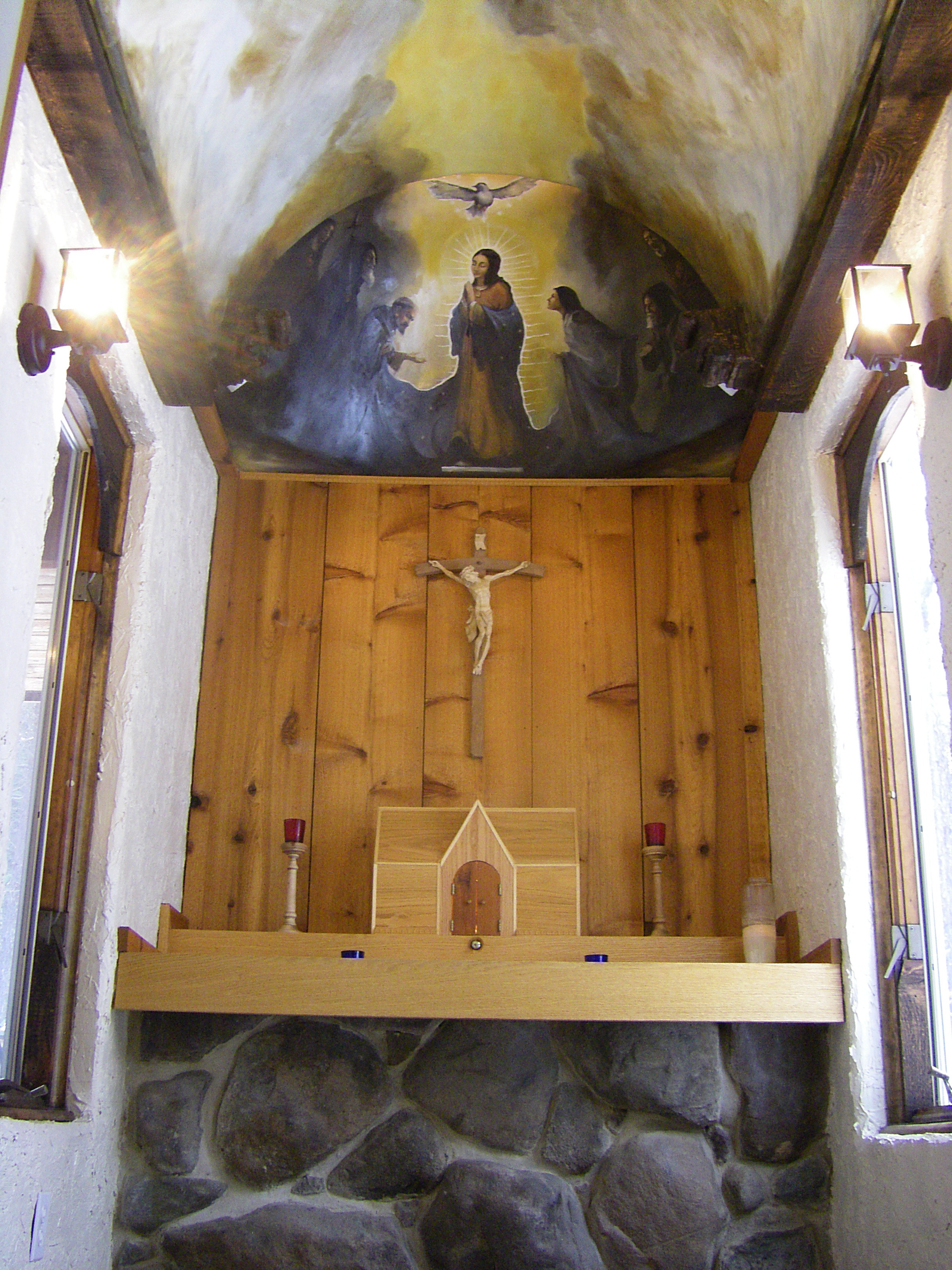
For the last 2 days I spent time in silence and solitude (with no community, no internet and barely phone service). My Franciscan Friars of the Renewal friends offered me one of their hermitages for two days of prayer, reading, nap time, and holy leisure: an opportunity for real education. The Friars have restored the Capuchin custom of the “desert day” once a month in order to spend time away from the normal routine to renew energies, to concentrate on the divine-human relationship and abandon the self to the Other –that is, to abandon oneself completely to God. The abandonment of self that is aimed for here is the self-gift, of love, where the more one abandons oneself in love the more love becomes a reality. The hermitage time reminds me of a something Msgr. Luigi Giussani said about poverty that I think is applicable here: “Poverty belongs then to the dynamic of knowledge, for which detachment is necessary to see things and then to use them and enjoy them more.”Wood Stove Regina Caeli.jpg

Blessed Nicholas Paglia

O Lord, you gave Blessed
Nicholas a special grace for preaching your word and
for
obtaining the salvation of his neighbors. With the help of his prayers may we
stand
firm in that same holy calling.


Blessed Nicholas Paglia having lived between the years of 1197 and 1256, born at Bari and educated at Bologna, was brought to the Order of Friars Preachers by the preaching of Saint Dominic; the holy father personally invested Nicholas with the habit inviting him to travel with him on mission. Blessed Nicholas is remembered for his preaching and compiling a compendium of sacred Scripture. We pray for those who preach the gospel and for Scripture scholars.

Clean Monday…getting into Great Lent


Thumbnail image for St Andrew of Crete.jpg

For Eastern Catholic and Orthodox Christians, today is “Clean Monday,”
the first day of the Great Fast. In many of these churches, the faithful will
gather tonight for the service of Compline with the singing of a portion of the
“Penitential Canon,” also known as the “Great Canon of St.
Andrew of Crete.” The
First Ode of the Great Canon uses as a springboard
the text of the Canticle of Moses contained in Exodus 15: 1-19. The
singing of the Great Canon in the First Week of the Great Fast, is intended to
invoke compunction in the penitent heart.

(Irmos) A Helper
and Protector has become salvation to me.

This is my God; I
will glorify Him.

God of my fathers,
I will exalt Him;

for in glory has He
been glorified!

Refrain

Glory to You, our
God, glory to You!
(or the refrain changes to “Have mercy on me, O God,
have mercy on me!” when sung at Compline in the first of the Fast)

Where shall I begin
to lament the deeds of my wretched life?

What first-fruits
shall I offer, O Christ, for my present lamentation?

But in your
compassion, grant me release from my sins.

Glory to You…

Come, wretched
soul,

with your flesh
confess to the Creator of All.

In future, refrain
from your former brutishness

and offer to God
tears in repentance.

Glory to You…

Having rivaled the
first-made Adam in my transgressions,

I realize that I am
stripped naked of God

and of the
everlasting kingdom of bliss through my sins.

Glory to You…

Alas, wretched
soul!

Why are you like
the first Eve?

For you have
wickedly looked and been bitterly wounded,

and you have
touched the tree

and rashly tasted
the forbidden fruit.  (cf Gen. 3:6)

Glory to You…

The place of bodily
Eve has been taken

by the Eve of my
mind,

in the shape of a
passionate thought in the flesh,

showing me sweet
things

yet ever making me
taste bitter things.

Glory to You…

Adam was rightly
exiled from Eden

for not keeping
Your one commandment.

O Savior, what
shall I suffer,

who am always rejecting
Your living words? (cf. Gen. 3:26/Acts 7:38)


Glory to the Father
and to the Son and to the Holy Spirit!

Trinity adored in
Unity,

take from me the
heavy yoke of sin,

and in Your
compassion,

grant me tears of
compunction.

Now and ever and
forever. Amen.

O Theotokos,

hope and
intercessor of those who sing to you,

take from me the
heavy yoke of sin,

and as you are our
pure Lady,

accept me that
repents.


(KATAVASIA)  A
Helper and a Protector is He unto salvation.

He is my God, and I
glorify Him;

God of my fathers,
and I magnify Him,

for He is greatly
glorified.

Bishop Peter A. Rosazza celebrates his 75th birthday

Peter A Rosazza.jpg

Bishop Peter Anthony Rosazza, an auxiliary bishop of the Archdiocese of Hartford, celebrates his 75th birthday today.

Our prayers are with him as he makes this milestone.

Bishop Rosazza was ordained a bishop in 1978 (31 yrs a bishop) at the age of 43 by the great Archbishop John Francis Whealon.

Since I am from New Haven, Bishop Peter (as he’s known) is a legendary character. For one, he confirmed me in 1982 at Saint Stanislaus Church (New Haven, CT) and he’s been a tireless advocate for those living on the margins of society (the poor, the immigrant, the widow).

He’s been known as a good preacher of the Gospel and attentive teacher of the faith. Significantly, Bishop Peter is also been a friend to the Communion and Liberation group of New Haven for which are we deeply grateful.

Happy 75th birthday Bishop Peter!

Blessed Jordan of Saxony

Bl Jordan of Saxony.jpegMy words that I have in your mouth, says the Lord, will never be absent from your lips, and your gifts will be accepted on my altar.

Gracious God, You called our brother Jordan to the preaching of the gospel by which he drew many to the apostolic way of life. Help us to preach the way of salvation faithfully and so proclaim the kingdom of Christ Your Son, who lives and reigns with You and the Holy Spirit, one God, for ever and ever.

Here’s the Legend of Blessed Jordan of Saxony, second Master General of the Order of Friars Preachers.