The Cross offers unlimited hope, Pope teaches


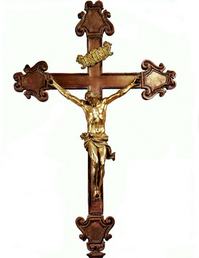
Cross GL Bernini.jpg

The Pope’s homily on the role of the Cross in our theology was a good reminder of who are as a people of faith: merciful, loving, and hope-filled. Sin and death don’t have the last word in life. It is sad that we don’t remember this more often, clergy and laity alike. This homily made me reflect back on an experience I had a few weeks back when I was told a priest in this particular parish preached that Catholics are “Easter people” and not a “Good Friday people.” Sorely misguided. On June 5th in Cyprus Pope Benedict celebrated the Votive Mass of the Holy Cross (praying
the various votive Masses is a good and noble tradition when there is no
specific liturgical memorial that particular day) when he acknowledged the work of
devoted priests, brothers, sisters catechists and the lay movements in preaching and teaching the Truth. In the
face of difficult and sometimes evil situations the Pope encouraged his
congregation (and us) to base their (our) lives on the Cross. For Christians, the cross is not
a failure but the symbol –the reality– of mercy, forgiveness, faith, hope and joy. And it is
the goal of priests and religious to conform their lives to their Cross because
it is at the foot of the Cross that we know the full power of the Trinity’s
love for us. Plus, the Pope reminds us that we are not the center of the faith, Christ is: it is His wisdom and salvation we communicate to others, not our own.

Here are excerpts from the Pope’s homily:

Beguiled by the serpent, Adam had foresaken his filial trust in
God and sinned by biting into the fruit of the one tree in the garden that was
forbidden to him. In consequence of that sin, suffering and death came into the
world. The tragic effects of sin, suffering and death were all too evident in
the history of Adam’s descendants. We see this in our first reading today, with
its echoes of the Fall and its prefiguring of Christ’s redemption.

As a
punishment for their sin, the people of Israel, languishing in the desert, were
bitten by serpents and could only be saved from death by looking upon the
emblem that Moses raised up, foreshadowing the Cross that would put an end to
sin and death once and for all. We see clearly that man cannot save himself
from the consequences of his sin. He cannot save himself from death. Only God
can release him from his moral and physical enslavement. And because he loved
the world so much, he sent his only-begotten Son, not to condemn the world – as
justice seemed to demand – but so that through him the world might be saved. God’s
only-begotten Son had to be lifted up just as Moses lifted up the serpent in
the desert, so that all who looked upon him with faith might have life.
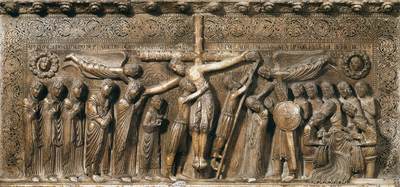
Descent from the Cross BAntelami.jpg

The
wood of the Cross became the vehicle for our redemption, just as the tree from
which it was fashioned had occasioned the Fall of our first parents. Suffering
and death, which had been a consequence of sin, were to become the very means
by which sin was vanquished. The innocent Lamb was slain on the altar of the
Cross, and yet from the immolation of the victim new life burst forth: the
power of evil was destroyed by the power of self-sacrificing love.

The Cross,
then, is something far greater and more mysterious than it at first appears. It
is indeed an instrument of torture, suffering and defeat, but at the same time
it expresses the complete transformation, the definitive reversal of these
evils: that is what makes it the most eloquent symbol of hope that the world
has ever seen. It speaks to all who suffer – the oppressed, the sick, the poor,
the outcast, the victims of violence – and it offers them hope that God can
transform their suffering into joy, their isolation into communion, their death
into life. It offers unlimited hope to our fallen world.
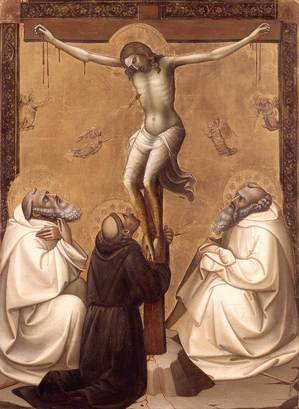
Cross with Sts Bernard, Francis and Benedict.jpg

That is why the world
needs the Cross. The Cross is not just a private symbol of devotion, it is not
just a badge of membership of a certain group within society, and in its
deepest meaning it has nothing to do with the imposition of a creed or a
philosophy by force.
It speaks of hope, it speaks of love, it speaks of the
victory of non-violence over oppression, it speaks of God raising up the lowly,
empowering the weak, conquering division, and overcoming hatred with love. A
world without the Cross would be a world without hope, a world in which torture
and brutality would go unchecked, the weak would be exploited and greed would
have the final word. Man’s inhumanity to man would be manifested in ever more
horrific ways, and there would be no end to the vicious cycle of violence. Only
the Cross puts an end to it
. While no earthly power can save us from the
consequences of our sins, and no earthly power can defeat injustice at its
source, nevertheless the saving intervention of our loving God has transformed
the reality of sin and death into its opposite. That is what we celebrate when
we glory in the Cross of our Redeemer. Rightly does Saint Andrew of Crete
describe the Cross as “more noble, more precious than anything on earth […] for
in it and through it and for it all the riches of our salvation were stored
away and restored to us” (Oratio X; PG 97, 1018-1019).

Dear brother priests,
dear religious, dear catechists, the message of the Cross has been entrusted to
us, so that we can offer hope to the world. When we proclaim Christ crucified
we are proclaiming not ourselves, but him. We are not offering our own wisdom
to the world, nor are we claiming any merit of our own, but we are acting as
channels for his wisdom, his love, his saving merits
. We know that we are
merely earthenware vessels, and yet, astonishingly, we have been chosen to be
heralds of the saving truth that the world needs to hear. Let us never cease to
marvel at the extraordinary grace that has been given to us, let us never cease
to acknowledge our unworthiness, but at the same time let us always strive to
become less unworthy of our noble calling, lest through our faults and failings
we weaken the credibility of our witness.
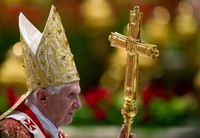
B16 Pentecost 2010.jpg

In this Year for Priests, let me
address a special word to the priests present today, and to those who are
preparing for ordination. Reflect on the words spoken to a newly ordained
priest as the Bishop presents him with the chalice and paten: “Understand what
you do, imitate what you celebrate, and conform your life to the mystery of the
Lord’s Cross”. As we proclaim the Cross of Christ, let us always strive to
imitate the selfless love of the one who offered himself for us on the altar of
the Cross, the one who is both priest and victim, the one in whose person we
speak and act when we exercise the ministry that we have received
. As we
reflect on our shortcomings, individually and collectively, let us humbly
acknowledge
that we have merited the punishment that he, the innocent Lamb,
suffered on our behalf.
And if, in accordance with what we have deserved, we
should have some share in Christ’s sufferings, let us rejoice because we will
enjoy a much greater gladness when his glory is revealed.

Watch the YouTube clip on the teaching of Pope Benedict on the Cross

Saint Ephrem the Syrian

saint-ephrem2.gifIt is indeed fitting to honor the blessed deacon of
Edessa for his desire that the preaching of the divine word and the training of
his disciples rest on the purity of Sacred Scripture. He also acquired honor as
a Christian musician and poet. He was so accomplished in both arts that he was
called the “lyre of the Holy Spirit.” From this, Venerable Brothers,
you can learn what arts promote the knowledge of sacred things. Ephrem lived
among people whose nature was attracted by the sweetness of poetry and music.
The heretics of the second century after Christ used these same allurements to
skillfully disseminate their errors. Therefore Ephrem, like youthful David
killing the giant Goliath with his own sword, opposed art with art and clothed
Catholic doctrine in melody and rhythm. These he diligently taught to boys and
girls, so that eventually all the people learned them. In this fashion he not
only renewed the education of the faithful in Christian doctrine and supported
their piety with the spirit of the sacred liturgy, but also happily kept
creeping heresy at bay.


The artistry introduced by Blessed Ephrem added dignity
to sacred matters as Theodoretus stresses. The metric rhythm, which our saint
popularized, was widely propagated both among the Greeks and the Latins. Indeed
does it seem probable that the liturgical antiphonary with its songs and
processions, introduced at Constantinople in the works of Chrysostom and at
Milan by Ambrose (whence it spread throughout all of Italy), was the work of
some other author? For the “custom of Eastern rhythm” deeply moved
the catechumen Augustine in northern Italy; Gregory the Great improved it and
we use it in a more advanced form. Critics acknowledge that that “same
Eastern rhythm” had it origins in Ephrem’s Syrian antiphonary.

It is no
wonder then that many of the Fathers of the Church stress the authority of St.
Ephrem. Nyssenus says of his writings, “Studying the Old and New
Scriptures most thoroughly, he interpreted them accurately, word for word; and
what was hidden and concealed, from the very creation of the world to the last
book of grace, he illumined with commentaries, using the light of the
Spirit.” And Chrysostom: “The great Ephrem is scourge of the
slothful, consoler of the afflicted, educator, instructor and exhorter of
youth, mirror of monks, leader of penitents, goad and sting of heretics,
reservoir of virtues, and the home and lodging of the Holy Spirit.” Certainly
nothing greater can be said in praise of a man who, however, seemed so small in
his own eyes that he claimed to be the least of all and a most vile sinner”
(12-14).

Pope Benedict XV

Principi
Apostolorum Pet
ro (On St. Ephrem the Syrian), 5 October 1920

The Sacred Heart of Jesus: What does the Church teach?

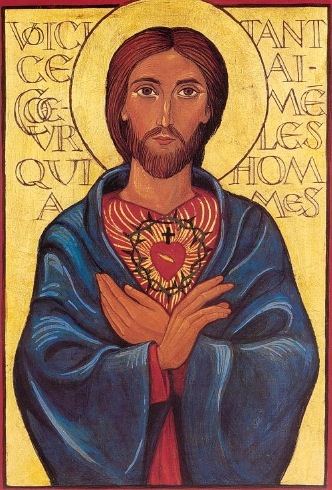
It bears reading and knowing what the Church advocates with regard to the Sacred Heart of Jesus. Why? Because we are meant to be in relationship with God through Jesus by the power of the Holy Spirit. We live in relation (communio) to Jesus –as Savior, brother, Redeemer, lover– through whom we see the face of God. In The Directory on Popular Piety and the Liturgy tells us:

The Roman Pontiffs have frequently averted to the scriptural basis of devotion to the Sacred Heart of Jesus.

Sacred Heart8.jpg

Jesus, who is one with the Father (cf. John 10, 30), invites his disciples to live in close communion with him, to model their lives
on him and on his teaching. He, in turn, reveals himself as “meek and
humble of heart” (Mt 11, 29). It can be said that, in a certain sense,
devotion to the Sacred Heart of Jesus is a cultic form of the prophetic and evangelic gaze of all Christians on him who was pierced (cf. John 19, 37; Zac 12, 10), the gaze of all Christians on the side of Christ, transfixed by a lance, and from which flowed blood and water (cf. John 19, 34), symbols of the “wondrous sacrament of the Church.”

The Gospel of St. John recounts the showing of the Lord’s hands and his side to the disciples (cf. John 20: 20), and of his invitation to Thomas to put his hand into his side (cf. John 20: 27). This event has also had a notable influence on the origin and development of the Church’s devotion to the Sacred Heart.

These and other texts present Christ as the paschal Lamb, victorious and slain (cf. Apoc 5,6). They were objects of much reflection by the Fathers who unveiled their doctrinal richness. They invited the faithful to penetrate the mysteries of Christ by contemplating the wound opened in his side. Augustine writes: “Access is possible: Christ is the door. It was opened for you when his side was opened by the lance. Remember what flowed out from his side: thus, choose where you want to enter Christ. From the side of Christ as he hung dying upon the Cross there flowed out blood and water, when it was pierced by a lance. Your purification
is in that water, your redemption is in that blood
” (ed. emphasis).

Devotion to the Sacred Heart was particularly strong during the middle ages. Many renowned for the learning and holiness developed and encouraged the devotion, among them St. Bernard (+1153), St. Bonaventure (+ 1274), the mystic St. Lutgarda (+1246), St Mathilda of Marburg (+ 1282), the sainted sisters Mathilda (+ 1299) and Gertrude (+ 1302) of the monastery of Helfta, and Ludolf of Saxony (+1380). These perceived in the Sacred Heart a “refuge” in which to recover, the seat of mercy, the encounter with him who is the source of the Lord’s infinite love, the fount from which flows the Holy Spirit, the promised land, and true paradise.

In the modern period devotion to the Sacred Heart of Jesus underwent new developments. At a time when Jansenism proclaimed the rigours of divine justice, the devotion to the Sacred Heart of Jesus served as a useful antidote and aroused in the faithful a love for Our Lord and a trust in his infinite mercy symbolized by his Heart. St. Francis de Sales (+ 1622) adopted humility, gentleness (cf. Mt 11, 29) and tender loving mercy, all aspects of the Sacred Heart, as a model for his life and apostolate. The Lord frequently manifested the abundant mercy of his Heart to St. Margaret Mary (+ 1690); St. John Eudes (+ 1680) promoted the liturgical cult of the Sacred Heart, while St. Claude la Colombière (+ 1682) and St. John Bosco (+ 1888) and other saints
were avid promoters of devotion to the Sacred Heart.

Devotions to the Sacred Heart of Jesus are numerous. Some have been explicitly approved and frequently recommended by the Apostolic See. Among these, mention should be made of the
following:

  • personal consecration, described by Pius XI as “undoubtedly the principal devotional practice used in relation to the Sacred Heart”;
  • family consecration to the Sacred Heart, in which the family, by virtue of the Sacrament of Holy Matrimony already participating in the mystery of the unity and love of Christ for the Church, is dedicated to Christ so that he might
    reign in the hearts of all its members;
  • the Litany of the Sacred Heart of Jesus, approved for the whole Church in 1891, which is evidently biblical in
    character and to which many indulgences have been attached;
  • the act of reparation, a prayer with which the faithful, mindful of the infinite goodness of Christ, implore mercy for the offences committed in so many ways against his Sacred Heart;
  • the pious practice of the first Fridays of the month which derives from the “great promises” made by Jesus to St. Margaret Mary.

At a time when sacramental communion was very rare among the faithful, the first Friday devotion contributed significantly to a renewed use of the Sacraments of Penance and of the Holy Eucharist. In our own times, the devotion to the first Fridays, even if practised correctly, may not always lead to the desired spiritual fruits. Hence, the faithful require constant instruction so
that any reduction of the practice to mere credulity, is avoided and an active faith encouraged so that the faithful may undertake their commitment to the Gospel correctly in their lives. They should also be reminded of the absolute preeminence of Sunday, the “primordial feast”, which should be marked by the full participation of the faithful at the celebration of the Holy Mass.

Devotion to the Sacred Heart is a wonderful historical expression of the Church’s piety for Christ, her Spouse and Lord: it calls for a fundamental attitude of conversion and reparation, of love and gratitude, apostolic commitment and dedication to Christ and his saving work. For these reasons, the devotion is recommended and its renewal encouraged by the Holy See and by the
Bishops. Such renewal touches on the devotion’s linguistic and iconographic expressions; on consciousness of its biblical origins and its connection with the great mysteries of the faith; on affirming the primacy of the love of God and neighbour as the essential content of the devotion itself.

Popular piety tends to associate a devotion with its iconographic expression. This is a normal and positive phenomenon. Inconveniences can sometimes arise: iconographic expressions that no longer respond to the artistic taste of the people can sometimes lead to a diminished appreciation of the devotion’s object, independently of its theological basis and its historico-salvific content.

This can sometimes arise with devotion to the Sacred Heart: perhaps certain over sentimental images which are incapable of giving expression to the devotion’s robust theological content or which do not encourage the faithful to approach the mystery of the Sacred Heart of our Saviour.

Recent time have seen the development of images representing the Sacred Heart of Jesus at the moment of crucifixion which is the highest expression of the love of Christ. The Sacred Heart is Christ crucified, his side pierced by the lance, with blood and
water flowing from it (cf, John 19, 34). (167-173).

Blessed Diana and Blessed Cecilia

Bl Diana & Cecilia.jpgMerciful Lord, we welcome in joy the feast of Blessed
Diana and Blessed Cecilia. With the help of their prayers may devotion to truth
and love for our brothers and sisters fill our hearts and our lives.


Blesseds Diana and Cecilia were among the first women followers of Saint Dominic and among the first members of the Dominican convent in Bologna, Italy. Blessed Diana was the prioress of the monastery and from extant, extensive correspondence with Blessed Jordan of Saxony (Dominic’s successor), we see the high regard for the hidden life of prayer and penance of the nuns supporting the endeavors of the friars. The preaching of Truth and the salvation of souls needed to be drawn from a life of holiness. From Blessed Cecilia we know what Saint Dominic looked like and who he was a person. The witness of Blesseds Diana and Cecilia is invaluable for the life of the Order of Preachers. As you may know, the contemplative nuns were founded before Dominic founded the friars because he was convinced that if the preaching apostolates were to be effective they had to be undergirded by prayer and penance. Hence, today is an opportunity to pray for the enclosed Dominican nuns and for vocations to this way of life.

Benedictines changing the way life is lived

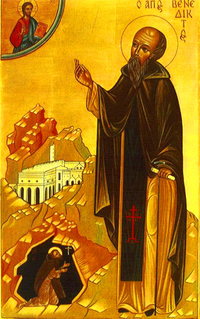
st benedict-thumb.jpg

Benedictine abbots and by extension all monks, nuns and Christians are expected to give to the Lord an account of the way the goods of creation are used (Rule of St Benedict & Luke 16:2). In various contexts Pope Benedict has also addressed the Church on the proper use of creation for the good humanity and over the long haul. Questions of environmental sustainability surface more and more these days with critical assessments of how we live viz. the ideals by which we live (the Gospel, theology), questions of stewardship, availability of manpower, money, etc.
A good example of what I am indicating are the environmental programs sponsored by the monks of St John’s Abbey and University to take a deeper look into a holistic approach to the environment in light of various disciplines. In the last few years the monks of the Abbey of Saint Gregory the Great, Portsmouth, RI, have begun a number of initiatives to be good stewards: a wind turbine and a large garden to supply the abbey and the school with fresh vegetables, name a few (more info here). Also, we can survey various abbeys who made some good choices by the planting of hundreds of trees to reclaim a forest by the monks of St Meinrad Archabbey, the comprehensive review of Sant’Anselmo (Rome) to see how more efficient they can be, Conception Abbey working wind technology and St Mary’s Abbey maintaining an apple orchard, an extensive garden, land preservation and a few bee hives. But these few good things raise the question of how all of us think and act green for better and healthy living.
Monks, nuns, priests, brothers and sisters are expected to live differently from the secular counterparts; seemingly the seculars do a lot better a living with a green consciousness. But Benedictines and Franciscans usually get praise for their being good stewards of creation.
Two very recent items which are good to note: 

Blessed Jerzy Popiełuszko, martyr

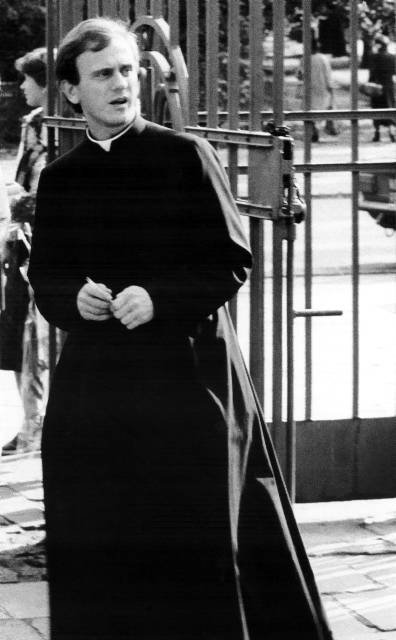
Jerzy Popiełuszko.jpg

The Church has a new blessed, an apostle for freedom, Blessed Jerzy Popieluszko.

From Cyprus on Sunday, June 6, 2010, Pope Benedict XVI
during the Angelus address spoke a “few words in Polish on the happy occasion
of the beatification today of Jerzy Popieluszko, priest and martyr: [I send
cordial greetings to the Church in Poland which today rejoices at the elevation
to the altars of Father Jerzy Popieluszko. His zealous service and his
martyrdom are a special sign of the victory of good over evil. May his example
and his intercession nourish the zeal of priests and enkindle the faithful with
love.]”


In 1984 I distinctively remember the tangible feelings upon hearing of the murder of the young priest, Father Jerzy Popieluszko, by the Communists. I think we all cried because he died for us. In fact, no person of Polish heritage could not not know about Popieluszko and identify with the struggle for human dignity and freedom he sought his people. He was seen as a the modern Saint Stanislaus, martyr. The tragic circumstances of his death were ever in front of us as yet another example of the evils of Communism.

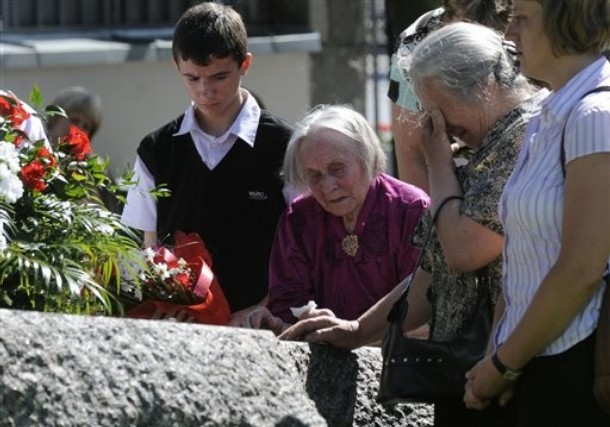
Marianna Popiełuszko.jpg

Father Jerzy was a popular chaplain to members of the Solidarity movement. Yesterday, Archbishop Angelo Amato, SDB, Prefect of the Congregation of Saints, beatified Father Jerzy in the presence of his mother Marianna, 100, and other family members and nearly 140,000 people. Marianna is yet another living member of a saint or “saint-to-be.” How moving it is two see Father Jerzy’s mother present for her son’s beatification and the tremendous outpouring of love for him and for her.

Known as a martyr of freedom, Blessed Jerzy Popieluszko’s tomb has had nearly 17 million visitors. Other details pertaining to Popieluszko’s beatification are in Jonathon Luxmoore’s Catholic News Service article, the Zenit article and another story about Blessed Jerzy that can be read here.

Some quick facts:

Born: September 14, 1947
Ordained priest: May 28, 1972
Kidnapped & killed: October 19/20, 1984
Venerated: December 19, 2009
Beatified: June 6, 2010
Liturgical memorial: October 19

Watch the note on a forthcoming movie on Blessed Jerzy

June is the month dedicated to the Sacred Heart of Jesus

Sacred Heart7.jpgFor a long time the Church has dedicated the month of June to the Sacred Heart of Jesus. The designation of the solemn feast of the Sacred Heart is on the Friday following the feast of Corpus Christi. This year the Sacred Heart feast is celebrated on June 11.

Biblically and spiritually we understand the heart to symbolize the center of one’s being, love, mercy, faithfulness, tenderness, compassion and other affective emotions. The Directory on Popular Piety and the Liturgy tells us that “Understood in the light of the Scriptures, the term “Sacred Heart of Jesus” denotes the entire mystery of Christ, the totality of his being, and his person considered in its most intimate essential: Son of God, uncreated wisdom; infinite charity, principal of the salvation and sanctification of mankind. The “Sacred Heart” is Christ, the Word Incarnate, Saviour, intrinsically containing, in the Spirit, an infinite divine-human love for the Father and for his brothers” (166).
Those who are familiar with the practice of dedicating each day to the Lord, do so through the Sacred Heart title of Jesus in the prayer commonly known as the Morning Offering. You can also use this prayer, too:
All for Thee, Most Sacred Heart of Jesus!
Sacred Heart of Jesus, I place all my trust in Thee!
Sacred Heart of Jesus, I believe in your love for me!
Sacred Heart of Jesus, have mercy on me, a sinner!
Sacred Heart of Jesus, Thy Kingdom come!
Let me recommend something: enroll in the ministry of the Apostleship of Prayer, which is dedicated to prayer for the Church, particularly the Pope through the Sacred Heart of Jesus.

Dominicans of the Eastern Province begin their Chapter

OP arms.jpgFor nearly a month the Dominican friars of the Province of Saint Joseph (the Eastern Province) elected and/or appointed as capitulars will be at Providence College doing the normal business of governance and making a review (and coming to some decision) on how they live the charism given by Saint Dominic.

Beginning today the 35 friars will enter a period of reflection and prayer as they prepare to elect a new Prior Provincial and other province officials. The vote for the new Provincial will be Friday, June 11.
Please beg the Holy Spirit and ask for the intercession of Saint Dominic with the Dominican blesseds and saints to ask the Lord to shower these friars with clarity of thought, charity and courage to make good decisions. Also, go to the Blessed Virgin Mary and Saint Joseph for help. What happens in the next few weeks charts the course for Dominican mendicant life for the next four years.
As point of interest, the Dominicans in North America (the Eastern, Southern and Canadian Provinces) are electing new leadership and assessing their fraternal life and apostolic priorities.
Praying to Saint Dominic for his help:
O wonderful hope which you gave to those who wept for you at the hour death, promising after your departure to be helpful to your brethren. Fulfill, father, what you have said and help us by your prayers. You who shone by so many miracles worked on the bodies of the sick, bring us the help of Christ to heal our sick souls.

Glory be to the Father, and to the Son, and to the Holy Spirit.

Fulfill, father, what you have said and help us by your prayers. Amen.

Corpus Christi procession at St Mary’s New Haven

Eucharistic procession-b Corpus Christ 2010.jpgO sacred Banquet in which Christ is received, the memory of His Passion is recalled, the mind is filled with grace, and pledge of future glory is given to us.

At churches around the world today we’ll notice processions with the Blessed Sacrament in honor of the Feast of the Most Holy Body and Blood of Christ (also called Corpus Christi). New Haven, Connecticut is no different: Saint Mary’s Church served by the Dominican Friars celebrated the Mass and formed a procession around the block though a small portion of the Yale University neighborhood. The Very Reverend Father Joseph Allen, OP, prior and pastor of Saint Mary’s presided at Mass and led the procession. Allen reminded us of Christ’s gift of Presence to the Church and it is an extension of Christ’s sacred humanity and divinity now, and the fruit of that presence is unity of faith and service to neighbor. Also assisting Father Allen in carrying the Blessed Sacrament is the recently ordained Dominican student brother, Brother Austin, assigned for the summer to Saint Mary’s Priory and Church.

We took Christ to the streets where He is little known and if he is known there, He is often neglected. “Our faith in the God who took flesh in order to become our companion along the way needs to be everywhere proclaimed, especially in our streets and homes, as an expression of our grateful love and as an inexhaustible source of blessings” (John Paul II, Mane nobiscum Dominie, 2005)

Benediction Corpus Christi 2010.jpg

The Corpus Christi festival clearly echoes the Holy Thursday commemoration of the institution of the Eucharist. Benedict XVI’s words come to mind:
We must never forget that the Church is built around Christ and that, as St Augustine, St Thomas Aquinas and St Albert the Great have all said, following St Paul (cf. 1 Cor 10:17), the Eucharist is the Sacrament of the Church’s unity, because we all form one single body of which the Lord is the head. We must go back again and again to the Last Supper on Holy Thursday, where we were given a pledge of the mystery of our redemption on the Cross. The Last Supper is the locus of the nascent Church, the womb containing the Church of every age. In the Eucharist, Christ’s sacrifice is constantly renewed, Pentecost is constantly renewed. (Benedict XVI, homily closing the 49th Eucharistic Conference, Quebec, June 22, 2008)

faithful Corpus Christ 2010.jpg

You may recall that since the 14th century a custom formed in carrying the Blessed Sacrament around town following Mass. Popes encouraged this devotional practice –even giving indulgences to those who walked with the Blessed Sacrament– and by the 16th century, the Council of Trent approved a public demonstration of the faith in the Eucharistic Presence. Through the various periods of Church history extraordinary events and processions developed with every segment of civil society taking part. In some countries the faithful wrote “Plays of the Sacrament” or performed “Eucharistic dances” as they did in Seville (not the type done by Sister Mary Leotard) to express their faith in the enduring Presence of the Lord.

benediction in Church Corpus Christi 2010.jpg

Today’s Eucharistic procession stopped at stations, a typical Roman liturgical custom, for a moment of prayer with the Blessed Sacrament which included singing “Tantum ergo,” the a prayer, benediction and the recitation of the Divine Praises. For us two points were selected outside the church and one at the main altar calling to mind the practice of Pope Martin V.
Holy Mother Church teaches us that her observance of Corpus Christi is a response that’s both doctrinal and pertaining to Divine Worship in the face of wrong teaching on the place of the Eucharist in ecclesial life. In many places, either in CCD, preaching at Mass or in conversation among friends, the mystery of the real presence of Christ in the Eucharist is misrepresented or ignored. Looking at many examples of contemporary church architecture I’ve noticed the displacement of the Eucharist from being central to the margins of the Church (cathedrals and monastic churches excepted). This is especially crazy when pastors renovate their traditional churches and move the tabernacle to a side chapel based on a mis-reading of the church documents and a faulty eucharistic theology. If you are in the NYC area stop by at the Jesuit Church of St Francis Xavier on West 16th Street and you’ll see what I mean. There the Jesuits moved the tabernacle to a side altar and replaced the traditional place for the tabernacle with components of a baptistry (a review of the recent renovation later). The concern for the Eucharist as central to one’s life is obviously nothing new to us today –or in the 2000 year history of the Church– as it was a concern of Pope Urban in 1264 when he gave the Roman Church this feast.

Eucharistic procession-a Corpus Christi 2010.jpg

Let me conclude by giving two principles that articulate Catholic belief in the Eucharist and the reason why we take the Blessed Sacrament on the road:
1. the supreme reference point for Eucharistic devotion is the Lord’s Passover; the Pasch as understood by the Fathers, is the feast of Easter, while the Eucharist is before all else the celebration of the Paschal Mystery … the Passion, Death and Resurrection of Christ;
2. all forms of Eucharistic devotion must have an intrinsic reference to the Eucharistic Sacrifice, or dispose the faithful for its celebration, or prolong the worship which is essential to that Sacrifice (Directory of Popular Piety).
What we did today and what others around the world did, is to make a public profession of faith in the promise of Christ to be with us till the end of time in the enduring Presence of Christ in the Eucharist.

Saint Norbert of Xanten

“I myself shall lead my sheep,
Guarding them from danger;
They shall hear and follow me,
Not go with a stranger.
Into pastures rich and green–
God the Lord has spoken–
I shall bring my Israel,
With my love as token.”
Norbert, father of his flock,
Took to heart this warning,
And in all his works and words
Toiled from night to morning.
Guiding all within his cure,
He took time to nourish
With the love of Christ most fair,

Causing souls to flourish.

St Norbert.jpg

Father of the canon’s life,
Bishop of his city,
Prayed before the Eucharist,
Served the poor with pity.
Crowned a sacrificial life
With a death of glory;
Now we join with saints above
To retell his story!
Glory to the Father give,
Source of ev’ry blessing,
Glory to the Son we sing,
Who, our wrongs addressing,
Came to us as one of us!
To the Spirit, praises!
Hear the songs of thankfulness
Each believer raises!

J. Michael Thompson
Copyright © 2010, World Library Publications
76 76 D, ST. KEVIN, AVE VIRGO VIRGINUM