”The moment when we sense the mystery of God, or better, the mystery of Christ, as something pertinent to our own lives, as –in some way– for we cannot imagine the “how” of it-something useful and connected to life, is the gift of the Holy Spirit, it is grace.”
Saint Lawrence
As blessed Lawrence lay on the gridiron, to which the
torturers held him fast with forks over the burning coals of fire, he cried out
to the wicked magistrate: “The roasting is done! turn now the carcass and
devour, for the rest of the substance of the church, which you desired, has
been garnered up into heaven by the hands of the poor! (an antiphon)
today the anniversary of the triumph of Saint Lawrence. For on this day he
trod the furious pagan world underfoot and flung aside its allurements, and so
gained victory over Satan’s attack on his faith. As you have often heard, Lawrence
was a deacon of the Church at Rome. There he ministered the sacred blood of
Christ; there for the sake of Christ’s Name he poured out his own blood. St.
John the Apostle was evidently teaching us about the mystery of the Lord’s
Supper when he wrote, “Just as Christ laid down His life for us, so we
ought to lay down our lives for the brethren.” Lawrence understood this,
and, understanding, he acted on it. Just as he had partaken of a gift of self
at the table of the Lord, so he prepared to offer such a gift. In his life,
Lawrence loved Christ; in his death, he followed n Christ’s footsteps.
Holiness is a disposition of the heart
Christian hope is not based on personal merit, nor
upon good works, nor good intentions, for all these are too transitory, and too
utterly disproportionate to the attainment of God; rather, our hope is based
upon God himself, upon Christ the one Mediator and Savior.
become rashness, it must obviously be accompanied by personal effort and
diligence; still we must be convinced that all our good will and good works are
always insufficient; only God can sanctify us, only God can raise us up to himself
and give us himself as our possession. Only God, the object of our hope, is
also the support of hope, its buttress, its fulcrum.
Therese of the Child Jesus wrote: Sanctity does not consist in this or that
practice; it consists in a disposition of the heart which make us humble and
little in the arms of God, conscious of our weakness, and confident to the
point of audacity in the goodness of our Father (Novissima Verba, pg. 29).
Intimacy
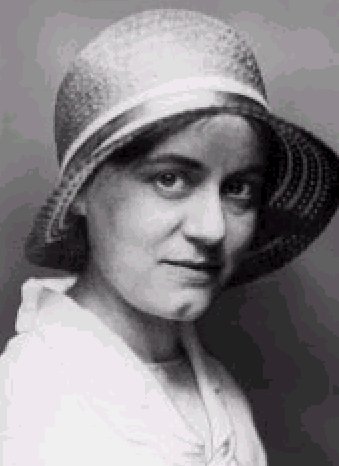
Saint Teresa Benedicta of the Cross (Edith Stein)
The liturgical prayer and some links for Saint Teresa Benedict is here…and a good biography is noted here.
14 Holy Helpers
Almighty and merciful God, who didst adorn Thy Saints
George, Blase, Erasmus, Pantaleon, Vitus, Christopher, Denis, Cyriacus, Acacius,
Eustace, Giles, Margaret, Barbara and Catherine with special privileges above
all others, so that all who in their necessities implore their help, according
to the grace of Thy promise, may attain the salutary effect of their pleading,
grant to us, we beseech Thee, forgiveness of our sins, and with their merits
interceding, deliver us from all adversities, and kindly hear our prayers.
Saint Dominic de Guzman
Blessed Cecilia’s description of Saint Dominic is how we know what he looked liked. And we have to be grateful for ancient chroniclers! They not only feed our curiosity but they show us concrete expressions of how God works through humanity … Descriptions like this one help us imagine what a person 8 centuries looked which helps to connect more closely to his reality. Blessed Cecilia wrote:
middle height and slender figure, of handsome and somewhat ruddy countenance,
his hair and beard of auburn, and with lustrous eyes. From out his forehead and
between his eye brows a radiant light shone forth, which drew everyone to
revere and love him. He was always joyous and cheerful, except when moved to
compassion at anyone’s sorrows. His hands were beautiful and tapering; his
voice was clear, noble, and musical; he was never bald, but kept his religious
tonsure entire, mingled here and there with a few grey hairs.” (From the
Legend of St. Dominic by Bl. Cecilia Cesarini)
Arrupe’s prayer for collaborating with Christ
Lord, meditating on our way of proceeding, I have discovered that the ideal of our way of acting is your way of acting.
Blessing of Grapes
A pious liturgical custom is for the priest to bless grapes on the feast of the Transfiguration of the Lord. Why do we bless grapes on the Transfiguration? Symbolically and on a concrete level grapes represent real transformation, an old vine produces new fruit, a new harvest for God. As the Lord was transfigured on Mount Tabor, so we too are given the grace by God to transform our lives more and more according to His will, the Gospel. The hard of personal conversion is done by authentically following the Church.
Theologically, one might say that the grape is symbolic of new life; think of the fruit derived from grapes, wine, used at Mass. That after the overshadowing of the Holy Spirit and the prayer of consecration the wine becomes the Precious Blood of Christ. It is by His Blood we are saved, given new life, a pledge of future glory with the Blessed Trinity in heaven. Many liturgical families, including the Latin, Byzantine and Armenian Churches have a liturgical theology and rite for the blessing of grapes and situate the blessing of grapes as a needed reminder of our real and on-going conversion to Christ in hearts and minds of Catholics. (Read this blog post on the blessing of grapes where the author brings together several elements: work, harvest, offering, human transformation by God, liturgy, new life, etc.).
The prayer
Priest: Our help is in the name of the Lord.
Response: Who made heaven and earth.
Priest: Let us pray to the Lord.
Response: Lord, have mercy.
Bless, O Father, this new fruit of the vine, which you permitted to ripen through good weather, and drops of dew and may it bring joy for us who will partake of this fruit of the vine, and forgiveness of sins to those who offer it, through the pure Body and Blood of Your Christ, with whom You are blessed, together with Your all holy, good and life-giving Spirit, now and always and forever and ever.
R. Amen.
(this blessing is taken from the August Menaion, Byzantine Melkite Euchologion published by the Melkite Eparchy of Newton.)
Transfiguration of the Lord
The Master came with his three friends
To climb Mount Tabor’s height
There he was changed,
transfigured with God’s uncreated light.
As Daniel, seer of old, had seen
One like a Son of Man,
On whom were kingship, sov’reignty,
And place at God’s right hand,
So too, said Peter, we have seen
His glory, come from God,
Revealed to us, who with him lived
And walked in ways he trod.
“This is my Son,” the Father said,
“In him is my delight.
To him give ear, that all your ways
May be within my light.”
Bring us, O Lord, to hear your Son
That, walking in his ways,
We as your daughters and your sons
May praise you all our days.
J. Michael Thompson
Copyright © 2009, World Library Publications
CM; ST. MAGNUS, ST. STEPHEN, MORNING SONG
Christ, the life of the Church
Are you thinking about the Transfiguration yet? You know, tomorrow’s feast. I think an excerpt from Samuel H. Miller’s The Life of the Church (p. 44ff) gets me pondering the person of Christ and who I want to be. And you?