Pope Benedict’s prayer intentions for December 2012


papa prega.jpgThe December prayer intentions of the Pope have us praying for migrants and for the Light of the Incarnation to radiate from our own faces as witnesses to someone greater than ourselves. These are particularly poignant set of prayer intentions for us in the USA: we are a nation of immigrants; we are a City set on a hill. Our solidarity in prayer if not in other concrete ways ought to remind us of our roots.

Let’s us join with Pope Benedict to pray for those who have left their home in the hope of finding work, peace, love and acceptance in other lands. Are we still hospitable children of God?

The general intention


That migrants throughout the world may be welcomed
with generosity and authentic love, especially by Christian communities.


The missionary intention


That
Christ may reveal himself to all humanity with the light that shines forth from
Bethlehem and is reflected in the face of his Church.

Speaking of God in 140 characters


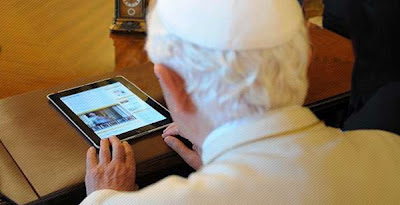
Pope with iPad.jpgThe Pope will tweet. Is this a mortal sin or a gospel value?


In today’s L’Osservatore Romano edition Mario Ponzi
writes of Pope Benedict’s latest venture into tweeting. The Pope is not going to give up his love of books, old fashion research and handwriting his talks, but he’s diving into more deeply in the digital world. He’ll have to keep his message
to 140 characters. Can he do it? I am sure the clarity of the Pope can be
limited to a mere 140 characters. It’s ancient history now in cyberworld but it
was June 2011 that the Holy Father touched his own iPad launching the Vatican’s
News.va portal; tweeting in five languages
is a polymath way of  communicating
at the Vatican.


Archbishop Claudio Maria Celli, 71, president of the Pontifical
Council for Social Communications
 since 2007, last week delivered his keynote address at
the 100th anniversary of Our Sunday Visitor. Celli has been hardworking in
moving the Holy See into the 21st century with an acceptance of social media and its benefits for communicating the gospel effectively today.


Enhanced by Zemanta

Continue reading Speaking of God in 140 characters

The Season of Advent proposes reclaiming the Garden of Eden

I love the Syriac tradition of liturgical theology. Often I find it a far more satisfying liturgical tradition than the Latin church craziness I face. It is Semitic, very biblical and rich in humanity. I recommend that you immerse yourself in the poetry of Saint Ephrem, deacon and Doctor of the Church.

The Maronite Church is one of whose heritage is West Syrian theologically; historically it’s rooted in the mountains of Lebanon. Their Advent Season has already begun with what is called the Season of Announcements (follow this link for more info on the season). This past Sunday was the Announcement to Mary. This coming weekend the Maronites will celebrate the Visitation of Elizabeth.
Father Steven Bonian, SJ, writes frequently on the sacred Liturgy of the West Syrian Church, the Maronites. See how he connects the Creator, creation and the Liturgy; the image of the Garden is key here for us Christians who are seeking salvation, that is, to dwell again in the Garden of Eden. 
Father Bonian said about the Sunday of Mary’s Announcement:

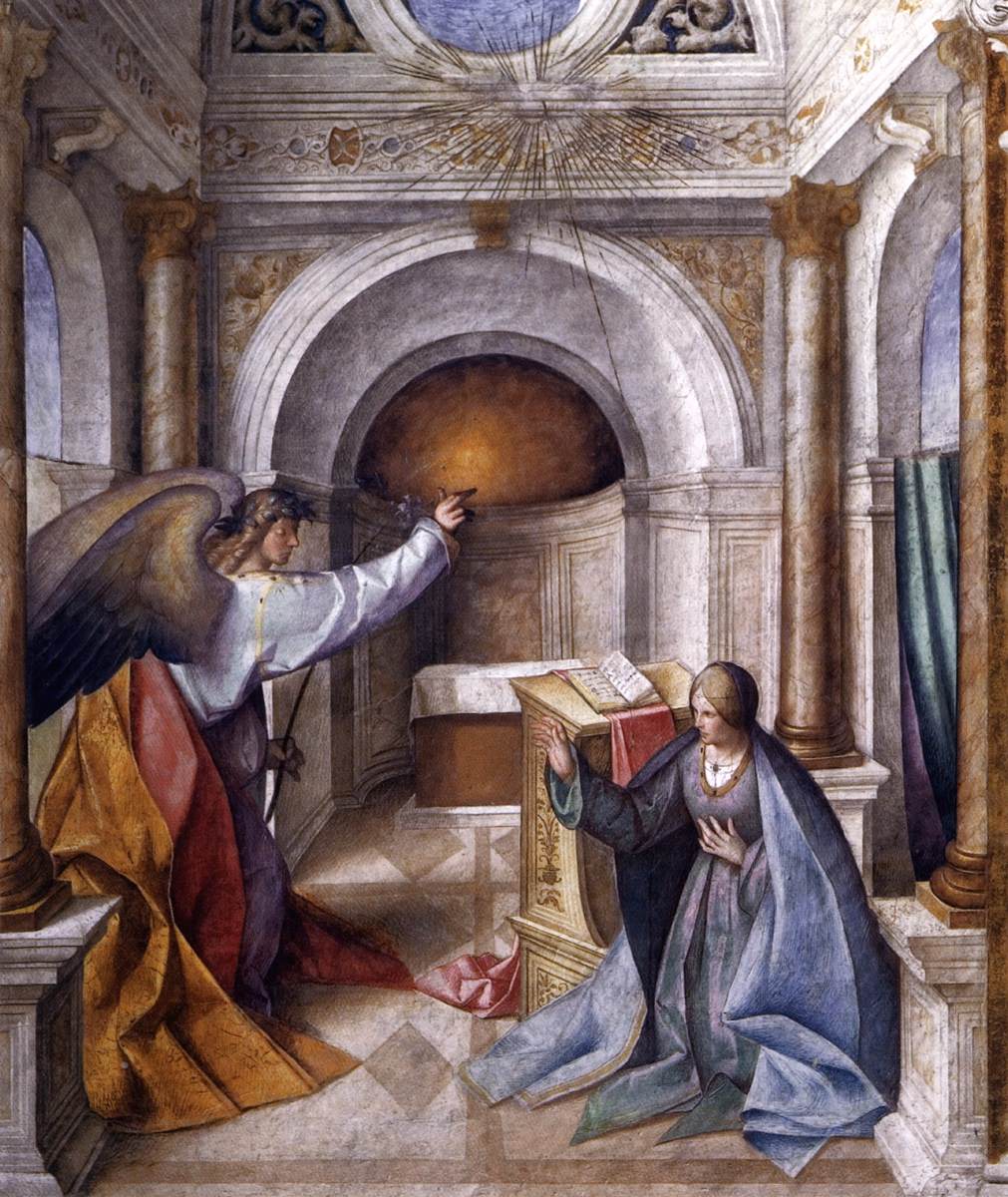
Annunciation Boccaccino.jpg

Today, the Letter of Saint Paul to the Galatians (3:15-22), reminds us of how the promise made to Abraham is now being fulfilled through those who believe; those who live by the Law and the Torah of the heart through righteousness. To such as these –like Mary– is the gift of God and his promise handed down through his angels. The Gospel of Luke makes it clear that Mary is the righteous one who has gained the favor of God, and thus, inherited this Gift (Christ) and the Promise (Salvation).
In the Gospel-Icon of Mary and the Angel drawn for us by Saint Luke, and framed for us in this Sunday’s prayers –in the context of the relationship of the creator with his creation –the mountains, the earth, the sea, and the waves are rejoicing in God’s Word! Mary herself has become the New Earth (as Saint Ephrem would teach us) and true representative for all of God’s creation. The Son of God comes to dwell in her, and through her God has returned to live –as in Paradise— in the midst of his creation. Now in Mary, the new covenant, and God’s plan of salvation is being fulfilled. She has become the Cloud, the Pure Womb, the Fountain of Life and Blessings!

Continue reading The Season of Advent proposes reclaiming the Garden of Eden

James Schall hits the target: On the “Art of Jesuitism”

I hate Jesuitism. Perhaps you do too. We stand in good company with Nietzsche and of course with Jesuit Father James Schall.

Full disclosure: I love Father Schall’s work. I love Nietzsche. Both get things correct. It may be surprising that someone as “crazy” as Nietzsche would interest me, or even Catholics. Several years ago I began to believe, after reading another Jesuit’s use of Nietzsche’s thought in one of his essays that we Christians need to take this man seriously. Whether you agreed with the philosopher and Schall is unimportant. What is crucial is that your horizons are stretched and forced to clarify and verify what we know to be true. Nietzsche means to be provocative, even nasty, but to dismiss him is wrongheaded.
Father Schall published an essay “On the Art of Jesuitism” looking at Nietzsche’s experience of Jesuits and their approach. You will be challenged in what both philosophers have to say.

Father James V. Schall, SJ, is a professor at Georgetown University and a well-published author. Father Schall is due to retire from GU.

Dorothy Day’s 32nd anniversary of death


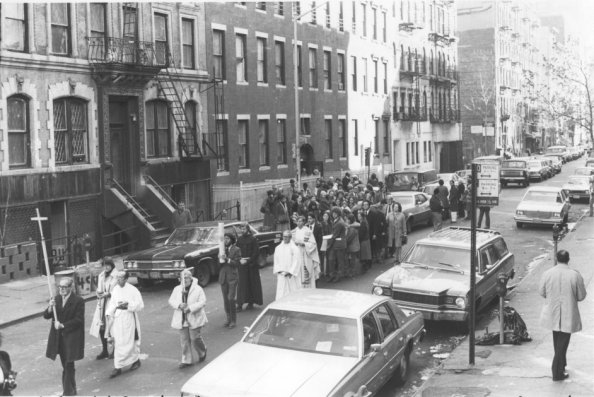
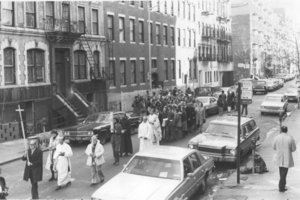
Day's Funeral procession.jpgToday is the 32nd anniversary of death of the Servant of God Dorothy Day. The Benedictine Oblate from Brooklyn Heights, NY, who is remembered for her conversion to Christ and His Church and with Peter Maurin founded The Catholic Worker Movement.

In recent days we’ve learned that the bishops of the USA are standing behind Day’s cause for canonization advancing it to the next canonical stage. While the process may be protracted for some, it is a good and substantial process to ascertain the claim of sanctity of the person in question. As an editorial, I tend to think 30 years is a good amount of time between the death of a person and the study process commencing; in my humble opinion I think it was far too short of time for Mother Teresa and Pope John Paul II beatifications; both are saints in my opinion, but I think the process can’t be shortchanged because of cosmic popularity.

Day was a Benedictine Oblate of St Procopius Abbey.

The Archdiocese of New York is in charge of the cause of canonization. You can contact the office at 212-371-1000, ext. 2474.

The following letter to the editors by Kenneth Woodward regarding the funeral of Dorothy Day which sheds some light on the New York Archdiocese’s involvement. Many are falsely led to believe the Church was callous because no bishop was present at the funeral Mass. Apparently, truth prevails. Read the letter.

To the Editors:

Your story on Dorothy Day and the bishops ignores a number of facts concerning her funeral, which I attended.

As it happened, Cardinal Terrance Cooke of New York wanted her funeral held in St. Patrick’s Cathedral, where the congregation would certainly have included many bishops, but the Catholic Worker community insisted that the funeral held in the neighborhood where Dorothy had lived so the poor could attend. Few actually did. At the church door each mourner was greeted by Cooke himself, not dressed in a cardinal’s finery but in a simple black cassock. Cooke did not stay for the mass because he did not want his presence to draw attention away from the woman for whose sake we mourners had gathered. Later, he held a memorial mass for Dorothy at the cathedral.

Cooke was a conservative churchman. So was Cardinal John O’Connor who formally initiated the cause on behalf of Dorothy Day’s canonization. Paradoxically, it was Father Daniel Berrigan and other members of the “Catholic Left” who opposed the effort to canonize Dorothy Day. Details can be found in my book, “Making Saints,” first published in 1996. Berrigan feared that in the canonization process the narrative of Day’s life would be stripped of its radical Christian elements. Those fears would indeed be realized if “Saint Dorothy” were to be venerated solely for her remorse for having had an abortion in the years prior to her conversion to Catholicism.

Kenneth L. Woodward

You also be interested to read the Eulogy given by the former Dominican Friar Geoffrey B. Gneuhs on December 2, 1980.

Benedictine Father Michael Zielinski appointed Head of Office for the Pope’s Worship Office

zielinski-sisinono.jpgThe Pope appointed Benedictine Abbot Christopher Michael John Zielinski to the be the Head of the Office (office manager) of the Congregation for Divine Worship and the Discipline of the Sacraments on Saturday, 24 November 2012. He is the number 3 person in the Congregation serving with Antonio Cardinal Cañizares, Archbishop Arthur Roche and Father Anthony Ward, SM.

Dom Michael, 59, a native of Lakewood, Ohio, is a monk of the Olivetan Congregation of Benedictines having professed monastic vows in 1972, who studied at Sant’Anselmo and ordained in 1977. Dom Michael is a past religious superior of the Abbey of Our Lady of Guadalupe (Pecos, NM). Until now and since 8 May 2008, he’s been the vice president of the Pontifical Commission for the Cultural Heritage of the Church and the Pontifical Commission for Sacred Archeology.

He is also a consultor to the same Congregation. 

Dom Michael gave an interview that covered his thinking on the Tridentine Mass in 2007.
Saint Benedict, pray for us.
Saint Bernard Tolomei, pray for Abbot Michael in his new work for the Church.
Enhanced by Zemanta

The “man from the Veneto” who was John Paul I

luciani.jpgMany of us only know the name Albino Luciani. He was the one who became Pope John Paul I in 1978 and lived only 33 days as the Supreme Pontiff. That was 34 years ago; I was only 9 when the smiling pope appeared and then departed. I often think of what the face of the Church would’ve been like had he lived longer.

Celebrating the 100th birthday of Pope John Paul I (17 October 1912), L’Osservatore Romano and Il Messaggero di sant’Antonio organized a symposium on November 8 learn more about this enigmatic man. An editorial in L’Osservatore Romano gave but a peek of what was learned.
Indeed, it’s interesting to hear that JPI followed three assumptions: “detachment from the world, obedience to superiors, and absolute faithfulness to the institution” in his ministry and that he was a lover of books. Me too. Apparently, JPI liked authors as diverse as Aesop, LaFontaine, Mark Twain (his favorite) to Chesterton and Dickens, among many. He also liked rock music and the comics. For a priest of the mountains he was an educated, curious and humane person. His cause for canonization is being studied.
Luciani spoke of the Second Vatican Council using soccer terms. Good for him. He got the point across to those who likely wouldn’t know where to begin to understand the complexities of a Ecumenical Council.
Read the editorial for yourself.
Enhanced by Zemanta

Dorothy Day not the patron saint of the “left” nor an agenda item of the “right”


Day the saint.jpgDorothy Day is not a pawn in political camps. She is the darling of a political camp for either the seculars or the ecclesials. To apply political monikers of liberal and conservative, left or right is grossly inaccurate and a rather reductionistic manner to understand a person and her vocation, the vocation defined by love and happiness. True to an authentic follower of Christ, Dorothy Day’s vocation was to be a saint, that is singularly focussed on her Lord and Savior; her vocation was to adore and follow Jesus Christ. Day’s vocation was not to feed the the poor and argue for a change in governmental policy. As a friend said, Day’s life is too easily “framed in political terms by people who anachronistically use words like ‘liberal’ and ‘conservative’ to describe a life that was never about that fight.” Additionally, I fully agree with Martha Hennessy, 57, the granddaughter of Day who said she was uncomfortable about her grandmother’s abortion. Let’s pay attention to Martha Hennessy, “I wish we would focus on the birth of her child more than on her abortion because that’s what really played a role in her conversion.” Indeed. This is the pro-life position of the Church.

I significantly dislike the way Day’s life is used to diminish a true practice of faith, of religion. The NY Times published Sharon Otterman’s article, “In Hero of the Catholic Left, a Conservative Cardinal Sees a Saint,” and it’s typically misguided with tired cliches and wrong information (her facts are often wrong) yet useful in a limited way because Dorothy Day saintliness shines. Obviously Otterman wanted a story and not the truth.

Feast of the Miraculous Medal

Miraculous medal.jpgThe feast of the Miraculous Medal may be surprising to a few. Catholics honor buildings, theological ideas, people and medals. The Miraculous Medal is known as the Medal of the Immaculate Conception, the medal that Our Lady on this date in 1830 instructed Saint Catherine Labouré to have struck. There is nothing miraculous about the medal. What is miraculous is the fact that it is a sign that God does miraculous things in our lives. In a boring world there are events that turn reality on end.

Do you believe in miracles? Do you believe that God cares for each of his creatures enough to make His presence known through signs?
The devotion to the medal is nothing more and nothing less than a person having trust in Mary’s instrumentality before the Throne of Grace. It is a devotion to the hearts of Jesus and Mary. Miracles of conversion, healing, cure, renewed faith, and more. Those who are devoted to the wearing the medal receive special graces at the time of death.

O Mary, conceived without sin, pray for us who have recourse to thee.

Schools of Theology: A 2012 Review

First Things editor RR Reno published his “A 2012 Ranking of Graduate Programs in Theology” yesterday, the annual romp through what’s out there for theological formation. A somewhat helpful review but it doesn’t really cover some important data. Nevertheless, it is good to see a review that advances a good perspective. What is that perspective? In my humble opinion: that in all things God may be glorified AND thinking with the Church.

The study of theology is not merely doing an academic program but it is truly a formation of the person so that he or she can be not only an excellent leader in theological investigation, spiritual formation, good pastoral practice but also work that one works out his or her own salvation.
  • The five areas a good school of theology needs to be attentive to: sacred Scripture, sacred Liturgy, patristic study, dogmatic study and ethics. I fully believe that Prosper of Aquataine is correct, and ought to orient all study of theology: legem credendi lex statuat supplicandi. In shorthand, the law of prayer is the law of belief.
I am happy that UND ranked high. I am interested to see how CUA will do in the year to come with the new dean Father Mark Morozowich. He’s got a lot of work to do. CUA is poised.