Day of penance for violations to the dignity of the human person

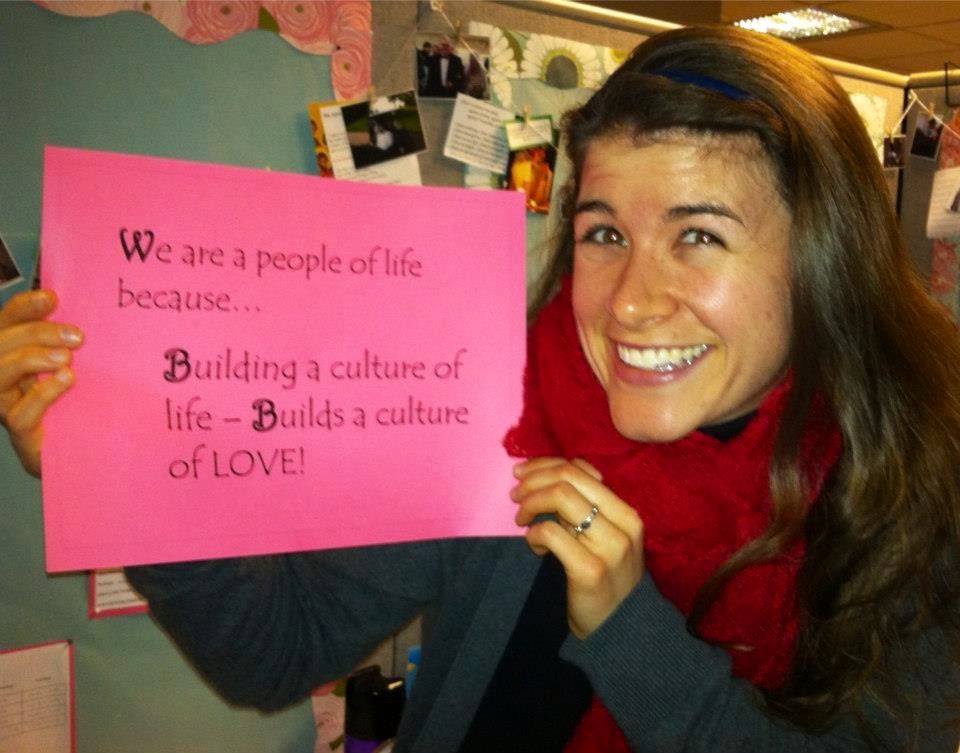
Pro lIfe girl.JPG

Let’s agree to follow the promptings of the Church and build a culture of LOVE.


Perhaps we can gather to have time for mental prayer, or to pray the Rosary and the Chaplet at 3pm.


From the US bishops we have this Mass rubric:


In all the dioceses of the United States of America, January 22 (or January 23, when January 22 falls on a Sunday) shall be observed as a particular day of penance for violations to the dignity of the human person committed through acts of abortion, and of prayer for the full restoration of the legal guarantee of the right to life. The Mass “For the Preservation of Peace and Justice” (no. 30 of the “Masses for Various Needs”) should be celebrated with violet vestments as an appropriate liturgical observance for this day.

General Instruction of the Roman Missal, no. 373

Prayer for the President of the United States of America

Seal of the President of the USA.jpg

We pray, Thee O Almighty and Eternal God! Who through Jesus Christ hast revealed Thy glory to all nations, to preserve the works of Thy mercy, that Thy Church, being spread through the whole world, may continue with unchanging faith in the confession of Thy Name.


We pray Thee, who alone art good and holy, to endow with heavenly knowledge, sincere zeal, and sanctity of life, our chief bishop, Pope Benedict, XVI, the Vicar of Our Lord Jesus Christ, in the government of his Church; our own bishop, Donald, all other bishops, prelates, and pastors of the Church; and especially those who are appointed to exercise amongst us the functions of the holy ministry, and conduct Thy people into the ways of salvation.


We pray Thee O God of might, wisdom, and justice! Through whom authority is rightly administered, laws are enacted, and judgment decreed, assist with Thy Holy Spirit of counsel and fortitude the President of these United States, that his administration may be conducted in righteousness, and be eminently useful to Thy people over whom he presides; by encouraging due respect for virtue and religion; by a faithful execution of the laws in justice and mercy; and by restraining vice and immorality. Let the light of Thy divine wisdom direct the deliberations of Congress, and shine forth in all the proceedings and laws framed for our rule and government, so that they may tend to the preservation of peace, the promotion of national happiness, the increase of industry, sobriety, and useful knowledge; and may perpetuate to us the blessing of equal liberty.


Continue reading Prayer for the President of the United States of America

Saint Agnes

Saint Agnes of Rome

Saint Agnes of Rome

What I longed for, I now see; what I hoped for, I now possess; in heaven I am espoused to him whom on earth I loved with all my heart. 

Saint Agnes raised her hands and prayed: Holy Father, hear me. I am coming to you whom I have loved, whom I have sought and always desired.

The feast of Agnes, like the other virgin martyrs of the Church point to the fact that loving Christ is no easy fact, even when the burning desire of the heart is tangible. Much suffering, much rejection, unto death, is the sign of discipleship. In many ways the line from yesterday’s gospel, “Do what he tells you” is very exacting today with Agnes.

The cost of being in love with Jesus Christ and the willingness to suffer for and with His sacrament, the Church, is as much a reality today in all parts of the world as it was for Agnes in hers.

Let is pray for persecuted Christians, those who desire to belong to Christ but can’t.

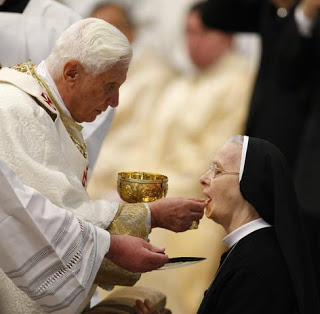
Receiving Holy Communion: correct gestures?

Three things came at me recently that I think needs to be looked at with intellectual and affective honesty. That is, from a perspective of faith and reason, the mind and the heart. The issue of how we receive Holy Communion.

When I was prepared to receive the sacrament of Holy Communion in the third grade by Sister M. Rosetta, CSFN, I was taught to receive our Eucharistic Lord kneeling and on the tongue. In fact, there were no other options available. At some point, for some unknown reason, I began to receive the Eucharist in my hand. And then the parishes I would attend all distributed Holy Communion standing. “That’s the way it’s done.” Surely there is a disconnect between what I was taught and what I eventually adopted. Mind you, I didn’t adopt a new way to receive Communion out of protest or because I thought better than the Magisterium. Sheer habit was born because, well, “just because.”
Back to the recent three things.
I heard, saw, experienced:
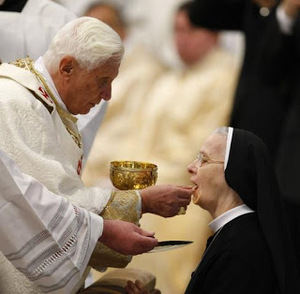
Pope gives HC.jpg

1. At the beginning of January, I heard Bishop Athanasius Schneider make a reasoned argument for receiving Holy Communion on the tongue and kneeling;
2. I’ve recently been re-adopting, in a conscientious manner, the way I receive Holy Communion: experience tells my heart and my mind that Communion received in a more traditional way, taking my example the papal Masses, is what the Lord requires in a relationship;
3. Deacon Greg Kendra (a permanent deacon of the Brooklyn Diocese) wrote on his blog that he thought it’s time to restore a greater sense of reverence in our liturgical practice by kneeling at the rail for Communion.
So, who cares what Deacon Kendra thinks? I am sure a few do; I think his blog piece opened a new window of opportunity to rethink pastoral practice for sensible and honest reasons. But if truth be told, Pope Benedict and Bishop Schneider carry the burden of argument.

The sacraments are events

[T]he sacraments constitute the events of a time which is the tension between the Resurrection and the Parousia …. Thus during the delay of the Parousia, the Eucharist prevents humanity, in this foretaste of celestial food …. And the Eucharist is the sacrament of unity which gathers about Christ of glory, present in the community, all nations in order to offer them through His hands to the Father.

Jean Cardinal Daniélou, SJ
Marxist History and Sacred History, 508-9

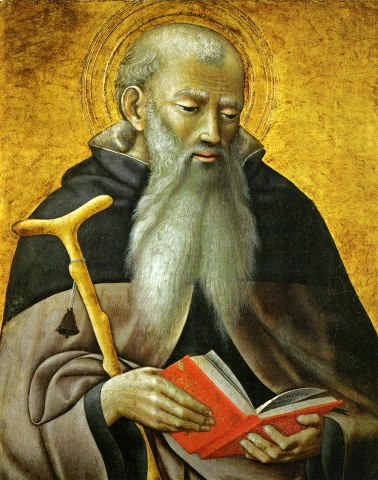
Saint Anthony Anthony of the Desert

Santo Antão.jpg

Saint Anthony, father of Monks, intercede for the monastic life in the present day for the monks and nuns can live his consecration in awe and charity at all pleasing only to God.

Saint Anthony Anthony of the Desert (c. 251-356) was a friend of God, and therefore a son and brother to others. His friendship with God flowed from his obedience (his listening to and building his relationship).

He’s known as the founder of monasticism. His rule of life established guidelines for living together as Christians. This is what came to be known as “monastic,” the intense and purpose driven living of the Gospel. Following the death of his parents and providing for his younger sister, Anthony became a monk at 20; his method was to live in total solitude on a desert mountain near the Nile River and eating only bread and water, which he never tasted before sunset, and sometimes only once in two, three, or four days. In the spiritual life the desert is the place to do battle with sin. Anthony shows us that it possible to overcome the temptations of the devil; emerging about 20 years later from total seclusion to instruct hermits in the ways of the Gospel, monasticism, Anthony gave witness to the power of Jesus Christ in his capacity to the heal the sick, being a spiritual father, by casting out demons and preaching. From him we begin to realize that not everything lasts forever. It is said that he lived at least to 100 years.

It is Saint Athanasius’s Life of Saint Anthony that perpetuates the narrative and inspired waves of monks who civilized and evangelized Europe and the Near East. Anthony established a monastery between the Nile and the Red Sea, which exists today.

Saint Anthony, pray for us. Help is to renew and in some cases, refound the monastic living.

Ibrahim Isaac Sidrak elected new Patriarch for Catholic Copts

Ibrahim Isaac Sidrak.jpegThe Most Reverend Ibrahim Isaac Sidrak, 57, was elected by the Synod of Bishop of the Catholic Coptic Church, to be Patriarch on January 15, 2013. He succeeds Antonio Cardinal Naguib.

Until now Patriarch Ibrahim has been the bishop of Minya since September 2002. He is the second bishop of Minya to be elected patriarch.
The Coptic Catholic Church is small with c. 165 thousand people. It was established in 1824. In Canada and the USA there are 5 parishes.

Continue reading Ibrahim Isaac Sidrak elected new Patriarch for Catholic Copts

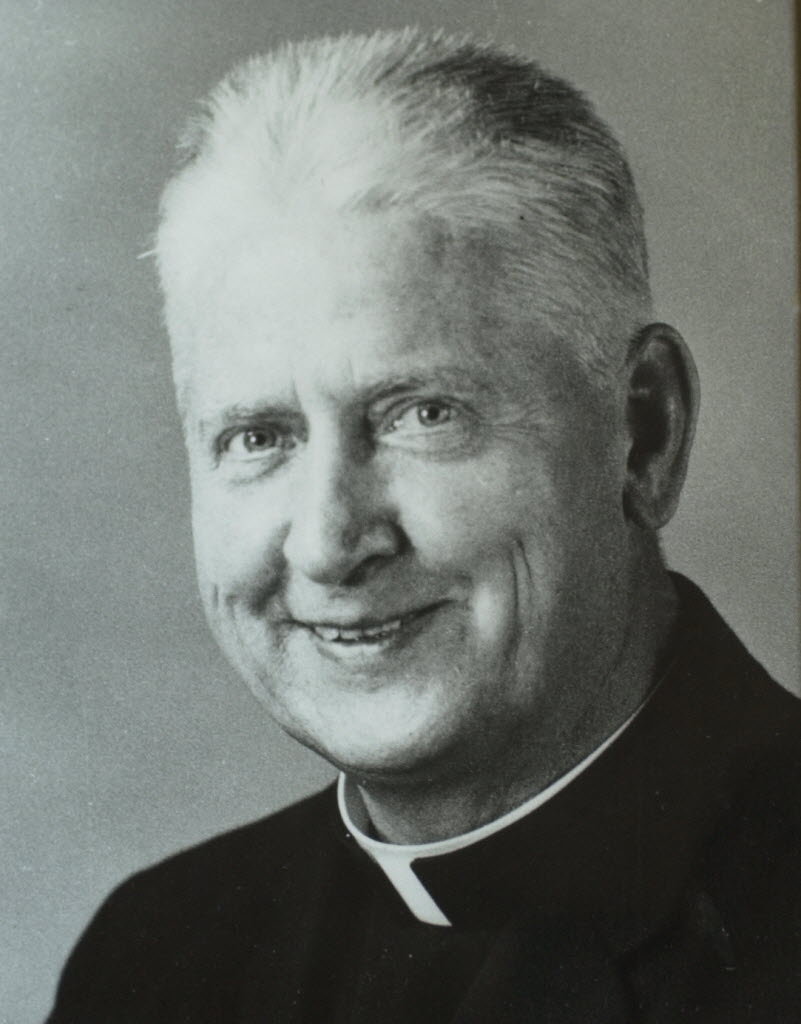
Walter Ciszek: Chained, but Free

Walter Ciszek.jpgFather Walter Ciszek (1904-84) is likely to be one the 20th century’s finest American priests –ever. If you don’t believe me read John Levko’s “Chained, but Free: How Walter Ciszek gained spiritual liberation in Lubyanka prison.” 

If you still don’t believe my assertion, read Ciszek’s With God in Russia and He Leadeth Me. Still lacking the same conviction that I have proposed, then you are hopeless. Father Walter Ciszek is not great because he survived 23 years of Soviet prison life; he’s the finest American priest’s of the 20th century because he allowed God to use his humanity and the Soviet prison to point to someone greater: Jesus Christ.

The Levko piece is a terrific testament to a life completely in communion with God. The article is too complicated to be digested here so you’ll have to read it for yourself. Enjoy it, but spend some time thinking and praying about what you’ve read.
You can read Father Jim Martin’s piece on Father Ciszek here.

Charles J. Chaput to Campus Ministers: enable students to hear God

Speaking to Catholic campus ministers on January 10, 2013 in Florida, Capuchin Archbishop Charles J. Chaput addresses the urgent need to give good, authentic formation to college students in the ways of God. As he says, the status quo is not good enough. Chessy programs are not satisfying.

The frequent question is how do we evangelize and give good formation to our college students today? I think we know what needs to be done. SO, let’s get to work; let’s teach, lead and pray. Campus ministry has an objective: seek the face of God; to enable one to hear the voice of God in the still small whisper. Of course, the issues of formation are not germane only to the college aged.

An excerpt: Campus ministry needs to lead young adults not just to good religious activities that keep them busy, but also to the beauty of interior silence that enables a person to hear the will of God and entrust his or her life to Jesus Christ.

The whole text: Charles J. Chaput on Catholic Campus Ministry Association 2013.pdf