In a meeting with Cardinal Angelo Amato, SDB, Prefect of the Congregation for Saints this morning in Rome, Pope Francis was presented with causes of several persons being studied for beatification and sainthood.
Lumen Fidei (“The Light of Faith”)
Pope Francis published his first encyclical today. Lumen Fidei (“The Light of Faith”), comes in the middle of the Year of Faith. The Pope told bishops, “It’s an encyclical written with four hands, so to speak, because Pope Benedict began writing it and he gave it to me. It’s a strong document. I will say in it that I received it and most of the work was done by him and I completed it.”
The full text is here: Lumen Fidei.pdf
Pope Benedict set out to write encyclicals on the theological virtues of faith, hope and charity. Two have been done and Lumen Fidei completes the course of study.
Thus Deus Caritas Est on charity in 2005 and Spe Salvi on hope in 2007.
Pope Benedict’s, Caritas in Veritate (Charity in Truth), published in 2009 focused on Catholic social teachings of the Church.
Lumen Fidei was presented Cardinal Marc Ouellet, prefect of the Congregation of Bishops, Archbishop Gerhard Ludwig Müller, prefect of the Congregation for the Doctrine of the Faith, and Archbishop Rino Fisichella, president of the Pontifical Council for Promoting the New Evangelization. Their presentation is here in various languages.
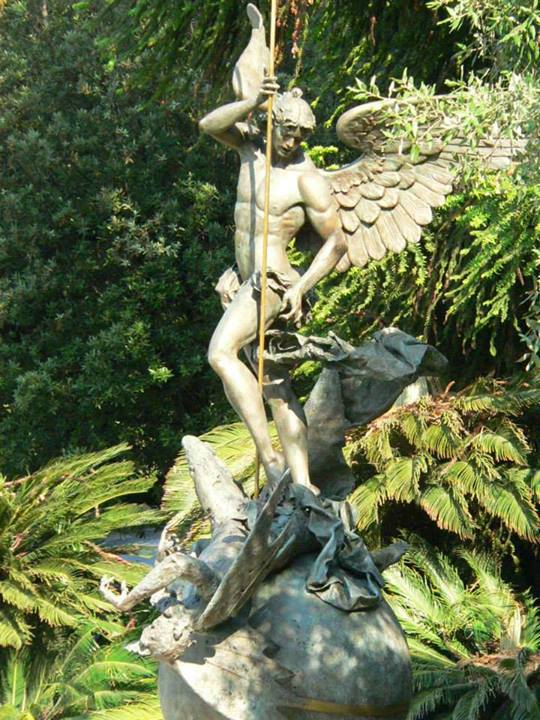
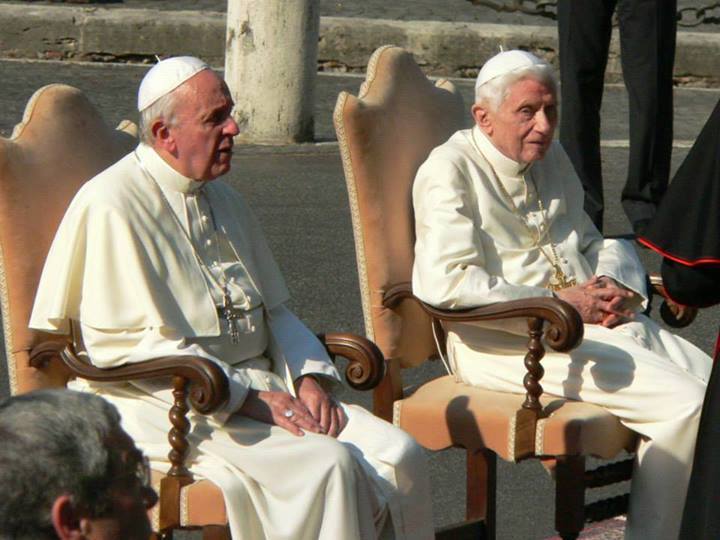
Francis and Benedict bless statue of St Michael
Popes Francis and Benedict at opening this morning at the blessing of a statue of Saint Michael the Archangel, near the Vatican Governorate. Pope Francis said,
“In the Vatican Gardens there are several works of art. But this, which has now been added, takes on particular importance, in its location as well as the meaning it expresses. In fact it is not just celebratory work but an invitation to reflection and prayer, that fits well into the Year of Faith. Michael – which means “Who is like God” – is the champion of the primacy of God, of His transcendence and power. Michael struggles to restore divine justice and defends the People of God from his enemies, above all by the enemy par excellence, the devil. And St. Michael wins because in him, there is He God who acts. This sculpture reminds us then that evil is overcome, the accuser is unmasked, his head crushed, because salvation was accomplished once and for all in the blood of Christ. Though the devil always tries to disfigure the face of the Archangel and that of humanity, God is stronger, it is His victory and His salvation that is offered to all men. We are not alone on the journey or in the trials of life, we are accompanied and supported by the Angels of God, who offer, so to speak, their wings to help us overcome so many dangers, in order to fly high compared to those realities that can weigh down our lives or drag us down. In consecrating Vatican City State to St. Michael the Archangel, I ask him to defend us from the evil one and banish him.”
The Fourth of July: looking to live in a freedom for excellence
Our prayer today ought to be for the citizens and the government of the USA. As the Collect for today’s Mass asks God who is justice and truth: to open our hearts to recognize divine truth and to be rule by His justice. We are not creators of our own destiny as Mr. Obama said today. God has given us our destiny. Our work is to recognize the path laid before us to walk to Him.
Continue reading The Fourth of July: looking to live in a freedom for excellence
In believing we may have life in Jesus
The feast of Saint Thomas is Easter in summer: an opportunity to open a new door in what we believe about in the Messiah. Saint Gregory notes below, God arranged His mercy particularly for us in concrete experience. He took the initiative once again.
With the Church, we pray:
Grant, almighty God, that we may glory in the Feast of the blessed Apostle Thomas, so that we may always be sustained by his intercession and, believing, may have life in the name of Jesus Christ your Son, whom Thomas acknowledged as the Lord.
From a homily on the Gospels by Saint Gregory the Great, pope
Thomas, one of the twelve, called the Twin, was not with them when Jesus came. He was the only disciple absent; on his return he heard what had happened but refused to believe it. The Lord came a second time; he offered his side for the disbelieving disciple to touch, held out his hands, and showing the scars of his wounds, healed the wound of his disbelief.
Dearly beloved, what do you see in these events? Do you really believe that it was by chance that this chosen disciple was absent, then came and heard, heard and doubted, doubted and touched, touched and believed? It was not by chance but in God’s providence. In a marvellous way God’s mercy arranged that the disbelieving disciple, in touching the wounds of his master’s body, should heal our wounds of disbelief. The disbelief of Thomas has done more for our faith than the faith of the other disciples. As he touches Christ and is won over to belief, every doubt is cast aside and our faith is strengthened. So the disciple who doubted, then felt Christ’s wounds, becomes a witness to the reality of the resurrection.
Touching Christ, he cried out: My Lord and my God. Jesus said to him: Because you have seen me, Thomas, you have believed. Paul said: Faith is the guarantee of things hoped for, the evidence of things unseen. It is clear, then, that faith is the proof of what can not be seen. What is seen gives knowledge, not faith. When Thomas saw and touched, why was he told: You have believed because you have seen me? Because what he saw and what he believed were different things. God cannot be seen by mortal man. Thomas saw a human being, whom he acknowledged to be God, and said: My Lord and my God. Seeing, he believed; looking at one who was true man, he cried out that this was God, the God he could not see.
What follows is reason for great joy: Blessed are those who have not seen and have believed. There is here a particular reference to ourselves; we hold in our hearts one we have not seen in the flesh. We are included in these words, but only if we follow up our faith with good works. The true believer practices what he believes. But of those who pay only lip service to faith, Paul has this to say: They profess to know God, but they deny him in their works. Therefore James says: Faith without works is dead.
The shared priesthood in a family
The are differences in how the Christian churches view priesthood. Generally speaking the priests of the Latin Church are celibate. But there are exceptions made for those who were formerly members of the Anglican Communion as married ministers who come into full communion with the Church of Rome. Then in many of the Eastern Catholic churches there are both married and celibate priests. In the USA, more of the Eastern Catholic priests are celibate due to an implementation of a rule imposed upon because of a strife between a Latin bishop and Eastern Catholics.
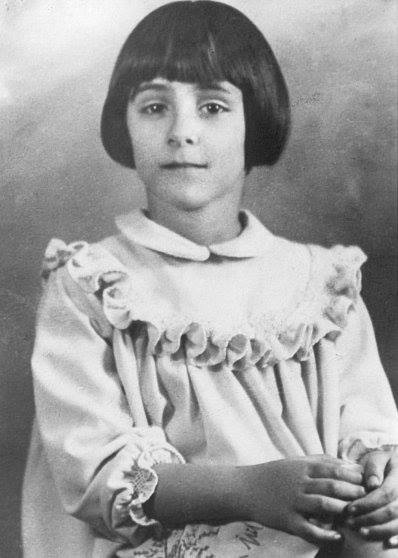
Antonietta (Nennolina) Meo
Today’s the anniversary of death (1937) of the Venerable Servant of God Antonietta Meo. She is known by many in Rome as Nennolina. Meo is a six year old candidate for sainthood, indeed a very young girl apparently was in love with Jesus and united her suffering (from cancer) to that of the Lord’s.
Actually I had forgotten about Nennolina’s anniversary until I saw it noted on a “friend’s page” on Facebook.
When I lived for a month with the Cistercians at Basilica of Santa Croce in Gerusalemme I came to know about this young sainthood candidate. I seem to recall that a family in Michigan and in Indiana was attributing a miracle through Meo’s intercession. Since I’ve not been following the cause, I don’t the state of her sainthood process except that Benedict XVI recognized her heroic virtues in 2007.
Antonietta Meo was a student of the Apostles of the Sacred Heart of Jesus in Rome.
Nennolina is buried in the Basilica of Santa Croce in Gerusalemme, the same place where the relics of the Holy Passion are located. She was baptized in this church and spent time in prayer there.
Read her letters.
Saint Thomas
Was Saint Thomas really doubting, skeptical, or trying understand a new reality he met in the risen Lord? The so-called skepticism is seen as weakness but in the Christian way of looking at life, weakness is power. Doubt is really clarification. Thomas, is really an apostle of the Lord’s glorification as John’s Gospel indicates for us. I can also see Thomas as the apostle who loves the Lord with passion, with ardor, as when he tells the disciples to go with the Lord to the cross when witnessing to the death of Lazarus. Thomas is also the apostle of Christology. He asks, “Lord, we don’t know where you are going, how can we know the way?” Jesus sets gives one of his clearest teachings of who He is: “I am the way, the truth and the life.” But somewhere along the path charted by Jesus Thomas doesn’t immediately accept what others have to say about the resurrection from the dead of Jesus but has to personally probe the fact.
Eusebius of Caesarea writes that Thomas evangelized the peoples of Persia; there is also the claim that he evangelized western India, founding what is known today as the Malabar Church, and later martyred there.
Like Thomas, Didymus, we’ve met the Lord in his glorious wounds and sometimes we miss what those wounds mean. Thomas is here to help us. Pope Francis tells us,
“We find Jesus’ wounds in carrying out works of mercy, giving to our body – the body – the soul too, but – I stress – the body of your wounded brother, because he is hungry, because he is thirsty, because he is naked because it is humiliated, because he is a slave, because he’s in jail because he is in the hospital. Those are the wounds of Jesus today. And Jesus asks us to take a leap of faith, towards Him, but through these His wounds. ‘Oh, great! Let’s set up a foundation to help everyone and do so many good things to help ‘. That’s important, but if we remain on this level, we will only be philanthropic. We need to touch the wounds of Jesus, we must caress the wounds of Jesus, we need to bind the wounds of Jesus with tenderness, we have to kiss the wounds of Jesus, and this literally. Just think of what happened to St. Francis, when he embraced the leper? The same thing that happened to Thomas: his life changed.
Second miracle for John Paul’s canonization approved by the bishops
Several weeks ago word was received that the theologians approved of the findings they were presented on a miracle studied to support Blessed John Paul’s cause of canonization. A second miracle is required for the canonization process to certify that the person being presented for canonization is authentic; the person doesn’t create the miracle but it is through that person’s intercession before God asking Him for the favor.
Why the face?
Bitchy Resting Face (BRF) is a syndrome that portrays a sour expression. Thoughtfully sad and silently suffering people, typically women. (There is a male version which I will leave alone for now.) Do you find it hard to match the others joyous attitude in an honest way? Are you smiling?