Blessed Martyrs of Nowogrodek, the 70th anniversary of their murder

Martyrs of NowogrodekA group of eleven Sisters of he Holy Family of Nazareth  were murdered by the Nazis in exchange for 120 condemned citizens of Nowogródek, current day Belarus.

Sister Stella and her companions were murdered on this date, 1 August 1943 by the Gestapo in Novogródek, Hrodzyenskaya voblasts’, Belarus.

Invited by the bishop of the area to come serve the Church in the village of Novogródek in 1929, the Congregation of the Holy Family of Nazareth were well received by the people.

Tensions ran high with the Nazi occupation. When it became clear that the sacrifice of life was imminent, the Sisters in conversation with their chaplain, Father Zienkiewicz, said, “My God, if sacrifice if life is needed, accept it from us and spare those who have families. We are even praying for this intention.”

Blessed John Paul beatified the sisters on 5 March 2000.

The Blessed Martyrs are stilled remembered with devotion.

Pius XII to made a saint?

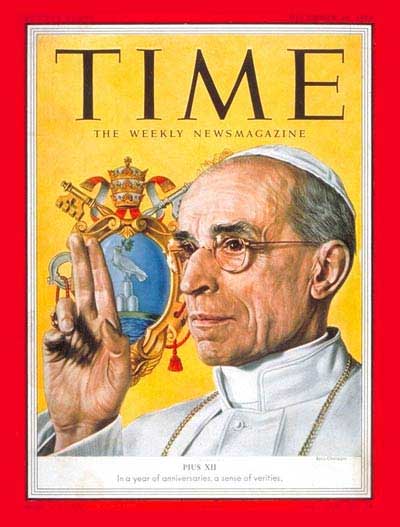
Pius XII on Time coverThe Catholic News Agency ran an article on Wednesday by Andrea Gagliarduccui, “Pope Francis thinking about declaring Pius XII a saint.” The idea of making Pius a saint more quickly has more than a passing interest for me: I think the Venerable Servant of God Pope Pius XII was a holy man and he ought to be made at least a blessed, but I will accept sainthood, too. The work he did to save the Jews from death contribute to us understanding his life in Grace.

It is being posited that Pope Francis may dispense with the beatification process and the rigorous examination of miracles and push Pius to sainthood. He recently decided to exempt Blessed John XXIII ahead of some of the sainthood process.

As the author notes, the study concerning Pius’s sanctity is near completion and there are several miracles attributed to Pius’ intercession.

Pius was the Roman Pontiff from 1939-1958.

Saint Alphonsus Liguori

O God, who constantly raise up in your Church new examples of virtue, grant that we may follow so closely in the footsteps of the Bishop Saint Alphonsus in his zeal for souls as to attain the same rewards that are his in heaven.

The following text is taken from a sermon by Saint Alphonsus Liguori (September 27, 1696 – August 1, 1787), bishop, founder of a religious order and a Doctor of the Church. You and I would do well to take stock of how much we really live a life of virtue and how much we are concerned with our final end, hopefully, heaven.

Saint Alphonsus:

All holiness and perfection of soul lies in our love for Jesus Christ our God, who is our Redeemer and our supreme good. It is part of the love of God to acquire and to nurture all the virtues which make a man perfect.

Has not God in fact won for himself a claim on all our love? From all eternity he has loved us. And it is in this vein that he speaks to us: “O man, consider carefully that I first loved you. You had not yet appeared in the light of day, nor did the world yet exist, but already I loved you. From all eternity I have loved you.”

Since God knew that man is enticed by favours, he wished to bind him to his love by means of his gifts: “I want to catch men with the snares, those chains of love in which they allow themselves to be entrapped, so that they will love me.” And all the gifts which he bestowed on man were given to this end. He gave him a soul, made in his likeness, and endowed with memory, intellect and will; he gave him a body equipped with the senses; it was for him that he created heaven and earth and such an abundance of things. He made all these things out of love for man, so that all creation might serve man, and man in turn might love God out of gratitude for so many gifts.

But he did not wish to give us only beautiful creatures; the truth is that to win for himself our love, he went so far as to bestow upon us the fullness of himself. The eternal Father went so far as to give us his only Son. When he saw that we were all dead through sin and deprived of his grace, what did he do? Compelled, as the Apostle says, by the superabundance of his love for us, he sent his beloved Son to make reparation for us and to call us back to a sinless life.

By giving us his Son, whom he did not spare precisely so that he might spare us, he bestowed on us at once every good: grace, love and heaven; for all these goods are certainly inferior to the Son: He who did not spare his own Son, but handed him over for all of us: how could he fail to give us along with his Son all good things?

Vatican Bank walks to transparency amid problems

Ernst von Freyberg and Pope Francis have been hot on reforming the Institute of Works of Religion (Istituto per la Opere di Religione [IOR]), also called the Vatican Bank. Work started under Benedict XVI and much has been done to give a comprehensive review and reform of the IOR’s workings. Behavior unbecoming of the IOR has been in the media and it greatly distracts from the Church’s work.

A new pontificate with interest in reform sets the stage and expectation.

Yesterday the IOR unveiled its new website that can be accessed here.

Lots of good and fundamental information is contained on website.

Compliments to Mr. von Freyberg for taking the work seriously. The website is only a beginning but what is given to us as a concrete gesture of trust. If the Vatican Bank is going to continue, and if it is going to truly live the mission to serve the universal Church, then nothing short of complete revision and coherence is required. The renewal of the IOR means: all of the clergy, especially the bishops and cardinals, need to be replaced with competent and honest men; plus, the integration of a group of international competent laity (men and women) to run the bank need to be appointed; and an attitude of service doing the Lord’s work for the common good needs to be concretely lived. This last point we can’t dismiss: there needs to be a program of spiritual formation in place. Take nothing for granted. Anything to the contrary ought to lead directly to the immediate closure of the Vatican Bank.

Pope Francis’ prayer intentions for August 2013

Some people are on the way back to school. St Benedict’s Prep (at Newark Abbey, Newark, NJ), an inner-city  school operated by the Benedictine monks began their academic year this past week. My prayer for the students, teachers, and staff members is for a year full of grace and an appreciation for wonder and awe in the work of study. Pope Francis’ prayer intention is the maturation of the Christian conscience. And there is the peace and justice work needs our attention before God and in our daily life.

Saint Thomas Aquinas, pray for us!

The general intention

That parents and teachers may help the new generation to grow in upright conscience and life.

The missionary intention

That the local Church in Africa, faithfully proclaiming the Gospel, may promote peace and justice.

Francis honors Ignatius, calls us to more faithful life in Christ

The faithfulness to the spiritual patrimony one is raised on is an essential piece of understanding one’s own history and the grace that you’ve been given. That doesn’t mean, in my mind, that you can’t augment the first inspiration with another so you can round-out your life in a new way. Perhaps making the connection between Ignatian spirituality with that of the Benedictine charism. Pope Francis has done that in my mind. He’s faithful to Loyola’s Exercises and yet has an appreciation for many of the Carmelites. Here is the papal homily given earlier in Rome for the liturgical memorial of Saint Ignatius of Loyola, a man who’s path to be a soldier for Christ and His Church was started by a cannonball injury. Later, Ignatius set his eyes on the Lord by doing an extended retreat at the Benedictine Abbey of Montserrat. Recall, it is Ignatius experience with the monks that his conversion takes shape and does the Spiritual Exercises. You would do well to be attentive to the Pope’s quoting of the Spiritual Exercises. AMDG
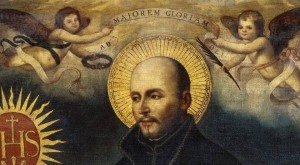
Loyola detailIn this Eucharist in which we celebrate our Father Ignatius of Loyola, in light of the Readings we have heard, I would like to propose three simple thoughts guided by three expressions: to put Christ and the Church in the centre; to allow ourselves to be conquered by Him in order to serve; to feel the shame of our limitations and our sins, in order to be humble before Him and before the brothers.

1. The emblem of us Jesuits is a monogram, the acronym of “Jesus, the Saviour of Mankind” (IHS). Every one of you can tell me: we know that very well! But this crest continually reminds us of a reality that we must never forget: the centrality of Christ for each one of us and for the whole Company, the Company that Saint Ignatius wanted to name “of Jesus” to indicate the point of reference. Moreover, even at the beginning of the Spiritual Exercises he places our Lord Jesus Christ, our Creator and Saviour (Spiritual Exercises, 6) in front of us. And this leads all of us Jesuits, and the whole Company, to be “decentred,” to have “Christ more and more” before us, the “Deus semper maior”, the “intimior intimo meo”, that leads us continually outside ourselves, that brings us to a certain kenosis, a “going beyond our own loves, desires, and interests” (Sp. Ex., 189). Isn’t it obvious, the question for us? For all of us? “Is Christ the centre of my life? Do I really put Christ at the centre of my life?” Because there is always the temptation to want to put ourselves in the centre. And when a Jesuit puts himself and not Christ in the centre, he goes astray. In the first Reading, Moses forcefully calls upon the people to love the Lord, to walk in His ways, “because He is your life” (cf. Deut. 30, 16-20). Christ is our life! The centrality of Christ corresponds also to the centrality of the Church: they are two flames that cannot be separated: I cannot follow Christ except in and with the Church. And even in this case we Jesuits and the whole Company, are not at the centre, we are, so to speak, “displaced”, we are at the service of Christ and of the Church, the Bride of Christ our Lord, who is our Holy Mother Hierarchical Church (cf. Sp. Ex. 353). To be men routed and grounded in the Church: that is what Jesus desires of us. There cannot be parallel or isolated paths for us. Yes, paths of searching, creative paths, yes, this is important: to go to the peripheries, so many peripheries. This takes creativity, but always in community, in the Church, with this membership that give us the courage to go forward. To serve Christ is to love this concrete Church, and to serve her with generosity and with the spirit of obedience.

2. What is the way to live this double centrality? Let us look at the experience of Saint Paul, which was also the experience of Saint Ignatius. The Apostle, in the Second Reading that we heard, writes: I press on towards the perfection of Christ, “because I have indeed been conquered by Jesus Christ” (Phil. 3:12). For Paul it came along the road to Damascus, for Ignatius in his house at Loyola, but the fundamental point is the same: to allow oneself to be conquered by Christ. I seek Jesus, I serve Jesus, because He sought me first, because I was conquered by Him: and this is the heart of our experience. But He is first, always. In Spanish there is a word that is very graphic, that explains this well: He “primerea” first ahead of us, “El nos primerea”. He is always first. When we arrive, He has already arrived and is expecting us. And here I want to recall the meditation on the Kingdom in the Second Week. Christ our Lord, the eternal King, calls each one of us, saying to us: “He who wants to come with Me must work with Me, because following Me in suffering, he will follow after Me likewise in glory” (Sp. Ex. 95): Being conquered by Christ in order to offer to this King our whole person and all our hard work (cf. Sp. Ex. 96); to say to the Lord that he would do anything for His greater service and praise, to imitate Him in bearing even injury, contempt, poverty (Sp. Ex. 98). But I think of our brother in Syria in this moment. To allow ourselves to be conquered by Christ means to be always directed towards what is in front of me, toward the goal of Christ (cf. Phil. 3:14), and to ask oneself with truth and sincerity: “What have I done for Christ? What am doing for Christ? What must I do for Christ?” (cf. Sp. Ex. 53).

3. And I come to the final point. In the Gospel, Jesus says to us: “Whoever would save his life will lose it, but whoever loses his life for my sake will save it . . . If anyone is ashamed of me . . .” (Lk 9:23). And so on. The shame of the Jesuit. The invitation that Jesus makes is for us to never be ashamed of Him, but to always follow Him with total dedication, trusting Him and entrusting ourselves to Him. But looking at Jesus, as Saint Ignatius teaches us in the First Week, above all looking at Christ crucified, we have that very human and noble feeling that is the shame of not reaching the highest point; we look at the wisdom of Christ and at our ignorance; at His omnipotence and our weakness; at His justice and our iniquity; at His goodness and our wickedness (cf. Sp. Ex. 59). Ask for the grace of shame; the shame that comes from the constant dialogue of mercy with Him; the shame that makes us blush before Jesus Christ; the shame that puts us in tune with the heart of Christ who is made sin for me; the shame that harmonises our heart in tears and accompanies us in the daily following of “my Lord”. And this always brings us, as individuals and as a Company, to humility, to living this great virtue. Humility that makes us understand, each day, that it is not for us to build the Kingdom of God, but it is always the grace of God working within us; humility that pushes us to put our whole being not at the service of ourselves and our own ideas, but at the service of Christ and of the Church, like clay pots, fragile, inadequate, insufficient, but having within them an immense treasure that we carry and that we communicate (2 Cor. 4:7). It is always pleasant for me to think of the sunset of the Jesuit, when a Jesuit finishes his life, when the sun goes down. And two icons of the sunset of the Jesuit always come to me: one classical, that of Saint Francis Xavier, looking at China. Art has painted this sunset so many times, this ‘end’ of Xavier. Even in literature, in that beautiful peace by Pemàn. At the end, having nothing, but in the sight of the Lord; it does me good to thing about this. The other sunset, the other icon that comes to me as an example, is that of Padre Arrupe in the last interview in the refugee camp, when he told us – something he himself said – “I say this as if it were my swan song: pray.” Prayer, the union with Jesus. And, after having said this, he caught the plane, and arrived at Rome with the stroke that was the beginning of so long and so exemplary a sunset. Two sunsets, two icons that all of us would do well to look at, and to go back to these two. And to ask for the grace that our sunset will be like theirs.

Dear brothers, let us turn again to Our Lady, to her who bore Christ in her womb and accompanied the first steps of the Church. May she help us to always put Christ and His Church at the centre of our lives and of our ministry. May she, who was the first and most perfect disciple of her Son help us to allow ourselves to be conquered by Christ in order to follow Him and to serve Him in every situation. May she that answered the announcement of the Angel with the most profound humility: “Behold the handmaid of the Lord, be it done unto me according to thy word” (Lk 1:38), make us feel the shame for our inadequacy before the treasure that has been entrusted to us, in order to live the virtue of humility before God. May our journey be accompanied by the paternal intercession of Saint Ignatius and of all the Jesuit saints, who continue to teach us to do all things “ad majorem Dei gloriam.”

Pope Francis offers Mass for St Ignatius’ feast

As the universal Church remembers Saint Ignatius of Loyola, founder of the Society of Jesus, the Jesuits in Rome the history’s first Jesuit pope offered Mass today at the Gesù, consecrated in 1584, known as the mother church of the Society.

In his homily Pope Francis said, “We serve Christ and His Church…. [with] no parallel or isolated paths.” He’s true to Loyola’s heart and mind.

About 270 Jesuits were present. At the conclusion of Mass, the Holy Father prayed at the tomb of the Servant of God Father Pedro Arrupe, Basque Jesuit and Superior General of the Society, 1965-83; he died in 1991.

As my friend Michael Brelsford observed, “Its cool when, during the intercessions when the church prays for the pope, you can look up and see him standing no more than 15 yards away. Thank you one last seat left in the third row! After Mass he came around the side to pray at a tabernacle next to me. At one point, I think I was the closest to him in the room!” Michael is entering the least Society in August; he’s been in Rome on pilgrimage.

Jesuit Father Norman Tanner and Veronica Scarisbrick of Vatican Radio spoke today about the Jesuit vocation. The conversation is here.

AMDG

The photo is courtesy of Antonio Spadaro, SJ.

Saint Peter Chrysologus

The reflection of Trappist Father Dominic (Spencer Abbey) is the best I can do today for Saint Peter Chrysologus (380-450), bishop of Ravenna, and Doctor of the Church. One Chrysologus’ famous lines that gets retold, “Anyone who wishes to frolic with the devil cannot rejoice with Christ.”

Father Dominic preached:

Saint Peter Chrysologus, whom we honor today, puts the following words on the lips of the Risen Lord Jesus, who still bears his wounds as he appears to his disciples:

In me, I want you to see your own body, your members, your heart, your bones, your blood. You may fear what is divine, but why not love what is human? You may run away from me as the Lord, but why not run to me as your father? Perhaps you are filled with shame for causing my bitter passion. Do not be afraid. This cross inflicts a mortal injury, not on me, but on death. These nails no longer pain me, but only deepen your love for me. I do not cry out because of these wounds, but through them I draw you into my heart. My body was stretched on the cross as a symbol, not of how much I suffered, but of my all-embracing love. I count it no loss to shed my blood: it is the price I have paid for your ransom. Come, then, return to me and learn to know me as you father, who repays good for evil, love for injury, and boundless charity for piercing wounds.

Indeed we are called to recognize our own humanity in both the Crucified and Risen Lord. In the incarnation Jesus reflects back to us, actually reveals to us, our own humanity. St. Leo the Great will add in a Lenten homily: “Is there anyone whose own weakness is not recognizable in Christ’s?” And he assures us: “The body that lay lifeless in the tomb, that rose again on the third day, and that ascended above the heavens to the Father’s right hand, belongs to us.”

Contemplation AND ordinary experience praise God

I would say that it is very important in the contemplative life not to overemphasize the contemplation. If we constantly overemphasize those things to which access is inevitably quite rare, we overlook the ordinary authentic real experiences of everyday life as real things to enjoy, things to be happy about, things to praise God for.

But the ordinary realities of everyday life, the faith and love with which we live our normal human lives, provide the foundation on which we build those higher things. If there is no foundation, then we have nothing at all!

How can we relish the higher things of God if we cannot enjoy some simple little thing that comes along as a gift from Him!

Thomas Merton
Contemplation in a World of Action

Pope speaks to journalists on his way home: divorced and remarried, women, and homosexuals

On his way back to the Eternal City from Rio de Janeiro, Pope Francis spoke with journalists for an hour and 20 minutes. Unscripted prior to the flight and a bit provocative if you don’t know how to “read” Pope Francis viz. the Church’s teaching and his pastoral sensitivities.

The news agencies latched onto Francis’s comments in such a reductionist way. They got lost in the weeds. Even the Catholic news people could find themselves out their quagmire of silly thinking and partial reporting. Do you get tired of part-time journalists who pander to the audience? I do.

Father Tom Rosica, CSB, head of Salt+Light TV who was on flight and took note of the question and he gives the Pope’s answer in full. In English with the original Italian. Read what the Holy Father said for yourself. Father Rosica gave the Catechism’s answer on homosexuality.

Here is the video from Rome Reports.

When you take things out of context, or don’t have a full grasp of the teaching of the Church, even the willingness to dig deeply into what is taught, the result you get is a reduction. AND we don’t live in reductions very well. As Rosica says, “His [the Pope’s] comments on the plane, particularly about the divorced and remarried, women, and homosexuals must be read and understood through the lenses of the Gospel of Jesus Christ, the outreach and concern of the Church for those on the fringes, and the mercy, tenderness and forgiveness of a pastor who walks among his people.”

Remember mercy is still a hallmark of our Christian faith!!!!