Knights of Columbus move to the Ukraine and Lithuania

The Knights of Columbus has now moved to new parts: the Ukraine and Lithuania. Great news! In 2006, the KofC  expanded to Poland with great hope and success. The natural progression in Eastern Europe is now to the peoples of the great East and Baltic states.

The roots of this move is heard in the 2005 homily of Cardinal Lubomyr Husar, MSU, now the Major Archbishop emeritus of the Ukrainian Church where he expressed in clear terms his hope that the Knights would come to his country. Let’s recall that in his early life, Cardinal Husar was a member of the Stamford Eparchy. Hence, he is a first hand witness to the good work of the Knights of Columbus in Connecticut, the USA, indeed, worldwide.

The Knights just completed their 131st convention in San Antonio. They wrote the following note on their webpage.

The Archeparchy of Philadelphia for the Ukrainians posted this announcement on their blog, The Way.

May God be glorified!

Cardinal O’Malley highlights Pope’s tenderness and compassion for others, but the media doesn’t listen

The people in the media sometimes hear the same words as everyone else does at the same time but they just don’t seem to get the story correct. Misinformation is generated and passed as correct thus obscuring the truth. I want to believe that media professionals are not extraordinarily ideological as much as they have are unable to connect the dots and to think theologically; they have little interest in matters of religion, plus there’s a tendency to reduce what is said to a least common denominator because there is no perceived value in the story. Lack of interest breeds misinformation.

Thinking in a public way the other day, Boston’s Cardinal O’Malley spoke of Pope Francis in these terms: “his tenderness which is not the virtue of the weak but a sign of strength of spirit and a capacity for concern and compassion, for genuine openness to others, for love.” However, what the press reported was that Pope Francis is only concerned for to love others and soft on life issues thus is changing the Church’s teaching on matters like abortion. But that’s not what the cardinal said, nor what the pope thinks and teaches us. The pope has demonstrated that his belief and teaching is in continuity with his predecessors and that he upholds each iota there is in biblical and magisterial teaching. See, for example, Francis’ various homilies and talks in recent months: June’s Evangelium Vitae Day, the Day of Life address in July, his message to the bishops of Latin America and to the Knights of Columbus.

What O’Malley said, in part, was the following:

Some people think that the Holy Father should talk more about abortion. I think he speaks of love and mercy to give people the context for the Church’s teaching on abortion. We oppose abortion, not because we are mean or old-fashioned, but because we love people. And that is what we must show the world. Recently I read about an American relief worker in Africa, who reported on being at a camp for a food-distribution line, it was very chaotic, even scary. He could see that they were running out of food and that these starving people were desperate. At the end of the line, the last person was a little nine-year-old girl. All that was left was one banana. They handed it to her. She peeled the banana and gave half each to her younger brother and sister. Then she licked the banana peel. The relief worker said at that moment he began to believe in God.

We must be better people; we must love all people, even those who advocate abortion. It is only if we love them that we will be able to help them discover the sacredness of the life of an unborn child. Only love and mercy will open hearts that have been hardened by the individualism of our age.

Sean Cardinal O’Mally, OFM Cap
Archbishop of Boston
Address to the Knights of Columbus Convention, excerpt
San Antonio, Texas

Whatever is said by the media about the pope these days needs to be fully scrutinized for its accuracy. You need to read the texts yourself; do your own homework; don’t let other digest what the teaching authority of the Church supposedly said, use your critical thinking skills. Secular news agencies, including some of the Catholic news agencies, count on you not doing your own work –they are happy to do the thinking for you. Some media elites are able to discredit the Church through the person of the pope as well as others because they hope you won’t notice coupled with the fact they accept what the bible and the Church teaches; if the media people don’t believe in the biblically revealed vision of life and happiness that the Church teaches as beautiful, good and true, then how could we accept at face value that they are conveying fact.

Opposition to abortion, care for the elderly, visiting the imprisoned, concern for the poor, uneducated and marginalized are some of the many ways the Church defines human dignity, love and happiness. The embrace of all human beings regardless of status in society is the Church’s way of life.

Witness to marriage, family and dignity of all life, Pope Francis tells KofC

Conscious of the specific responsibility which the lay faithful have for the Church’s mission, he invites each Knight, and every Council, to bear witness to the authentic nature of marriage and the family, the sanctity and inviolable dignity of human life, and the beauty and truth of human sexuality. In this time of rapid social and cultural changes, the protection of God’s gifts cannot fail to include the affirmation and defense of the great patrimony of moral truths taught by the Gospel and confirmed by right reason, which serve as the bedrock of a just and well-ordered society.

Pope Francis to the Knights of Columbus
San Antonio Convention 2013, excerpt

Saint Dominic

In 2016, the Order of Preachers, the Dominicans, will observe 800 years of being an approved form of life in the Church. The Dominican family of nuns, friars, sisters, and laity –indeed, the whole Church, can be grateful to God for the genius of Saint Dominic. The image to the left expresses the Dominican charism as given by God through apostolic imitation of Saints Peter and Paul, and below, there is the narrative of the Order being under the mantle of Our Lady. Without these two bookends, the Order of Preachers is nothing. May we all follow this heavenly guidance.

Dominic was wrapt in spirit unto God. And he saw the Lord with the Blessed Virgin standing on His right hand… And looking about him he saw religious of every Order standing before God, but of his own he did not see one. Then he began to weep bitterly… but our Lady beckoned him with her hand to approach. Nevertheless he did not dare to come until our Lord also in His turn had made him a sign to do so. He came therefore and fell prostrate before them, weeping bitterly. And the Lord commanded him to rise and when he was risen, He said to him, “Why weepest thou thus bitterly?” And he answered, “I weep because I see here religious of all Orders except mine own.” And the Lord said to him, “Wouldst thou see thine own?” And he trembling replied, “Yes, Lord.” Then the Lord placed His hand on the shoulder of the Blessed Virgin and said to the blessed Dominic, “I have given thine Order to My Mother.” …Then the Blessed Virgin opened the mantle in which she seemed to be dressed, and extending it before the eyes of Dominic so that its immensity covered all the space of the heavenly country, he saw under its folds a vast multitude…

Augusta Theodosia Drane
The History of St. Dominic, Founder of the Friars Preachers

Gay men and the priesthood: change in content, or difference in style?

This morning a friend asked me about Pope Francis’ statement on the plane ride to Rome coming from Brazil about gay men and the priesthood: did the pope change the Church’s teaching? No, was my reply. The teaching is not changed as the Pope echoed what the Catechism teaches. What the Pope did, I told Harry, was to emphasize a pastoral approach of mercy and helping each person attain a mature Christian faith, and that the Church has always held this approach but frequently gets forgotten due the subject. The approach of Pope Francis is to speak about the merciful face of Jesus Christ; but I have to say, Benedict also said as much but he was often roundly dismissed because of some people’s ideology. Hence, there is a line of continuity in the teaching and style of Pope Francis and Pope Benedict XVI. I don’t see the hard differences between the two.

Aaron Taylor wrote the following piece, “Francis and Benedict on gay priests,” for On the Square published online at First Things (7 August 2013). Taylor’s piece is a short but good piece covering the basic matters at hand; gives perspective that can’t be dismissed. I recommend the article.

Given the ruckus over Pope Francis’ comments on homosexuality, one could make the mistake of thinking he had announced a revolutionary change, not restated basic Christian doctrine:

If a person is gay and seeks the Lord and has good will, who am I to judge that person? . . . These persons must never be marginalized, and “they must be integrated into society.” The problem is not that one has this tendency. No, we must be brothers.

While the substance is old as the Gospel, the form is not what we are used to. Secular journalists are likely to see an irreconcilable contradiction between the Pope who made these comments and the Cardinal who warned that same-sex marriage is a “total rejection of God’s law engraved in our hearts,” a “move by the father of lies that seeks to confuse and deceive the children of God.”

Yet Christians ought to see no contradiction between a robust commitment to defending the dignity of all people, including gays and lesbians, and a robust commitment to opposing sexual sin. In both instances, Francis was simply doing what he does best: stating basic truths in blunt, common-sense words that everyone can understand.

Another alleged contradiction at which many reports are hinting lies in the fact that the Pope’s remarks do nothing to alter the current ban on ordaining homosexual men. Some may ask, if Francis is willing to admit that gays can seek God and be persons of good will, why not allow them to be priests?

Current Vatican policy on the ordination of homosexuals is a disciplinary matter, not a doctrinal one. In theory it could change (though I think it unlikely). But even if it did, there would be no reason to assume that more than a small minority of homosexuals have a genuine vocation. The idea often heard that the priesthood is an “ideal” state of life for homosexual men since they are already compelled to be celibate is woefully misguided.

Rather than focusing on the narrow question of gays and the priesthood, what we need most urgently at the present time are spiritual approaches that help gay Christians to integrate their sexual orientation with their faith in a manner that steers a safe course between the Scylla of indulging in sexual vice and the Charybdis of destroying their sanity through denial about their sexuality.

One such approach, suggested by Cardinal Ratzinger in his Pastoral Letter on the Care of Homosexual Persons, is a spirituality of vicarious redemptive suffering for gay people:

What, then, are homosexual persons to do who seek to follow the Lord? Fundamentally, they are called to enact the will of God in their life by joining whatever sufferings and difficulties they experience in virtue of their condition to the sacrifice of the Lord’s Cross. That Cross, for the believer, is a fruitful sacrifice since from that death come life and redemption.

The fact that God gives homosexuals a heavy cross means that they have an opportunity to unite their sufferings to those of Christ and become instruments of salvation on behalf of others. It is classic Pauline spirituality: “In my flesh I complete what is lacking in Christ’s afflictions for the sake of his body, that is, the Church” (Col 1:24).

Ratzinger’s approach will not be appealing to all gay people, nor need it be. The Church has always accommodated a range of spiritualities within the boundaries of orthodoxy, and gay Christians’ own experience of their sexuality is diverse. For some, it is a great struggle bound up with a history of abuse and compulsive sexual behavior. For others, it is a fact of life that does not cause particular suffering.

Elizabeth Scalia suggests that “homosexuals are in fact ‘special and exceptional others,’ . . . created and called to play a specific role in our shared humanity.” And Joshua Gonnerman tells us that, as a celibate gay Christian, there are nevertheless many things in his experience of being gay that he finds valuable. These new approaches complement rather than contradict the spiritual approach outlined by Ratzinger, and are also grounded in the Pauline witness. In his First Letter to the Corinthians, the Apostle makes clear that every Christian is given gifts for the building up of the Church. There is no reason whatsoever to assume that gay Christians are an exception to what Paul says.

Aside from the litmus test of orthodoxy, the mark of a healthy spiritual approach to homosexuality should lie in the fact that it empowers gay Christians with a sense of moral agency. Gays are not to be “marginalized,” as the Pope notes, but neither are they to be patronized by well-meaning Christian organizations that portray them as helpless sex addicts who are simply passive recipients of the Church’s pastoral care. With the recognition that one has received gifts from God for active participation in the life of the Church, there comes a grave responsibility to follow the moral law. Christ’s calling restores to people the grace necessary to live in right relationship with God, but this means that gay Christians cannot portray themselves as victims of external forces if they fail to live up to their Christian calling.

Above all, a healthy spiritual approach to homosexuality ought to make clear that gay Christians have a legitimate place within the Body of Christ without having to pretend that they don’t exist by being pressured either into marriage or into becoming closeted priests. Though we should not overstate the innovation in Francis’ off-the-cuff remarks, the Pope has made a significant contribution to the development of a healthy spirituality for gay Christians by speaking of the need to integrate them within society (the Church is a society, too, after all), and by his recognition that many gay Christians already exist within the Church who are of “good will” and wish to “seek the Lord.”

Aaron Taylor, a Ph.D. student in ethics at Boston College, holds degrees from the University of Oxford and from Heythrop College, University of London.

YouCat is essential reading

At the 2011 World Youth Day in Madrid, Pope Benedict unveiled what is called, YouCat, the Youth Catechism of the Catholic Church. It was his hope and intention to make the beauty of the Catholic Faith be available to many. The Pope’s foreword says the text provides a tool for all, laity and clergy, “who are looking for answers to problems” as well as “paths for personal and group reflection.”

YouCat is worldwide success with some 27 translations (and counting). It is, without a doubt, an immense success from a publishing point of view. Recent news on YouCat speaks of Taiwanese Catholics welcoming their edition (天主教 青年 教 理). This good news comes on the heels of a report that 1.5 million copies of the YouCat were distributed for free by Aid to the Church in Need to Brazilian young people to help in WYD 2013.

It goes to show that a book can have a positive effect on faith formation, evangelization, with an emphasis on faith and reason. Just like the standard volume of the Catechism of the Catholic Church, YouCat covers doctrine, sacraments, the moral life, prayer and spirituality.

I find YouCat extraordinarily helpful and promote its use among people of all ages. It is categorically NOT only for young people. Adults of all ages benefit from an attentive use of YouCat. I used it in the RCIA and other adult faith formation forums. The authors/editors made certain that the text gives an excellent user friendly experience, its content is accessible and very handy. It has great images and several great features like definitions, cross-referencing and a good layout. I urge you to get a copy today! Follow the link above.

Prayer connects all of us to God’s mercy

All prayer is communion, not only between Christ and me but also between everybody in the Church and myself. All prayer takes us into the communion of saints.

Perhaps it would be helpful to think that when I am praying I am closely united with everybody who ever prayed and everybody now praying. I am completely caught up in this communion of saints and this great reality of the prayer of Christ.

I am not lost or submerged in it, but I am truly myself when I am praying in union with Christ and with the communion of saints.

Thomas Merton
Thomas Merton in Alaska

Russian Patriarch losing popularity at home, and in the Ukraine

One doesn’t point to the failures of others in a mean-spirited way. No one likes it done to himself, but more importantly, it isn’t Christian. Nevertheless, we need to get to the heart of certain issues.

An article by Andriy Skumin, “Mission: Impossible” published today online on the international edition of  The Ukrainian Week raises a lot of questions about how the Orthodox see themselves as they observe 1025 years since receiving Jesus Christ as Lord and Savior. Patriarch Kirill, the Patriarch of the Russian Orthodox Church is facing lots of difficulties these days in places like the Ukraine, some of his own making, and some he’s been made to face from outside the Church.

Whether Skumin’s article is completely objective may be debated. But what needs to be studied are the ways by which the Christian Church’s ability to proclaim the gospel is effective today given certain cultural, political and religious factors. Also, whether the Christian Church is Orthodox or Catholic, both ecclesial communities face similar issues in their milieu; reality is crucial to acknowledge and work within. Hopefully, Patriarch Kirill will be able to service the Gospel and not his own ideology. And I would say the say for the Catholic Major Archbishop in the Ukraine.

At this time Christians are celebrating 1025 years of the reception of sacrament of Baptism of the Rus; and in particular, the Kyian Rus. I happen to think that the Russian Orthodox Church is a bit too imperialistic in their own circles but also in forcing others to follow them. They are often economical with the truth when it comes to common history.

Locally, the Catholic bishop of the Stamford Eparchy of the Ukrainians, Bishop Paul Chomnycky, had a Moleben in thanksgiving to God for the gift of baptism.

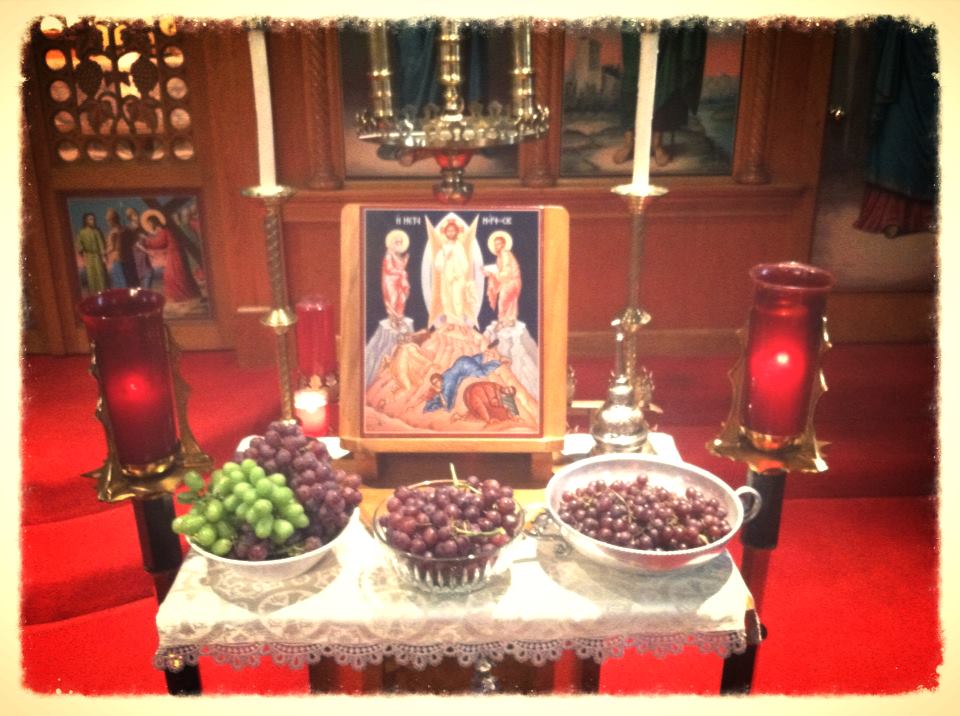
Blessing of Grapes reminds us of the Transfiguration, the Lord’s and ours

The faithful way of reading the sacred Scriptures and living the sacred Liturgy, you could also say, live the Scriptures, is understand that the Lord works in our lives as he did in the lives of the Apostles. He is contemporaneous with our human experience today.

A great line in today’s second reading at Mass stands out: “We did not follow cleverly devised myths when we made known to you the power and coming of our Lord Jesus Christ, but we had been eye-witnesses of his majesty” (2 Peter 1:16)

The author of Second Peter is not communicating to us a doctrine, a formula, or a moralism. He’s communicating to us that he met a person that changed his life and oriented the rest of his existence. The meeting he’s speaking of was that a meeting of God in the person of Jesus Christ. An experience is not fiction; it is not a cleverly devised myth, an experience is not a casual entertaining fantasy. The meeting Peter speaks of is the keen meeting with the Divinity, and thus all is changed. We believe, based on Scripture, that the divine encounter allowed the Gospel of Mark to write, “And he was transfigured before them, and his garments became glistening, intensely white” (9:2).

The economy of our salvation, that is, God’s plan of salvation given to us through the divine person of Jesus Christ, shows us that in and through creation we are brought into God’s life, into God’s existence. The natural grape is transformed into wine and by  the action of the priest and the power of the Holy Spirit the wine becomes the Blood of Christ. And by the Precious Blood of Christ we are healed and saved.

What does the feast of the Transfiguration have to do with the blessing of grapes? Here, and read.

The Blessing of Grapes may be found here. I recommend that the blessing be prayed!!! How else are we to remember that we are graced by the Transfiguration?

Pope Paul VI remembered for a faith that is open

The Venerable Servant of God Pope Paul VI died on this day in 1978, the Feast of the Transfiguration. He was the Roman Pontiff for 15 years. Notable in his pontificate were several events: the closing of the Second Vatican Council, the erection of the created a Secretariat for non-Christians, later renamed the Pontifical Council for Interreligious Dialogue, the publication of 7 encyclicals including the most contentious of the 20th century, Humane Vitae, the mutual lifting of the ex communications between Rome and Constantinople (Patriarch Athenagoras) and the meeting with Pope Shenouda III (of Egypt) resolving Christological differences, the meeting with Archbishop Michael Ramsey of Canterbury, plus he held 6 consistories that created 143 cardinals. The reform of the sacred Liturgy is likely the one enduring bone of contention that gets lots of people riled up to this day.

It must be said in my opinion, not all the problems that Paul faced were of his making. Society was haywire which adversely affected the Church in all quadrants.

Back in June the Vatican newspaper published a translation of a homily likely never read in English by many Americans given to honor the deceased Pontiff by the cardinal-archbishop of Munich, Joseph Ratzinger.

In a homily given by Joseph Ratzinger recalling Pope Paul VI, he said, “the transfiguration promised by the faith as the transformation of man is above all a journey of purification, a journey of suffering. Paul VI accepted his papal service increasingly as a transformation of faith in suffering. The last words of the Risen Lord to Peter, after constituting him as the Shepherd of his flock, were: “when you are old, you will stretch out your hands, and another will gird you and carry you where you do not wish to go” (Jn 21:18).  It was a reference to the cross awaiting Peter  at the end of his journey. It was, in general, a reference to the nature of this service. Paul VI let himself be lead more and more where as a human being he did not want to go alone. More and more the pontificate meant for him wearing the cloth of another, being nailed to the cross. (…) He gave new value to authority as service, bearing it as suffering. He took no pleasure in power, in position, in a successful career; and it was precisely because of this, his dutiful authority – ‘they will lead you where you do not want to go’ – became great and credible. Paul VI  carried out his service by faith. From this derived  both his firmness and his willingness to compromise. For both he was criticized, and some comments after his death were even in bad taste.  But today a Pope who  isn’t criticized  would be failing to carry out his duty to this age.  Paul VI resisted the intense scrutiny of the media, the powers of the day. He could do this because he didn’t consider success and approval the measure of truth and faith, but rather his conscience.

Those who met him in his last years were able to experience directly his extraordinary transformation in faith, its transfiguring power. One could see how much the man, who by his nature was an intellectual, surrendered himself day after day to Christ, how he let himself be changed, transformed, purified by him, and  how this made him ever more free, ever more profound, good, perceptive and simple.

Faith is a death, but it is also a metamorphosis for entering into authentic life, towards transfiguration. In Pope Paul one could see all this. Faith gave him courage. Faith gave him goodness. And in him it was also clear that a faith of conviction is not closed but open. In the end, our memory will treasure the image of a man who held out his hands. He was the first Pope to have travelled to all the continents, fixing in this way an itinerary of the Spirit, which began in Jerusalem, the centre of meeting and of parting of the three great monotheistic religions; then his journey to the United Nations, to Geneva, his meeting with humanity’s greatest non-monotheistic religious cultures, India, and his pilgrimage to the people who suffer in Latin America, in Africa, in Asia. Faith holds out its hands. Its sign is not a fist, but an open hand”.

Joseph Cardinal Ratzinger
1978 homily for Pope Paul VI
L’Osservatore Romano
21 June 2013