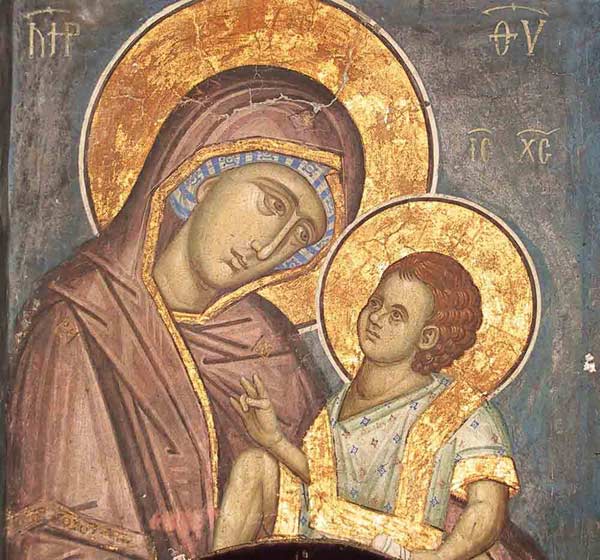
Mary the Mother of God (Theotokos)

TheotokosThe beginning of the calendar year in the Missal of Paul VI is dedicated to Mary, Mother of God. The readings at Mass are still those connected with the older tradition of the Naming of Jesus, the circumcision of the Lord (according to the Mosaic Law). A new facet of the Incarnation of the Word. It is the eighth day since the Nativity. In the sacred Liturgy we commemorate the holy Child receiving the name Ieusha, Jesus, the Lord saves; the name given to us by the angel (Lk 1:31). What we get is a liturgical mess: is it a liturgical remembrance of Mary as the Mother of God, or the eighth day celebration of Jesus fulfilling the Law. The readings for this day of Christmastide give the clue, but I digress.

As a Marian feast day it seems appropriate to reflect upon what the dogma of the Theotokos (Mary, the Mother of God) means for us. To do so we need to look at a piece of Church history.

Much of the way we come to understand this dogma is to look at the problem that gave rise to a church council and a solemn acceptance of a Christology and a Marian teaching. Most of the early councils were called not by the Church but by the emperor. Historically speaking Pope Saint Celestine I did not personally attend the council but sent three representatives who knew his thinking and his expectations. Pope Celestine delegated Cyril to teach with pastoral sensitivity with the hope of brining the now famous and dissenting Nestorius back to the heart of orthodox Christianity.

By AD 431 the 50 year old theologian-monk  Nestorius, educated in Antioch known for his great capacity to move people’s hearts by preaching. He was elected as the bishop of Constantinople by Emperor Theodosius II in 428.

One of Nestorius’ interlocutors was John Cassian, a monk in Egypt and disciple of Saint John Chrysostom. Cassian is accorded the title of Father of Monasticism in France and prolific author. (He is revered in some Church circles as a saint.) It is Cassian who helps to refine our Christology and what was later to become believed in the dogma of Mary as God’s mother.

In history we know that it was Nestorius who agitated for a change in church teaching on Christology. Recall that all that is said of Mary is a Christological statement of belief. Hence, Nestorius was not merely wanting to make a change in what we believe about Mary but what we believe about Jesus Christ, Savior. Nestorius began to reconsider how his people understand the mystery that Jesus Christ is equally God and man.

According to Nestorius the people think the humanity of Jesus was divine; that the people do not think that God was born in history, that God was buried, and professed that the Mary, the ever virgin, as bringing God forth in the flesh – that she is the Mother of God, Theotokos. Rather, he said that the Blessed Virgin Mary should really be called – Christotokos – the one who brought forth Christ, the mother of Christ. With great vigor he denied Mary the title of Theotokos. There is a theological difference in Jesus from Christ.

Then, as today, many people, laity and clergy alike, may not be well schooled in the details of theological and philosophical thought, nor would they be able to say with precision why a particular point about God and the economy of salvation is true or false. What we often see is that the Christian faithful echo —and believe— what is credibly taught in catechism and from the pulpit. The Church’s credible witnesses and teachers are given incredible authority when they often have not earned such. “Father said thus and such. Who are you to say otherwise?”

The people, hence, may not have clearly understood all the doctrinal errors that Nestorius was propagating through his preaching, but many did detect his choice in an alternative view when he declared that Mary was not the Theotokos. Those who knew in their gut something was wrong rejected Nestorius’ false teaching. Sometimes true piety is stronger than theological disputation.

It was a letter from Cyril to Nestorius that set the council fathers to define in certain terms what the true faith of Christians was with regard to Jesus and His mother. The letter that was read to the bishops declares that the patriarch of Constantinople, Nestorius, erred in his teachings. Cyril’s letter says,

“The holy Fathers do not hesitate to call the holy Virgin Theotokos, not in the sense that the divine nature of the Word took its origin from the holy Virgin, but in the sense that he took his holy body, gifted with a rational soul, from her. Yet, because the Word is hypostatically united to this body, one can say that he was truly born according to the flesh.” 

Then, Nestorius’ letter to Cyril was read to the bishops. Thereafter, Nestorius was unseated from his position as patriarch of Constantinople and excommunicated; some branded him as “the new Judas.”

The faithful’s love for Mary could be seen in their declaration, “Hagia Maria Theotokos” (Holy Mary, Mother of God) and “Praised be the Theotokos.”

Ours is a Savior who is the Eternal Word of God, born of Mary, the Mother of God.

Pope Francis’ prayer intentions for January 2014

2014 is a new year of faith, hope and charity. A new of knowing, loving and serving the Lord. It is also a new year of interceding before the Throne of Grace for those graces we need to fully live as Christian men and women in a diverse world.

Each month we recall the prayer intentions of the Holy Father. Just as Jesuit Father Francis Xavier Gautrelet told a group of Jesuit scholastics eager to serve on the missions: “Be apostles now, apostles of prayer! Offer everything you are doing each day in union with the Heart of our Lord for what He wishes, the spread of the Kingdom for the salvation of souls.” We who attend to praying for these intentions form the Pope’s prayer group, we are the Pope’s apostles of prayer in our local context. Though local, our prayer is expansive; its scope is for the City and the World. You may be interested in joining the Apostleship of Prayer.

With Pope Francis we remember in our prayer to the Most Holy Trinity, the following in January:

The general intention

That all may promote authentic economic development that respects the dignity of peoples.

The mission intention

That Christians of diverse denominations may walk toward the unity desired by Christ.

Theresa Neumann the mystic and stigmatist

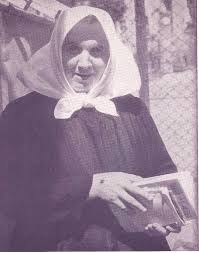
Theresa NeumannThe mystical life of the Catholic Church is rich with a variety of experiences. Let’s think of many men and women through the ages: Francis and Dominic, Catherine of Siena, Padre Pio, Catherine of Genoa, Hildegard of Bingen, and Sister Nazarena, to name a few. There are those who, because of God’s will, bore the wounds of the Lord’s holy Passion, not for their own designs but to bring others closer to the Savior. This is key. Yet this is a remarkable claim to make. I am sure there frauds but the people I am mentioning here do not fall into this category. I can think of Francis of Assisi, Catherine de Ricci, Anne Catherine Emmerich, Gemma Galgani, Rita of Cascia. In the history of salvation the Church can name more than 300 persons, most of them women, who bore in their body the wounds of Jesus.

The Servant of God Theresa Neumann (1898-1962) is one such person who is known to be a mystic and stigmatist. She is a person who trusted deeply in the Lord. The teaching of the Church says mysticism is that “intimate union with the Divinity, or a system growing out of such a tendency and desire.” Mystics are intimately connected with what we believe about the Holy Spirit and discernment. And by “mystic” I do not mean Theresa Caputo the Long Island Mystic who is a fraud.

This afternoon, at the request of my friend Glenn, I watched a 50 minute film on the life of Theresa Neumann, a German mystic and stigmatist who faced controversy and yet was resolute in doing what God asked of her. Glenn studies the mystical phenomenon found in the Church. Without Glenn’s encouragement I wouldn’t be drawn to this form of discernment.

For looking for the remarkable, many are intrigued that Theresa Neumann subsisted for 36 years only the Eucharist; it wasn’t that Neumann lived on nothing –she lived on the Savior. She said, “The Savior can do all things. Did He not say that “my Flesh is real food, and my blood is real drink?”

Her visions were spontaneous and biblical; she was convinced that her life was guided The Little Flower (many of Neumann’s own healings coincided with Theresa’s beatification and canonization). Neumann experienced the Lord’s Passion 780 times except during the liturgical season of Christmas and Easter. For what it’s worth, Churchmen and scholars, laity and professionals say that they felt her visions and stigmata were a genuine supernatural manifestation.

Some who met her attested to Neumann’s visions being authentically biblical, even her speaking in the Lord’s tongue, Aramaic, and bestowing certitude in the Lord’s holy Passion and resurrection. But only in knowing Theresa Neumann could one say with certitude that she was doing the Lord’s work and not her own: knowing Theresa you came to know a woman who had a deep trust in God; skeptics left converted.

What I became interested in as a result of this film was Neumann’s humanity. Who was she as a person? Several things were revealed: she was not easily influenced, she was vivacious, warm, loved to joke and tease, a god mother, cared for the dying, loved nature and working, tended a garden and prefer the outdoors, not overly pious, loved horses, and like to travel. Sounds like a good woman to me!

What Theresa Neumann verified in her life with the wounds of the Passion was what Saint Theresa had said, “more souls are savers through suffering than by brilliant sermons.” She felt a deep responsibility to lead others to Jesus Christ, the Savior. And this central for us: do we feel the responsibility to show the face of Jesus Christ to others? Does our life lead others to a deeper communion with the Trinity?

God’s body made flesh

AdorationPope Saint Leo the Great draws our attention to what is essential to our august liturgical season of adoration by speaking of the body:

God’s Son did not disdain to become a baby. Although with the passing of the years he moved from infancy to maturity, and although with the triumph of his passion and resurrection all the actions of humility which he undertook for us were finished, still today’s festival renews for us the holy childhood of Jesus born of the Virgin Mary. In adoring the birth of our Saviour, we find we are celebrating the commencement of our own life, for the birth of Christ is the source of life for Christian folk, and the birthday of the Head is the birthday of the body.

[Adoration of the Shepherd, Carl Maratta (c.1690)]

Christ or Christendom?

There is much consider as the culture many of us live in secularizes, that is, divorces us from a tangible Christian perspective, manner of being, and how we live in a world with diverse opinions. Today, we have to ask about Christ or Christendom. It is said that Saint Augustine asked, what there is of Christian among Christians is Christ.  He is orienting our attention not to an idea but to a person, a meeting, an encounter, with a person. Emphatically we all have to state that to be a Christian is to be in contact with a person, Jesus the Christ. Being Christian does not mean moral norms, cultural ideology, and precepts of the Church. Morality, culture and precepts within an ecclesiology are extraordinarily important, but they are secondary in accepting Jesus Christ as Lord and Savior and adhering to Him; it is also a firm belief in heaven (salvation).

Is Christ important, or are consequences of Christ? We all have to come to terms with how we let what and who we believe in impact the way we live. That is, does Jesus Christ really mean something to you and does said belief  have consequences in the manner of how you live? As a friend of Jesus Christ, what does it mean to hold to an “economy of salvation”? How do we interpret history of the Christian era? What role does true faith play in this period of history? Where are we as Christians in this history? Does eternal life with the Trinity mean anything anymore?  In order to do so we have to be as objective as possible; our ideological impulses have to be put aside so as to deal with reality without rewriting the past.

Start now in developing a more coherent, mature faith in Jesus Christ and then in His Church. You ought to read the following articles to begin (remember not to form conclusions yet) your thinking on the subject:

How are far are you willing to change your mind and evangelize?

Catholics need to change direction: to move from the Counter-reformation approach, what is now too ghetto-like today, to one that is more evangelical. We are indeed moving in that direction but as far as I can see, we are moving too slowly. The work started by Pope Leo XIII and concluded by Pope Benedict XVI still is highly instructive. What is clear to historians, it was Leo who changed the Church’s approach to education, culture, politics, etc. that was evident in previous generations in the pontificates of Gregory XVI and Pius IX. Leo’s 25 years and Benedict’s 8 years are bookends. Leo dealt with all the points of human history; Benedict continued what John Paul started in completing the Second Vatican Council and bridging faith and reason. What Francis will give us is still too new to determine in a critical way.

All this is to encourage you to read and fully digest George Weigel’s Evangelical Catholicism: Deep Reform in the 21st Century Church (Basic Books). I wrote about this book earlier here on Communio. What I said earlier remains the same now: Weigel is proposing to new evaluation, a new way for Catholics to engage the world. What we’ve been doing is simply not working anymore. Some Catholics are being eased into mediocre Christianity, others are walking away, others are searching for new ways to propose the truth of Jesus Christ and His sacrament, the beauty Catholic life. What Weigel suggests –and I am not going to give away the detail of his work here– is potentially going to anger some people and make others happy; he’s challenging every concept we have with regard to our ecclesial life: catechetics, preaching, liturgical music, the celebration of sacraments, matters of governance, education at all levels, how we use resources (economic and human), and so forth. Nothing is left unaffected by this public intellectual.

It is my considered opinion that dioceses and religious orders ought to take heed and at the very least allow Weigel’s ideas to ruminate in heart and mind. We can be uncritical of the ghetto mentality of Christian living and expect to be doing what Christ wants us to do. If it is, why are so many priests doing bad things, dioceses going bankrupt, Catholic hospitals merging with secularist institutions, religious order dying because they don’t, won’t, can’t live their charism with new vigor, parishes closing, etc.?

Jesus’ presence fixes our gaze

The revealed Word of God has set Christ Jesus before us in order that we may have that on which to fix our eyes. We cannot, with Paul, strive to gain Christ and be found in Christ without precise existential and personal knowledge of who Christ is.

And this knowledge has been made available to us in the living and often paradoxical figure of Christ we encounter in the “Gospel.” Without continually feeding on the Gospel text, Christian contemplation withers and dies or mutates into something strange.

Thus, being with Jesus interiorly and contemplating Jesus in the Gospel objectively are almost synonymous events.

Fire of Mercy
Erasmo Leiva-Merikakis (now Fr. Simeon, OCSO)

What Fr Simeon speaks of is precisely why we study the sacred Scripture, why we do lectio divina, why we pray the Scripture in the Liturgy. God’s definitive (complete) revelation in Jesus Christ sets the stage for all other things.

Pedro Calungsod, Batang Martir

St Pedro film imageI hold that one way of knowing the contours of the bible, the New Testament in particular, is knowing the lives of the saints. Hence, I advocate taking in the lives of the saints from across history and cultures. A little known saint in the USA is Saint Pedro Calungsod, the second Filipino saint in the Church martyred in 1672. Saint Pedro was a layman, catechist, and  was canonized by Pope Benedict XVI on 21 October 21, 2012. Therefore, look to the recent movie on St. Pedro Calungsod, “Pedro Calungsod, Batang Martir”,

The movie was entered into the 2013 Metro Manila Film Festival.

“We hope to bring St. Pedro Calungsod closer to the students through new evangelization such as this film. With all our collaborative efforts, we can inspire more children and young students to be heroes and saints (in the future). We hope that Pedro Calungsod will be an inspiration for the Filipino people with the message that we can reach sainthood through our everyday lives especially as we can all relate to him for he was a youth, an overseas Filipino worker, a catechist, a missionary and a faithful friend,” Br. Narciso Erguiza, FSC, said.

Holy Family

Holy Family FAlbaniAt the praying of the Angelus today, the Holy Father gave a brief address as is custom. The Latin Church following the Ordinary Form of the Mass celebrated the feast of the Holy Family.

Today our contemplation of the Holy Family lets itself be drawn also by the simplicity of the life they lead at Nazareth. It is an example that is very good for our families, it helps them further to become communities of love and reconciliation in which tenderness, mutual help and reciprocal forgiveness are experienced. Let us remember the 3 key phrases for a life of peace and joy in the family: excuse me, thank you, I’m sorry. In a family when you are not intrusive but say “excuse me,” when you are not self-centered but say “thank you,” and when you realize that you have done something wrong and you say “I’m sorry,” in that family there is peace and joy. Let us remember these 3 phrases. But we can say them all together: excuse me, thank you, I’m sorry.  I would also like families to be aware of their importance in the Church and in society. The proclamation of the Gospel, in fact, passes first of all through families to then reach the different spheres of daily life.

Let us fervently invoke Mary Most Holy, the Mother of Jesus and our Mother, and St. Joseph her husband. Let us ask them to enlighten, to comfort, to guide every family in the world so that they may carry out the mission that God has entrusted to them with dignity and serenity.

 Pope Francis
29 December 2013
Angelus address for the Holy Family feast

Holy Innocents


The day on which we recall those innocent children, the boys we call holy, who unknowingly gave their lives for their Savior, let’s hear the words of Saint Augustine of Hippo.

Today, dearest brethren, we celebrate the birthday of those children
who were slaughtered, as the Gospel tells us, by that exceedingly cruel king,
Herod. Let the earth, therefore, rejoice and the Church exult — she, the
fruitful mother of so many heavenly champions and of such glorious virtues.
Never, in fact, would that impious tyrant have been able to benefit these
children by the sweetest kindness as much as he has done by his hatred
. For as
today’s feast reveals, in the measure with which malice in all its fury was
poured out upon the holy children, did heaven’s blessing stream down upon them.