Pope Francis is a cafeteria Catholic, and he carries his own tray.
Joy Alappat as new auxiliary bishop for the Syro-Malabarese USA
I awoke today to read that His Holiness, Pope Francis, nominated a friend and former colleague to be an auxiliary bishop for the Syro-Malabarese Eparchy of Saint Thomas the Apostle of Chicago. Father Joy Alappat, 57, the current rector of Mar Thoma Sleeha Cathedral in Bellwood, IL, takes on a new ministry: the first auxiliary bishop for the Syro-Malabar Catholic Church in the USA.
The Syro-Malabar Catholic Church is a fast growing Eastern Catholic Church which follows the East Syrian liturgical tradition; it would be a cousin to the Chaldean (Iraqi) Catholic Church. Often this Church is referred to as the Thomas Christians.
Born in Kerala, in 1956 the bishop-elect was ordained a priest of the Syro-Malabar Eparchy of Irinjalakuda in 1981. Following graduate studies and ministry in India, Father Joy came to the US in 1993 and served as a hospital chaplain at Georgetown University Hospital (1999-2002). Father Alappat worked in New Milford, CT, and Newark and Garfield, NJ.
The Church to which the bishop-elect belongs number about 4 million worldwide, largely in India; it is the second largest Eastern Catholic Church. In the USA, the Malabars have one eparchy, St. Thomas the Apostle of Chicago led by Bishop Jacob Angadiath, the first bishop of the eparchy. The official 2010 stats indicated that the eparchy serves 86,000 faithful, with 37 diocesan priests, 10 religious priests, and 18 parishes.
The date of Fr. Alappat’s episocopal consecration has yet to be determined.
May Saint Thomas richly bless my friend, Father Joy, as he takes up the cross of being a bishop in Christ’s vineyard.
Saint Mary Magdalen
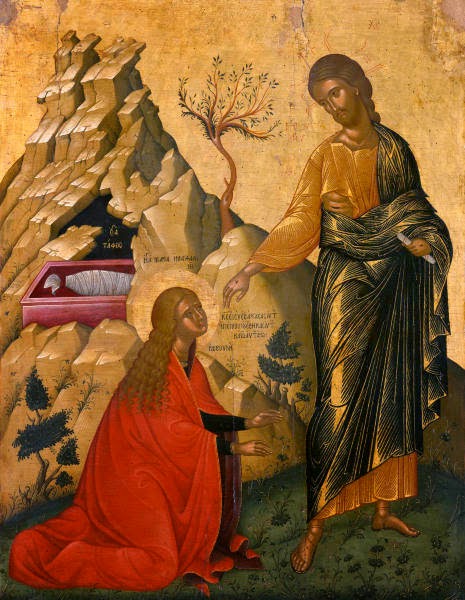
We love Mary Magdalen because of the way in which the boldness of her love for Jesus made her stare death down beyond all human logic or hope. For her there is no question that the Messiah of Israel, sent to redeem all humankind, and the Beloved of her most intimate heart are one and the same person. She perseveres in weeping at the entrance to the tomb because she perseveres in her love: the presence and actions of Jesus in her own life had taught her that love is indeed stronger than death. Against all odds and logic, in a sort of sublime madness, she clings to her Jesus dead or alive; and she does not reason about a her relative physical strength when she says ironically to the man she thought was the gardener, “Tell me where you laid him, and I will take him away.” Because she loves Jesus so much, she is prepared to carry his body away single-handed.Rowan Williams promotes Jesus Prayer
The Orthodox Christian Network reports that Rowan Williams, former archbishop of Canterbury, advocates the use of the Jesus prayer. The prayer, “Lord, Jesus Christ, have mercy on me, a sinner.” The prayer is more than a self-help, it is really a game-changer in this sense: the prayer’s simplicity and profundity moves the heart to a new level of awareness of one’s relationship with the Lord; it opens the door to new a point of life in the Spirit. It is also a whole body experience in the way you position your body, how you breathe and your attitude. Difference it makes in one’s spiritual life is only understood to the degree that you are faithful to this gesture. That is, it takes years to see a personal difference.
He was asked “After God: How do we fill the faith-shaped hole in modern life?” The response is in the article, “Rowan Williams Promoting the Jesus Prayer as Answer to Modern Angst.”
In part Williams said,
The prayer isn’t any kind of magical invocation or auto-suggestion – simply a vehicle to detach you slowly from distracted, wandering images and thoughts. These will happen, but you simply go on repeating the words and gently bringing attention back to them. If it is proceeding as it should, there is something like an indistinct picture or sensation of the inside of the body as a sort of hollow, a cave, in which breath comes and goes, with an underlying pulse. If you want to speak theologically about it, it’s a time when you are aware of your body as simply a place where life happens and where, therefore, God “happens”: a life lived in you.
Williams is a long time advocate of Benedictine spirituality, and Orthodox theology. Westerners are familiar with the Jesus prayer.
Saint Mary Magdalen
The Church remembers liturgically the woman called the Apostles to the Apostles, the penitent woman who loved the Lord with a totality of being (Luke 8:2-3); from Bethany to the tomb to new life Mary give witness to something and to someone amazing! It is said that seven devils had been cast out of Mary (Mark 16:9). She is named as standing at the foot of the cross with the Blessed Mother and St John (Mark 15:40; Matthew 27:56; John 19:25; Luke 23:49). She saw Christ laid in the tomb, and she was the first recorded witness of the Resurrection. She met the Divine Presence, received forgiveness, and followed the Him to the Cross and was the first to witness the resurrection. The meeting of Jesus is the crucial point here. Tradition holds that Mary died in AD 68. The Greek Church says that she retired to Ephesus with the Mary, the Mother of God. Some of her relics are in Constantinople and others in France.
The Magdalen is the patron saint of those in process (journey) of conversion, of monks and nuns, of Dominicans, those who struggle with sexuality, southern France, and the Diocese of Salt Lake City.
Of St. Mary Magdalen, Bishop Alfred A. Curtis had this to say:
“We find in this Saint all that is noble, precious, beautiful and admirable; her creatures and contempt of self – and the root of all, her supreme and ultimate confidence in God was founded on the knowledge of her misery and nothingness, which made her despise self. She knew our Lord, He had reproved her for her crimes, but she turned to Him with her whole heart, and sought Him at a time and place that men might call unseemly. Oh, what a gift to know and loathe one’s self, and at the same time to believe that God does not loathe us! Let us ask St. Magdalen to get for us that confidence which she possessed in such a supreme degree.” (The Sisters of the Visitation of Wilmington (1913). The Life and Characteristics of Right Reverend Alfred A. Curtis, D.D. New York: P.J. Kenedy & Sons.)
Saint Elijah, holy prophet
Praises to the great Elijah!
Let our songs to heaven rise.
His the grace to hear God’s whisper
Where all earthly music dies.
Clad in skins he made his dwelling
On Mount Carmel, finding there
That austere and lonely wisdom
Hidden in a life of prayer.
Yet he went forth at God’s bidding,
Flashed God’s word and law abroad
Till the idols fell around him
And his people turned to God.
May we, too, make war on falsehood,
Burn with zeal for God’s command
Till we follow our true Master
In whose sight we always stand.
Now we pray our Prophet-father
That our lives obtain this grace:
An outpouring of God’s Spirit
Over every time and place.
Praise and honor to the Father,
To the Son and Spirit praise.
Theirs be all our love and worship
Now and through eternal days.
Saint Apollinare
Saint Apollinare of Ravenna was a third century saint from Antioch who was the first bishop and saint of Ravenna. It is recorded that his martyrdom happened on 23 July but the Church’s liturgical memorial is July 20.
Saint Apollinare was originally from Antioch (where the followers of Jesus Christ were first called Christians according to the Acts), was ordained bishop by Saint Peter and believed to be a disciple of his since AD 44. The tradition holds that Apollinare travelled with Peter from Antioch to Rome. Recall that Peter was the bishop of Antioch before this move.
One of the historic martyrologies records a brief historical note on saints indicates that Apollinare was first mentioned in the 5th century Gerominiano Martyrology listing him as a “confessor” and “priest.” In the Roman martyrology the record notes him as “a Bishop who, by knowing the Gentiles the unfathomable riches of Christ, preceded as a good Shepherd his flock, honoring the Church at Ravenna in Romagna with his glorious martyrdom.”
Saint Peter Chrysologus (425-451), a renown doctor of the Church, cites Saint Apollinare in his sermon 128, giving some historical information on Apollinare: he was the first bishop of Ravenna; because of his faith, he suffered many torments and shed his blood, dying from wounds received.
Saint Camillus de Lellis
Today is the Feast of Saint Camillus de Lellis (1550-1614), spiritual son of Saint Philip Neri, who under his guidance founded a new order in the Church, the Camillans, who are dedicated to the care of the sick. He had the charism of honoring the sick as living images of Christ. This captures our Christian life in a clear way.
Please keep the sons of Camillus in prayer who recently elected a new general superior.
Pope Leo XIII made Saint Camillus, with Saint John of God, a patron of the sick.
Red versus White Martyrdom
A “Passion-bearer,” is one who is killed, not directly for professing the Christian Faith, but while practicing and upholding the practical implications of the Faith, frequently accepting death rather than themselves shedding blood. Their voluntary death links them in a very special way, to that of Christ’s Passion, so they are said to bear his passion in their own bodies.Traditional Catholicism has virtue
In an April 2012 Wall Street Journal article by Anne Hendershott and Christopher White, “Traditional Catholicism is Winning” the authors calmly present the data of what is happening in the various sectors of the Church that are prospering, that is, thriving, in an authentic way. Clear teaching and beautiful liturgical practice leads to human flourishing. As I am fond of saying, communion with the Divine Majesty leads to one’s greater freedom in Christ Jesus.
Pairing the word “traditional” with Catholicism gives some people the hives. Knee jerk reactions to all sorts of things happen and the reasonable and the holy are marginalized. The trouble is that as Catholics we’ve been sloppy in living the gift of Catholic faith and we’ve been too easy with regard to the manner in which we live it. In short, we’ve experienced these past years a lack of coherence in the areas of what we believe, how we pray and how we live. It all has to hang together in an authentic way. Otherwise the faith becomes moralism –lifeless.
It is true that we have to be very clear on what we mean, how we live the faith, and why we do what propose to do. Remember that Catholicism bridges the gap between faith and reason; it does not abandon the mind, nor does it rely merely on liturgical practice. Catholic faith is totality of reality, revealed and natural.
The authors of the article say,
They are attracted to the philosophy, the art, the literature and the theology that make Catholicism countercultural. They are drawn to the beauty of the liturgy and the church’s commitment to the dignity of the individual. They want to be contributors to that commitment—alongside faithful and courageous bishops who ask them to make sacrifices.
and
Cardinal Francis George, the longtime leader of the Chicago archdiocese, once gave a homily that startled the faithful by pronouncing liberal Catholicism “an exhausted project . . . parasitical on a substance that no longer exists.” Declaring that Catholics are at a “turning point” in the life of the church in this country, the cardinal concluded that the bishops must stand as a “reality check for the apostolic faith.”
Read the whole article. You will want to read it, and reflect –and then do your part.