Blessed Paul VI

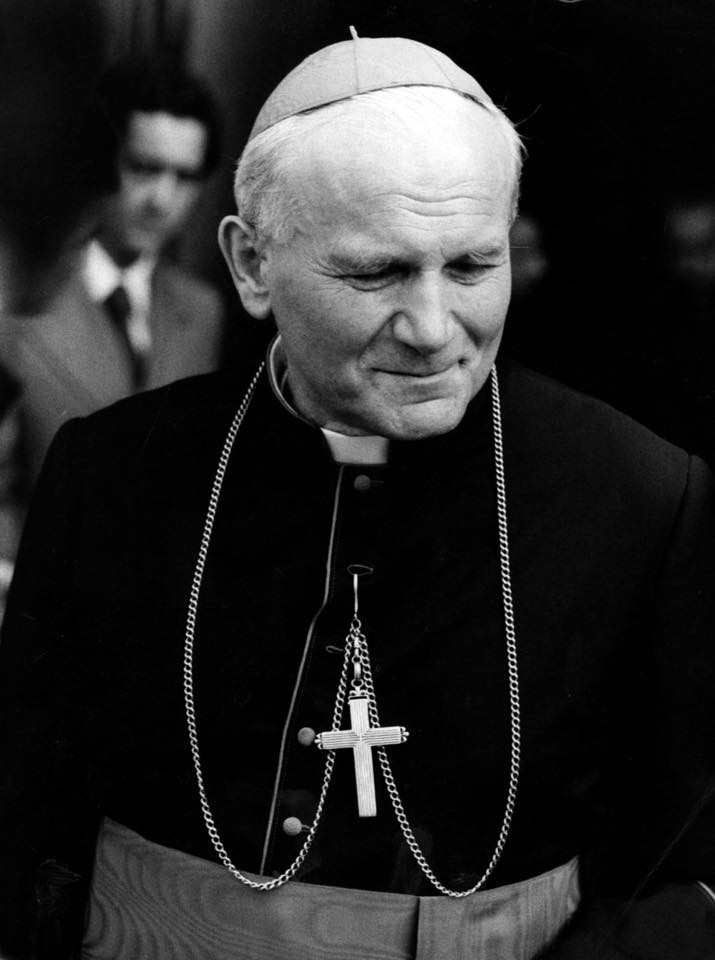
Paul VI with tiaraAfter two weeks of meetings on the family and marriage, Pope Francis offered Mass at which he beatified the Venerable Servant of God Pope Paul VI. whom he called a “great Pope,” a “courageous Christian” and a “tireless apostle.”

This action of the Pope’s means that several of the 20th century popes have been raised to the altar: John Paul II, Paul VI, John XXIII, Pius X. We ought to keep in mind that John Paul I and Pius XII have their causes for sainthood being studied, too.

The emeritus pope Benedict XVI was present for the Mass.

Here are the relevant paragraphs of Pope Francis’ homily at Mass that pertain to the beatification:

On this day of the Beatification of Pope Paul VI, I think of the words with which he established the Synod of Bishops: “by carefully surveying the signs of the times, we are making every effort to adapt ways and methods… to the growing needs of our time and the changing conditions of society” (Apostolic Letter Motu Proprio Apostolica Sollicitudo).

When we look to this great Pope, this courageous Christian, this tireless apostle, we cannot but say in the sight of God a word as simple as it is heartfelt and important: thanks!  Thanks! Thank you, our dear and beloved Pope Paul VI!  Thank you for your humble and prophetic witness of love for Christ and his Church!

In his personal notes, the great helmsman of the Council wrote, at the conclusion of its final session: “Perhaps the Lord has called me and preserved me for this service not because I am particularly fit for it, or so that I can govern and rescue the Church from her present difficulties, but so that I can suffer something for the Church, and in that way it will be clear that he, and no other, is her guide and saviour” (P. Macchi, Paolo VI nella sua parola, Brescia, 2001, pp. 120-121).  In this humility the grandeur of Blessed Paul VI shines forth: before the advent of a secularized and hostile society, he could hold fast, with farsightedness and wisdom – and at times alone – to the helm of the barque of Peter, while never losing his joy and his trust in the Lord.

Paul VI truly “rendered to God what is God’s” by devoting his whole life to the “sacred, solemn and grave task of continuing in history and extending on earth the mission of Christ” (Homily for the Rite of Coronation: Insegnamenti I, 1963, p. 26), loving the Church and leading her so that she might be “a loving mother of the whole human family and at the same time the minister of its salvation” (Encyclical Letter Ecclesiam Suam, Prologue).

In God’s image we are made

“The image of God is not depicted on gold but is imaged in humanity. The coin of Caesar is gold; that of God, humanity. Caesar is seen in his currency; God, however, is known through human beings. And so give your wealth to Caesar but reserve for God the sole innocence of your conscience, where God is beheld.”

This reflection for the 29th Sunday of Church year from an unknown 5th century author names a key in our spiritual life: our humanity, not temporal items. God reveals Himself in the body, not in gold, real estate or academic degrees. Whom do we seek to know: God or things?

Baldwin of Ford

In 1190 the Cistercian monk and Archbishop of Canterbury Baldwin of Ford died in Tyre, Lebanon.

Baldwin was born around the year 1120 in Devonshire, England. After completing his studies, perhaps at Exeter, he began a successful career in the service of Pope Eugenius III, who had begun his spiritual life as a Cistercian monk.
Upon returning to England, in 1169 Baldwin left all else behind and became a monk at the Cistercian abbey of Ford. He was soon made abbot, and although he did not spend many years in the monastery, he understood that monastic life is essentially a search for communion. In his beautiful treatises on community life, Baldwin was the first to assert that every human form of communion, especially in a monastic community, descends from the shared life of the three Persons of the Trinity.

Baldwin was elected bishop of Worcester in 1181, and several years later he became Archbishop of Canterbury. As leader of the Church of England, he was forced against his will to enter the turmoil of politics. During the reign of Henry II, who was responsible for the death of Thomas Becket, Baldwin defended the memory of his predecessor at Canterbury in his preaching and writing. He met his death participating in the third crusade at the orders of the new king, Richard the Lionheart.

From the Martyrology of the Monastery of Bose, Italy

Are you wearing the wedding garment of Charity?

A thought for today’s Scripture proclaimed at Sunday Mass today –St. Augustine taught:

“‘The goal of this command is charity,’ says the apostle, ‘which comes from a pure heart and a good conscience and a sincere faith.’ This is the wedding garment. Not charity of any kind whatever, for very often they who are partakers together of an evil conscience seem to love one another… But in these is no charity from a pure heart, a good conscience and a faith unfeigned. The wedding garment is charity such as this: ‘Though I speak with the tongues of men and of angels and have not charity, I have become like a sounding brass and a tinkling cymbal.’ Suppose someone who speaks in tongues comes in and is asked, ‘How did you get in here without a wedding garment?’ Suppose he answers, ‘But I have the gift of prophecy and understand all mysteries and all knowledge and I have all faith, so that I could remove mountains.’ But if he has no charity, he has nothing. Such may be the clothing of those who in fact lack the wedding garment.”

A Reflection for the 28th Sunday through the Year on Matthew 22:1-14

Komen pushes fiction over evidence

Judy Roberts has an interesting article “Susan G. Komen’s Moral Dilemma” outlining the difficulties in those organizations that attempt to do good but in fact are conflicted by their support of abortion research with money and certain medical procedures. Ms Roberts’ article doesn’t reveal new knowledge but it continues to shine light on the problem of the research’s evidence and logic of sin. We have a similar moral problem with ALS research (but that’s another story). The distressing thing for many is the rejection of the research that links abortion and cancers in women like breast cancer. This is a serious lack of concern for the health of women. From the moral perspective, Catholics can’t give money to the Komen foundation for the lack of honesty in organizations like the Komen foundation is misleading to  say the least.

Blessed John Henry Newman

newman detailFrom the writings of Blessed John Henry Newman, Priest

(Apologia Pro Vita Sua, Chapter V: Position of My Mind since 1845, London 1864, pp. 238-239, 250-251)

It was like coming into port after a rough sea.

From the time that I became a Catholic, of course I have no further history of my religious opinions to narrate. In saying this, I do not mean to say that my mind has been idle, or that I have given up thinking on theological subjects; but that I have had no variations to record, and have had no anxiety of heart whatever. I have been in perfect peace and contentment; I never have had one doubt. I was not conscious to myself, on my conversion, of any change, intellectual or moral, wrought in my mind. I was not conscious of firmer faith in the fundamental truths of Revelation, or of more self-command; I had not more fervour; but it was like coming into port after a rough sea; and my happiness on that score remains to this day without interruption.

Nor had I any trouble about receiving those additional articles, which are not found in the Anglican Creed. Some of them I believed already, but not any one of them was a trial to me. I made a profession of them upon my reception with the greatest ease, and I have the same ease in believing them now. I am far of course from denying that every article of the Christian Creed, whether as held by Catholics or by Protestants, is beset with intellectual difficulties; and it is simple fact, that, for myself, I cannot answer those difficulties. Many persons are very sensitive of the difficulties of Religion; I am as sensitive of them as any one; but I have never been able to see a connexion between apprehending those difficulties, however keenly, and multiplying them to any extent, and on the other hand doubting the doctrines to which they are attached. Ten thousand difficulties do not make one doubt, as I understand the subject; difficulty and doubt are incommensurate. There of course may be difficulties in the evidence; but I am speaking of difficulties intrinsic to the doctrines themselves, or to their relations with each other. A man may be annoyed that he cannot work out a mathematical problem, of which the answer is or is not given to him, without doubting that it admits of an answer, or that a certain particular answer is the true one. Of all points of faith, the being of a God is, to my own apprehension, encompassed with most difficulty, and yet borne in upon our minds with most power.

People say that the doctrine of Transubstantiation is difficult to believe; I did not believe the doctrine till I was a Catholic. I had no difficulty in believing it, as soon as I believed that the Catholic Roman Church was the oracle of God, and that she had declared this doctrine to be part of the original revelation. It is difficult, impossible, to imagine, I grant;—but how is it difficult to believe? …

I believe the whole revealed dogma as taught by the Apostles, as committed by the Apostles to the Church, and as declared by the Church to me. I receive it, as it is infallibly interpreted by the authority to whom it is thus committed, and (implicitly) as it shall be, in like manner, further interpreted by that same authority till the end of time. I submit, moreover, to the universally received traditions of the Church, in which lies the matter of those new dogmatic definitions which are from time to time made, and which in all times are the clothing and the illustration of the Catholic dogma as already defined. And I submit myself to those other decisions of the Holy See, theological or not, through the organs which it has itself appointed, which, waiving the question of their infallibility, on the lowest ground come to me with a claim to be accepted and obeyed. Also, I consider that, gradually and in the course of ages, Catholic inquiry has taken certain definite shapes, and has thrown itself into the form of a science, with a method and a phraseology of its own, under the intellectual handling of great minds, such as St Athanasius, St Augustine, and St Thomas; and I feel no temptation at all to break in pieces the great legacy of thought thus committed to us for these latter days.
RESPONSORY Ephesians 3:7, 10; John 16:13

R. Of this Gospel I was made a minister according to the gift of God’s grace which was given me by the working of his power,* that through the Church the manifold wisdom of God might be made known.
V. When the Spirit of Truth comes, he will guide you into all the truth.
R. That through the Church the manifold wisdom of God might be made known.
PRAYER

O God, who bestowed on the Priest Blessed John Henry Newman the grace to follow your kindly light and find peace in your Church; graciously grant that, through his intercession and example, we may be led out of shadows and images into the fulness of your truth. Through our Lord Jesus Christ, your Son, who lives and reigns with you in the unity of the Holy Spirit, one God, for ever and ever.

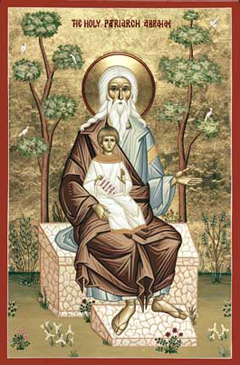
Patriarch Abraham

Holy Patriarch AbrahamThe feast of Abraham recalls the person, our father in monotheistic Judaism who opened the door to human faithfulness before the holiness of a God who revealed Himself to humanity in a new way. The holy Patriarch’s liturgical memorial is not celebrated in the Latin Church but in the Byzantine Church does so today. He is, however, recalled in the Roman Canon of the Mass and in several of the prayers used during the year. What we believe, and why we pray is expressed in the hymn texts of the Divine Liturgy. By looking at the liturgy we know what we believe and how to live. Here, the holy Patriarch Abraham is extolled a light to follow and a man of God who mediates for humanity before the Throne of Grace.

In the night universal of ignorance towards God, and in that starless, profound gloom bereft of heavenly light, you, O Abraham, were kindled in the firmament, burning with bright far-shining faith in the Everlasting light. Who shines forth to us from your seed, entreat Him with fervor, that He enlighten us and save our souls. (Troparion, Tone 1)

You were a servant, a mortal fashioned from the earth, your master was God, Lord and Fashioner of creation, yet, well-pleased to glorify your celestial greatness, the Lord of all called Himself the God of Abraham Procure for us mercies from your merciful God. (Kondak, Tone 2)

Saint Bruno

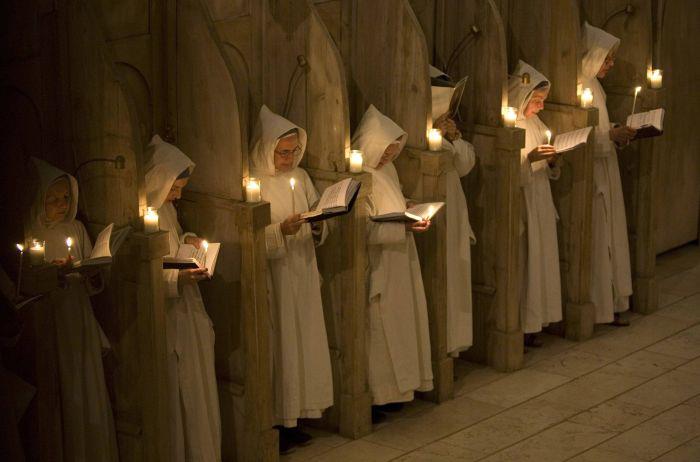
Monastic Family of BethlehemThe Statutes of the Carthusian Order begin with, “Blessed is the glory of the Lord, The Christ, Word of the Father, for all times men were chosen by the Holy Spirit to lead a life of solitude and to unite them in an intimate love. Answering this calling, Master Bruno, year of our Lord 1084, entered the desert of Chartreuse with six companions and began life there.” The life is wholly devoted to the Lord in solitude from the world, rarely having interaction with others.

But the person of Bruno is one that we are keen to know. Very briefly, the Liturgy tells us that he was man who was intent on rejecting the distractions of the world that would take him away from his only love, God. A witness from one of Bruno’s brothers in Calabria :

“Bruno deserves to be praised for many a thing, but especially in this matter: he was always a man of even temper, that was his specialty. His face was always joyful, and he was modest of tongue; he led with the authority of a father and the tenderness of a mother. No one found him too proud, but gentle like a lamb.”

930 years later, people still follow Saint Bruno into the solitude of the cloister. In the USA, there is one monastery of monks in Vermont, and there is a group of nuns who follow the spirituality of Bruno in a relatively new order founded called the Monastic Family of Bethlehem in Livingston Manor, NY.

May Saint Bruno teach how to love God alone.

All I have is what I love

It is said that one of our late Benedictine abbesses said, “All I have is what I love!” This is what learned in homily today at Vespers.

A true judgment of man’s spirit and humanity. It is a touchstone in understanding who each of us is before God and others. The question” What do I love?” needs to be asked and answered daily. In fact, that is what happens in the daily Ignatian Examen. The discovery in answering this question is a work.

But as fragile people we are easily distracted; we can fool ourselves by making excuses, and rationales get in the way. Still, “What do I love” requires a concrete answer. What specifically do I love? Deeper down, a love holds my heart?
What stands out in what St Paul said today in his Letter to the Philippians:
Have no anxiety at all, but in everything,
by prayer and petition, with thanksgiving,
make your requests known to God.
Then the peace of God that surpasses all understanding
will guard your hearts and minds in Christ Jesus.Finally, brothers and sisters,
whatever is true, whatever is honorable,
whatever is just, whatever is pure,
whatever is lovely, whatever is gracious,
if there is any excellence
and if there is anything worthy of praise,
think about these things.
Keep on doing what you have learned and received
and heard and seen in me.
Then the God of peace will be with you.

St Paul’s letter can remain in the abstract and useless without going deeper in ascertaining the meaning of the various points the Apostle raises viz. our experience. Hence, we have to ask: What do I think is true? What is does it means to act honorably? What difference does purity make? What does the word gracious mean to mean?
It seems that this matter one of several keys for the spiritual life, and not mere word-smithing and academic argumentation. What it does necessitate, I have learned, is a disciplined focus of mind and heart in working with divine revelation.

Blessed Bartolo Longo

Bartolo LongoThere is a marvelous figure of holiness inscribed on the calendar today: Blessed Bartolo Longo, the great Apostle of the Rosary and the founder of the shrine of the Madonna of the Rosary at Pompei in Italy. Born in 1841, Blessed Longo died in 1926. He was a contemporary of Saint Faustina. Pope John Paul II beatified him in 1980. Several times in his pontificate, Saint John Paul II called our attention to the example of this holy layman, calling him “l’uomo della Madonna,” Our Lady’s man.

Divine Mercy Displayed

Blessed Bartolo Longo’s story is a dramatic illustration of Divine Mercy. The mystery of Mercy announced by Saint Faustina played itself out in the life of Blessed Longo. As a young man, following studies in Law, Bartolo Longo abandoned his faith and allowed himself to be drawn into paths of great spiritual darkness. He practiced spiritism, found himself entrenched in the occult, and became a practicing Satanist. Longo went so far as to have himself ordained a priest of Satan. He very nearly lost his sanity, becoming a mere shadow of himself.

Spiritually Sick

In one particular séance Longo was distressed to see the face of the deceased king of Naples and the Two Sicilies: Ferdinand II. That same night he saw the soul of his mother circling his bed, begging him to return to the Catholic faith. His practice of the occult had so affected him that he was barely recognizable to those who once knew him as a handsome young man, full of vitality and promise. A Catholic friend, seeing him in such a pitiful spiritual, psychological, and physical state, begged him to at least meet with Father Radente, a wise Dominican priest. After some time, Longo made a thorough confession and, under the direction of this priest, began the reform of his life. He entered the Third Order of Saint Dominic, receiving the name, Brother Rosario.

Conversion and Healing

Bartolo’s Dominican spiritual father told him that the Mother of God promised that anyone who promoted her Rosary would assuredly be saved. The rest of Blessed Barolo’s life was dedicated to the Most Holy Rosary. The Rosary was his lifeline. The Rosary was the anchor of his salvation. The Rosary was the means by which the Holy Mother of God brought him back from hell. It was through the prayer of the Rosary that the Blessed Virgin healed his soul, restored him to health, and entrusted him with a mission. Later Blessed Bartolo wrote, “What is my vocation? To write about Mary, to have Mary praised, to have Mary loved.

Rosary Apostolate

Blessed Longo reached out to the desperately poor, ignorant, and needy people of the town of Pompei. He taught them to pray the Rosary. The Rosary did for that entire town what it had done for him in his personal life; it brought healing, refreshment, holiness, joy, and peace. With the help of the Countess Mariana de Fusco whom he later married on the advice of Pope Leo XIII, while preserving with her his vow of chastity, Bartolo Longo undertook the construction of the church of the Madonna of the Rosary of Pompei. The city that grew up around it became the City of the Rosary.

He founded a congregation of Dominican Sisters to care for the poor. He established a school for boys. He wrote tirelessly in the service of Madonna and of her Rosary. His beautiful supplication to the Madonna of the Rosary has been translated into countless languages. Pope John Paul II prayed it when, on October 7, 2003, he visited Pompei to conclude the Year of the Rosary. In Italy, every year on the first Sunday of October, everything comes to a halt at noon while people, young and old, poor and rich, healthy and sick, pause to pray Blessed Longo’s supplication to the Virgin of the Rosary.

Divine Mercy Available to All

Saint Faustina made known the mystery of Divine Mercy. Blessed Bartolo Longo experienced Divine Mercy in a dramatic and deeply personal way. The same Divine Mercy is available to us: the mercy that brings back from hell, the mercy that raises the soul from spiritual death, the mercy that heals, restores, forgives, and repairs the past.

The Divine Mercy comes to us through the intercession of the Mother of God and, most efficaciously, through the humble prayer of the Rosary. It comes to us in the Sacrament of Penance: the mystery of the blood and the water from the side of Christ washing over the soul. And the Divine Mercy comes to us in the mystery of the Eucharist. The Mass is the real presence of Crucified Love. The Holy Sacrifice of the Mass is Divine Mercy flowing from the Heart of the Lamb, making saints out of sinners.

Father Mark Daniel Kirby, OSB
Silverstream Priory