Conscience is the window to truth

right wrongIn the 10th grade Confirmation class that I teach the question of Conscience and its formation was the topic of conversation the other day. Most of the students knew nothing about conscience, why it was important to inform and to form and how it functions in making good decisions.

One of the things the ecclesial movement of Communion and Liberation has reminded me that ethics (conscience) never comes before the event of the Incarnation. Conscience is first built on the relationship one has with his or her God (Father, Son, Holy Spirit) lived within the companionship of the Church. More on this subject later.

This article published on LifeSiteNews highlights the Pope’s theologian, Dominican Father Wojciech Giertych, who is addressing the change, or not, of Catholic doctrine by local conferences of bishops, and he gets into the role of conscience. “Many people identify conscience with feelings…Feelings are secondary; conscience is a window to truth. … The conscience has to be formed to see the truth.” AND “You have to perceive the truth of the matter, by reason.” There is more in this article and so I ask that you read the article and think about the facts, not merely what you want to hear.

Religious practice of Americans fall

The practice of religion is falling according to the Pew Research Center on religion and public life. Experience tells us by looking at the Mass attendance and participation in religious education programs that many people no longer consider official religious practices essential to their life of “faith.” Sherry Weddell, as other researchers have said, has said that the fastest growing religious denomination is the USA are the “nones” –those people who check the box saying they are spiritual but not religious.

While Pew research is interesting, it does not cover the entire story of a person’s journey in faith. The caution I would propose is whether a person believes in the need of having a savior. Many people, I contend, don’t think they need to be saved. Their conception of salvation, heaven, sin, grace, sanctity is now very much a private affair, these people isolate themselves from other members of the Church. In the USA, as in other countries, the need and desire fora religious community is waning.

On one level I can see why people don’t want to be a part of a religious community: their priest/minister no longer really cares for them and their spiritual life, the priest/minister is a gossip, the priest/minister doesn’t preach well, know the ritual well, and the sacred music is poor, the priest/minister has little concern for the poor, the needy, sick, etc. The teaching of the faith is grossly watered down with no ideal to strive for and to live within (the journey of faith is flat).

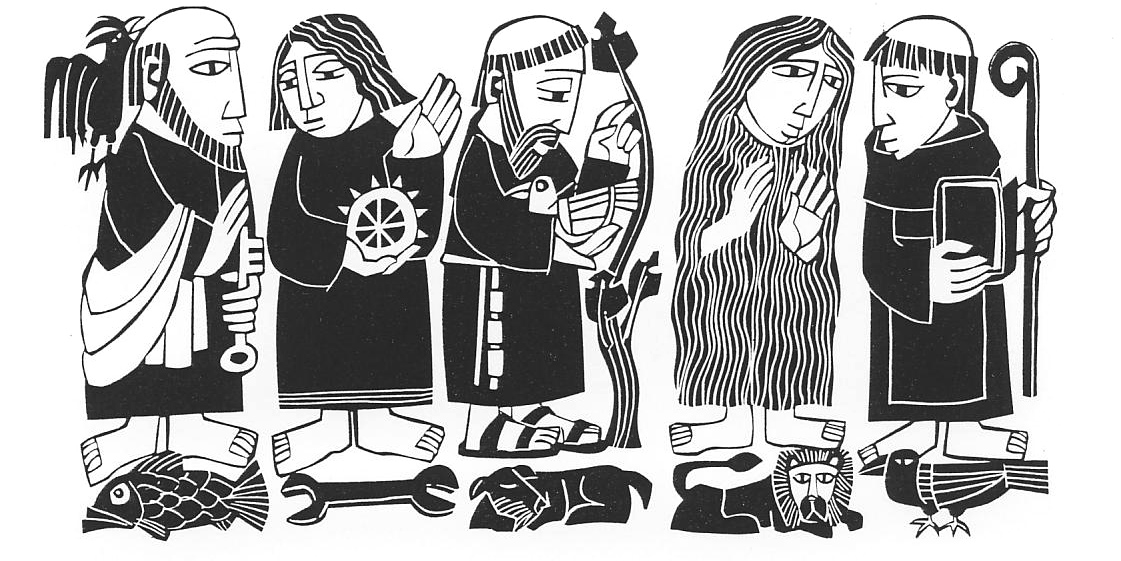
In short, our pastoral ministers have become very narcissistic and self-serving. I know several priests who are in trouble in their ministry: they do not attend to their spiritual life, they do not read literature or spiritual topics, they are lazy and watch tons of TV. One can see why over the centuries many of the saints have proposed a new way of living, acting and working for the proclamation of the Good News of Jesus Christ and the administration of the sacraments. The Latin phrase comes comes to mind: the Church always needs reform. Our ecclesiastical reform movements have generated great beauty and intense of love for the Church and for humanity. We’ve had saints like Benedict, Ambrose, Augustine, Bernard, Dominic, Catherine of Siena, Francis, Angela Merici, Ignatius of Loyola, Charles Borromeo, John Paul II, Luigi Giussani and countless others who have pointed a new way.

But all the blame can’t be placed on the ministers. Our Christian Faith requires a personal engagement, a personal bringing together of faith, reason, and living concretely in the community of the family and the secular world. You have to show up, you have engage your heart, mind and body. You have to be willing to be honest, and to be with others and to allow our spiritual life to be changed by Christ Jesus.

The Pew report is here.

Pray for the Church and ALL her members.

René Noël Théophile Girard, RIP

Rene GirardRené Noël Théophile Girard died today. Girard (1923-2015), the Andrew B. Hammond Professor of French Language, Literature and Civilization at Stanford, was arguably one of the best known French (American) intellectuals whose academic work was mainly in history, literary criticism, philosophy and anthropology. I was introduced to his work in my study of Liturgy viz. the role of sacred, an understanding of imitation, the use of language, an understanding of violence and sacrifice, the place of sacred myth, and the like. He was a formidable thinker.

Professor Girard was honored by several institutions of higher studies and various cultural groups, but I suspect an honor of deep appreciation was his election in 2005 into the French Academy. In French they say, he was an “Immortel Académie Française.”

Artur Rossman writes about René Girard here.

May God give rest and mercy to this man of learning and faith.

Saint Charles Borromeo

San Carlo BorromeoFrom a sermon by St. Charles Borromeo:

“My brothers, you must realize that for us churchmen nothing is more necessary than meditation. We must meditate before, during and after everything we do. The prophet says: I will pray, and then I will understand. When you administer the sacraments, meditate on what you are doing. When you celebrate Mass, reflect on the sacrifice you are offering. When you pray the office, think about the words you are saying and the Lord to whom you are speaking. When you take care of your people, meditate on how the Lord’s blood that has washed them clean so that all that you do becomes a work of love.

This is the way we can easily overcome the countless difficulties we have to face day after day, which, after all, are part of our work: in meditation we find the strength to bring Christ to birth in ourselves and in other men.”

All Saints

Solemnity of All Saints

“I travel slowly, one step at a time, because I am carrying two big suitcases. One of them contains my sins, and in the other, which is much heavier, are the infinite merits of Jesus. When I reach heaven I will open the suitcases and say to God: ‘Eternal Father, now you can judge.’ And to St. Peter: ‘Close the door, because I’m staying.’”

― St. Josephine Bakhita

All Saints Day

All Saints Day ErspamerSaints are the fruits of the Holy Eucharist. Holy men and women extrovert the grace of Communion and say to us that living the Gospel is possible and reasonable. In Mane nobiscum, Domine, Pope Saint John Paul writes:

We have before us the example of the Saints, who in the Eucharist found nourishment on their journey towards perfection. How many times did they shed tears of profound emotion in the presence of this great mystery, or experience hours of inexpressible “spousal” joy before the sacrament of the altar!

Today is also the day on which Saint John Paul II was ordained to the priesthood of Jesus Christ 69 (1 November 1946). In the twenty-six years of being the Roman Pontiff, John Paul gave us more than 1,300 blessed and 480 saints.

Chiara Luce Badano

Luce Badano“I offer everything, my failures, my pains and joys to Him, starting again every time the Cross makes me feel all its weight. The important thing is to do God’s will. I might have had plans about myself but God came up with this. The sickness came to me at the right time… [and] now I feel like I am wrapped into a wonderful design that is slowly unfolding itself to me.”

A member of the Focolare ecclesial movement, she wrote to Chiara Lubich, the founder of the movement: “I’ve rediscovered the Gospel in a new light. Now I want this book to be the sole purpose of my life!”

(Blessed Chiara Badano, who died on October 7, 1990 at the age of 18 after a painful struggle with osteosarcoma. She was beatified in 2010; her feast day is today.)

Jesus heals the blind man

william blake Christ giving sight BartimaeusToday’s gospel is pointing the way as we move to the end of the civil year and the end of the liturgical year: Jesus cures the blind man Bartimaeus. With the gradual loss of light we are keen to see, and spiritually speaking, to see in a new way. The blind beggar gives us the direction.

The only other man singled out (named in this way) for such a healing is Lazarus. We know from our study of and prayer with sacred Scripture will help is to recognize that a significant portion of Jesus’ mission was healing and making whole of humanity. This beggar Bartimaeus, a blind man from birth, knows he can find healing only from Jesus alone. The gift of sight given to Bartimaeus is not only physical, but also spiritual. He recognizes the Lord. And the consequence of sight is the act of following. And in this healing and following Bartimaeus becomes a disciple. This is our goal too: follow Christ closely.

Saint Clement of Alexandria speak of the grace of uncreated light: “The commandment of the Lord shines clearly, enlightening the eyes. Receive Christ, receive power to see, receive your light, that you may plainly recognize both God and man. More delightful than gold and precious stones, more desirable than honey and the honeycomb is the Word that has enlightened us…Despite the other stars, without the sun the whole world would be plunged in darkness. So likewise we ourselves, had we not known the Word and been enlightened by him, should have been no better off than plump poultry fattened in the dark, simply reared for death. Let us open ourselves to the light, then, and so to God.”

The grace we ask for today is the grace to recognize the person of Jesus, the Son of David, Son of God, as the One who can give life, peace, and healing. As Clement indicates, from the Lord we are enlightened…the gift of openness to the Light of Faith.

Saint Thérèse of Lisieux gives us a hint of how to approach this enlightenment: “Miss no single opportunity of making some small sacrifice, here by a smiling look, thereby a kindly word; always doing the smallest good thing and doing it all for love.”

Saint John Paul II

JPIIBlessed  Feast of Pope Saint John Paul II!

Saint John Paul II: “In its present form, inspired above all by Saint Benedict, Western monasticism is the heir of the great number of men and women who, leaving behind life in the world, sought God and dedicated themselves to him, “preferring nothing to the love of Christ”.The monks of today likewise strive to create a harmonious balance between the interior life and work in the evangelical commitment to conversion of life, obedience and stability, and in persevering dedication to meditation on God’s word (lectio divina), the celebration of the Liturgy and prayer.”
–Vita Consecrata, 6