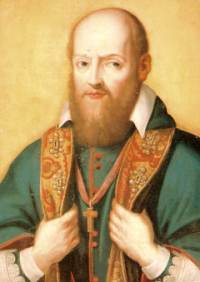
Saint Francis de Sales & World Communications Sunday

St Francis de Sales2.jpg

In graciousness and dignity
Saint Francis led Christ’s own,
That through the gospel’s gentle love
Reforming strength be shown.

Mid fractious striving, Francis preached
The Cath’lic faith and shared
His riches with the poor he met;
Bore witness everywhere.

May each of us, by Francis led,
Commit our lives anew
To Father, Son, and Spirit blest,
God loving, wise, and true. 

J. Michael Thompson, Copyright © 2009, World Library Publications
CM; AZMON


Today is also the 44th World Communications Day, on feast of the saintly patron is Saint Francis de Sales who tirelessly brought the faith to others in an understandable way. Those claiming to be interested in the New Evangelization, especially seminarians, pay attention to what the Pope is saying! What is your diocese doing to reach out to those not hearing the Gospel on Sunday morning? How does your parish measure up to the Pope’s ideas? Does your seminary promote communication, in its various forms, for the good of teaching the faith? Are you, as a Catholic, prepared to meet the post-modern era? If not, why?


The Priest and Pastoral Ministry in a Digital World:
New Media at the Service of the Word.

The theme of this year’s World Communications Day – The Priest and Pastoral Ministry in a Digital World: New Media at the Service of the Word – is meant to coincide with the Church’s celebration of the Year for Priests. It focuses attention on the important and sensitive pastoral area of digital communications, in which priests can discover new possibilities for carrying out their ministry to and for the Word of God. Church communities have always used the modern media for fostering communication, engagement with society, and, increasingly, for encouraging dialogue at a wider level. Yet the recent, explosive growth and greater social impact of these media make them all the more important for a fruitful priestly ministry.

All priests have as their primary duty the proclamation of Jesus Christ, the incarnate Word of God, and the communication of his saving grace in the sacraments. Gathered and called by the Word, the Church is the sign and instrument of the communion that God creates with all people, and every priest is called to build up this communion, in Christ and with Christ. Such is the lofty dignity and beauty of the mission of the priest, which responds in a special way to the challenge raised by the Apostle Paul: “The Scripture says, ‘No one who believes in him will be put to shame … everyone who calls on the name of the Lord will be saved.’ But how can they call on him in whom they have not believed? And how can they believe in him of whom they have not heard? And how can they hear without someone to preach? And how can people preach unless they are sent? (Rom 10:11, 13-15).

Responding adequately to this challenge amid today’s cultural shifts, to which young people are especially sensitive, necessarily involves using new communications technologies. The world of digital communication, with its almost limitless expressive capacity, makes us appreciate all the more Saint Paul’s exclamation: “Woe to me if I do not preach the Gospel” (1 Cor 9:16) The increased availability of the new technologies demands greater responsibility on the part of those called to proclaim the Word, but it also requires them to become more focused, efficient and compelling in their efforts. Priests stand at the threshold of a new era: as new technologies create deeper forms of relationship across greater distances, they are called to respond pastorally by putting the media ever more effectively at the service of the Word.

The spread of multimedia communications and its rich “menu of options” might make us think it sufficient simply to be present on the Web, or to see it only as a space to be filled. Yet priests can rightly be expected to be present in the world of digital communications as faithful witnesses to the Gospel, exercising their proper role as leaders of communities which increasingly express themselves with the different “voices” provided by the digital marketplace. Priests are thus challenged to proclaim the Gospel by employing the latest generation of audiovisual resources (images, videos, animated features, blogs, websites) which, alongside traditional means, can open up broad new vistas for dialogue, evangelization and catechesis.

Using new communication technologies, priests can introduce people to the life of the Church and help our contemporaries to discover the face of Christ. They will best achieve this aim if they learn, from the time of their formation, how to use these technologies in a competent and appropriate way, shaped by sound theological insights and reflecting a strong priestly spirituality grounded in constant dialogue with the Lord. Yet priests present in the world of digital communications should be less notable for their media savvy than for their priestly heart, their closeness to Christ. This will not only enliven their pastoral outreach, but also will give a “soul” to the fabric of communications that makes up the “Web”.

God’s loving care for all people in Christ must be expressed in the digital world not simply as an artifact from the past, or a learned theory, but as something concrete, present and engaging. Our pastoral presence in that world must thus serve to show our contemporaries, especially the many people in our day who experience uncertainty and confusion, “that God is near; that in Christ we all belong to one another” (Benedict XVI, Address to the Roman Curia, 21 December 2009).

Who better than a priest, as a man of God, can develop and put into practice, by his competence in current digital technology, a pastoral outreach capable of making God concretely present in today’s world and presenting the religious wisdom of the past as a treasure which can inspire our efforts to live in the present with dignity while building a better future? Consecrated men and women working in the media have a special responsibility for opening the door to new forms of encounter, maintaining the quality of human interaction, and showing concern for individuals and their genuine spiritual needs. They can thus help the men and women of our digital age to sense the Lord’s presence, to grow in expectation and hope, and to draw near to the Word of God which offers salvation and fosters an integral human development. In this way the Word can traverse the many crossroads created by the intersection of all the different “highways” that form “cyberspace”, and show that God has his rightful place in every age, including our own. Thanks to the new communications media, the Lord can walk the streets of our cities and, stopping before the threshold of our homes and our hearts, say once more: “Behold, I stand at the door and knock. If anyone hears my voice and opens the door, I will enter his house and dine with him, and he with me” (Rev 3:20).

In my Message last year, I encouraged leaders in the world of communications to promote a culture of respect for the dignity and value of the human person. This is one of the ways in which the Church is called to exercise a “diaconia of culture” on today’s “digital continent”. With the Gospels in our hands and in our hearts, we must reaffirm the need to continue preparing ways that lead to the Word of God, while being at the same time constantly attentive to those who continue to seek; indeed, we should encourage their seeking as a first step of evangelization. A pastoral presence in the world of digital communications, precisely because it brings us into contact with the followers of other religions, non-believers and people of every culture, requires sensitivity to those who do not believe, the disheartened and those who have a deep, unarticulated desire for enduring truth and the absolute. Just as the prophet Isaiah envisioned a house of prayer for all peoples (cf. Is 56:7), can we not see the web as also offering a space – like the “Court of the Gentiles” of the Temple of Jerusalem – for those who have not yet come to know God?

The development of the new technologies and the larger digital world represents a great resource for humanity as a whole and for every individual, and it can act as a stimulus to encounter and dialogue. But this development likewise represents a great opportunity for believers. No door can or should be closed to those who, in the name of the risen Christ, are committed to drawing near to others. To priests in particular the new media offer ever new and far-reaching pastoral possibilities, encouraging them to embody the universality of the Church’s mission, to build a vast and real fellowship, and to testify in today’s world to the new life which comes from hearing the Gospel of Jesus, the eternal Son who came among us for our salvation. At the same time, priests must always bear in mind that the ultimate fruitfulness of their ministry comes from Christ himself, encountered and listened to in prayer; proclaimed in preaching and lived witness; and known, loved and celebrated in the sacraments, especially the Holy Eucharist and Reconciliation.

To my dear brother priests, then, I renew the invitation to make astute use of the unique possibilities offered by modern communications. May the Lord make all of you enthusiastic heralds of the Gospel in the new “agorà” which the current media are opening up.

With this confidence, I invoke upon you the protection of the Mother of God and of the Holy Curè of Ars and, with affection, I impart to each of you my Apostolic Blessing.

From the Vatican, 24 January 2010, Feast of Saint Francis de Sales.

BENEDICTUS PP. XVI

Saint Agnes

St Agnes3.jpg

Almighty and everlasting God, you choose those whom the world deems powerless to put the powerful to shame: Grant us so to cherish the memory of your youthful martyr Agnes,  that we may share her pure and steadfast faith in you.

Let us now our voices raise,
Wake this day with gladness;
God has now to joy and praise
Changed our human sadness–
Joy that Agnes won her crown,
Entered heaven’s portal
When she laid the mortal down

For the life immortal!
Praise we God, whose wondrous grace
Showered on this martyr,
Giving strength in death’s fierce face
Not with sin to barter;
Rather claiming Christ as Lord,
Vowed to him forever.
Fullest praise let us afford,
Hymns that shall cease never!

To the Father, giving life,
Endless praise be given,
To the Son, who through death’s strife
Brings us all to heaven,
To the Spirit, Paraclete,
Filling all with graces
Be our song of joy complete,
Through the endless ages.

J. Michael Thompson
Copyright © 2009, World Library Publications
76 76 D
TEMPUS ADEST FLORIDUM, AVE VIRGO VIRGINUM

For more on Saint Agnes, read the post from last year which includes a brief paragraph on the blessing of lambs.
What the video on the blessing of lambs whose wool is used for the weaving of pallia.

Blessed Basil Anthony Moreau


Bl Basil Moreau.jpg

Spirituality. He practiced poverty to a heroic degree. He
never looked to do anything for himself. It was his view that everybody should
have better than he had and that everybody should have the best. He learned a
deep sensitivity in dealing with others. He was a man who understood people.
When he was a young priest, he was supposed to go study theology and he said,
“I don’t know theology, I can’t do this, I am not equipped to do this.” And,
his spiritual director wrote, “Rejoice above all that you see nothing in
yourself to depend on in this new post. That’s a very good beginning, to put
nothing of yourself into it and to await the Lord who will not fail you.”

(Cardinal McCarrick’s address on Blessed Basil Moreau, Stonehill College)

A prayer and other info on Blessed Basil Moreau may be found here.

Saint Hilary of Poitiers


St Hilaire Poitiers.jpg

Saint Hilary worked tirelessly to defend the faith from wrong-thinking Christians, typically called heretics. What follows is Hilary’s teaching on God the Father.

It is the Father from whom everything that exists has been
formed. He is in Christ and through Christ the source of all things. Moreover,
His being is in Himself and He does not derive what He is from anywhere else,
but possesses what He is from Himself and in Himself. He is infinite because He
Himself is not in anything and all things are within Him; He is always outside
of space because He is not restricted; He is always before time because time
comes from Him…. But, God is also present everywhere and is present in His
entirety wherever He is. Thus, He transcends the realm of understanding,
outside of whom nothing exists and of whom eternal being is always
characteristic. This is the true nature of the mystery of God; this is the name
of the impenetrable nature in the Father.

(On the Trinity, Bk. 2, Ch.6; ML 10,
54; FC XXV, 39-40) 

The Liturgical prayer for Saint Hilary may be prayed here.

Saint Gregory of Nyssa

St Gregory of Nyssa3.jpgYou have shown forth your watchfulness, and were a
fervent Preacher of godliness: by the wisdom of the teachings you have gladden
the Church’s faithful, Righteous Father Gregory, entreat Christ our God to
grant us his great mercy
.
(Troparion, tone 3)


God our Father, Saint Gregory, Your bishop, praised You by the splendor of his life and teaching. In your
kindness, as we forget what is past and reach out to what is before us, help us
to attain that vocation to which we are called.

Saint Gregory of Nyssa once said:

A greedy appetite for food is
terminated by satiety and the pleasure of drinking ends when our thirst is
quenched. And so it is with the other things… But the possession of virtue,
once it is solidly achieved, cannot be measured by time nor limited by satiety.
Rather, to those who are its disciples it always appears as something ever new
and fresh.

More on Saint Gregory of Nyssa may be read here.

Saints Philip of Moscow & Herman of Kazan, Saints Theodore Solovetsky & Cornelius Pskovsky

Into Your Hands, O Lord, I commend my spirit. For the name of Jesus, and in defense of the Church, I am willing to lay down my life.

Father, we honor the martyrs Philip and Herman, Your bishops and Your monastic priests, Theodore and Cornelius. Through their struggles and by their intercession may we willingly accept any hardship while serving Your beloved people.

Blessed André Bessette

Blessed André Bessette, your devotion to Saint Joseph is an inspiration to us. You gave your life selflessly to bring the message of his life to others. Pray that we may learn from Saint Joseph, and from you, what it is like to care for Jesus and do his work in the world. Amen.

St Andre Bessette.jpg

Pope John Paul II said this of Brother André:

A daily crowd of the sick, the afflicted, the poor of all kinds–those who were handicapped or wounded by life–came to him. They found in his presence a welcome ear, comfort and faith in God. Do not the poor of today have as much need of such love, of such hope, of such education in prayer?

One of Brother André’s friends said of him: “He spent his whole life speaking of others to God, and of God to others.”

More on Blessed –soon to be a saint– André is found here, including the liturgical prayer.

Info on Brother André’s canonization of will be announced here soon.

Saint John Neumann

sjnmosaic.jpgMerciful
Father, You have given me all that I have in this world, even life itself. In
all my daily needs, help me to remember the needs of others too. Make me aware
of the need to pray to You not just for myself but for the Church, the Pope,
for the clergy and for people who suffer any need.


Make me as selfless as Saint
John Neumann. Throughout my life, give me the grace to direct my first thoughts
to the service of You and of others. Make my prayer – “Your will be
done” knowing that in Your mercy and love, Your will for me is my
sanctification. I ask this through Jesus Christ, Our Lord. Amen. (Prayer to
Saint John Neumann)

The liturgical prayer, a brief chronology and a prayer for
the saint’s intercession may be found here.


Canonization
homily of Pope Paul VI, Sunday, 19 June 1977

Greetings to you, Brethren, and
sons and daughters of the United States of America! We welcome you in the name
of the Lord!

The entire Catholic Church, here, at the tomb of the Apostle
Peter, welcomes you with festive joy. And together with you, the entire
Catholic Church sings a hymn of heavenly victory to Saint John Nepomucene
Neumann
, [1811-1860] who receives the honor of one who lives in the glory of Christ.

In a
few brief words we shall describe for the other pilgrims some details of his
life, which are already known to you.

We ask ourselves today: what is the
meaning of this extraordinary event, the meaning of this canonization? It is
the celebration of holiness. And what is holiness? It is human perfection,
human love raised up to its highest level in Christ, in God.

At the time of
John Neumann, America represented new values and new hopes. Bishop Neumann saw
these in their relationship to the ultimate, supreme possession to which
humanity is destined. With Saint Paul he could testify that “all are yours, and
you are Christ’s, and Christ is God’s” (1 Cor. 3, 22). And with Augustine he
knew that our hearts are restless, until they rest in the Lord (St. Augustine,
Confessions, 1, 1).

His love for people was authentic brotherly love. It was
real charity: missionary and pastoral charity. It meant that he gave himself to
others. Like Jesus the Good Shepherd, he lay down his life for the sheep, for
Christ’s flock: to provide for their needs, to lead them to salvation. And
today, with the Evangelist, we solemnly proclaim: “There is no greater love
than this: to lay down one’s life for one’s friends” (Jn. 15, 13).

John
Neumann’s pastoral zeal was manifested in many ways. Through faithful and
persevering service, he brought to completion the generosity of his initial act
of missionary dedication. He helped children to satisfy their need for truth,
their need for Christian doctrine, for the teaching of Jesus in their lives
. He
did this both by catechetical instruction and by promoting, with relentless
energy, the Catholic school system in the United States. And we still remember
the words of our late Apostolic Delegate in Washington, the beloved Cardinal
Amleto Cicognani: “You Americans”, he said, “possess two great treasures: the
Catholic school and the Confraternity of Christian Doctrine. Guard them like
the apple of your eye
” (Cfr. Epistola 2 June 1963).

And who can fail to admire
all the loving concern that John Neumann showed for God’s people, through his
priestly ministry and his pastoral visitations as a Bishop? He deeply loved the
Sacramental of Reconciliation
: and like a worthy son of Saint Alphonsus he
transmitted the pardon and the healing power of the Redeemer into the lives of
innumerable sons and daughters of the Church. He was close to the sick; he was
at home with the poor; he was a friend to sinners. And today he is the honor of
all immigrants, and from the viewpoint of the Beatitudes the symbol of
Christian success.

John Neumann bore the image of Christ. He experienced, in
his innermost being, the need to proclaim by word and example the wisdom and
power of God, and to preach the crucified Christ. And in the Passion of the
Lord he found strength and the inspiration of his ministry: Passio Christi
conforta me
! (The Passion of Christ strengthens me)

The Eucharistic Sacrifice was the center of his life, and
constituted for him what the Second Vatican Council would later call “the
source and summit of all evangelization” (Presbiterorum Ordinis, 5). With great
effectiveness, through the Forty Hours Devotion he helped his parishes become
communities of faith and service.

But to accomplish his task, love was
necessary. And love meant giving; love meant effort; love meant sacrifice. And
in his sacrifice, Bishop Neumann’s service was complete. He led his people
along the paths of holiness. He was indeed an effective witness, in his
generation, to God’s love for his Church and the world.

There are many who have
lived and are still living the divine command of generous love. For love still
means giving oneself for others, because Love has come down to humanity; and
from humanity love goes back to its divine source! How many men and women make
this plan of God the program of their lives! Our praise goes to the clergy,
religious and Catholic laity of America who, in following the Gospel, live
according to this plan of sacrifice and service. Saint John Neumann is a true
example for all of us in this regard. It is not enough to acquire the good
things of the earth, for these can even be dangerous, if they stop or impede
our love from rising to its source and reaching its goal. Let us always
remember that the greatest and the first commandment is this: “You shall love
the Lord your God” (Matt. 22, 36).

True humanism in Christianity. True
Christianity
-we repeat –is the sacrifice of self for others, because of Christ,
because of God
. It is shown by signs; it is manifested in deeds. Christianity
is sensitive to the suffering and oppression and sorrow of others, to poverty,
to all human needs, the first of which is truth.

Our ceremony today is indeed
the celebration of holiness. At the same time, it is a prophetic
anticipation-for the Church, for the United States, for the world-of a renewal
in love: love for God, love for neighbor.

And in this vital charity, beloved
sons and daughters, let us go forward together, to build up a real civilization
of love.

Saint John Neumann, by the living power of your example and by the
intercession of your prayers, help us today and for ever.

Saint Elizabeth Ann Seton

St Elizabeth Ann Seton3.jpg

Lord Jesus, Who was born for us in a stable, lived for us a life of pain and sorrow, and died for us upon a cross; say for us in the hour of death, Father, forgive, and to Your Mother, Behold your child. Say to us, This day you shall be with Me in paradise. Dear Savior, leave us not, forsake us not. We thirst for You, Fountain of Living Water. Our days pass quickly along, soon all will be consummated for us. To Your hands we commend our spirits, now and forever. Amen. (a prayer by Saint Elizabeth Seton)


Saint Elizabeth Ann Seton (1774-1821), a native of New
York was socialite, a wife, a mother, a convert to Catholicism and a foundress
of a religious community of women. Seton is the first native-born American
citizen to be canonized. She founded the Society for the Relief of Poor Widows
With Small Children, New York City’s first private charitable organization, and
founded the U.S. Sisters of Charity. Seton was responsible for the parochial
school system in the USA. 

A video was made of Seton and you can watch the trailer here.

Even more on Saint Elizabeth Ann Seton may be found here,
including the liturgical prayer for her.

Saint Basil the Great & Saint Gregory Nazianzian


Sts Basil, John Gregory.jpg

Saint Basil the Great, bishop of Caesarea was one of the
most distinguished Doctors of the Church. He lived c. 329 to January 1, 379.
Theologians place Saint Basil after Saint Athanasius as a defender of the
Church against the heresies of the fourth century (the most destructive of the
faith was the Arian heresy).

Saint
Gregory of Nazianzus
(c. 325-389) was also from Cappadocia and a friend of Basil, followed
the monastic way of life for some years. Eventually the Church called Nazianzus to be a priest and later bishop of Constantinople (in 381). Saint
Gregory was given the title “The Theologian” because of his learning
and oratory.

Many icons of Saints Gregory of Nazianzus and Basil include
Nazianzus’ brother Saint Gregory of Nyssa. The group is known as “The
Three Cappadocians.” Some make the claim that Basil outshines Nazianzus and
Nyssa in practical genius and actual achievement. BTW, the icon presented here does not include Nyssan but Saint John Chrysostom.

The liturgical prayer for today’s memorial may be found here.

Saint Basil the Great writes on life’s journey:

We read in the Book of
Psalms: ‘Blessed is the one who walks not in the counsel of the wicked, nor
follows in the way of sinners.’ Life has been called a ‘way’ because everything
that has been created is on the way to its end. When people are on a sea
voyage, they can sleep while they are being transported without any effort of
their own to their port of call. The ship brings them closer to their goal
without their even knowing it. So we can be transported nearer to the end of
our life without our noticing it, as time flows by unceasingly. Time passes
while you are asleep. While you are awake time passes although you may not notice.

All
of us have a race to run towards our appointed end. So we are all ‘on the way’.
This is how you should think of the ‘way’. You are a traveller in this life.
Everything goes past you and is left behind. You notice a flower on the way, or
some grass, or a stream, or something worth looking at. You enjoy it for a
moment, then pass on. Maybe you come on stones or rocks or crags or cliffs or
fences, or perhaps you meet wild beasts or reptiles or thorn bushes or some
other obstacles. You suffer briefly then escape. That is what life is like.

Pleasures
do not last but pain is not permanent either.

The ‘way’ does not belong to you
nor is the present under your control. But as step succeeds step, enjoy each
moment as it comes and then continue on your ‘way’.

Commentary
on Psalm 1, 4
(PG 29, 220)