Saint Katharine Drexel

St Katharine Drexel2.jpg

Ever-loving God, You called Blessed Katharine Drexel to teach the message of the Gospel and to bring the life of the Eucharist to the African American and Native American peoples. By her prayers and example, enable us to work for justice among the poor and the oppressed, and keep us undivided in love in the eucharistic community of Your Church.
A homage to Saint Katharine can be viewed here.

Read last year’s entry for Saint Katharine.

Saint Gabriel of the Sorrowful Mother

St Gabriel of the Sorrowful mother with St Gemma.jpg

My servant continued with all his heart doing what is just before my eyes.
O God, Who in the design of Your love called Saint Gabriel of Our Lady of Sorrows to live in the mystery of the Cross with Mary, the Mother of Jesus, guide our spirit towards Your Crucified Son so that by participating in His Passion we may achieve the glory of the Resurrection.

Among the young saints of the Church are those who followed the Passionist charism, that is, those who made the paschal offering of Christ on the cross and His sorrowful mother so very central to their. The oblation of Christ crucified is THE Christian spirituality of our day, especially given the suffering many of us endure for the faith and for Saint Gabriel of the Sorrowful Mother is one such figure that we would do well to spend time learning. As the Mass collect above suggests, we are to ask for the grace to participate in the Lord’s Passion with the hope of his glory. This is the destiny of all Christians.

At 24 he was stricken with TB and died prior to his ordination. As grace is operative I feel close to Gabriel and ask his intercession for young seminarians even for me not being so young having just turned 41 a few weeks ago. Saint Gabriel’s youthful witness to Christ led him to being named a patron for the youth and seminarians by Pope Benedict XV in 1920 when he was canonized. The image given here is that of Saint Gabriel healing Saint Gemma, whom she was devoted.

Read up on Saint Gabriel here.
A rather helpful blog is maintained on our friend, called “Saint Gabriel Our Lady of Sorrows,” you can explore of Gabriel’s life and legacy for today.
May the Passion of Jesus and the Sorrows of Mary be ever in our hearts!
motto of Saint Paul of the Cross

Blesseds Francisco & Jacintha

Bl Jacinta & Francisco.jpgUnless you change and become like little children you will never enter the Kingdom of Heaven.

God of infinite goodness who loves the innocent and exalts the humble grant that, in imitation of Blesseds Francisco and Jacintha, we may serve You with purity of heart and so be worthy to enter the Kingdom of Heaven.
I would recommend watching the recently released movie, “The 13th Day” on the Fatima apparition of Our Lady. It is a beautiful movie!

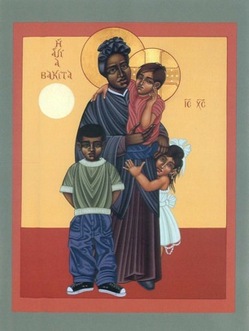
Saint Josephine Bakhita

Thumbnail image for St. Josephine Bakhita.jpg

With the Church we pray:

God, who drew blessed Josephine from abject servitude to
the dignity of being your daughter and a spouse of Christ, grant to us, we ask, that by her example, we may follow the crucified Jesus with constant love, and be lovingly ready to persevere in mercy. 

The young Miss Bakhita (1869-1947) was entrusted to the Canossian Sisters of the Institute of the Catechumens in Venice and it was there that she came to know about God whom “she had experienced in her heart without knowing who He was” ever since she was a child. “Seeing the sun, the moon and the stars, I said to myself: Who could be the Master of these beautiful things? And I felt a great desire to see him, to know Him and to pay Him homage…”

After several months in the catechumenate, Bakhita received the sacraments of Christian initiation (Baptism, Confirmation and Holy Eucharist) and was given the new name, Josephine on January 9, 1890. With expressive eyes that sparkled, revealing intense emotions, she radiated joy. Josephine was often observed kissing the baptismal font and saying: “Here, I became a daughter of God!”

The Arabic word “Bakhita” means fortunate one. Indeed, Saint Josephine was fortunate. The Vatican biography written at the time of her canonization can be found here. When Pope John Paul II canonized Josephine she was the first Sudanese saint and she is the patron of evangelical reconciliation and freedom.

Would that we all kissed the baptismal font!!!

What does Saint Agatha teach us today?

“Let us all rejoice in the Lord, celebrating a festival day in honor of blessed Agatha, virgin and martyr; at whose passion the angels rejoice, and give praise to the Son of God.” (Introit)
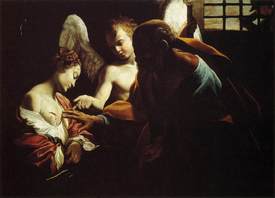
St Agatha healing GLanfranco.jpg

Today’s feast of a young virgin martyr is the last in a series courageous women of faith over the last few months. My The heart is always moved when I hear their story of faith and suffering and meditate on their iconography. As you know, the Roman Canon (the Eucharistic prayer at Mass) mentions a number of early women martyrs and then liturgical calendar recalls four virgin-martyrs that just cannot be forgotten: Cecilia (November), Lucy (December), Agnes (January) and Agatha (February).
History tells us that Agatha was martyred during the Decian persecution in AD 254. She suffered her breasts being torn off but later healed and restored by Saint Peter. Undeterred Agatha fearlessly faced the cruelty of her tormentors. She was buried in Catania, Sicily. Agatha had a double crown: of virginity and martyrdom thus becoming a praiseworthy witness of Christ, the patron of her home city and the whole Church and the patron those living with the diseases of the breast. To her we look for divine mediation for a cure for breast cancer. Let us remember the words of the Communion antiphon (verse): “He who deigned to heal my every wound and to restore my breasts, Him I invoke as the living God.”
Shortly after the death of Agatha people and the Church, in particular, recognized her holiness in a public way. Her name was entered in the Roman Canon (the first Eucharistic Prayer) very early in Christian history while Pope Symmachus built a basilica in Agatha’s honor as did Saint Gregory the Great as well as a few other popes and bishops.
Agatha is remembered not only for the courage, strength and love that sustained her in times of trial, but also her single-mindedness and praise of of God alone. Her love for God was stronger than human cruelty, pain and suffering. AND this is key: a determined focus on God, for how else are healed and saved? Catholic spirituality tells us to pattern our lives on Christ and the saints. The former because he is God made flesh, our Savior, the who loves us beyond all telling; the latter because they make the gospel concrete for us –the saints tell us that a life of holiness is possible and beautiful. But this singular focus Agatha’s is tough to focus on because of human frailty and personal distractions.
The Church’s hagiography acknowledges today the virginity of Agatha as a good thing to imitate, but the Church also acknowledges, as Ildefonso Schuster points out, “Virginity is not, however, a universal law; it is a special vocation, to which God calls only certain chosen souls, those generous souls who with the spiritual sword of mortification voluntarily take upon themselves perfect chastity, in order to consecrate themselves body and soul to God.”
Our praise is for God’s bestowal of many graces on Agatha, notably healing of body. May we also be filled with the spirit of Agatha when trial stares us in the face.


Blessing of Bread, Wine, Water and Fruit for the Feast of Saint Blase

Blessing of Bread, Wine, Water and Fruit

for the relief of throat ailments on the Feast of Saint Blase, Bishop and Martyr

V. Our help is in the name of the Lord.
R. Who made heaven and earth.

V. The Lord be with you.
R. And with your spirit.

bread.jpg

O God, Savior of the world, Who did consecrate this day with the martyrdom of the most venerable Blase, granting him among other gifts the power of healing all who are afflicted with throat ailments; we humbly beseech Your boundless mercy, and beg that these fruits, bread, wine, and water, which Your devoted people today, be blessed + and sanctified + by Your goodness. May they who taste thereof be fully healed of all afflictions of the throat, as well as every infirmity of soul or body, through the prayers and merits of the same Blase, Pontiff and Martyr. You who live and reign God, forevermore.

R. Amen.

The items are sprinkled with holy water.

Blessing of Candles on the feast of Saint Blase

Blessing of Candles on the feast of Saint Blase,
Bishop & Martyr


San Biagio.jpg

V. Our help is in the name of the Lord.
R. Who made heaven
and earth.

V. The Lord be with you.
R. And with your spirit.

Let us pray.

O God
of gentleness and might, by You Word alone You did create the manifold things
of the world, and did cause this same Word, Maker of all things, to take flesh
in order to repurchase us. You are great and wonderful, awesome and
praiseworthy, a doer of wonderful deeds. Wherefore, in professing his fealty to
You, the glorious martyr and bishop, Blasé did not fear any manner of torment,
but gladly accepted the palm of martyrdom. In virtue of which, among other
gifts, You did bestow on him this prerogative -of healing all ailments of the
throat. Thus we beg Your Majesty that overlooking our guilt, and considering
only his merits and intercession You world grant to bless + and sanctify + and
bestow Your grace on these candles. Let all Christians of good faith whose
necks are touched with them be healed of every malady of the throat, and being
restored in health and cheer, let them return thanks in Your holy Church, and
give praise to Your wondrous name which is blessed forever. Through our Lord,
Jesus Christ, Your Son, Who lives and reigns with You in the unity of the Holy
Spirit, God, eternally.


R. Amen.
St Blase candles Feb 3 2010.jpg

The candles are sprinkled with holy water. Then
the pries, holding two crossed candles to the throat of each one to be blessed,
as they kneel before the altar, says:


Through the intercession of Saint Blase,
Bishop and Martyr, may God deliver you from sickness of the throat and from
every other evil. In the name of the Father, and of the Son, + and of the Holy
Spirit. Amen.

Saint John Bosco

The kingdom of heaven is
like a mustard seed which a man took and sowed in his field. It is the smallest
of all the seeds but when it has grown it is the biggest shrub of all and
becomes a tree so that the birds of the air come and shelter in its branches.


St John Bosco.jpg

Because today is a Sunday, the Church does not observe the feast of Saint John Bosco, known also as Don Bosco. However, in the Salesian family, Don Bosco’s it is a feast day. My encounters with members of the Salesian family have been few so I’ve poked around their website to learn a little more of the spirit of Don Bosco. The
paragraphs are excerpts of a May 10, 1884 letter by Saint John Bosco,
considered by some to be the “Magna Carta” of Salesian Education. It
is included as an appendix to the Constitutions of the Salesian Society, and
given to members of the Salesian Family. In the USA the Salesians are not as
known as in other parts of the world. Here, their educational system was
perceived to be competing with the Jesuits, and Salesians could not compete.
The Jesuits have about 47 high schools in all the major cities. Be that as it
may, Saint John Bosco provides for us an insight into effective pastoral
ministry. The Salesians of Don Bosco are influential in various sectors of the
Church, primarily in education and with the youth. The reasons for this fact are evident in the letter below. If you are interested in the Salesian priests and sisters, visit their website.

From the letter of Don Bosco

By
a friendly informal relationship with the boys, especially in recreation
. You
cannot have love without this familiarity, and where this is not evident there
can be no confidence. If you want to be loved, you must make it clear that you
love
. Jesus Christ made himself little with the little ones and bore our
weaknesses. He is our master in the matter of the friendly approach. The
teacher who is seen only in the classroom is a teacher and nothing more; but if
he joins in the pupils’ recreation he becomes their brother. If someone is only
seen preaching from the pulpit it will be said that he is doing no more and no
less than his duty, whereas if he says a good word in recreation it is heard as
the word of one who loves.

How many conversions have been brought about by a
few words whispered in the ear of a youngster while he is playing
. One who
knows he is loved loves in return, and one who loves can obtain anything,
especially from the young. This confidence creates an electric current between
youngsters and their superiors. Hearts are opened, needs and weaknesses made
known. This love enables superiors to put up with the weariness, the annoyance,
the ingratitude, the troubles that youngsters cause. Jesus Christ did not crush
the bruised reed nor quench the smouldering flax. He is your model
. Then you
will no longer see anyone working for his own glory; you will no longer see
anyone punishing out of wounded self-love; you will not see anyone neglecting
the work of supervision through jealousy of another’s popularity; you won’t
hear people running others down so as to be looked up to by the boys: those who
exclude all other superiors and earn for themselves nothing but contempt and
hypocritical flattery; people who let their hearts be stolen by one individual
and neglect all the other boys to cultivate that particular one. No one will
neglect his strict duty of supervision for the sake of his own ease and
comfort; no one will fail through human respect to reprimand those who need
reprimanding. If we have this true love, we shall not seek anything other than
the glory of God and the good of souls. When this love languishes, things no
longer go well. Why do people want to replace love with cold rules? Why do the
superiors move away from the observance of the rules Don Bosco has given them?
Why the replacement little by little of loving and watchful prevention by a
system which consists in framing laws? Such laws either have to be sustained
through punishment and so create hatred and cause unhappiness or, if they are
not enforced, cause the superiors to be despised and bring about serious
disorders. This is sure to happen if there is no friendly relationship. So if
you want the Oratory to return to the happiness of old, then bring back the old
system: let the superior be all things to all, always ready to listen to any
boy’s complaints or doubts, always alert to keep a paternal eye on their
conduct, all heart to seek the spiritual and temporal good of those Divine
Providence has entrusted to him. Then hearts will no longer be closed and
deadly subterfuge will no longer hold sway
. The superiors should be unbending
only in the case of immoral conduct. It is better to run the risk of expelling
someone who is innocent than to keep someone who causes others to sin.
Assistants should make it a strict duty in conscience to refer to the superiors
whatever they know to be an offence against God.

Saint Angela Merici

St Angela Merici.jpgBorn in northern Italy in 1474, Angela Merici was orphaned by
the age of 10, she was soon alone in this world without her nuclear family
since her older sister suddenly died. Called to a life committed to the Lord,
Angela was a Franciscan tertiary (today known as Secular Franciscan) who
devoted herself to as much time in prayer as possible. She was particularly
devoted to Christ crucified because it is “the book from which the soul
learns,” having spent hours in prayer before the crucifix. On pilgrimage to the
Holy Land she went blind but was miraculously healed after prayer before the
cross.


In a vision from the Lord, Angela formed a group of women who would care
for families and the education of children. The group was called the Company of
Saint Ursula and in some places it is referred to the Institute of Saint
Ursula. Marcocchi’s 1986 biography of the saint he said, “In 1535 Angela Merici
founded at Brescia the Company of St Ursula. Its members observed the
evangelical counsels without being bound by vows; they wore no particular
habit; they did not lead a common life as in a monastic community, but lived
with their own families and earned their own living. This initiative, aimed at
inserting consecrated virgins into the world, introduced a feature of great innovation,
as it took shape outside a monastery, in other words, outside the structure
which for centuries had channeled religious life for women (XV).” At this time
in the Church, the Company of Saint Ursula was a completely new form of
religious life that many churchmen had problems with it because it challenged
every sort of preconceived notion of what and how women acted in church and
society. The only form of religious life offered to women was the cloister or
the hospital. An apostolic life like that of the Franciscan and later of the Society
of Jesus for women was unknown. Angela lived under the spiritual influence of Saints
Francis of Assisi and Catherine of Genoa, and later those who followed the converted
solider of Manresa. Angela would not only heed the spiritual doctrines of the Franciscan
but keenly the Spiritual Exercises of Saint Ignatius of Loyola. Angela died in 1540, the year the Jesuits were approved by Pope Paul III for the Church universal.


Saint Angela
Merici was canonized by Pope Pius VII and is the patron saint of physically
challenged people, sick people, and orphans. Her body remains incorrupt.

My hope is that a revival of the Company of Saint Ursula (the Ursulines) would happen…we need their witness today. Pray for this grace.

Saints Timothy and Titus, bishops

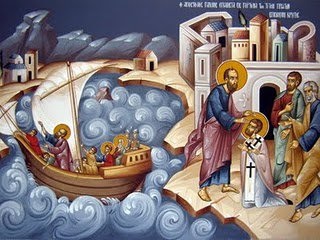
Titus ordained by Paul

The icon of Titus being ordained by the Apostle Paul is an intriguing piece since most of us just presume that the Apostles of Paul’s stature ordained others. Rather than presume, the Church offers this sacred image to us for our prayer.

This hymn captures poetically the vocation of these two saints.

For your servants and your bishops,
God, this day our thanks we bring.
Timothy and Titus, teachers
Of your word: their praise we sing.
In the church’s youngest days
They were faithful to your ways;
With Saint Paul the gospel preaching,
Each day saw them new souls reaching.

With such witnesses surrounded,
Let us run in faith our race
That, with Jesus as our leader,
Buoyed up with Spirit’s grace
We may reach our heav’nly goal,
True in body and in soul.
Praise the Father, Son, and Spirit!
We are saved through Jesus’ merit!

J. Michael Thompson
Copyright © 2009, World Library Publications
87 87 77 88;  FREU DICH SEHR