Saint Mary of the Cross MacKillop

The Church in Australia has a her first native born
saint, Mary of the Cross MacKillop. 
The canonized Saint Mary of the Cross with 5 others earlier today. The feast day of Saint Mary of the Cross is August 8.


St Mary of the Cross MacKillop.jpg

“She
dedicated herself as a young woman to the education of the poor in the
difficult and demanding terrain of rural Australia, inspiring other women to
join her in the first women’s community of religious sisters of that country.
She attended to the needs of each young person entrusted to her, without regard
for station or wealth, providing both intellectual and spiritual formation.
Despite many challenges, her prayers to Saint Joseph and her unflagging
devotion to the Sacred Heart of Jesus, to whom she dedicated her new
congregation, gave this holy woman the graces needed to remain faithful to God
and to the Church. Through her intercession, may her followers today continue
to serve God and the Church with faith and humility! She dedicated herself as a
young woman to the education of the poor in the difficult and demanding terrain
of rural Australia, inspiring other women to join her in the first women’s
community of religious sisters of that country. She attended to the needs of
each young person entrusted to her, without regard for station or wealth,
providing both intellectual and spiritual formation. Despite many challenges,
her prayers to Saint Joseph and her unflagging devotion to the Sacred Heart of
Jesus, to whom she dedicated her new congregation, gave this holy woman the
graces needed to remain faithful to God and to the Church. Through her
intercession, may her followers today continue to serve God and the Church with
faith and humility!”

(Pope Benedict XVI, 17 October 2010, canonization
homily)

Saint Edward the Confessor

St Edward the Confessor.jpgHail to You, Christ, Prince of Peace!

Your great reign shall never cease!
Model of each Christian king,
Hear the song of praise we bring
For Saint Edward, strong and true,
Ever faithful, Lord, to You!
On this day we sing his fame,
And proclaim Your holy Name!
Steadfast in his nation’s care,
Fervent with the poor to share,
Just to great and small, they say;
His good deeds we sing this day!
Give us grace, like him to strive,
That our faith might be alive,
Full of mercy, love, and grace
That the world may see Your face!
Glory to the Father bring!
Glory to the Son, our King!
Glory to the Spirit blest!
Three-in-One, in heaven’s rest!
With St. Edward joined as one,
May we pray, “Thy will be done!”
Till we there in heav’n may be
Joined with You, forever free!
77.77D
suggested tune: St George’s Windsor

Blessed John XXIII

Pope John XIII.jpgToday we are given Blessed John XXIII as a model of holiness. Pope Blessed John’s liturgical memorial is not the date of his death but the anniversary of the opening of the Second Vatican Council.

As one example of his holy inclinations I recently read his 1962 letter to women religious, “Il Tempio Massimo.” It is remains a beautiful testament to a great man filled with the Holy Spirit lived as a man of the Church. In this letter the Pope talks about the place of spiritual renewal in religious life; he’s got the grace of a new Pentecost in mind: an old person can be born again.
The new Pentecost in Blessed John’s mind is evidenced in a life of prayer, a life of example and a life in the apostolate, whether active or in the cloister. Of course, this letter to the women religious has a specific structure and emphasis but one that ought not be lost to the rest of the Church today; the Pope encourages us “to cultivate a holy enthusiasm” in life in Christ aiming to a more complete and full vocation first introduced to us in the Sacraments of Initiation (Baptism, Confirmation & Eucharist) and then in the call to serve the Lord and the Church in a particular manner (the vowed life, priesthood for those given that vocation, the married state and single life).
 Blessed John’s points on prayer could be summarized as follows:
1. “…more rigid mortification and penance is intended to affirm once again the pre-eminence of the duties of worship and of complete consecration of life to prayer over any other form of apostolate…;
2. “…conform more perfectly to the call of the Divine Master…in the contemplative life”;
3. “…the only foundations and soul of the apostolate is the interior life”;
4. without a life of prayer can “…fall into that ‘heresy of action’;
5. a life of prayer “…entails not a mechanical repetition of formulas but is rather the irreplaceable means by which one enters into intimacy with the Lord, to better understand the dignity of being daughters of of God and spouses of the Holy Spirit, the ‘sweet guest of the soul’ Who speaks to those who know how to listen in recollection”;
6. “holy Mass should be the center of your day, so much so that every action converges on it as a preparation or as a thanksgiving. Let Holy Communion be the daily food which sustains, comforts and strengthens you”;
7. 3 recommended and fundamental devotions: “Nothing is better for enlightening and encouraging the adoration of Jesus than to meditate upon Him and invoke Him in the threefold light of the Name, the Heart and the Blood.
I’d recommend reading the rest of the letter because Pope John talks about honoring poverty, radiating chastity, a life of sweet obedience and the apostolic and contemplative life.

Blessed John Henry Newman

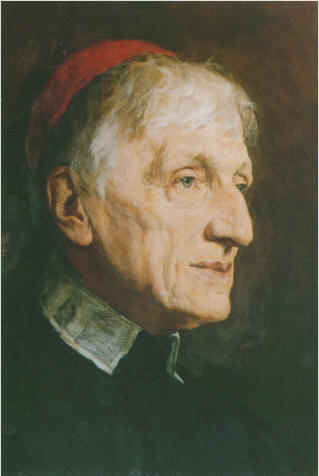
Bl John Henry Newman.jpgO God, who bestowed on the priest Blessed John Henry Newman the grace to follow Your kindly light and find peace in Your Church; graciously grant that, through his intercession and example, we may be led out of shadows and images into the fulness of Your truth.


“God has created me to do him some definite service. He has committed some work to me which he has not committed to another” (JH Newman, Meditations on Christian Doctrine).

Blessed John Henry’s feast day today is the anniversary of his conversion to Catholicism and not the date of his birth into eternal life (death), as most of the saints are honored. 

The other Propers for Mass and the Office of Readings for Newman’s feast day can be found here.

Saint Faustina Kowalska


St Faustina.jpg

Clued-in Catholics know the Chaplet of Divine Mercy. They are, however, unlikely to know the person who made this devotion known to the world and who was instrumental in getting the work of divine mercy known in the world today. Today, the Church gives us the woman who made the Lord’s mercy known to men and women of today. 


Sr Faustina
Kowalska wrote in her Diary:  “I feel tremendous pain when I see the
sufferings of my neighbours. All my neighbours’ sufferings reverberate in my
own heart; I carry their anguish in my heart in such a way that it even
physically destroys me. I would like all their sorrows to fall upon me, in
order to relieve my neighbour” (Diary, p. 365). This is the degree of
compassion to which love leads, when it takes the love of God as its
measure!

It is this love which must inspire humanity today, if it is to face
the crisis of the meaning of life, the challenges of the most diverse needs
and, especially, the duty to defend the dignity of every human person. Thus the
message of divine mercy is also implicitly a message about the value of every
human being. Each person is precious in God’s eyes; Christ gave his life for
each one; to everyone the Father gives his Spirit and offers intimacy. (Pope John Paul II, Canonization homily, April 30, 2000).

Saint Jerome

St Jerome and lion.jpgAt Mass today the preacher told us of a vision Saint Jerome had of Christ who asked him: Are you going to follow Cicero or me? (Jerome was educated in Latin literature and was a “student” of Cicero.) We know the end of the story for Jerome, but what of each of us?

Whom do you follow? Are you in love with Christ or merely giving lip service in being in relationship to Him?
Saint Jerome, pray for us!

Saints Michael, Gabriel and Raphael, archangels

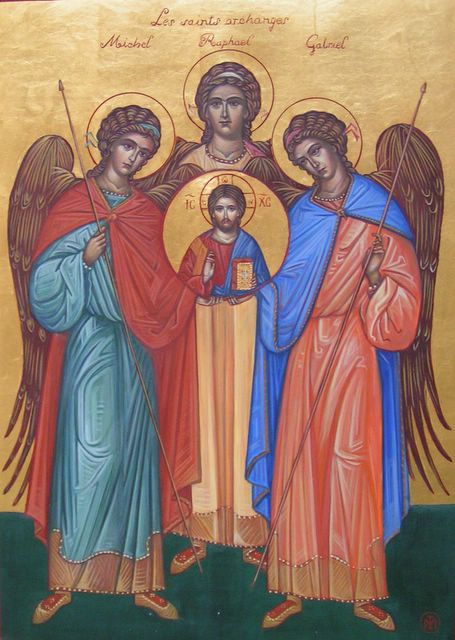
Archangels.jpgOur Catholic faith teaches us that angels have a general and yet an important part to play in our salvation history, especially personally guiding us. Moreover, the Archangels Michael, Gabriel and Raphael are given to us by God for very specific purposes and they are the only angels named in sacred Scripture.

And so today, the Church honors the archangels, invokes their intercession and relies on their assistance in the spiritual warfare we daily face.

In Hebrew, “Michael” means “Who is like God?” Saint Michael is mentioned four times in Scripture: Daniel 10 and 12, in Jude and in Revelation. Scripture reveals to us that Saint Michael is known as the “Prince of the Heavenly Host,” hence, the leader of all angels. It is to the Prince of the Heavenly that we owe a debt of gratitude for casting down to Hell Lucifer and the evil spirits; he is invoked for protection against Satan and all evil.

Sacred Tradition teaches that there are four offices connected to Saint Michael:

  • to fight against Satan, his minions and the power of evil
  • to rescue and protect the faithful from evil, especially at the hour of death
  • to lead the people of God to full communion with God Himself
  • to call our souls to judgment before God.

We know the archangel from his announcement of the dawn of salvation to Mary: “I am Gabriel, who stand before God” (Luke 1:19). What is crucial to remember about Gabriel are his two announcements in the New Testament: the birth of John the Baptist to his father Zachary and of the Incarnation, the Word made flesh in Mary. Saint Gabriel, whose name means “God’s strength,” is also mentioned four times in Scripture. 

Again, sacred Tradition tells us that it is Saint Gabriel who appeared to Saint Joseph and to the shepherds. At the beginning of the Passion it was Gabriel who “strengthens” Jesus in the his agony of the garden.

“I am the angel Raphael, one of the seven, who stand before the Lord” (Tobit 12:15)

Saint Raphael, whose name means “God has healed” because of his healing of Tobias’ blindness in the Book of Tobit. This book in the Old Testament is the only book in which Raphael is mentioned. He is the archangel of healing and acts of mercy. Tradition tells us that Saint Raphael is the angel in John 5:1-4 who descended upon the pond and bestowed healing powers upon it so that the first to enter it after it moved would be healed of whatever infirmity he was suffering.

As point of trivia, the Catholic hospital in New Haven, CT is named for Saint Raphael, likely the only one in the USA.

Those familiar with what is called the “old Mass” will remember praying the Prayer to Saint Michael at the conclusion of Mass. In 1899, after a vision of evil, Pope Leo XIII wanted to protect the Church and instructed that his prayer be prayed by all, especially the priest. I can’t recommend the prayer enough to you when making your thanksgiving following Mass or the Divine Office. Plus, I would recommend that you pray the Prayer to Saint Michael prior to going to bed.

Saints Michael, Gabriel and Raphael, pray for us.

350 years since the deaths of Sts Vincent de Paul & Louise de Marillac

In the Pope’s Weekly Sunday Angelus Address (September 26, 2010) he spoke of Saint Vincent de Paul. Sunday’s gospel of the parable of the rich man and Lazarus gave Benedict XVI a perfect context by which to teach that us that “God loves the poor and raise them from their abjection; secondly, that our eternal destiny is dependent upon our behavior, it is up to us to follow the path God has shown us in order to achieve live, and this path is love, understood not as emotion but as service to others in the charity of Christ,” and further the Pope said:

“By a happy coincidence, tomorrow (9/26/2010) we will celebrate the liturgical memorial of St. Vincent de Paul, patron of Catholic Charities, which marks the 350th anniversary of his death. In France of 1600, he touched with his hand the sharp contrast between the richest and poorest. In fact, as a priest he was able to attend both the aristocratic circles, campaigns, as well as the slums of Paris. Driven by the love of Christ, Vincent de Paul was able to organize stable forms of service to the marginalized people, giving rise to so-called “Charitees,” the “Charity,” i.e., groups of women who put their time and property available to more marginalized. Among these volunteers, some chose to devote themselves completely to God and the poor, and thus, along with St. Louis de Marillac, St. Vincent founded the “Daughters of Charity,” the first female congregation to live their consecration “in the world,” among all the people, the sick and needy.”

350th of CM.jpg

Strive to live content in the midst of those things that
cause your discontent. Free your mind from all that troubles you, God will take
care of things. You will be unable to make haste in this [choice] without, so
to speak, grieving the heart of God, because he sees that you do not honor him sufficiently
with holy trust. Trust in him, I beg you, and you will have the fulfillment of
what your heart desires
(St. Vincent de Paul, Letters).

Saint Vincent de Paul

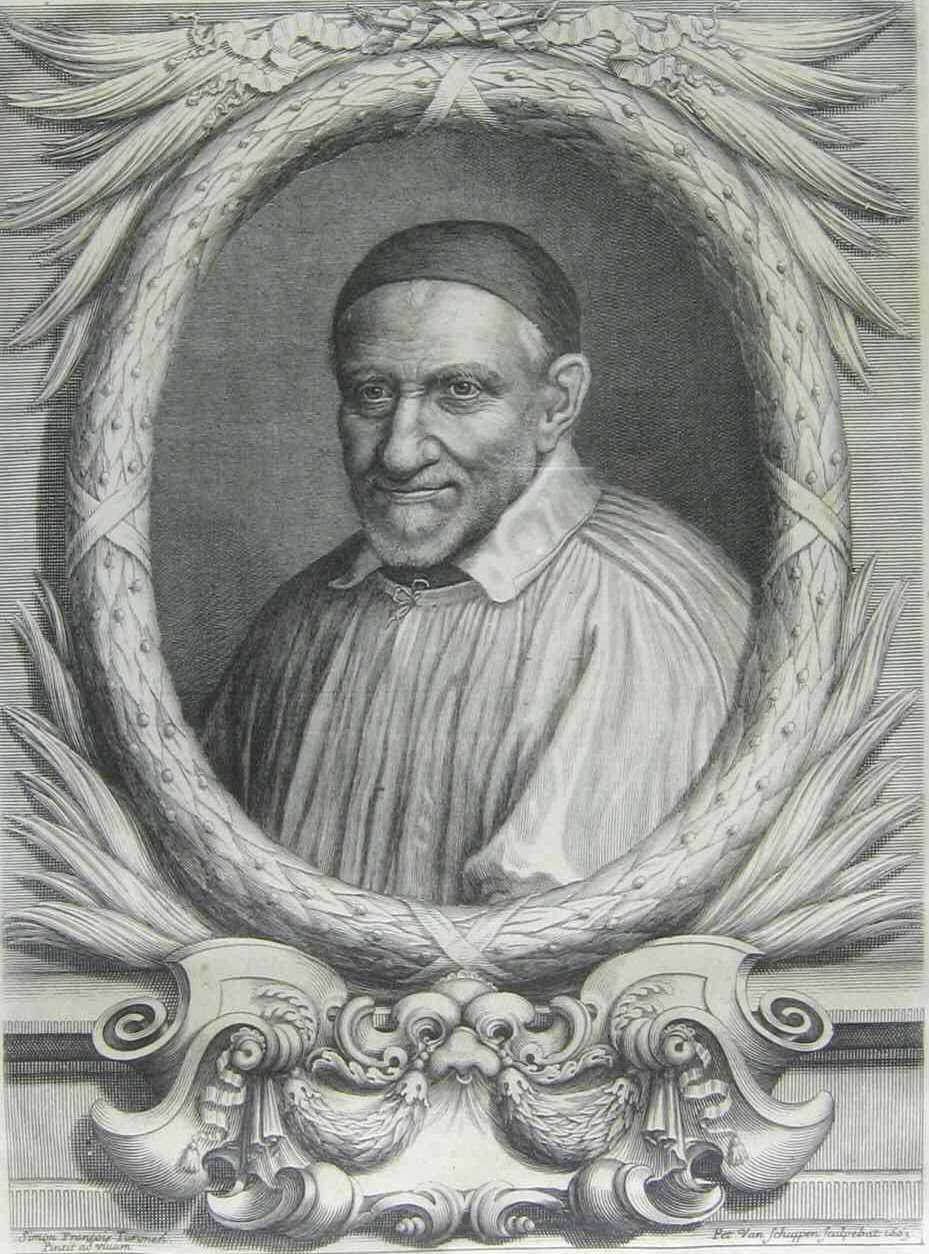
St Vincent de Paul framed.jpgIn honoring Saint Vincent de Paul today let’s call to mind the myriad of ways he and his spiritual sons and daughters have served, and continue to serve, the Gospel by serving the poor and uneducated. Have you got your copy of the video “Charity’s Saint: St Vincent de Paul“? I pray in thanksgiving for the Vincentian priests in New Haven who were my spiritual guides as a child.

With glowing light sent from above,     

O Vincent, how you guide our way!     

Your virtues and example pure     

Show us the path to heaven’s day.


With self-effacing modesty,     

You made yourself of little state;     

Your gentleness and simple life     

Made you revered by small and great.


Amidst the graces of your life     

Your charity sheds brightest fire:     

How many of the poor it fed,     

Filled many hearts with Christ’s desire.


Urged on by zeal and charity,     

You preached in town and countryside,     

Proclaiming all God’s mysteries     

To poor and rich, both far and wide.


Beneath your wings you gathered those     

Who longed to share both work and strife.     

By word and deed you taught them well;     

You formed and taught them by your life.


To God, the holy Three-in-One,     

All praise and glory be addressed,     

Whose life divine is best reward,     

And light eternal for the blessed.


J. Michael Thompson

Copyright © 2009, World Library Publications


LM; WINCHESTER NEW, HAMBURG, ST. VINCENT 

Don Bosco’s relic comes to New York City

A relic of Saint John Bosco, patron of youth, is visiting New York City on Friday, October 1. The relic’s pilgrimage is in preparation for the saint’s 200th anniversary of birth. Being in the USA is only one of 130 nations that the relic is visiting.

Don Bosco’s relic will be at Saint Patrick’s Cathedral, NYC. Veneration of the relic will be 10 am until 11 pm. Mass will be celebrated by Archbishop Timothy Dolan at 7 pm.

More info can be found here (this is an excellent website!)

RelicTour.jpg
Saint John Bosco
born 1815
died 1888
canonized a saint 1934
the Salesians of Don Bosco, the religious order founded by the saint can be seen here.