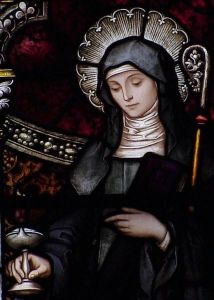
Saint Polycarp

St Polycarp3.jpg

If you really want to know what tradition is look at the life of today’s
saint. Saint Polycarp had indirect knowledge of Jesus: he had known those who
had direct knowledge of the Savior. Polycarp was a disciple of the Beloved
Disciple, Saint John the Evangelist, who had converted him around the year AD 80.
And from Saint Irenaeus of Lyons, we learn that Polycarp taught him as a young
man what he learned about Jesus and the Kingdom from the Apostles, which the
Church hands down, which are true.
 Irenaeus testifies to the seriousness, holiness, and the devotion
Polycarp had for Christ.

The Martyrology tells us that Polycarp became bishop
of Smyrna and administered the diocese for some 70 years. He defended the
Church’s orthodox faith against those who taught a different doctrine,
especially Marcionism and Valentinianism (the most influential of the Gnostic
sects).

From a hagiography

“At Smyrna, the death of St. Polycarp. He was a disciple of the holy apostle John, who consecrated him bishop of that city; and there he acted as the primate of all Asia Minor. Later, under Marcus Antoninus and Lucius Aurelius Commodus, he was brought before the tribunal of the proconsul; and when all the people in the amphitheater cried out against him, he was handed over to be burned to death. But since the fire caused him no harm, he was put to death by the sword. Thus he gained the crown of martyrdom. With him, twelve other Christians, who came from Philadelphia, met death by martyrdom in the same city”


Pius Parsch
The Church’s Year of Grace
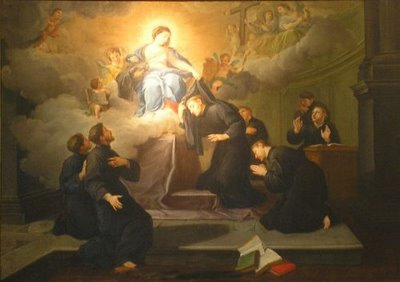
The 7 Holy Servite Founders

Servite Holy Founders.jpgThe collect prayed by the priest at Mass for today’s
optional memorial of the 7 holy founders of the Servite Order asks the Lord for
same “love which inspired the seven holy brothers to honor the Mother of God
with special devotion and to lead your people to you.” Servites, a 13th century mendicant order inspired by the first Dominican martyr, Saint Peter of Verona, are devoted to
the Our Lady of Sorrows and are to live a life of penance.  Theirs, like what all Christians live, is a life
discipleship with Christ Crucified. The is the key to our salvation. And the
Servite founders remind us that following Christ necessarily means bearing the
cross.

Wisdom and knowledge stimulates virtue

God’s promise to us is to remain with use for ever.

“Wisdom has built herself a house, and she has set up
seven pillars.” To man, who was made in the image of God when the rest of
creation was created, Wisdom gave the seven gifts of the Spirit to enable man
to believe in Christ and to keep His commandments. By means of these gifts, the
spiritual man grows and develops until, through firm faith and the supernatural
graces he receives, he finally reaches maturity. Knowledge stimulates virtue,
and virtue reflections knowledge. The fear of the Lord, understanding, and
knowledge give true orientation to his natural wisdom. Fortitude makes him
eager to seek understanding of the will of God, as revealed in the laws by
which the entire creation is governed. Counsel distinguishes these most sacred
and eternal laws of God from anything opposed to them, for these laws are meant
for man to ponder, to proclaim, and to fulfill. Insight disposes man to embrace
these expressions of God’s will and to reject whatever contravenes them.


Office of Readings
a
commentary on the Book of Proverbs by Procopius of Gaza, bishop

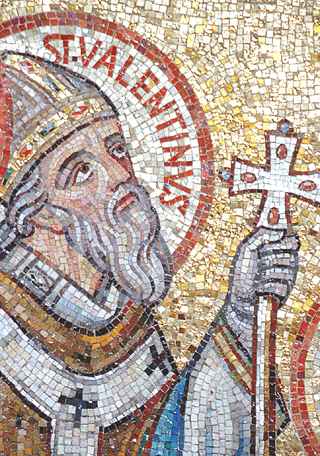
Saint Valentine


St Valentine.jpg

The Church’s hagiographical
tradition (lives of the saints) the Roman Emperor Claudius prohibited
young men from getting married because he wanted them for his army. Valentine,
a priest of Rome, contradicted the Emperor’s wishes and married couples in
secret. This act of deviance, and the fact that he helped martyrs at the time of persecution, landed Valentine in prison with a death
sentence. He was beaten and beheaded. Saint Valentine’s relics repose in the Church of Saint Praxedes (near to the papal basilica of Santa Maria Maggiore). Corresponding with some married couples Valentine would sign his
letters, ‘Your Valentine’.

Valentine was martyred in 269 at Rome and buried on
the Flaminian Way. He is the patron saint of beekeepers, engaged couples,
epilepsy, fainting, greetings, happy marriages, love, lovers, plague,
travelers, and young people. Valentine is often portrayed with birds and roses
in iconography.

As a cultural note, the Flaminian Way is one of the principal Roman roads leading from
Rome to Gaul. The road’s construction was begun in 220 BC by Caius Flaminius.

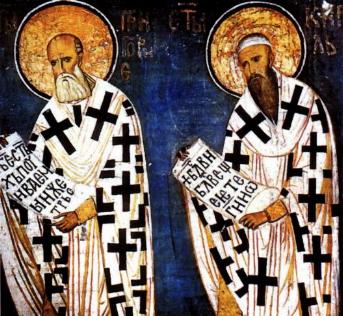
Saints Cyril and Methodius

Ss Cyril & Methodius.jpgO Cyril Methodius, glorious teachers, with brilliance you taught
the Moravians to bless God in their own words, by translating the law of the
Lord from Greek into Slavonic. You taught His righteousness. Therefore, the
Slav peoples now give glory to God in joy.


Who can proclaim the wonders of the
Lord, which Cyril and Methodius did to his glory? They overcame the poison of the Saracens. They tore apart the heavy nets. Their language closed the mouths of the corrupt
Khazars with the faith of the Lord. They made sweet the bitter waters and
delighted the good people that had sat in darkness.

Stichera at the Praises,
Tone 8

Saint Maron

In honor of the 1600th anniverssary of the death of Saint Maron, the Holy Father Pope Benedict XVI blessed and unveiled a new statue of the saint at the Vatican basilica of Saint Peter’s.
For the past year, Maronites and others around the world have been observing a jubliee year called by His Beatitude, Patriarch Nasralla Peter Sfeir. In a letter to the Maronite Church around the world he said, in part, 
Our Church was not built after a name of a See or Apostle, but rather took its identity from the radiance of a man and a monastery: the Maronite Church, a Church of asceticism and adoration attached from the beginning to a solitary man, not a man of rank or a Church leader.
The faith lived out by the hermit Maron became the inner strength of a people’s history. As for the successive migrations from Syria (in the 5-10th centuries), the Maronites gave them one meaning, that is, giving up land, wealth and comfort in Syria moving toward a poor land where anxiety and austerity prevail, so they could preserve their faith and remain attached to their freedom … This event is not a simple historical fact among others …  it is the very beginning of a new history, the history of the Maronites.
The Jubilee Prayer

Lord, Jesus, You called Your chosen one, Saint Maron, to the monastic life, perfected him in divine virtues, and guided him along the difficult road to the heavenly kingdom.

During this jubilee year, commemorating 1600 years since the death of Your chosen one, Saint Maron, when he was called to the house of Your heavenly Father, we ask You, through his intercession, to immerse us in Your love that we may walk in Your path, heed Your commandments, and follow in his footsteps.
May his holy example resonate throughout our lives. With Your love, may we achieve that final distination reached by our father, Saint Maron, and carry Your Gospel throughout the world.
Through his intercession, may we attain the glory of the resurrection and everlasting life in You.
Glory and thanks are due to You, to Your blessed Father, and to Your living Holy Spirit, now and forever. Amen.

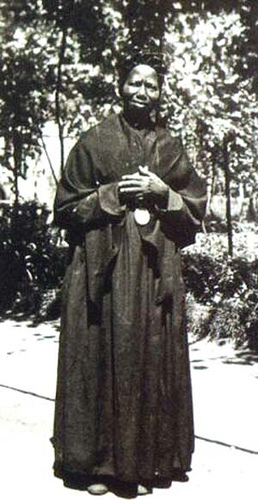
Saint Josephine Margaret Bakhita

St Josephine Bakhita.jpg

Jesus left his throne in heaven,
Humbly coming as a slave,
Here his love and his obedience
Were the ransom that still saves:
Strong the song the Church now raises
For this humble virgin’s day,
Praising God that, through all struggles,
She was led to Christ, the Way.
As a child torn from her fam’ly,
Made a slave, great suff’ring bore,
And by those who took her childhood,
Named “Bakhita” everymore.
Brought to Italy and rescued
By Cannosian sisters there,
She found Christ and then was baptized,
Lived in service and in prayer.
As the virgins in the Gospel,
Josephine was filled with light,
Daily serving at her convent,
Greetings all with heaven’s sight;
Loving all with Jesus’ mercy,
Treating each as she would him–
Persevered through pain and sorrow,
Making life her off’ring-hymn.
Glory to the loving Father
Who has made us for his own;
Glory to the Son, who saves
And who lifts us to his throne;
Glory to the Holy Spirit,
Never-ending font of love!
With our saint, the “one most blessèd,”
We raise songs to God above!
J. Michael Thompson
Copyright © 2010, WLP
8787D; BEACH SPRING

A previous post on Saint Josephine

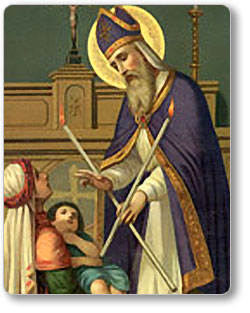
Saint Blase and the Blessing of Throats

St Blaise blessing throats.jpg

Lord, hear the prayers of Your martyr Blase. Give us the joy of Your peace in this life and help us to gain the happiness that will never end.

The Church has few exact details of the life of Saint Blase (also Blaise, Biago, Sveti Vlaho) but we have the experience of his popularity through the centuries in the churches of the East and West. What we know is that Blase was a physician, the Bishop of Sebaste, Armenia and martyr. The Roman Martyrology tells us that he was beheaded in 316.

More info on Saint Blase is found here and here.

The Blessing of Candles on the feast of St Blase can be found here.

The Blessing of Bread, Wine, Water and Fruit for the feast.

blessing of throats.jpg

From the Golden Legend again: 

And when this good widow, which by S. Blase had recovered her swine, heard thereof, she slew it, and the head and the feet with a little bread and a candle, she brought to S. Blase, and he thanked God and ate thereof, and he said to her that every year she should offer in his church a candle, and know thou that to thee and to all them that so shall do shall well happen to them, and so she did all her life, and she had much great prosperity.

Even after imprisonment, he refused to worship the prince’s gods, and for punishment his flesh torn by wool combs. He was finally beheaded, martyred along with seven women and two children.

Today, due to the cure of the boy’s throat when the boy was choking, Saint Blase is patron against diseases or any other trouble of the throat.

The priest will bless two candles in honor of Saint Blase.

Saint Brigid of Ireland


St Brigid of Ireland.jpg

O holy Brigid, you became sublime through your humility, and flew on the wings of your longing for God. When you arrived in the eternal City and appeared before your Divine Spouse, wearing the crown of virginity, you kept your promise to remember those who have recourse to you. You shower grace upon the world, and multiply miracles. Intercede with Christ our God that He may save our souls. (Troparian, tone 1)


Lord, you
inspired in Saint Brigid such whole-hearted dedication to your work that she is
known as Mary of the Gael; through her intercession bless our country; may we
follow the example of her life and be united with her and the Virgin Mary in
your presence.


More on Saint Brigid here.

Formerly ex-communicated saints

Much is made of canonization of Saint Mary MacKillop with her sordid past of being an ex-communicated Catholic.
Whether by ex-communicated we mean official ecclesiastical punishment or a punishment imposed by a religious superior. One’s being cut off from the Christian community sacramentally is strikingly painful but sometimes a needed medicine for the cure of some spiritual sickness typically demonstrated in an act of disobedience to the Church’s authority based on intellectual separation from some dogma or doctrine of the Church. You’ll see this with matters pertaining to abortion and certain healthcare matters. One simple example is that the medicine of excommunication is automatically imposed by the act itself for threatening the life of the pope. For more information see Book VI of the 1983 Code of Canon Law, canons 1364-99 outline
Some good examples of saints who were once excommunicated and then restored to communication in the Church are:
Saint Cyprian
Saint Hippolytus of Rome
Saint Joan of Arc
Saint Gerard Majella – by St Alphonsus Liguori
Saint Mary of the Cross MacKillop – by the bishop in Australia
Saint Theodore Guerin by her bishop