The Gospel Proclaimed in Greek at St Peter’s, 2020

The Gospel Proclaimed in Greek at Pope’s Easter Mass doesn’t seem newsworthy unless you have a special concern for the catholic Church’s Sacred (Divine) Liturgy. Yesterday caught our attention.

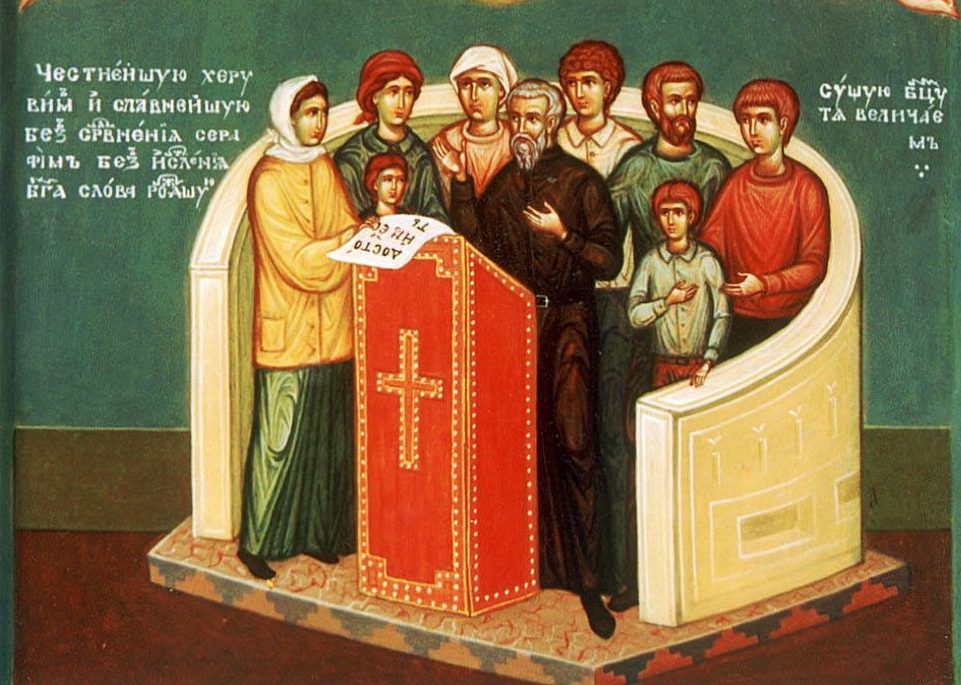
If you watched Pope Francis’ Easter Mass at St Peter’s Basilica yesterday, then you may have noticed the very moving gospel of the Resurrection sung in Greek. The deacon, Gianpiero Vaccaro, from the Italo-Albanian Eparchy of Lungro (Calabria, Italy, is also a student of the Pontifical Greek College in Rome.

It was a good thing to see this “tradition” for Easter as it gives one the sense of greater universality of the Catholic Church. As you know, the Church is much more that Latin; for that matter, it is much larger than the Greek Churches, too. We do have the Armenian, Chaldean, Coptic, and Syriac families! Wouldn’t be nice to hear the Gospel sung in liturgical Armenian or Syriac (or Aramaic)?

In the meantime, let us pray for Deacon Gianpiero Vaccaro and his ministry for the Eparchy of Lungro.

https://www.facebook.com/fr.d.duvelius/videos/10158199961882512/UzpfSTY5MTA2MzY2NToxMDE1NzM4MDU3MDMwODY2Ng/
Recalling Fr Schmemann today

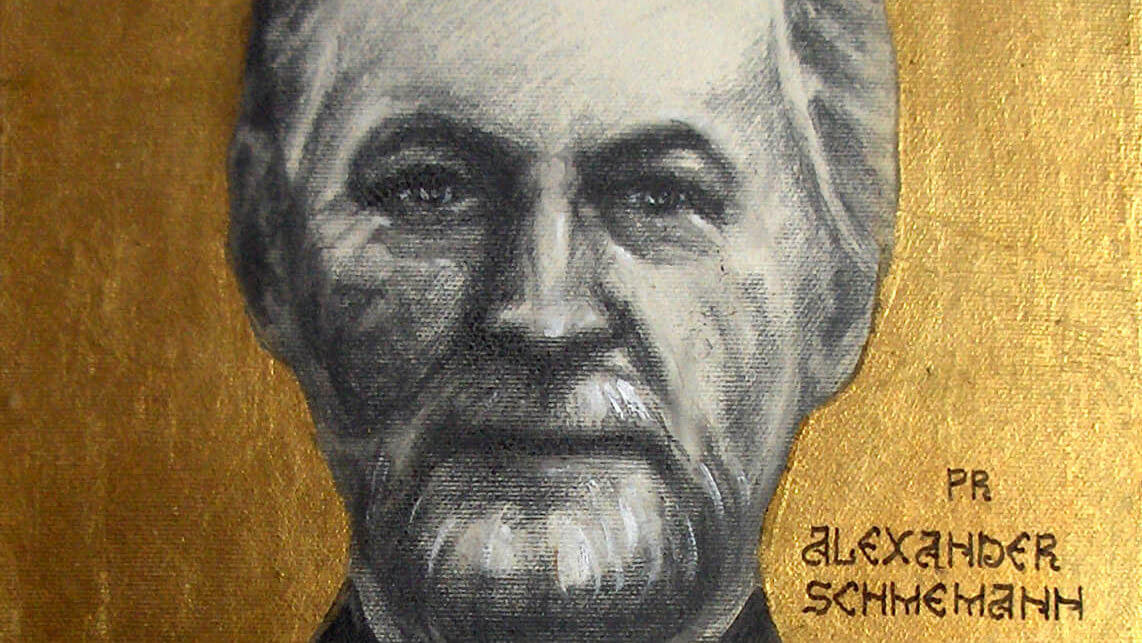
On this day in 1983 Father Alexander Schmemann died. He is a favorite liturgical theologian of the Orthodox Church. A prolific speaker and author, a man of great vision. May Father Alexander’s memory be eternal.

“Man is a hungry being. But he is hungry for God. Behind all the hunger of our life is God. All desire is finally a desire for Him.”

Nothing more important than Sacred Liturgy

There is nothing on Earth, higher, greater or more holy than the divine liturgy, nothing more solemn, nothing more life-giving.

~Saint John Kronstadt

Experience and the witness of the saints on the importance of the sacred Liturgy (or Divine Liturgy, if you will) has a correspondence to truth that is undeniable. Much of what passes as the worship of the Triune God is unspeakable. What needs to happen in the Church, especially here in the Northeast, is a move to adopt a living sense of the Catholic Tradition.

Prayer to Bless New Honey

Prayer to Bless New Honey

Priest: Let us pray to the Lord.
Laity: Lord, have mercy.

O Lord Jesus Christ, Whose mercies cannot be contained and Whose bounties are ineffable; Who are wondrous in glory and Who works miracles, Who by the operation of the Holy Spirit once blessed Israel and nourished them with honey from a rock and fed ascetics with honey: as the same Lord, look down now from above on this Your work, and with Your heavenly blessing bless and consecrate this honey.

Grant to the honey the action of a blessing beyond all perfection, so that all tasting of it, receiving it and eating it, may find good health, and by this nourishment be satisfied and filled with all good things.

For You are He Who bestows all good things, and to You we ascribe glory, together with Your Father Who is without beginning, and Your Most-holy, Good and Life-creating Spirit, now and ever and unto ages of ages. Amen.

The priest sprinkles the honey with Holy Water, saying:

This honey is sanctified by the sprinkling of this Holy Water, in the name of the Father, and of the Son, and of the Holy Spirit. Amen.

***Typically, the blessing of new honey among the Eastern European Byzantines happens on the first day of the Dormition Fast (on the new Gregorian calendar that would be August 1) but the blessing can happen on other days for example on the Transfiguration like many of the Ukrainian Byzantine Catholics from the Eastern part of the country.

Blessings on the Transfiguration 2019

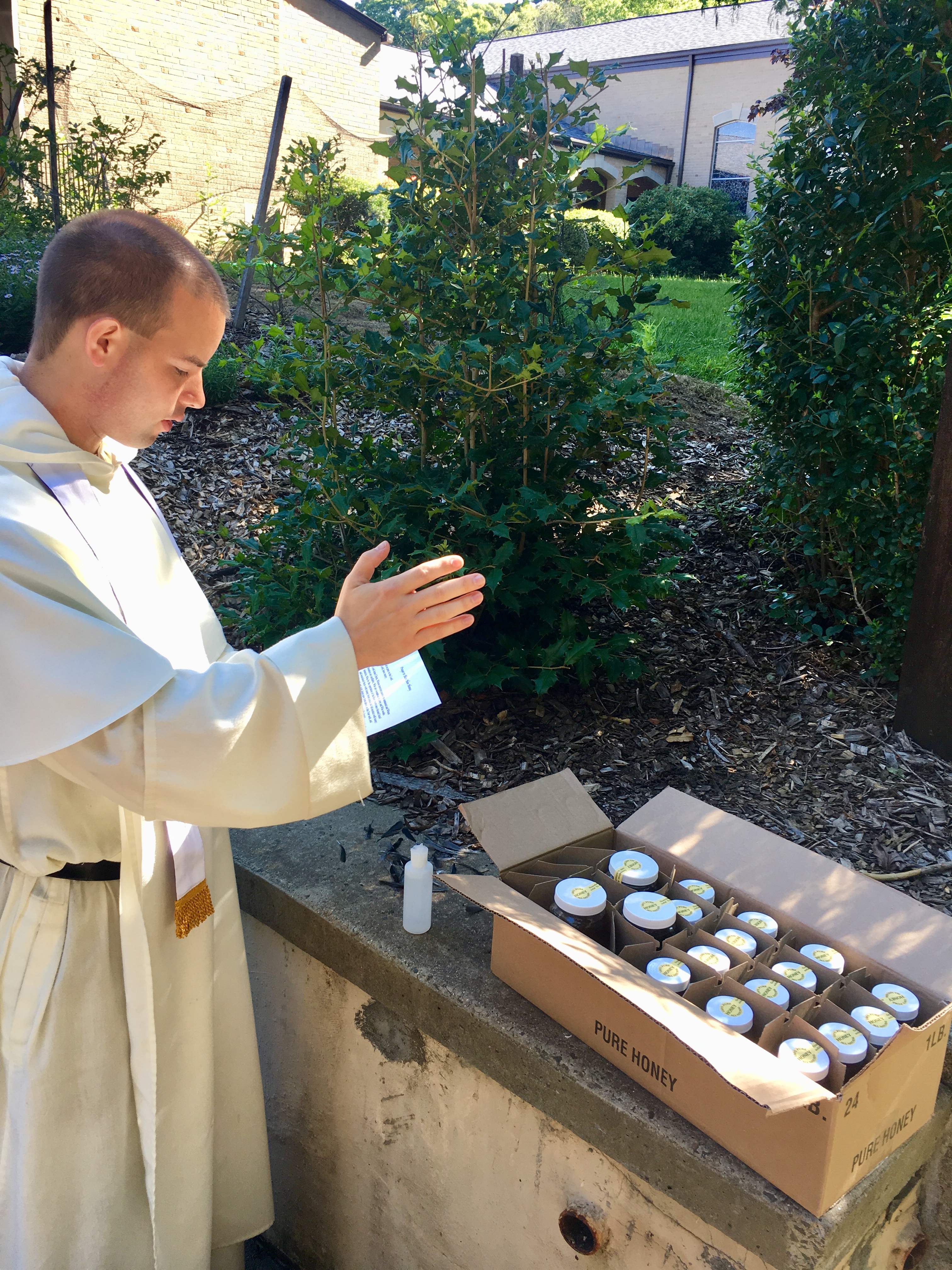
At the conclusion of the Divine Liturgy for the feast of the Transfiguration of the Lord, Father Iura (St. Michael the Archangel Ukrainian Catholic Church, New Haven, CT) blessed grapes, harvested fruits and vegetables and honey.

According to the Gospel of John, Jesus said, “I am the vine, you are the branches, apart from me you can do nothing.” Grapes connect us to the wine changed in the Blood of Christ at the Liturgy, the fruits and vegetables return to the Lord the blessings He’s bestowed on us, and honey reminds of the sweetness of the Beauty of God.

The blessings, therefore, remind us of place of the Eucharistic sacrifice of the Liturgy and how we are transfigured into someone new in Christ.

As close followers (disciples) of Jesus Christ we know we don’t give ourselves anything; everything we have is a gift. Therefore, we say we depend on God for everything in our lives. It was same recognition that Moses had and taught the people of Israel to offer their first and finest harvest back to the Lord.

Good Church Music Starts with Kids

Music is essential to life. Sacred music –that which is lived and performed in the Liturgy– is crucial important and integral to the worship of God. Yes, we live the text and the notes.

I love music. I love listening to music. I love sharing the experience of listening to music with others. I love purchasing, supporting musicians, and the like. I don’t sing even though I probably have one note (like everybody else).

The “normal” parish does not spend enough time thinking about the sacred music program never mind spending money on it. Even a financially strapped parish could put $50.00 per week away for sacred music. More important to money is the understanding of pastor and laity have regarding the music and give personal, informed and reasonable interest to it and the people involved. The worship of God is paramount; the lifting of our soul is desired and beautiful and healing.

I stumbled upon Benedict Sheehan’s blog post “Good Church Music Starts with Kids” and I think he’s spot-on and parishes, especially Catholic parishes, need to attend to what he Benedict proposes.

Benedict Sheehan regularly posts at The Music Stand –visit him there.

Holy Name of Jesus

“You shall call His name Jesus, for He shall save His people from their sins.”

The Latin Church has today as the Feast of the Holy Name of Jesus; it is historically associated with the Feast of the Circumcision of Jesus celebrated on the 8th Day of Christmas, January 1. Both the Latin and Eastern Churches have the Feast of the Circumcision of Jesus. It is not only the shedding of skin but the giving of the name according to Jewish Law thus making the baby a member of God’s household committed to the Covenant.

We know that the name ‘Jesus’ means ‘God Saves’ and is the name that St. Joseph was instructed by an angel to name the Child. By Divine Will, it is the sacred name before which “every knee should bend, in heaven and on earth and under the earth, and every tongue should confess that Jesus Christ is Lord, to the glory of God the Father” (Phil. 2:10-11). The only name that saves.

Devotion to the Most Holy Name of Jesus was popularized by the Franciscan St. Bernardine of Siena in the 15th century, often symbolized by the monogram IHS (denoting the first three letters of the Greek spelling of Jesus’ name). The feast was given to the Order of Friars Minor by Clement VI.  But it is known by the Cistercians with the preaching of St. Bernard before this time; it is the same monogram that Loyola used for the Jesuits. By 1721, Innocent XII gave the feast of the Holy Name to the entire Church as the Emperor Charles VI.

Today the feast of the Holy Name of Jesus is celebrated on January 3rd. And the month of January is dedicated to the Holy Name.

Eternal Kingdom and the dignity of its King

The glory and nobility of God’s eternal Kingdom have to be estimated from the dignity of its King, since a king is not derived from a kingdom but a kingdom from a king. And he indeed is King who has on his garment and on his thigh a name written: King of kings and Lord of lords (Apoc. 19:16), whose power is everlasting power that shall  not be taken away (Dan. 7:14), whose kingdom will not be destroyed and whom all tribes ad peoples and tongues (Apoc. 7:9) will serve throughout eternity. He is truly a peaceable (1 Chron. 22:9) King, whose countenance both heaven and all the earth desire to look upon  (1 Kings 10:24).

In this eternal kingdom, all good and perfect gifts come down in plenty and abundance from the Father of Lights (James 1:17) through Jesus Christ, who is the super-essential Ray and who since he is one, can do all things, and renews all things (Wisdom 7:27).

St. Bonaventure
The Tree of Life