Category: Sacred Liturgy & Sacraments
Chair of Saint Peter
With the Church we pray
Grant, we pray, almighty God, that no tempests may disturb us, for you have set us fast on the rock of the Apostle Peter’s confession of faith.
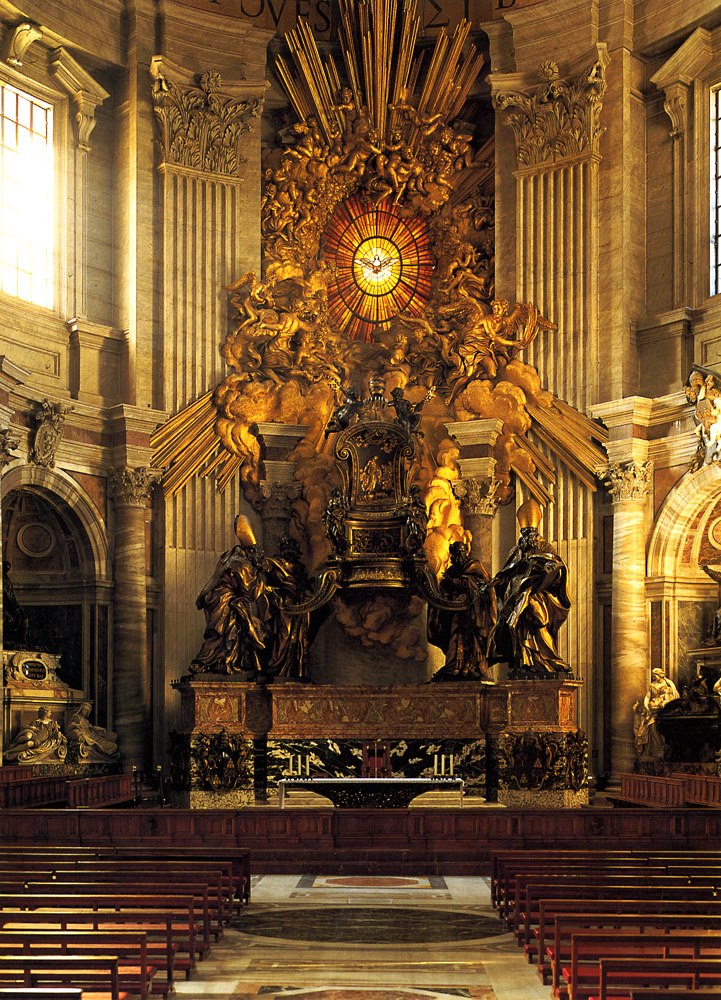
Has anyone promised you anything? As Catholics, we can say with certainty that we have been promised something. In fact, we are promised not only something, but Someone. We can identify that we have been promised the truth, happiness (in this life) and eternal life (happiness in the next life); we’ve also been promised a rich relationship with God, with Jesus, and the Holy Spirit. Today’s feast of the Chair of Saint Peter is the Church’s way of reminding God and each other that we have been promised all these things: truth, happiness, and life eternal with God.
For a very, very long time, actually since the 4th century, the Church of Rome has had a special commemoration of the pastoral, spiritual authority of Saint Peter as the rock upon which the Lord built His Church. Historians estimate that Saint Peter was executed between the years 64 and 68. In fact, the Church in Antioch, founded by Saint Peter, has also had this feast on their liturgical calendar. The witnesses found in the Apostolic Fathers, the Roman See has always held a special place in the obedience of orthodox Christian believers because of the bishop of Rome “presides in love” and in service over all the Churches of God.
Today’s feast ought to remind each one of us that we don’t celebrate furniture but it calls us to see in Peter Jesus. Each feast of a saint, including the Blessed Mother, always points to Jesus. To do otherwise would be idolatry. The Chair of Saint Peter is fundamentally about work, the mission of bishop as overseer, teacher and pastor conferred by Jesus on Peter, and continued through the ages to Pope Benedict XVI (and soon on his successor). See the Gospel of Matthew 16:13-20. What we celebrate today is the communion of faith, the truth of the faith given to us by the Lord through the apostles to the bishop of Rome and to all bishops. You may even say the feast we celebrate today is the ministry of the Church’s Magisterium located in the Roman Pontiff in that he cannot teach error. That does not mean the pope is a saint; that the pope does not sin; on contrary, we believe the pope is a sinner and in need of redemption like each one of us: he has clay feet like you and me. But having clay feet doesn’t mean that teach that we believe in “Christ, the Son of the Living God.” His job is to help us see the face of Christ in this world, and to lead us to Him so that may enjoy eternity with Him.
In 2006, Benedict XVI gave the following address on this feast which is required reading,
Indulgences when there is no pope

We Catholics have confidence in the proper use of indulgences for flourishing of the spiritual life on earth and in purgatory. Indulgences are often more known in concept but not always with the needed exactitude with regard to the high religious ideals of theology and sacramentality in following Jesus Christ more closely in His Resurrection.
Catholics know that one of the conditions of gaining the gift of indulgence is prayer for the Pope’s intentions. But when there is no pope, how does one fulfill the requirements of the indulgence? Are indulgences unavailable to the faithful during the papal vacancy?
The Apostolic Penitentiary answered this question in 2005 at the papal vacancy, stating that indulgences are still available to the faithful during the interregnum, since the “intentions of the Holy Father” perdure past the life of the same Holy Father, therefore prayer for those intentions made known by the Apostolic See remain necessary and efficacious for the purposes of indulgences.
I note the Pope’s Intentions on the first day of the month here on the Communio blog, but the Apostleship of Prayer, whose ministry it is in the USA, makes these intentions available online and in a nicely printed pamphlet. The papal intentions for February 2013 are noted here.
In the text, The Gift of the Indulgence (2000), the Apostolic Penitentiary writes,
1. This is how an indulgence is defined in the Code of Canon Law (can. 992) and in the Catechism of the Catholic Church (n. 1471): “An indulgence is a remission before God of the temporal punishment due to sins whose guilt has already been forgiven, which the faithful Christian who is duly disposed gains under certain prescribed conditions through the action of the Church which, as the minister of redemption, dispenses and applies with authority the treasury of the satisfactions of Christ and the saints”.
2. In general, the gaining of indulgences requires certain prescribed conditions (below, nn. 3, 4), and the performance of certain prescribed works (nn. 8, 9, 10 indicate those specific to the Holy Year).
3. To gain indulgences, whether plenary or partial, it is necessary that the faithful be in the state of grace at least at the time the indulgenced work is completed.
4. A plenary indulgence can be gained only once a day. In order to obtain it, the faithful must, in addition to being in the state of grace:
— have the interior disposition of complete detachment from sin, even venial sin;
— have sacramentally confessed their sins;
— receive the Holy Eucharist (it is certainly better to receive it while participating in Holy Mass, but for the indulgence only Holy Communion is required);
— pray for the intentions of the Supreme Pontiff.
5. It is appropriate, but not necessary, that the sacramental Confession and especially Holy Communion and the prayer for the Pope’s intentions take place on the same day that the indulgenced work is performed; but it is sufficient that these sacred rites and prayers be carried out within several days (about 20) before or after the indulgenced act. Prayer for the Pope’s intentions is left to the choice of the faithful, but an “Our Father” and a “Hail Mary” are suggested. One sacramental Confession suffices for several plenary indulgences, but a separate Holy Communion and a separate prayer for the Holy Father’s intentions are required for each plenary indulgence.
6. For the sake of those legitimately impeded, confessors can commute both the work prescribed and the conditions required (except, obviously, detachment from even venial sin).
7. Indulgences can always be applied either to oneself or to the souls of the deceased, but they cannot be applied to other persons living on earth.
The grants of indulgence are contained in the Enchiridion Indulgentiarum (4th ed., 1999). You will see special grants of the Holy See, such as for the Year of Faith, World Day of the Sick, World Youth Day or some special observance in dioceses or religious orders.
Liturgical notes for the papal transition
The United States Conference of Catholic Bishops (USCCB) under the direction of Monsignor Richard Hilgartner of the Secretariat for Divine Worship, has produced a packet of materials regarding the pope.
Go and do likewise –21st World Day of the Sick
Today is the 21st observance of the World Day of Prayer for the Sick. This one paragraph of Pope Benedict’s is instructive. The picks some holy people to help us see the face of Christ more clearly in the everyday. Can we be a good samaritan in the communities in which we find ourselves?
May Our Lady of Lourdes, pray for us.
For the rest of the document, see the link here.
The Year of Faith which we are celebrating is a fitting occasion for intensifying the service of charity in our ecclesial communities, so that each one of us can be a good Samaritan for others, for those close to us. Here I would like to recall the innumerable figures in the history of the Church who helped the sick to appreciate the human and spiritual value of their suffering, so that they might serve as an example and an encouragement. Saint Thérèse of the Child Jesus and the Holy Face, “an expert in the scientia amoris” (Novo Millennio Ineunte, 42), was able to experience “in deep union with the Passion of Jesus” the illness that brought her “to death through great suffering” (Address at General Audience, 6 April 2011). The Venerable Luigi Novarese, who still lives in the memory of many, throughout his ministry realized the special importance of praying for and with the sick and suffering, and he would often accompany them to Marian shrines, especially to the Grotto of Lourdes. Raoul Follereau, moved by love of neighbour, dedicated his life to caring for people afflicted by Hansen’s disease, even at the world’s farthest reaches, promoting, among other initiatives, World Leprosy Day. Blessed Teresa of Calcutta would always begin her day with an encounter with Jesus in the Eucharist and then she would go out into the streets, rosary in hand, to find and serve the Lord in the sick, especially in those “unwanted, unloved, uncared for”. Saint Anna Schäffer of Mindelstetten, too, was able to unite in an exemplary way her sufferings to those of Christ: “her sick-bed became her cloister cell and her suffering a missionary service. Strengthened by daily communion, she became an untiring intercessor in prayer and a mirror of God’s love for the many who sought her counsel” (Canonization Homily, 21 October 2012). In the Gospel the Blessed Virgin Mary stands out as one who follows her suffering Son to the supreme sacrifice on Golgotha. She does not lose hope in God’s victory over evil, pain and death, and she knows how to accept in one embrace of faith and love, the Son of God who was born in the stable of Bethlehem and died on the Cross. Her steadfast trust in the power of God was illuminated by Christ’s resurrection, which offers hope to the suffering and renews the certainty of the Lord’s closeness and consolation.
Presentation of the Lord, Candlemas
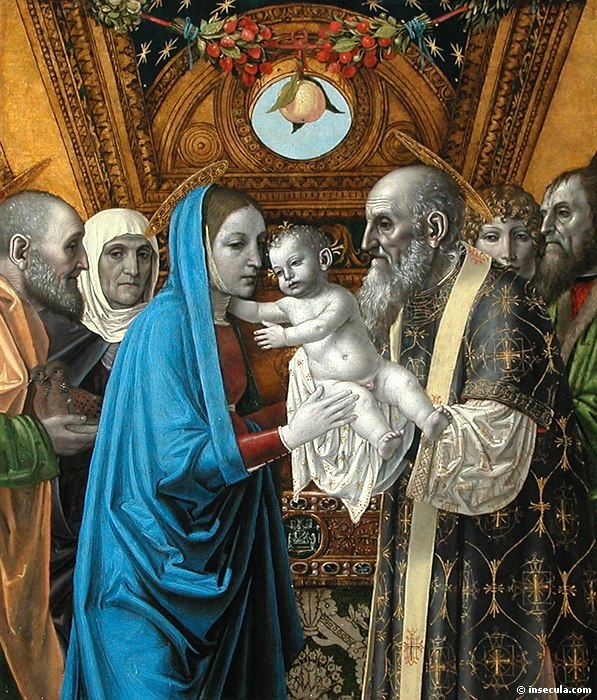
We are 40 days away from the Nativity of the Lord. The Presentation of the Lord is a feast the Church in the Eastern part of the ecclesial world, known as an “Encounter,” a second epiphany of the new born King and Messiah given the words of the Simeon. Christ is identified as the Light of the Nations.
The Christology of the Liturgy is quite clear and instructive: by no other person is salvation possible. By the same token this Light to the Nations is a supreme sign of contradiction (St Cyril of Jerusalem) and a stumbling block (St Paul)
The feast began to observed in the 6th century. The Western Church made this feast more penitential because it began to be linked with the purification of Mary according to the Mosaic law.
In the Missal of Blessed John XXIII today ends the Christmas season whereas in the Missal of Paul VI the feast of the Baptism of the Lord ends Christmas.
Our liturgical observance of the Lord’s Presentation is also called “Candlemas” because the Church blesses candles, all the candles to be used in the Mass, including the Paschal Candle to be used at the Easter Vigil; home candles are also brought to church for this blessing. Besides the special prayers prayed, Simeon’s song Nunc dimittis, Saint John of Damascus’ song Adorna thalamum tuum, Sion AND Zacharia’s Benedictus are sung by the choir. Christ as the light of the world is not merely a theological statement, it is a reality in the life of the Christian. To what end do we reflect the light of Christ in the home, in the workplace, in social settings?
V. Zion, let your wedding chamber be prepared to receive Christ your King.
R. The Virgin conceived and gave birth to a son, yet she remained a virgin for ever. She knelt in worship before her child.
V. Simeon took the child in his arms and gave praise and thanks to God.
R. The Virgin conceived and gave birth to a son, yet she remained a virgin for ever. She knelt in worship before her child.
Ave, Mary full of grace
In whose virgin arms’ embrace
God to God Himself doth vow!
Alleluia, alleluia!
Let me in the temple wait,
Jesu, for mine all art Thou.
God is to His temple come;
Angels throng the hallowed dome;
What beyond hath heav’n in store?
Alleluia, alleluia!
God Himself our flesh doth wear;
This than heav’n itself is more.
Incense gales of gladness rise
Where this morning sacrifice
‘Mid re-echoing shouts is made.
Alleluia, alleluia!
Evening’s rite in tears shall end,
On the dark’ning Cross displayed.
There behold th’Oblation wrought,
By Whose precious ransom bought,
We are all to God made nigh.
Alleluia, alleluia!
Now no longer, Lord, our own,
Thine we live and Thine we die!
Let Thy servants now depart;
May we see Thee as Thou art,
Nought of earth arrest our eyes!
Alleluia, alleluia!
Let us here with Jesus grow,
And in Him hereafter rise!
A sequence from an 18th century Paris Missal
Preaching … to the pope and others
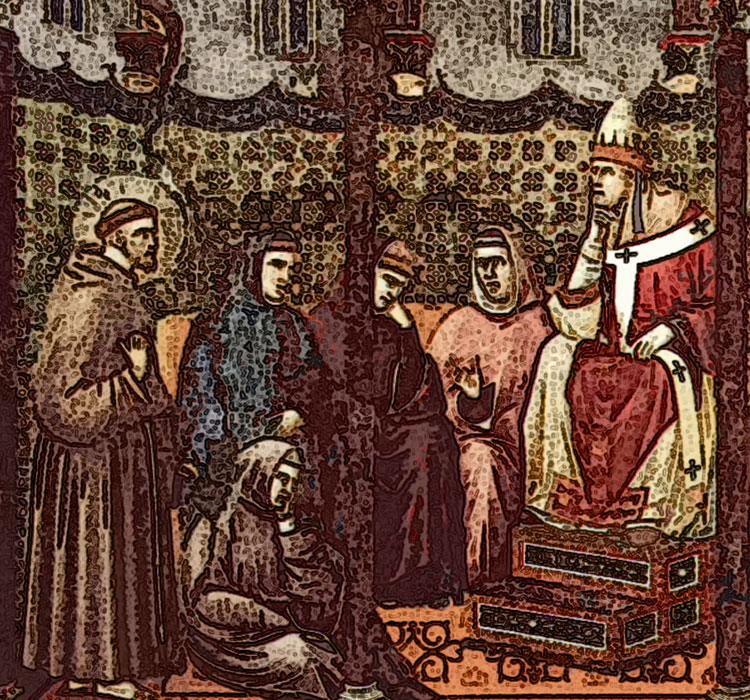 Last Sunday at the keynote address given by Father Julián Carrón who said among many other good things is that preaching is taking part in man’s search for God. Moreover, preaching arouses curiosity from within, that one of its aim is to overcome the divide between faith and life.
We can point to the many instances when the preacher goes to his file, looks for the right date, and proceeds to inflict on the faithful yet another good example of pastoral slothfulness as if the faithful will not recall the last time the priest said the exact same thing. You can say that the quest of the Infinite, the quest for the Faith is severely reduced.
In his Vatican Diary yesterday, Sandro Magister wrote a piece that may interest you, “Those who preach to the pope.” A timely essay given that Pope Benedict recently chose Cardinal Gianfrance Ravasi, president of the Pontifical Council for Culture, to preach this coming Lent.
Magister’s essay is good not only because it reveals some insight into an aspect of papal life not often thought about by the laity, but it also shows a certain commitment of the Pope to hear others share what Father Carrón says about our searching for God and the preacher arousing curiosity in the hearer. Magister also provides a helpful list of names and affiliations.
Receiving Holy Communion: correct gestures?
Three things came at me recently that I think needs to be looked at with intellectual and affective honesty. That is, from a perspective of faith and reason, the mind and the heart. The issue of how we receive Holy Communion.
When I was prepared to receive the sacrament of Holy Communion in the third grade by Sister M. Rosetta, CSFN, I was taught to receive our Eucharistic Lord kneeling and on the tongue. In fact, there were no other options available. At some point, for some unknown reason, I began to receive the Eucharist in my hand. And then the parishes I would attend all distributed Holy Communion standing. “That’s the way it’s done.” Surely there is a disconnect between what I was taught and what I eventually adopted. Mind you, I didn’t adopt a new way to receive Communion out of protest or because I thought better than the Magisterium. Sheer habit was born because, well, “just because.”
Back to the recent three things.
I heard, saw, experienced:
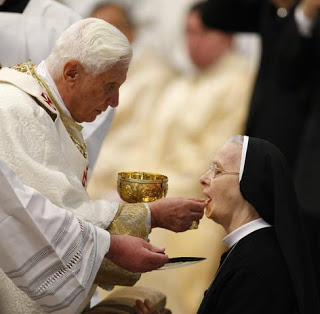
1. At the beginning of January, I heard Bishop Athanasius Schneider make a reasoned argument for receiving Holy Communion on the tongue and kneeling;
2. I’ve recently been re-adopting, in a conscientious manner, the way I receive Holy Communion: experience tells my heart and my mind that Communion received in a more traditional way, taking my example the papal Masses, is what the Lord requires in a relationship;
3. Deacon Greg Kendra (a permanent deacon of the Brooklyn Diocese) wrote on his blog that he thought it’s time to restore a greater sense of reverence in our liturgical practice by kneeling at the rail for Communion.
So, who cares what Deacon Kendra thinks? I am sure a few do; I think his blog piece opened a new window of opportunity to rethink pastoral practice for sensible and honest reasons. But if truth be told, Pope Benedict and Bishop Schneider carry the burden of argument.
The sacraments are events
[T]he sacraments constitute the events of a time which is the tension between the Resurrection and the Parousia …. Thus during the delay of the Parousia, the Eucharist prevents humanity, in this foretaste of celestial food …. And the Eucharist is the sacrament of unity which gathers about Christ of glory, present in the community, all nations in order to offer them through His hands to the Father.
Jean Cardinal Daniélou, SJ
Marxist History and Sacred History, 508-9
Benedict XVI to new bishops: Our criterion is the Lord himself…fear of God frees us
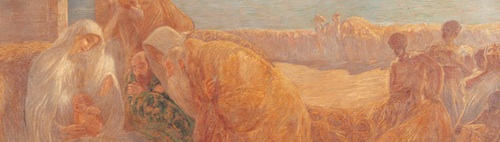
We honor the witness of the Magi, Casper, Melchior and Balthasar. The Seekers from the East following the signature of God to the star burning brightly over the Light of the World. Saint John
Chrysostom taught, “If the Magi had come in search of an earthly king, they
would have been disconcerted at finding that they had taken the trouble to come
such a long way for nothing. Consequently they would have neither adored nor
offered gifts. But since they sought a heavenly king, though they found in him
no signs of royal pre-eminence, yet, content with the testimony of the star
alone, they adored: for they saw a man, and they acknowledged a God.”
As you know Pope Benedict ordained 4 priests to the Order of Bishops today at the Sacrifice of the Mass for the Solemnity of the Epiphany. The Pope, per usual, hits the ball out of the park. He speaks eloquently about the ministry of the bishop for the Church. I read the following homily with astonishment. I am in awe of the profound nature of the vocation; I am sad to know so many called to this office by the Spirit and the Church live it with such lack of faith, hope, and charity, with a lack of mercy and the good of the people put in his charge. On this feast we pray for all the pastors of the Church, including the bishops. Let’s look with mercy as the Lord has shown us mercy. Pay close attention to Pope.
Continue reading Benedict XVI to new bishops: Our criterion is the Lord himself…fear of God frees us