Work for the good of every person on earth: fight spiritual and material poverty, Pope exhorts

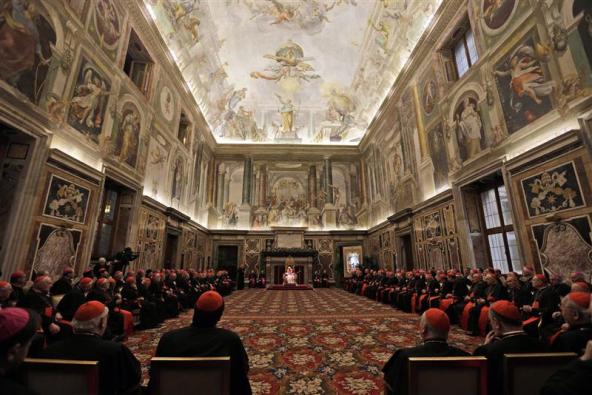
Speaking in French today, Pope Francis gave his talk in Italian outlined to the world’s diplomats the mission of his pontificate: building peace AND constructing bridges of dialogue,  combatting spiritual AND material poverty. This is part 2 of his “pontifical program of ministry.” The Pontiff met the more than 180 accredited diplomats in Sala Regia of the Apostolic Palace, the Vatican.

English: world map of the Vatican foreign rela...

World map of the Vatican foreign relations; dark green: diplomatic relations, light green: other relations, gray: no official relations (credit: Wikipedia)

Heartfelt thanks to your Dean, Ambassador Jean-Claude Michel, for the kind words that he has addressed to me in the name of everyone present. It gives me joy to welcome you for this exchange of greetings: a simple yet deeply felt ceremony, that somehow seeks to express the Pope’s embrace of the world. Through you, indeed, I encounter your peoples, and thus in a sense I can reach out to every one of your fellow citizens, with their joys, their troubles, their expectations, their desires.

Your presence here in such numbers is a sign that the relations between your countries and the Holy See are fruitful, that they are truly a source of benefit to mankind. That, indeed, is what matters to the Holy See: the good of every person upon this earth! And it is with this understanding that the Bishop of Rome embarks upon his ministry, in the knowledge that he can count on the friendship and affection of the countries you represent, and in the certainty that you share this objective. At the same time, I hope that it will also be an opportunity to begin a journey with those few countries that do not yet have diplomatic relations with the Holy See, some of which were present at the Mass for the beginning of my ministry, or sent messages as a sign of their closeness – for which I am truly grateful.

As you know, there are various reasons why I chose the name of Francis of Assisi, a familiar figure far beyond the borders of Italy and Europe, even among those who do not profess the Catholic faith. One of the first reasons was Francis’ love for the poor. How many poor people there still are in the world! And what great suffering they have to endure! After the example of Francis of Assisi, the Church in every corner of the globe has always tried to care for and look after those who suffer from want, and I think that in many of your countries you can attest to the generous activity of Christians who dedicate themselves to helping the sick, orphans, the homeless and all the marginalized, thus striving to make society more humane and more just.

But there is another form of poverty! It is the spiritual poverty of our time, which afflicts the so-called richer countries particularly seriously. It is what my much-loved predecessor, Benedict XVI, called the “tyranny of relativism,” which makes everyone his own criterion and endangers the coexistence of peoples. And that brings me to a second reason for my name. Francis of Assisi tells us we should work to build peace. But there is no true peace without truth! There cannot be true peace if everyone is his own criterion, if everyone can always claim exclusively his own rights, without at the same time caring for the good of others, of everyone, on the basis of the nature that unites every human being on this earth.

One of the titles of the Bishop of Rome is Pontiff, that is, a builder of bridges with God and between people. My wish is that the dialogue between us should help to build bridges connecting all people, in such a way that everyone can see in the other not an enemy, not a rival, but a brother or sister to be welcomed and embraced! My own origins impel me to work for the building of bridges. As you know, my family is of Italian origin; and so this dialogue between places and cultures a great distance apart matters greatly to me, this dialogue between one end of the world and the other, which today are growing ever closer, more interdependent, more in need of opportunities to meet and to create real spaces of authentic fraternity.

pontiff with dips.jpg

In this work, the role of religion is fundamental. It is not possible to build bridges between people while forgetting God. But the converse is also true: it is not possible to establish true links with God, while ignoring other people. Hence it is important to intensify dialogue among the various religions, and I am thinking particularly of dialogue with Islam. At the Mass marking the beginning of my ministry, I greatly appreciated the presence of so many civil and religious leaders from the Islamic world. And it is also important to intensify outreach to non-believers, so that the differences which divide and hurt us may never prevail, but rather the desire to build true links of friendship between all peoples, despite their diversity.

Fighting poverty, both material and spiritual, building peace and constructing bridges: these, as it were, are the reference points for a journey that I want to invite each of the countries here represented to take up. But it is a difficult journey, if we do not learn to grow in love for this world of ours. Here too, it helps me to think of the name of Francis, who teaches us profound respect for the whole of creation and the protection of our environment, which all too often, instead of using for the good, we exploit greedily, to one another’s detriment. The Pope said:

Dear Ambassadors, Ladies and Gentlemen,

Thank you again for all the work that you do, alongside the Secretariat of State, to build peace and construct bridges of friendship and fraternity. Through you, I would like to renew to your Governments my thanks for their participation in the celebrations on the occasion of my election, and my heartfelt desire for a fruitful common endeavor. May Almighty God pour out his gifts on each one of you, on your families and on the peoples that you represent. Thank you!
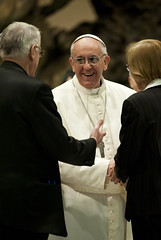
A focus on mission, Pope Francis points to direction

Pope Francis met with media

Pope Francis met with media

I don’t think Pope Francis will be too different from the last several Roman Pontiffs. As bishop of Rome he will preach and teach, govern and sanctify.The Pope’s un-programatic homily is in fact programatic if you can read the details. In some ways Francis’s homily is an Aesopian creature.

First, style is substance. Second, the liturgical preaching thus far indicates a trajectory. Third, focus on the Pope’s connection with people of belief and unbelief because this connection ought to be assessed for the facts and and not cliché. What the Pope said and what he’s done matters. Who’s present, and who’s not. (And this data is not to be reduced to politics.) All this is to say that you can’t miss “a trick” if you really want to know what and who Pope Francis is, and why he is doing what he’s doing and with whom. 
We are living nothing different from what Blessed John Paul and Pope Benedict did in their pontificates. Three things to pray for daily: conversion, vocation and mission.
A “news” man and priest whom I respect very much is the editor-in-chief for AsiaNews.it, Bernardo Cervellera. Tonight, his article, “Like Benedict, mission is Pope Francis’s focus,” captures what I am indicating and what I am urging you to attend.
Want to be informed about Christianity, and the global Church of Christ, read AsiaNews.it.
Enhanced by Zemanta

Hanging Concentrates the Mind

Be sure to have enough sleep and at least have eaten one meal today before you read and give some serious consideration to what Father George Rutler, pastor of the Church of Our Saviour (NYC) has to say about the death penalty. A recent essay was published today in Crisis Magazine online.


MOST Catholics, the informed and untrained, have no idea what the Church teaches about the subject. Many will recall that Pope John Paul II taught in Evangelium vitae (1995) and that he frequently spoke against the death penalty and it was the subject of intervention when he would visit a country where the death penalty was utilized (think of his visit to Missouri). A papal encyclical doesn’t change the teaching of the Church; it is however authoritative and it needs to be received. The matter of what level teaching an encyclical is, and to what degree it would bind conscience. For our purposes here, let’s say that a papal encyclical is authoritative and it involves the virtue of prudence but that it doesn’t contravene but it does nuance the teaching of the Church. Prudential judgment is just that, prudential. The Pope never changed the teaching of the Church. The blessed pope did try to reorient our thinking and the practice of killing legitimately convicted criminals. Remember, too, several years the heated debated between Cardinal Avery Dulles and Justice Scalia on the subject in First Things?


Father Rutler’s article is helpful in giving us yet another understanding of how we might understand the death penalty. Do we actually accept Christian belief in the salvation of one’s soul, that is, do we want to go to heaven? Read the article with openness, with a critical mind. As Saint Ignatius would teach, approach with the best of intentions to truly understand the other person. Knee jerk reactions are unacceptable for a Catholic who holds the integration of faith and reason. Father Rutler’s argument is Catholic on all levels.


The article…


Capital punishment does not inspire roaring humor in healthy minds, so wit on the subject tends to be sardonic.  Two of the most famous examples, of course, are: “In this country it is wise to kill an admiral from time to time to encourage the others,”  and “Depend upon it, sir, when a man knows he is to be hanged in a fortnight, it concentrates his mind wonderfully.”

The first, “pour encourager les autres,”  is in “Candide” where Voltaire alludes to the death by firing squad of Admiral John Byng in 1757 for having let Mincorca fall to the French.  The second was Samuel Johnson’s response to the hanging of an Anglican clergyman and royal chaplain William Dodd for a loan scam.  Byng’s death was the last instance of shooting an officer for incompetence, while Dodd’s was the last hanging at Tyburn for forgery. Dodd’s unsuccessful appeal for clemency was ghostwritten by Dr. Johnson.

Continue reading Hanging Concentrates the Mind

Prayer for the President of the United States of America

Seal of the President of the USA.jpg

We pray, Thee O Almighty and Eternal God! Who through Jesus Christ hast revealed Thy glory to all nations, to preserve the works of Thy mercy, that Thy Church, being spread through the whole world, may continue with unchanging faith in the confession of Thy Name.


We pray Thee, who alone art good and holy, to endow with heavenly knowledge, sincere zeal, and sanctity of life, our chief bishop, Pope Benedict, XVI, the Vicar of Our Lord Jesus Christ, in the government of his Church; our own bishop, Donald, all other bishops, prelates, and pastors of the Church; and especially those who are appointed to exercise amongst us the functions of the holy ministry, and conduct Thy people into the ways of salvation.


We pray Thee O God of might, wisdom, and justice! Through whom authority is rightly administered, laws are enacted, and judgment decreed, assist with Thy Holy Spirit of counsel and fortitude the President of these United States, that his administration may be conducted in righteousness, and be eminently useful to Thy people over whom he presides; by encouraging due respect for virtue and religion; by a faithful execution of the laws in justice and mercy; and by restraining vice and immorality. Let the light of Thy divine wisdom direct the deliberations of Congress, and shine forth in all the proceedings and laws framed for our rule and government, so that they may tend to the preservation of peace, the promotion of national happiness, the increase of industry, sobriety, and useful knowledge; and may perpetuate to us the blessing of equal liberty.


Continue reading Prayer for the President of the United States of America

Chaput speaks about the issues

Archbishop Charles J. Chaput, OFM, Cap., the archbishop of Philadelphia, has been in the center of a lot revisioning of the temporal affairs in the archdiocese since he came just over a year ago. He’s had some hard decisions to make when comes to education, parish buildings, financial transparency, etc. Then there’s sex abuse crisis and Obamacare.

He talks about Catholic schools, School choice, sex abuse crisis, priests, laity, conscience, healthcare…
Have a listen to a podcast.

113th United States Congress took office

us-congress-logo2.jpg

The 113th United States Congress was sworn into office today.

Our prayers ought to be with them,

O God, who arrange all things in wondrous order and govern in marvelous ways, look with favor on the assembled, for whom we now pray, and mercifully pour out upon them the spirit of your wisdom, that they may decide everything for the well-being and peace of all and may never turn aside from your will. 

By the numbers: 13 new senators, 84 new congress people. This freshman class has a Kennedy, a reindeer farmer and animal vet; 2 physicists in Congress. The longest in office, 38 years, is Senator Patrick Leahy of Vermont.

Catholics are concerned for the common good, the good working of the public order.

Locked doors, open hearts -to Satan


Father George Rutler, pastor of the Church of Our Saviour (NYC) wrote the following in a recent newsletter that ought to be part of our ongoing reflection on what happened to the good people of the Sandy Hook Elementary School:

Locking school doors will not keep Satan out if our
hearts are open to him. Nor will banning weapons ban murder if God is banned
from the conscience. Cain slew Abel without a gun. An illogical world can be
saved from self-destruction only by loving the Logos who was in the Beginning,
who was with God and was God.

Continue reading Locked doors, open hearts -to Satan

In a fractured world is Pope Benedict calling for political engagement?

benedict to curia.jpg

Pope Benedict
gave his annual address, a “State of the Church,” if you will, to the curial officials
of the Holy See today. 

You might say the content talk is crucially relevant for the
work of the Church and the proclamation of the Gospel as he reviews key events
and focuses on some themes.  Among many things which need our attention and reflection,
the Pope spoke about nature of man, family life, and inter-religious dialogue.
Regarding man in which he gave insight into, he speaks of how evil and destructive vague and
ideological the “gender conscious crowd” is to the nature of the person and removes God from conversation. Read the full text here.

The Pope notes the crisis of the family and its effect on society, caused by the
unwillingness to make a commitment and by unwillingness to suffer.  But he
goes beyond the symptoms to diagnose the cause of the crisis. This talk is not an attack, it is an appeal to truth.

Each of Pope
Benedict’s addresses to the Roman Curia are important, certainly the 2005
address stands out, but today’s will be memorable. 

Here’s a section:

First of
all there is the question of the human capacity to make a commitment or to
avoid commitment. Can one bind oneself for a lifetime? Does this correspond to
man’s nature? Does it not contradict his freedom and the scope of his
self-realization? Does man become himself by living for himself alone and only
entering into relationships with others when he can break them off again at any
time? Is lifelong commitment antithetical to freedom? Is commitment also worth
suffering for? Man’s refusal to make any commitment – which is becoming
increasingly widespread as a result of a false understanding of freedom and
self-realization as well as the desire to escape suffering – means that man
remains closed in on himself and keeps his ‘I’ ultimately for himself, without
really rising above it. Yet only in self-giving does man find himself, and only
by opening himself to the other, to others, to children, to the family, only by
letting himself be changed through suffering, does he discover the breadth of
his humanity. When such commitment is repudiated, the key figures of human
existence likewise vanish: father, mother, child – essential elements of the
experience of being human are lost”.

Enhanced by Zemanta

Continue reading In a fractured world is Pope Benedict calling for political engagement?

Cardinal Francis George details keeping Catholic faith part of American consensus


English: Coat of arms of Francis cardinal Geor...

Chicago’s archbishop, Francis Cardinal George, soon to be 76, spoke to 45 members of his Archdiocese Pastoral Council on November 17th about the need to clarify what we as Catholics believe and how we ought to live if we want to make a contribution to any of the national dialogues. For example, had the topic been center stage at the time of the meeting, the cardinal may asked a question like, given the tragedy in Newtown, CT, how would an informed and reasonable Catholic respond to matters: of mental health, to the Second Amendment, to God’s role in our life with such violence?

Enhanced by Zemanta

Continue reading Cardinal Francis George details keeping Catholic faith part of American consensus

From Nazareth to the street

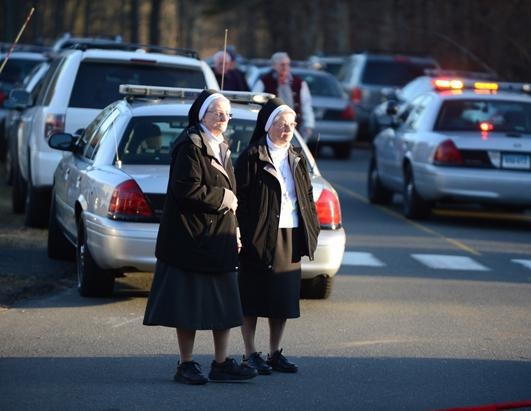
Srs Mary Ellen and Jude Thaddeus CSFN Newtown.jpgIn the days following the Newtown tragedy many people are applying the concept of hero to those who lived and died with dignity offering themselves for the good of others. The adults at the Sandy Hook School can certainly be labeled as a heros. We can also bestow the title of hero on those who responded: police and fire personnel, healthcare professionals and social workers, and members of the clergy and consecrated religious. 

Here on Communio I want to single out the good and exemplary witness of Monsignor Robert Weiss, Father Ignacio Oritgas, Father Luke Suarez, Sister Mary Ellen Genova, CSFN and Sister M. Thaddeus Rajka, CSFN. The deacons are to be mentioned here, too. Each of them, with affection for the self lived the law of the Gift given in spirit of the family.

Continue reading From Nazareth to the street