Endogamous discrimination in the Syro-Malabar Church?

Many times when Catholics think of inculturation they mis-identify the term by saying that the Church just needs to lighten up its rule and fit to the local culture. Others will locate the philosophical and missionary effort inculturation in the liturgical sphere. Inculturation matters are a very contentious matter that gets people in crosshairs. Adapting or in some way making changes to a system  of living so that you can “fit in” is an external fact and is not the method the Catholic Church uses to bring Lord’s Good News to other peoples, that is, those who outside the European and North American context. The Catholic Church tends to focus on the interior life of the person; externals are secondary and may change in time.

There is, however, a more precise way of understanding inculturation deals with adaption in saying that it is “the incarnation of the Gospel in autonomous cultures and at the same time the introduction of these cultures into the life of the church” (John Paul II’s 1985 encyclical Slavorum Apostoli, or his address to the Pontifical Council for Culture plenary assembly on Jan. 17, 1987). It is also understood that inculturation is, as John Paul II said in his 1990 encyclical Redemptoris Missio, “an intimate transformation of the authentic cultural values by their integration into Christianity and the implantation of Christianity into different human cultures.”

As Redemptoris Missio said, “By inculturation, the church makes the Gospel incarnate in different cultures and at the same time introduces peoples, together with their cultures, into her own community” (52). And yet the Church speaks of a interpenetration of the Gospel into a given, that is, a particular socio-cultural context which  “gives inner fruitfulness to the spiritual qualities and gifts proper to each people …, strengthens these qualities, perfects them and restores them in Christ” (Gaudium et spes, 58). More on this issue here.

This is a long way to introduce the sticky issue of Indian Catholics retaining their customs of endogamy and not truly inculturating the Gospel. Judge for yourself: do the adherents to Knanaya customs cause a philosophical and theological problem here is that if we use the definitions noted above, or are we being “too Western” in wanting others to conform to a radical way of thinking which may weaken a culture? How would Christ judge the situation? Who bears the standard? How are the demands of the gospel really lived in this Christian caste? Who has ultimate authority, the Syro-Malabar Catholic Church, the Holy See, or the persons involved? Can endogamy be tolerated for a greater good?

The story of alleged discrimination among the Syro-Malabars can be read here.

Russian Patriarch losing popularity at home, and in the Ukraine

One doesn’t point to the failures of others in a mean-spirited way. No one likes it done to himself, but more importantly, it isn’t Christian. Nevertheless, we need to get to the heart of certain issues.

An article by Andriy Skumin, “Mission: Impossible” published today online on the international edition of  The Ukrainian Week raises a lot of questions about how the Orthodox see themselves as they observe 1025 years since receiving Jesus Christ as Lord and Savior. Patriarch Kirill, the Patriarch of the Russian Orthodox Church is facing lots of difficulties these days in places like the Ukraine, some of his own making, and some he’s been made to face from outside the Church.

Whether Skumin’s article is completely objective may be debated. But what needs to be studied are the ways by which the Christian Church’s ability to proclaim the gospel is effective today given certain cultural, political and religious factors. Also, whether the Christian Church is Orthodox or Catholic, both ecclesial communities face similar issues in their milieu; reality is crucial to acknowledge and work within. Hopefully, Patriarch Kirill will be able to service the Gospel and not his own ideology. And I would say the say for the Catholic Major Archbishop in the Ukraine.

At this time Christians are celebrating 1025 years of the reception of sacrament of Baptism of the Rus; and in particular, the Kyian Rus. I happen to think that the Russian Orthodox Church is a bit too imperialistic in their own circles but also in forcing others to follow them. They are often economical with the truth when it comes to common history.

Locally, the Catholic bishop of the Stamford Eparchy of the Ukrainians, Bishop Paul Chomnycky, had a Moleben in thanksgiving to God for the gift of baptism.

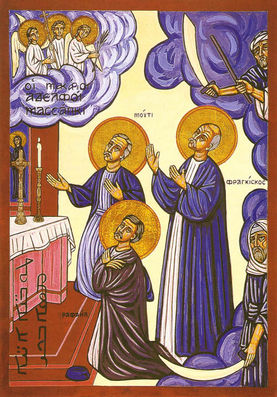
Blessed Massabki Brothers

Blessed Massabki Brothers.jpg


Abdel Mohti, Francis, and Raphael were three Maronite laymen killed inside the Franciscan church in Damascus while they were praying. 


On 9 July 1860, the killers entered the Franciscan church in Damascus where the Brothers were in prayer. The Islamic fanatics gave the Brothers a choice: reject Christianity and accept Islam, or, be killed. The Brothers said: “You may destroy our lives but you cannot destroy our faith in Christ and our souls; we are Christians. In the faith of Christ we live and in the faith of Christ we shall die.” The three holy brothers were killed as were several of the Franciscan friars.


Pope Pius XI beatified the three Massabki  brothers on 7 October 1926.


Blessed Massabki Brothers, pray for Lebanon, the Church in the USA, and each one of us.

Abdallah Zaidan is new bishop for Maronite Eparchy of Our Lady of Lebanon

Zaidan.jpeg

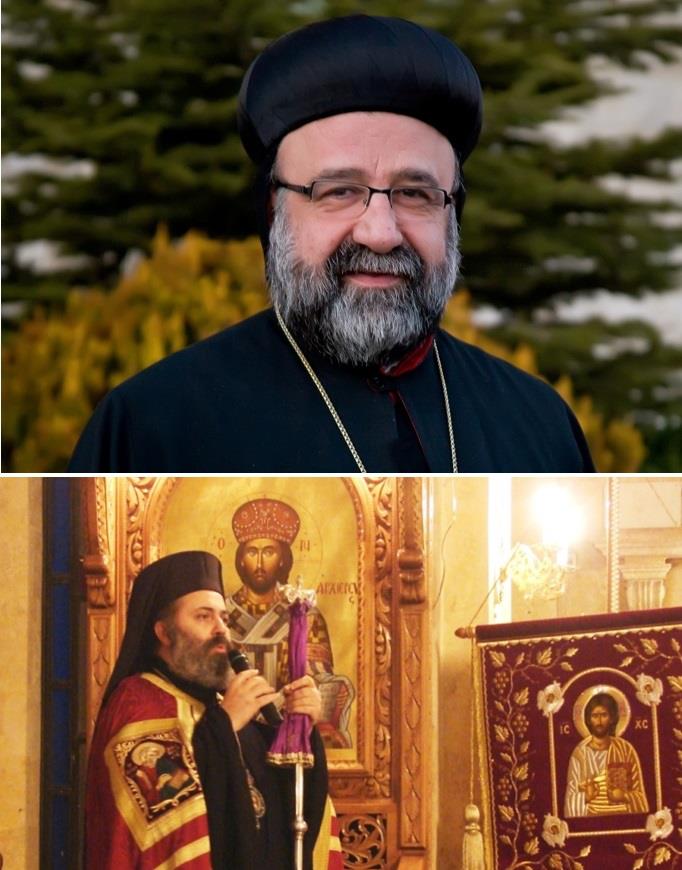
Today, the Holy Father, Pope Francis, has accepted the resignation of Bishop Robert J. Shaheen from the pastoral governance of the Eparchy of Our Lady of Lebanon of Los Angeles, and has appointed as Bishop of the same Eparchy the Reverend Father Abdallah Elias Zaidan, MLM, 50, up until now Rector of Our Lady of Mt. Lebanon-St. Peter Maronite Cathedral in Los Angeles. He was ordained a priest on 20 July 1986.

Bishop Robert Joseph Shaheen was the first native American (born in Danbury, CT) to be nominated bishop for the Maronites in the USA, and the second bishop of of the Eparchy of Our Lady of Lebanon of Los Angeles. He was ordained a priest 1964 and a bishop on 15 February 2001.

Bishop-elect Zaidan will be ordained in Lebanon and later enthroned in the United States.

May God grant Bishop-elect Abdallah many years of faithful service.

Our Lady of Lebanon, intercede for the Eparchy.

Saint Maron, pray for us.

The shared priesthood in a family

stagon.JPGThe are differences in how the Christian churches view priesthood. Generally speaking the priests of the Latin Church are celibate. But there are exceptions made for those who were formerly members of the Anglican Communion as married ministers who come into full communion with the Church of Rome. Then in many of the Eastern Catholic churches there are both married and celibate priests. In the USA, more of the Eastern Catholic priests are celibate due to an implementation of a rule imposed upon because of a strife between a Latin bishop and Eastern Catholics.

Eastern Christianity has had a long and venerable tradition of a married priesthood. Peggy Fletcher of the RNS wrote a very fine story on a family with priests “doing God’s work with sincerity and earnestness” in “Like father like son(s): Boys follow their father’s calling,” (The Washington Post, July 1, 2013). I recommend reading the article.
I am not calling into question the valid spiritual discipline of a celibate priesthood in the Catholic Church; the celibate Catholic priesthood has a valuable spiritual tradition with good reasons for following in this manner. The point here is that among those in the Catholic Church and the Orthodox Church a man can validly follow the Lord as being married and being a priest. We have a history of it. Eastern Catholic Christians in the USA have been told by the authorities in Rome that a married priesthood is not possible. Certain biases are evident. American Eastern Catholic bishops say a married priesthood is part of the long, lived theological tradition –and it is part of canonical tradition– and that they ought to be free to ordain married men without issue. There are practical matters that always need to be accounted for, but one can say that both vocations, being married and being a priest, is possible. The article is less about a political statement than it is about the beauty of two vocations cohering well.

Father Franҫois Mourad, Syrian monk, killed

Fr Franҫois Mourad.JPG

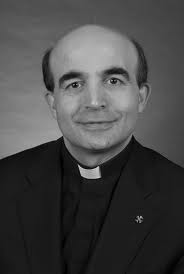
Father Franҫois Mourad, 49, a Syrian monk, was killed on June 23, during a raid on the Franciscan monastery of Saint Anthony of Padua in Ghassanieh, a predominantly Christian village in the district of Jisr al-Shughur in the province of Idlib, near the border with Turkey.

Father Mourad was trained by the Franciscan Friars of the Holy Land Custody before joining the Trappists for a period of time. His formation as monk with the Trappists eventually led him to be ordained a priest in the Syrian Catholic Church of Al-Hasakah. Following the teaching of Saint Simon, Father Mourad founded a monastic community in Hwar, in the Aleppo Province.


Vatican Radio has a story here and there is another news report here.


May Father Franҫois Mourad’s memory be eternal.

Apostles’ Fast 2013

Ss Peter and Paul coptic.jpeg

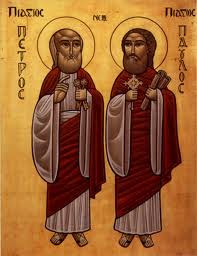
Recently on the Sunday of All Saints (26 May 2013) –the Byzantine Church observes a different feast of All Saints than do the Latin Christians– the Eparch (the Greek word for bishop) of the Melkites in the in the USA, Bishop Nicholas James Samra wrote to his people about preparing for the feast of Saints Peter and Paul on June 29. Yes, some Catholics do make preparations for other feasts!

One of the reasons I am drawing our attention to this matter is two-fold: 1.) being Catholic is more than merely following the Latin Church’s disciple — we can learn from others; and 2.) the discipline of those who belong to Christ is more than merely praying, fasting, and almsgiving for selfish reasons, that is, these spiritual activities are to break open our spiritual capacities. Remember what John Paul taught: Christians breathe with two lungs.

The liturgical feast of Ss. Peter and Paul is traditionally preceded by a period of concerted prayer and fasting. These saints –indeed, all of the apostles– are the pillars of our Church. In times past the period of fasting was significant while today it is much modified. The controlling idea is that before an important feast of the Lord, the Mother of God and some saints, the faithful are encouraged to prepare themselves to receive God’s graces in a worthy manner. We prepare by getting rid of sin and living virtuously: corporal and spiritual works of mercy are good things to do.

Bishop Nicholas recalls for us that the Monday after Sunday of All Saints the Byzantine Church begins a time of prayer and fasting leading us to the Feast of the Holy Apostles Peter and Paul on 29 June.  But now the preparation is modified to 10 days by the Melkite Synod of Bishops. Fittingly, the bishop notes: “We are given this “Apostles Fast” in order to fan into flame the grace of the Holy Spirit within us and to reflect upon the hardships endured by the Apostles as they preached Divine grace and truth to the world.”

Faith needs to be connected with reality. This is the context in which God acts. Several things in our own lives can and ought to be connected with life. Bishop Nicholas indicates that one good way to extrovert our faith by having some sense human ecology on the spiritual level is remember those suffering the effects of the war in Syria. Certainly, we pray for all but special attention to be paid to the Catholics and Orthodox peoples.

Hence, the proposal is to begin our spiritual discipline on June 19. I recommend that you make a confession of sin and receive Holy Communion, pray for the Pope’s intention for June, and name the intentions. Select a charitable organization to to make a donation of funds.

Perhaps we can also use the Apostles’ Fast to pray for those living with cancer. I am thinking of my friend Jesuit Father Edward Oakes who is in need of a miracle due to his recent diagnosis of Type 4 pancreatic and liver cancer.

Saints Peter and Paul, pray for us.
The unexpected grace of Matushka Magdalena

We need witnesses. This is an idea that I am echoing from the teaching of Paul VI. Who are the witnesses that lead you to a deeper relationship with the Other, with friends, and with oneself?

A friend sent me the story of Matushka Magdalena who faced persecution wreaked by the Khruschev’s regime. What this story gets at, I think, is that nothing is given to us by happenstance. That is, in some strange yet beautiful way we ought to attribute the circumstances of our life to Divine Providence. Nothing is by accident. At least that’s what I think the article “An Amazing Story of Betrayal and Repentance” gets at.
Eastern Christians need our support through prayer and friendship. Let’s pray for the Catholic and Orthodox Churches in lands of the Rus.

Father Taft: we need a new ecclesiology –a startling revolution– Catholics are the no longer the only kids on the block

Taft and the Easterns.jpg

It is said that “The Eastern Churches have a special vocation in the contemporary world, which is both distinct from, and complementary to, that of the Western Church. Pope John Paul saw it thus, but he was not the only one. The language of the ‘two lungs’ of the Church suggests that the Church’s activity in the world is much diminished when one of the lungs is operating at a reduced capacity – which it certainly is if it is not fully being what it is meant to be.”


A vocation to serve the Churches, East and West, has been radically lived by a New England Province Jesuit priest, Robert F. Taft, for nearly a half-century. Christopher B. Warner published a terrific interview in the Catholic World Report, “Building Bridges Between Orthodox and Catholic Christians” is required reading to get a sense of the Church’s teaching and life.


Father Taft was a professor of mine, and he remains an inspiration and mentor.