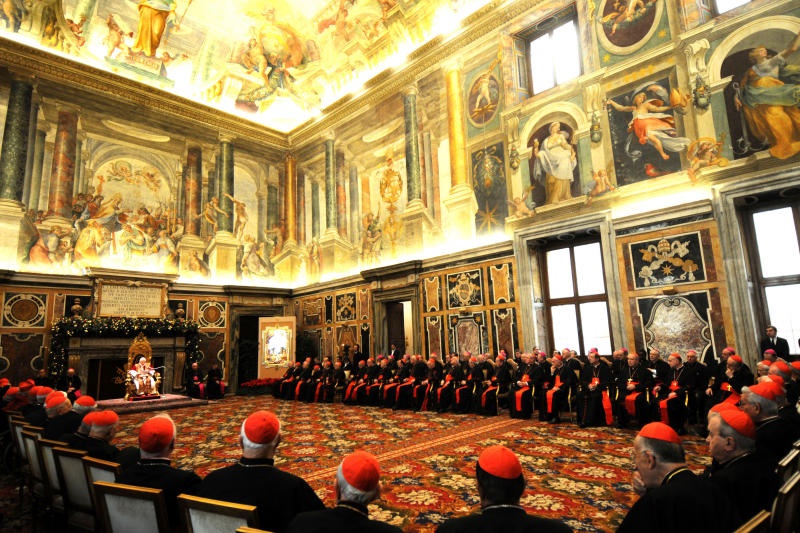
The Holy Father’s annual address to the Roman Curia -the
Cardinals and bishops resident in Rome and other officials of the Roman Curia who assist him in
his governance of the Universal Church– took place yesterday. In it the Pope points to some notable concerns that he thinks that ought to be the concern of all
of us who believe faith is central our lives. Namely, belief and unbelief,
doubt and certainty and freedom with regard to God and humanity’s search for God. In my humble opinion, this papal address should be an essential point in any diocesan, parish or ecclesial movement’s pastoral plan in 2010 and beyond. In part the Holy Father said,
Even the
people who describe themselves as agnostics or atheists must be very important
to us as believers. When we talk about a new evangelization, these people may
become afraid. They do not want to see themselves as an object of mission, nor
do they want to renounce their freedom of thought or of will. But the question
about God nonetheless remains present for them as well, even if they cannot
believe in the concrete nature of his attention to us.
people who describe themselves as agnostics or atheists must be very important
to us as believers. When we talk about a new evangelization, these people may
become afraid. They do not want to see themselves as an object of mission, nor
do they want to renounce their freedom of thought or of will. But the question
about God nonetheless remains present for them as well, even if they cannot
believe in the concrete nature of his attention to us.
In Paris, I talked
about the search for God as the fundamental motive from which Western
monasticism was born, and with it, Western culture. As the first step in
evangelization, we must try to keep this search alive; we must take pains that
man not set aside the question of God as an essential question of his
existence. Take pains that he accept this question and the longing concealed
within it.
about the search for God as the fundamental motive from which Western
monasticism was born, and with it, Western culture. As the first step in
evangelization, we must try to keep this search alive; we must take pains that
man not set aside the question of God as an essential question of his
existence. Take pains that he accept this question and the longing concealed
within it.
Here I am reminded of the words that Jesus quoted from the prophet
Isaiah, that the temple should be a house of prayer for all peoples (cf. Isaiah
56:7; Mark 11:17). He was thinking about what was called the court of the
gentiles, which he cleansed of extraneous business so that it could be the
space available for the gentiles who wanted to pray to the one God there, even
if they could not take part in the mystery, for service of which the interior
of the temple was reserved.
Isaiah, that the temple should be a house of prayer for all peoples (cf. Isaiah
56:7; Mark 11:17). He was thinking about what was called the court of the
gentiles, which he cleansed of extraneous business so that it could be the
space available for the gentiles who wanted to pray to the one God there, even
if they could not take part in the mystery, for service of which the interior
of the temple was reserved.
A place of prayer for all peoples: by this was
meant the people who know God, so to speak, only from afar; who are
dissatisfied with their gods, rites, myths; who desire the Pure and the Great,
even if God remains for them the “unknown God” (cf. Acts 17:23). They
needed to be able to pray to the unknown God, and so be in relation with the
true God, although in the midst of obscurities of various kinds.
meant the people who know God, so to speak, only from afar; who are
dissatisfied with their gods, rites, myths; who desire the Pure and the Great,
even if God remains for them the “unknown God” (cf. Acts 17:23). They
needed to be able to pray to the unknown God, and so be in relation with the
true God, although in the midst of obscurities of various kinds.
I think that
the Church should also open today a sort of “court of the gentiles”
where men can in some manner cling to God, without knowing him and before they
have found the entryway to his mystery, which the interior life of the Church
serves. To the dialogue with the religions it must above all add today a
dialogue with those for whom religion is something foreign, to whom God is
unknown, and who nonetheless would not like simply to remain without God, but
at least to approach him as the Unknown.
the Church should also open today a sort of “court of the gentiles”
where men can in some manner cling to God, without knowing him and before they
have found the entryway to his mystery, which the interior life of the Church
serves. To the dialogue with the religions it must above all add today a
dialogue with those for whom religion is something foreign, to whom God is
unknown, and who nonetheless would not like simply to remain without God, but
at least to approach him as the Unknown.