Advent: a recognition of the point of the Birth of Christ

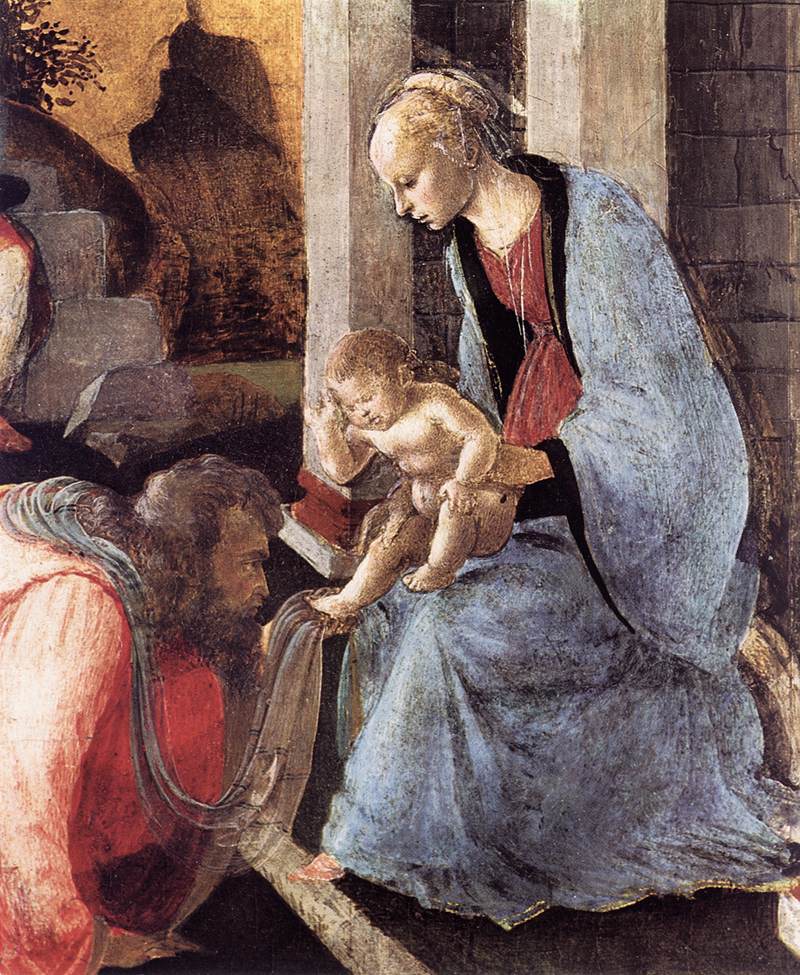
Botticelli, Madonna del Libro, 1483.jpg

It is truly meet and just, right and available to salvation, that we should give thanks to thee, O Lord God, almighty: and that we
should, whilst invoking Thy power, celebrate the feasts of the blessed Virgin Mary; from whose womb grew the Fruit, which has filled with the Bread of angels. That Fruit which Eve took from us when she sinned, Mary has restored to us, and it has saved us. Not as the work of the serpent is the work of Mary. From the one, came the poison of our destruction; from the other, the mysteries of salvation. In the one, we see the malice of the tempter; in the other, the help of the divine Majesty. Be the one, came death to the creature; by the other the resurrection of the Creator, by whom human nature, now not captive but free, is restored; and what it lost by its parent Adam, it regained by its Maker Christ.


(A prayer from the Ambrosian Breviary, a Sixth Sunday of Advent, Preface)


Dolan calls for a truce: don’t mall each other at Christmas

TMD.jpgToday the NY Daily News published a letter written by Archbishop Timothy M. Dolan, archbishop of New York. I am happy that the News published this letter because it is not only a message for Christians, but people of faith, and those looking for the gift of faith. The substance of the Archbishop’s letter can be summarized in this way: this is a time for peace among peoples; for love and reconciliation. And even though not all go about observing this season in the same way, we ought to respect one another! 

Christians, particularly, are preparing themselves to welcome the Prince of Peace, the Wonder-Counselor, the Word made flesh, Jesus Christ, into their whole being. Others will be observing Chanuka and still others will just try to live the best they now how.
While faith-neural language like “holiday parties,” “Seasons Greetings,” or “holiday sale,” can get annoying, even ridiculous, our attention ought not to be exclusively on how “others” are removing Jesus Christ from view at this point of the calendar. Sure, some of our brothers and sisters are frustrated by this move away from our Christian roots. I am, too. However, I am not giving more power to those who agitate to rid the world of Advent & Christmas.
So we need ask ourselves, is the frustration worth it? Is letting the secularization of our Christian culture “get to us” giving more power to the forces of the faith-neutral ideologues in our lives than need be? If so, they’ve won. Reasonable people of faith and good will won’t think of Christ being removed from our hearts or families or the work place by anyone but ourselves. We can’t blame others for everything. So, the Archbishop’s call for a truce on all that distracts from the real meaning of Advent and the forthcoming Christmastide is well-taken.

I, for one, am going to get back to listening to “Christmas at Ephesus,” the recent album of Christmas hymns recorded by the Benedictines of Mary, Queen of the Apostles. Perhaps I’ll pray the Joyful mysteries of the rosary.

Advent 2009: Come Lord, Jesus, “my eyes are toward, You Lord, leave me not defenseless”

Los entering the Grave Wm Blake.jpgTo Thee, O Lord, have I lifted up my soul: in Thee, O my God, I put my trust; let me not be ashamed. Neither let my enemies laugh at me: for none of them that wait on Thee shall be confounded.

(Introit, 1st Sunday of Advent)

The Latin Church begins her observance of Advent with First Vespers for the First Sunday of Advent tonight (in Rome Advent has already begun with the Pope’s leading Vespers at Saint Peter’s Basilica). Vespers (evening prayer) is a way of sanctifying the day, giving to God all of the fruits of the day.

Other Catholic Churches, for example, the Ambrosian Church (the Archdiocese of Milan), the Syriac Churches, as in the Maronite Church, and the Byzantine Churches (as well as the Orthodox) began their Advent observance and fast two weeks ago.

B16 with new pastoral staff Vespers Advent 2009.jpg

Saint Paul invites us to prepare for the coming of Lord in a blameless manner. Paul uses the word “coming,” in Latin, “adventus,” meaning “presence, arrival, coming.” An adventus is arrival of an official but can also mean the diety’s coming forth showing his Presence to us. Christians adopted the word to establish a relationship with God. We participate in his coming by our participation in and with the liturgical assembly which knows in the heart: God is here, He has not left us and visits us in many ways: Advent is a personal visit from God entering into my life who wants to talk to me. We have to guard against the “doing” of our lives which monopolizes our interior life and thus distracts from the talking personally with God. Advent invites to see the daily events of our lives as God’s gifts to us, as signs of His Presence in our life, His love in our life. Our recollection of these events is a gesture of gratitude and a method recognizing the Presence of God personally.
With Saint Paul, let’s keep our body and soul blameless for God calls, He is faithful; and He will do it. We are with Mary in preparing room for the newborn Child, the Incarnate Word of God, Jesus.
At the name of Jesus every knee should bow…

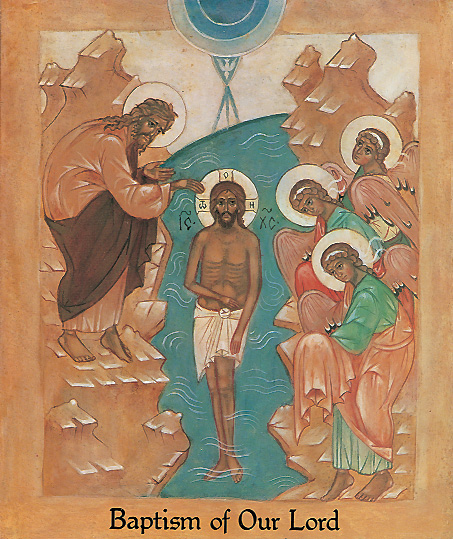
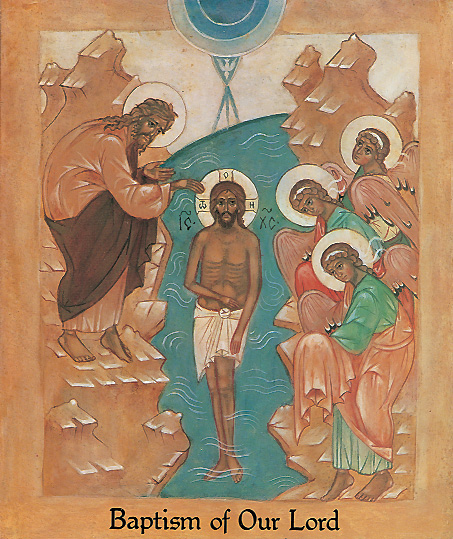
Baptism of the Lord

Almighty, eternal God, when the Spirit descended upon Jesus at His baptism in the Jordan, You revealed Him as Your own beloved Son. Keep us, Your children born of water and the Spirit, faithful to our calling.
Thumbnail image for Baptism of the Lord.jpgChrist’s Baptism – from the Catechism of the Catholic Church


All the Old Covenant prefigurations find their fulfillment in Christ Jesus. He begins his public life after having himself baptized by Saint John the Baptist in the Jordan. After His resurrection Christ gives this mission to His apostles: “Go therefore and make disciples of all nations, baptizing them in the name of the Father and of the Son and of the Holy Spirit, teaching them to observe all that I have commanded you.”

Our Lord voluntarily submitted Himself to the baptism of Saint John, intended for sinners, in order to “fulfill all righteousness”. Jesus’ gesture is a manifestation of His self-emptying. The Spirit who had hovered over the waters of the first creation descended then on the Christ as a prelude of the new creation, and the Father revealed Jesus as His “beloved Son.”

In His Passover Christ opened to all men the fountain of Baptism. He had already spoken of His Passion, which He was about to suffer in Jerusalem, as a “Baptism” with which He had to be baptized. The blood and water that flowed from the pierced side of the crucified Jesus are types of Baptism and the Eucharist, the sacraments of new life. From then on, it is possible “to be born of water and the Spirit” in order to enter the Kingdom of God.

See where you are baptized, see where Baptism comes from, if not from the cross of Christ, from His death. There is the whole mystery: He died for you. In Him you are redeemed, in Him you are saved. (1223-1225)

Epiphany: The Light of Life


Epiphany.jpgThe star which leads us to Jesus is sacred Scripture. Behold our light has already come (Is 60:1), because for us and for our salvation God has become man. He was seen on earth and dwelt among us men and women, so that, by the might of his word and the example of his life he might enlighten those who are sitting in darkness and direct them into the way of peace (Lk 1:79).  It is no wonder that before the Lord’s coming, when they heard nothing of God, when they did not discern the light of Scripture, the pagans lay prostrate in their sins and in the darkness of their errors. But now lying prostrate in carnal desires and in the darkness of inequities is a matter for great agitation, for the true light that enlightens every one coming into this world (Jn 1:9), Christ Jesus, has now come. We cannot have further excuse for our sins, for Christ, who takes away the sins of the world and justifies, for the wicked, now speaks to us openly. Someone who follows me does not walk in darkness but will have the light of life (Jn 8:12).


Saint Aelred of Rievaulx

Sermon 4 for the Epiphany, 32-33

Epiphany Novena for priests

John Paul with BS.jpgLittle more than a year my friend Fr. Mark at Vultus Christi initiated a plan of prayer for the priesthood, particularly in reparation for sins committed by priests. This plan of prayer was inspired by a letter from Cardinal Claudio Hummes, OFM to the world’s bishops encouraging them to designate people, including priests, whose “ministry” it would be to pray for the priesthood in the wake of the sex abuse crisis. The point of the letter was to begin to think about and work for a renewal of the priesthood. Today begins a novena inspired by Saint Peter Julian Emyard who in 1857 began his own renewal of the priesthood adoration movement. Let’s be united in prayer for the intentions of our priests.

Fr. Mark has also developed a program of prayer called Thursdays in Adoration and Reparation for Priests which keeps the Holy Thursday event of Our Lord forming the priesthood and giving us the gift of His Eucharistic Presence.

There are many opportunities to spend time in prayer before the Blessed Sacrament in parishes today (more now than a few years ago). And there religious orders who make it a point to adore Christ in the Blessed Sacrament regularly, if not daily, for example, the Dominican nuns in North Guilford, CT and Linden, VA to name two monasteries, the pink sisters found in cities such as Philadelphia, St. Louis, Lincoln and Corpus Christi; the monks of Saint Vincent Archabbey and Newark Abbey have the daily practice of adoration prior to the Divine Office, the monks of Saint Mary’s Abbey (Morristown, NJ) have adoration and confession on the second Friday of the month for vocations and for the priesthood, the monks of Belmont Abbey (Belmont, NC) have recently dedicated an adoration chapel in the center of their college campus in honor of Saint Joseph where monks, students and other interested people gather with the Eucharistic Lord.

What better time than in Epiphanytide to develop a habit of prayer in adoration of the Blessed Sacrament? 


The Epiphany Proclamation


Magi Aldighieri da Zevio.jpg


The Epiphany Proclamation


Dear brothers and sisters, the glory of the Lord has shone upon us, and shall ever be manifest among us, until the day of his return. Through the rhythms of times and seasons let us celebrate the mysteries of salvation.


Let us recall the year’s culmination, the Easter Triduum of the Lord: his last supper, his crucifixion, his burial, and his rising celebrated between the evening of the 9th of April and the evening of the 12th of April.


Each Easter – as on each Sunday – the Holy Church makes present the great and saving deed by which Christ has for ever conquered sin and death.


From Easter are reckoned all the days we keep holy.


Ash Wednesday, the beginning of Lent, will occur on the 25th of February.

The Ascension of the Lord will be commemorated on the 21st of May.

Pentecost, the joyful conclusion of the season of Easter, will be celebrated on the 31st of May.


Corpus Christi will be celebrated on the 11th of June.


The First Sunday of Advent will be celebrated on the 29th of November.


Likewise the pilgrim Church proclaims the passover of Christ in the feasts of the holy Mother of God, in the feasts of the Apostles and Saints, and in the commemoration of the faithful departed.


To Jesus Christ, who was, who is, and who is to come, Lord of time and history, be endless praise, for ever and ever.


R. Amen.

Epiphany

Vidimus stellam ejus in Oriente,

et venimus cum muneribus adorare Dominum.

We have seen his star in the East and are come with gifts to adore the Lord.
(Matthew 2:2)


Magi Bartolo de Fredi.jpg

O God, who today revealed your Only-begotten, a star having been the guide, graciously grant, that we, who have already come to know you from faith, may be led all the way unto the contemplation of the beauty of your majesty.


Blessed Columba Marmion’s essage on the Epiphany is an excellent meditation.


Begotten of the Father before the daystar shone or time began, the Lord our Savior has appeared on earth today.


Blessing of Chalk on Epiphany


Magi detail Bottocelli.jpgEpiphany inscription over the doorway of the home:

20 + C + M + B + 09

The letters have two meanings. They are the initials of the traditional names of the Three Magi: Caspar, Melchior and Balthasar. All three revered as saints and honored in the Munich cathedral. We abbreviate the Latin words “Christus mansionem benedicat” (“May Christ bless the house”). The letters recall the day on which the inscription is made, as well as the purpose of blessing.

The crosses represent the protection of the Precious Blood of Christ, whom we invoke, and the holiness of the Magi who adored of the infant Jesus. The inscription is made above the front door, so that all who enter and depart this year may enjoy God’s blessing. The month of January bears the name of the Roman god Janus, the doorkeeper of heaven and protector of the beginning and end of things. This blessing “christens” the ancient Roman observance of the first month.

Blessing of Chalk

V. Our help is the name of the Lord.
R. Who made heaven and earth.

V. The Lord be with you.
R. And with your spirit.

Let us pray.

Bless, O Lord God, this creature chalk to render it helpful to your people. Grant that they who use it in faith and with it inscribe upon the doors of their homes the names of your saints, Caspar, Melchior, and Balthasar, may through their merits and intercession enjoy health of body and protection of soul. Through Christ our Lord. Amen.

And the chalk is sprinkled with Holy Water.

A Christmas Carol


The Christ-child lay on Mary’s lap,
Nativity Angelico.jpgHis hair was like a light.
(O weary, weary were the world,
But here is all aright.)

The Christ-child lay on Mary’s breast
His hair was like a star.
(O stern and cunning are the kings,
But here the true hearts are.) 

The Christ-child lay on Mary’s heart,
His hair was like a fire.
(O weary, weary is the world,
But here the world’s desire.)

The Christ-child stood on Mary’s knee,
His hair was like a crown,
And all the flowers looked up at Him,
And all the stars looked down.


G.K.Chesterton