In 1626, Rome’s new St Peter’s Basilica on Vatican Hill was consecrated. It replaced an earlier church on the same site. A magnificent piece of architecture executed on a grand scale, the Basilica remains one of the largest church buildings in the world. This image gives a great perspective of the colonnades stretching out –as if to embrace the world– thus creating St Peter’s Square. It is holy site for Catholics: –at the basilica, St Peter’s tomb is directly below the high altar.
Author: Paul Zalonski
Dedication of the Basilicas of SS. Peter & Paul
Today is the Feast of the Dedication of the Basilicas of SS. Peter & Paul. This is an ancient feast which the Church recalls the place of two great Roman churches in our theology. The Roman Church claims two principal churches, St. John Lateran and St. Peter’s. YET, the Basilicas of Sts. Peter and Paul –shrine churches– were built by the Emperor Constantine the Great during the 4th century connecting the dots of the faith with these two Apostles and founders. Hence, we say with conviction that two marks of the Church are Petrine and Pauline.
We hold near and dear the places of Peter and Paul. St. Paul’s Outside-the-Walls stands near the Benedictine Abbey of the Tree Fountains, where Saint Paul is believed to have been beheaded.
What lessons do we glean from the Roman Church’s traditions concerning the two basilicas whose dedication feast we are celebrating? Dom Gueranger speak to us from his Liturgical Year:
Among the holy places venerated of old by the Christians, those were the most honoured and most frequented in which the bodies of the saints were preserved, or some relic or memorial of the martyrs. Chief among these holy places has ever been that part of the Vatican hill which was called the Confession of St. Peter. Christians from all parts of the world flocked thither, as to the rock of the faith and the foundation of the Church, and honoured with the greatest reverence and piety the spot hallowed by the holy sepulchre of the prince of the apostles. Hither on the octave day of his baptism came the emperor Constantine the Great; and taking off his diadem, he prostrated on the ground with many tears. Then taking a hoe and mattack, he broke up the earth of which twelve basketfuls were taken away in honour of the twelve apostles; and on the site thus marked out he built the basilica of the prince of the apostles. Pope St. Sylvester dedicated it on the fourteenth of the Calends of December, just as he had consecrated the Lateran church on the fifth of the Ides of November. He erected in it a stone altar which he anointed with chrism, and decreed that thenceforward all altars should be made of stone. The same blessed Sylvester dedicated the basilica of St. Paul the apostle on the Ostian Way, also magnificently built by the emperor Constantine, who enriched both basilicas with many estates and rich gifts and ornaments…
It is very important that we pray today for the unity of the Catholic Church, the Holy Father and the Bishops who are the successors of Peter & Paul.
Saints Peter & Paul: pray for us!
To Abide in Jesus
One of St. John’s favorite words is the Greek verb menos which is usually translated as “abide” or “remain” or “continue.” He uses this word more than all other New Testament writers together and it is one of the richest words in his theological vocabulary. When he uses this word in reference to a person, it suggests a deeply personal and constant union. It would thus be contrasted with a contact that may be intense but which soon fades and has no lasting effect.
To abide in Jesus is to be attached to him in such a way that life would seem impossible without him; Abide in me as I abide in you. Just as the branch cannot bear fruit by itself unless it abides in the vine, neither can you unless abide in me (15:4). To be detached from Jesus is to live a shadow life that has no real meaning and benefits no one in a permanent way It is a waste of precious time.
A Mystical Portrait of Jesus
Demetrius R. Dumm, OSB
St. Josaphat
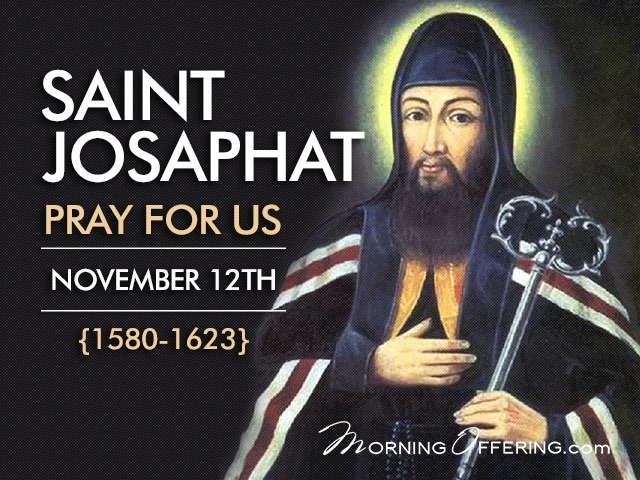
St. Josaphat (1580-1623) was born to a devout religious family of Ruthenian ancestry in what is now Ukraine, and was baptized in the Eastern Orthodox Church. He devoted his virginity to the Virgin Mary and grew in his reverence for ancient liturgy. During a revival of Eastern Catholic monastic life he became a monk in the Order of St. Basil, and was ordained to Holy Orders in the Ukrainian Greek Catholic Church in 1609. He was noted for his life of asceticism, holiness, and virtue which led to his appointment as Archbishop of Polotsk in what is today Belarus. During his lifetime there was much sociopolitical and ecclesiastical rivalry between the Catholics and Orthodox and the Latin and Byzantine rites, especially in the wake of the 1596 Union of Brest which saw the Ruthenian Church break with Orthodox and place itself under the authority of the Holy See. St. Josaphat was passionate about working for the reunification with Rome and won many heretics and schismatics back to communion with the Holy See. However, he was also strongly opposed to the Latinization of his people. This combination of views drew ire from both Catholic and Orthodox clergy. His diocese was contested by the Orthodox, and a rival Orthodox bishop was set up to oppose him, causing riots. During one uprising Josaphat tried to calm the tensions and work for reunification and peace, but his enemies plotted to kill him. A mob of Orthodox Christians entered Josaphat’s home, stabbed and axed his body and threw it into a river. His body was seen glowing in the water and was recovered, and after his martyrdom many miracles were attributed to his intercession. Josaphat’s sacrifice became a blessing as regret and sorrow over his death converted many hearts toward reunification with Rome. In 1867, Josaphat became the first saint of the Eastern Church to be formally canonized by Rome. His feast day is November 12.
St Martin of Tours
“Martinmass”
John Clare written on 11 Nov 1841.
‘Tis Martinmass from rig to rig
Ploughed fields and meadow lands are blea
In hedge and field each restless twig
Is dancing on the naked tree
Flags in the dykes are bleached and brown
Docks by its sides are dry and dead
All but the ivy-boughs are brown
Upon each leaning dotterel’s headCrimsoned with awes the awthorns bend
O’er meadow-dykes and rising floods
The wild geese seek the reedy fen
And dark the storm comes o’er the woods
The crowds of lapwings load the air
With buzes of a thousand wings
There flocks of starnels too repair
When morning o’er the valley springs
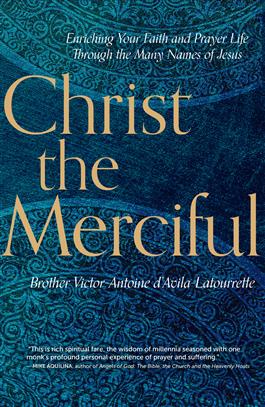
Br Victor-Antoine d’Avila-Latourrette publishes “Christ the Merciful”
Brother Victor-Antoine d’Avila-Latourrette explores the absolute centrality of Christ in the prayer life of any Christian. The end result is a comprehensive confession of his faith and testimony to the many “names of Christ” that cross through historical, monastic, and mystical traditions. Keeping true to the hope for a unified Church, Christ the Merciful incorporates both Western and Eastern Orthodox sources.
Chapters situating Christ in context of his life in Palestine, his role as a son, friend, and family member, and his place in the living history of the church all help to create a full, well-rounded portrait of his divine and human lives. By viewing Christ through these various facets, the book helps readers enrich their relationship to the mystery of God, adding contour to their spiritual journey.
Brother Victor-Antoine makes difficult concepts clear in a straightforward manner, informed by years of Benedictine monastic practice.
Dedication of St John Lateran Basilica
The Basilica of Saint John Lateran is the cathedral church of the Bishop of Rome, the Pope, and not Saint Peter’s Basilica as many would think. The Liturgy given to us is the feast of the Dedication of the Lateran Basilica because it is the oldest and highest ranking of the four major basilicas in Rome. The Lateran is the oldest church in the West, constructed in the era of the Emperor Constantine and consecrated by Pope Sylvester in AD 324.
What do we celebrate with this feast? We don’t celebrate a building as magnificent as it is; we don’t honor the craftsmanship of the building as important and relevant as this idea is because of beauty and harmony in themselves. But, we do recognize as Pope Benedict XVI said on this feast in 2008: “The beauty and harmony of the churches, destined to give praise to God, also draws us human beings, limited and sinful, to convert to form a “cosmos,” a well-ordered structure, in intimate communion with Jesus, who is the true Saint of saints. This happens in a culminating way in the Eucharistic liturgy, in which the “ecclesia,” that is, the community of the baptized, come together in a unified way to listen to the Word of God and nourish themselves with the Body and Blood of Christ. From these two tables the Church of living stones is built up in truth and charity and is internally formed by the Holy Spirit transforming herself into what she receives, conforming herself more and more to the Lord Jesus Christ. She herself, if she lives in sincere and fraternal unity, in this way becomes the spiritual sacrifice pleasing to God.” Hence, we honor the fact that Jesus Christ through his Apostles and disciples founded a church for our salvation and the proper teaching of the Christian Gospel.
Again Benedict said: “God’s desire to build a spiritual temple in the world, a community that worships him in spirit and truth (cf. John 4:23-24). But this observance also reminds us of the importance of the material buildings in which the community gathers to celebrate the praises of God. Every community therefore has the duty to take special care of its own sacred buildings, which are a precious religious and historical patrimony. For this we call upon the intercession of Mary Most Holy, that she help us to become, like her, the “house of God,” living temple of his love” (November 9, 2008).
A feast with a universal observance, the Church tells us that the archbasilica, the ecclesiastical mother church, called “the mother and mistress of all churches of Rome and the world” (omnium urbis et orbis ecclesiarum mater et caput).
Saint Bernard, Sermon for the Dedication of a Church gives a particular insight into what we do liturgically:
Today’s feast, brothers, ought to be all the more devout as it is more personal. For other celebrations we have in common with other ecclesiastical communities, but this one is proper to us, so that if we do not celebrate it nobody will. It is ours because it concerns our church; ours because we ourselves are its theme. You are surprised and even embarrassed, perhaps, at celebrating a feast for yourselves. But do not be like horses and mules that have no understanding. Your souls are holy because of the Spirit of God dwelling in you; your bodies are holy because of your souls and this building is holy because of your bodies.
Our Christian Object of Faith
Today gave me the opportunity to read through some things today that I have put on the back burner. You can see why I would post this thinking. One such item includes the following:
“The Christian faith has only one object: the mystery of Christ dead and risen. But this unique mystery subsists under different modes: it is prefigured in the Old Testament, it is accomplished historically in the earthly life of Christ, it is contained in mystery in the sacraments, it is lived mystically in souls, it is accomplished socially in the Church, it is consummated eschatologically in the Heavenly Kingdom. Thus the Christian has at his disposition several registers, a multi-dimensional symbolism, to express this unique reality. The whole of Christian culture consists in grasping the links that exist between Bible and Liturgy, Gospel and Eschatology, Mysticism and Liturgy. The application of this method to Scripture is called spiritual exegesis; applied to liturgy it is called mystagogy. This consists in reading in the rites the mystery of Christ, and in contemplating beneath the symbols the invisible reality.”
Jean Cardinal Danielou, SJ
Will we be protagonists or followers?
“The apathy that characterizes our time does not originate in the political process, nor does it confine itself to politics. Its source is quite different; we are dealing with a crisis of the person.”
In the very few days leading up to the US presidential elections we need to stay focussed on the essential matters at hand and not to be distracted by incidental. Hence, our call right now is to make a fervent prayer to the Holy Spirit.
Additionally, I would encourage you to read this 2 page reflection “protagonists-of-our-history.”
Nothing will satisfy us, as Father Giussani reminds, but the desire to be with God who is Father, Son and Holy Spirit.
Attend!
Pope Francis’ Prayer Intentions for November
The November Prayer Intentions of the Holy Father
Universal Intention
That the countries which take in a great number of displaced persons and refugees may find support for their efforts which show solidarity.
Evangelization Intention
That within parishes, priests and lay people may collaborate in service to the community without giving in to the temptation of discouragement.