In Memorian: Columba Kelly, OSB

Earlier today, the memorial by Br. Stanley Rother Wagner, O.S.B. written for Dom Columba Kelly appeared. Br. Stanley captured in a few words the person of Columba –monk and pries and friend– wonderfully well. I am grateful for Brother Stanley’s work. Thanks be to God for Columba: with eschatological hope I am confident that he is now in the embrace of the Most Blessed Trinity.

From April 2017 until the death of Fr. Columba Kelly in the early evening of June 9, 2018, I had the privilege to serve as Fr. Columba’s valet (a novice or junior monk who assists an older confrere with day-to-day tasks). I tidied-up Fr. Columba’s cell, took his linens to our laundry room, and bombarded him with innumerable questions about the liturgical reforms after the Second Vatican Council and his role in them. Between my making his bed and vacuuming the carpet, he and I caught each other up on what occurred in our prayer and work that past week. Eventually, though, our conversations would drift to our observations on the liturgical life of the Church and monasticism as a way of life. I shared with Fr. Columba a confrere’s insight: “I have never been more in touch with my humanity than within the walls of this monastery.” Columba smirked and replied, “Benedict was truly a psychologist ahead of his time.”

Columba never eulogized himself, claiming he was an extraordinary man or that he single-handedly renewed chant after Vatican II. On the other hand, he acknowledged his role and the contributions that the monks of Saint Meinrad made to the liturgy and sacred music in the 1960s and beyond. He did not allow his work to overshadow the goal: That all English-speakers would be able to offer one actual, conscious, and fruitful sacrifice of praise to our triune God. Up to the last week of his life, he told me that, “No one person created this.”

During one of our Saturday morning chats, I asked Columba to sum up in a word or phrase the rationale behind his use of the Solesmes Method of plainchant composition. He stated – after a few ponderous moments – “Speech blossoming into song.” Columba was not shy about sharing his love for how chant should be viewed as “sung speech”; no doubt an idea he borrowed from our holy father, St. Benedict: “Prayer should therefore be short and pure, unless perhaps it is prolonged under the inspiration of divine grace. In community, however, prayer should always be brief” (The Rule of Benedict ch. 20, vv. 4-5a). Benedict wanted his monks and nuns to pray the psalms, the arrangement of which takes up 13 out of 73 chapters in the Rule (not to mention the countless liturgical-catechetical nuggets in other chapters). Columba composed his eight psalm tones so every Christian could pray the same words that Christ offered to our Father. He quite often said: “I’d much rather sing scripture; straight, no chaser.”

As a musician as well as a theologian, Columba saw his work as not his own – or even of our community’s – but as the work of God. Some scholars and academics may dissect the word “liturgy” to manufacture an agenda, but the monks of Saint Meinrad know even today that the liturgy is God’s work that, through our baptism into Christ’s one priesthood, we are ever-invited to participate in through our respective states in life – lay, clerical, religious, married, and even monastic. Saint Meinrad’s contribution to the work of liturgical renewal after Vatican II came about with God’s providence manifesting itself through the talents of several monks: Fr. Gavin Barnes, whose input on choral recitation still influences our prayer; Fr. Cyprian Davis, whose vast historical knowledge helped hand on the Church’s tradition of liturgical prayer; Fr. Simeon Daley, who gave to the liturgical renewal an authentic understanding of rubrics and custom; and Fr. Aidan Kavanaugh, one of the more well-known of the twentieth century liturgiologists, who brought an encyclopedic knowledge of liturgical aesthetics and best practices that have influenced extensive numbers of churches beyond the Catholic Church.

In those moments of cleaning and solving the Church’s liturgical problems, a friendship blossomed. I no longer saw Columba as an elder confrere, but as my brother. God called us both to Saint Meinrad Archabbey for reasons we one day may be told. For now, though, I remember fondly the informal monastic formation Columba gave me, not just in the areas of liturgy, the Solesmes Method, Gregorian seminology, or a vibrant history lesson; he taught me how to bear wrongs patiently, how to live in community, and, most of all, how God’s grace has a transformative effect over the course of one’s whole life.

Columba was many things – a monk, a priest, a theologian, a musician, and a teacher. Beyond these, though, the most important is that he was a disciple of Jesus Christ. He may have had his flaws and quirks like all the rest of us, but he will be remembered for his way of preaching the Good News through a medium that drew people into the very mystery of Salvation: The loving dialogue occurring timelessly between our Heavenly Father, his Sole-Begotten Son, and their Spirit of communion. Fr. Columba did not just bring chanting to the people or people to chanting, but he served as a bridge between Christ and his people; a task he undertook using the gifts and talents our Provident God gave to him during a decisive moment in church history. This will certainly not be the only tribute to make the rounds of the Catholic blog-o-sphere, but I hope it gives some insight into what I learned from a monk who wished to bring Christ’s words closer to people’s lips and, most of all, to their hearts. That is how I will remember my friend and brother, Fr. Columba Kelly, O.S.B.

Br. Stanley Rother Wagner, O.S.B. is a junior monk of Saint Meinrad Archabbey. He made first vows, upon the completion of novitiate, in January 2018.

Mary’s Immaculate Heart

In the midst of the second world war Pope Pius XII put the whole world under the special protection of our Savior’s Mother by consecrating it to her Immaculate Heart, and in 1944 he decreed that in the future the whole Church should celebrate the feast of the Immaculate Heart of Mary. This is not a new devotion. In the seventeenth century, St. John Eudes preached it together with that of the Sacred Heart; in the nineteenth century, Pius VII and Pius IX allowed several churches to celebrate a feast of the Pure Heart of Mary.

Pius XII instituted today’s feast of the Immaculate Heart of Mary for the whole Church, so as to obtain by her intercession “peace among nations, freedom for the Church, the conversion of sinners, the love of purity and the practice of virtue” (Decree of May 4, 1944). In 1942 during the ravages of World War II, Pope Pius XII dedicated the world to the Immaculate Heart of Mary and set the feast for August 22nd.

In 1969, Pope Paul VI moved the celebration of the Immaculate Heart of Mary to the day, Saturday, immediately after the Solemnity of the Sacred Heart of Jesus.

(cf. DG for text)

Today, let’s beg for the gift of “peace among nations, freedom for the Church, the conversion of sinners, the love of purity and the practice of virtue.”

The Heart of Jesus bids us

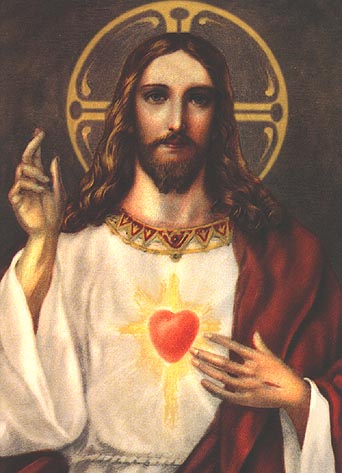
We have this solemnity of the Sacred Heart of Jesus today. A tradition of delving more deeply into the whole Christ: humanity and divinity, mercy, love and judgment, deepest longings and the tenderness of our own heart in the face of the heart of the Lord’s.

Today is a day to spend time in Eucharistic adoration, because in this event we see in the Blessed Sacrament the Risen Jesus truly present offering each one of us His heart, His tender, merciful Love. At adoration we come to Him to adore Him; the Church proposes to us that this is the best expression of devotion to the Sacred Heart of Jesus which Saint Margaret Mary Alacoque said: “Behold the Heart which so loved mankind”!

Benedict XVI illuminates for us this mystery: “The heart that resembles that of Christ more than any other is without a doubt the Heart of Mary, his Immaculate Mother, and for this very reason the liturgy holds them up together for our veneration. Responding to the Virgin’s invitation at Fatima, let us entrust the whole world to her Immaculate Heart, which we contemplated yesterday in a special way, so that it may experience the merciful love of God and know true peace” (Benedict XVI, Angelus, 5 June 2005).

The pure heart finds room

On this solemn feast of the Most Sacred Heart of Jesus, we need to reflect on the nature of the heart, and the truth of the reality.

The purer the heart is, the larger it is, and the more able it is to find room within it for the a greater number of beloved ones; while the more sinful it is the more contracted it becomes, and the fewer number of beloved can it find room for, because it is limited by self-love, and that love is a false one.

St John of Kronstadt

St Norbert and the spider

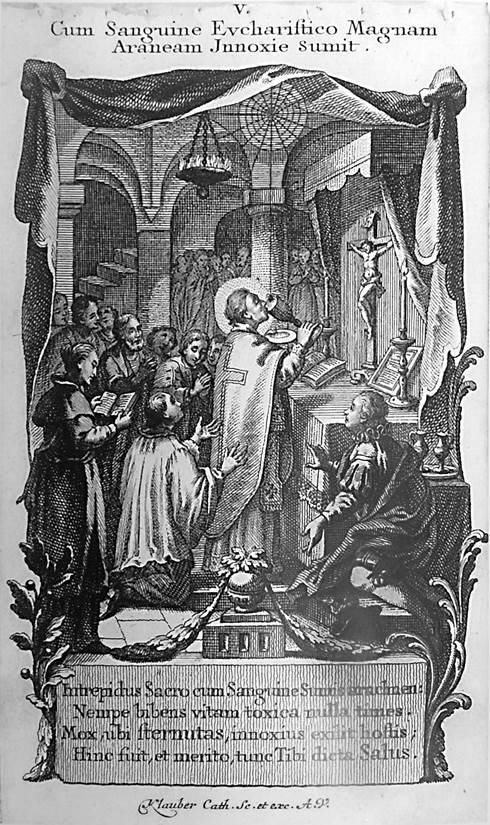
“Sometime later he was wearing himself out by severe fasting and abstinence, pushing himself day and night with vigils and prayer. While he was celebrating Mass as customary in a certain crypt, a spider fell into the already consecrated chalice.[6-2] When the priest saw it he was shocked. Life and death hovered before his eyes. The spider was large. What should the man do whose faith[6-3] was now deeply rooted in the Lord? Lest the sacrifice suffer any loss he chose rather to undergo the danger and consumed whatever was in the chalice.

When the sacrifice was finished he expected to die immediately. While he remained at his place before the altar he commended his awaited end to the Lord in prayer. When he was disturbed by an itching in his nose he scratched it and suddenly he sneezed expelling the whole spider. Once again God did not want the death[6-4] but the faith of his priest who he knew would be useful to him.”

-Life of Norbert B (Vita Norberti B)

St Boniface preaches God’s plan

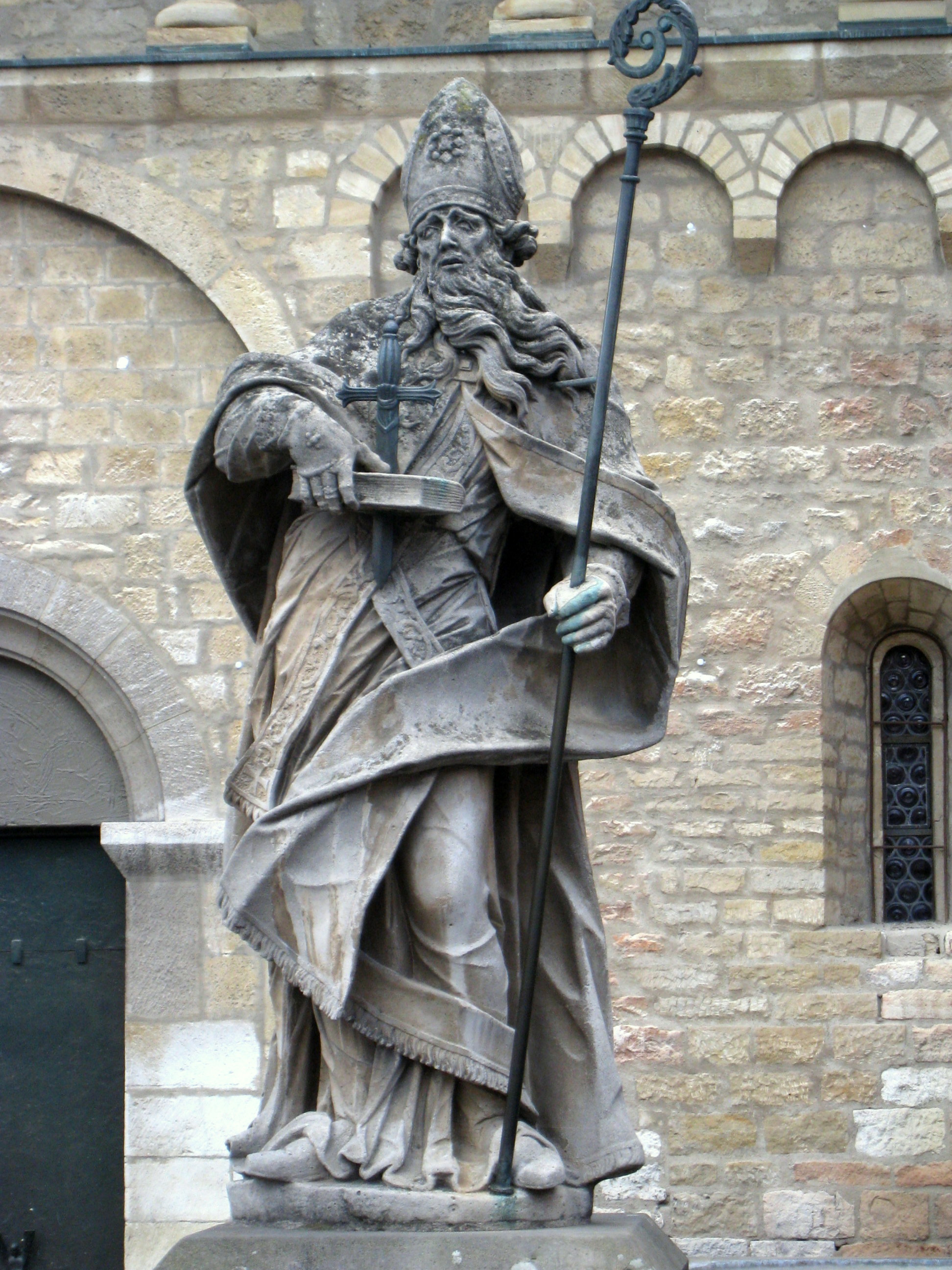
“Let us be neither dogs that do not bark nor silent onlookers nor paid servants who run away before the wolf. Instead let us be careful shepherds watching over Christ’s flock. Let us preach the whole of God’s plan.” -St. Boniface

The saint’s exhortation is key here for the serious Christian. But I have to wonder how often we hear about God’s plan preached by the clergy (bishops and priests) and the witness of our lives. Is this whole plan preached by the catechists and lay leaders in our parish, schools, hospitals and soup kitchens? Do we actually believe there is a divine plan to be preached, lived and taught? Do we believe in Divine Providence and it’s revelation in history?

If so, then let’s live as though we mean it. Seek the face of God!

Sacred Heart and Pope’s prayer intention for June 2018

Today, as we begin the month of June, a month dedicated to the Sacred Heart of Jesus, we think of, we relish in, we abide in the great love Our Lord has for us. Having just finished the Paschal Cycle of our Faith, here is another opportunity to move more deeply into a familiarity with Jesus Christ.

“In biblical language, “heart” indicates the centre of the person where his sentiments and intentions dwell. In the Heart of the Redeemer we adore God’s love for humanity, his will for universal salvation, his infinite mercy. Practising devotion to the Sacred Heart of Christ therefore means adoring that Heart which, after having loved us to the end, was pierced by a spear and from high on the Cross poured out blood and water, an inexhaustible source of new life” (Benedict XVI, Angelus 5 June 2005).

Also in June, we have this prayer intention of Pope Francis: “That social networks may work towards that inclusiveness which respects other for their differences.”

The Visitation, God’s in-breaking

Today we celebrate the Feast of the Visitation of the Blessed Virgin Mary. It is the in-breaking of God’s joy in history.

The theological explanation of the Vistiation reminds us that at the annunciation, the Archangel Gabriel informs Mary that her cousin Elizabeth is six months pregnant. A startling divine gift.

Then we see Mary hurrying to visit Elizabeth. An interior in-breaking extroverting itself.

I think the key here is Mary’s selflessness and her sharing in the joy of God. Containing the joy she feels is impossible. In her visitation Mary brings the joy of God to both Elizabeth and to John the Baptist who moves in Elizabeth’s womb. 

As we know, this second of the joyful mysteries of the Rosary is about Joy who desires to expand into our heart and abide there. Let’s pray for the movement of joy in our life today.

Trinity Sunday

In the Western Church, the Sunday following Pentecost is Trinity Sunday. As point of comparison the Byzantine Church today is the Sunday of All Saints.

There are plenty of things to say about the Holy Trinity but I think this hymn attributed to St. Jacob of Sarug found today in the Syriac Maronite at the Third Hour of Sunday, says all of what we believe.

Glory be to the Father Who chose the prophets and they foreshadowed His Only-Begotten Son. Worship be to the Son Whose Gospel the apostles proclaimed in the world. Thanks be to the Spirit Who strengthened the martyrs and they died in His hope, and may mercy be upon us sinners through their prayers.

Today, I am also reminded of the life and writings of Saint Elizabeth of the Trinity and Blessed Itala Mela (Maria of the Trinity). The first a Discalced Carmelite and the second a Benedictine Oblate. Both devoted their lives to make this piece of dogma, this beautiful mystery, known and lived.

Blessed Itala said, “The will of Christ, which I feel in the depths of my soul, is to drag me, to immerse myself with Himself in the abysses of the Holy Trinity … It is useless to look for other ways: this is what He has chosen for my sanctification.”