
Author: Paul Zalonski
Saint Robert Bellarmine
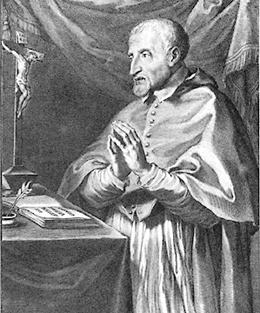
He ran the good race of faith to win eternal life. He professed the faith boldly before many witnesses.
God our Father, you gave Robert Bellarmine wisdom and goodness to defend the faith of your Church. By his prayers may we always rejoice in the profession of our faith.
Ember Days at the start of Autumn
Lost
but not forgotten in Catholic practice are the observances for Autumn Ember
Days, the “Four Seasons.” Other ember days are prayed in
December (3rd week of Advent), Lent (after the 1st Sunday of Lent) and after
Pentecost but in its octave. The autumn ember days are observed on the
Wednesday, Friday and Saturday following the Triumph of the Holy Cross, September 14. This year
the ember days are September 16, 18, & 19. Tradition has also called this
period of prayer, procession, fasting and partial abstinence the Michaelmas
Ember Days
given the proximity to the liturgical memorial of Saint Michael the Archangel
on September 29th.

The occasion for Ember Days are the seasons of the year.
As you would think, each season we give ought to give thanks to God for graces
received and the fruits of the harvest. Ember days are rich in theology and
culture going back a very long time in the Catholic Church, one can argue to
the very early Church where the first fruits were given to the Lord. One might also recall the Jewish customs of prayer and
fasting and purification in the autumn. Those with a strong liturgical bent will recall that before the “reform” of the
missal following the Second Vatican Council the Church had a richer and deeper
understanding of the nature of ember days: each day had their own Mass,
Scripture readings from both Testaments, processions and prayers. Today, ember days are all but forgotten save for a small number of people who bother to read ritual books and liturgical theology and who think these things have import for the contemporary life of the Church.
As we delve
more deeply into our Catholic faith and the various liturgical observances of
thanksgiving, conversion and supplication, we might consider spending time
during these ember days in gratitude to God for what He’s given for our earthly
sustenance asking Him for the grace of conversion. Additionally, I am reminded
with these ember gestures of the recent emphasis on the environment and ecology viz. the faith that Pope Benedict said last week: “Today
more than ever people must be helped to see in creation something more than a
simple source of wealth or exploitation in man’s hands. The truth is that when
God, through creation, gave man the keys to the earth, he wanted him to use
this great gift responsibly and respectfully, making it fruitful. The human
being discovers the intrinsic value of nature if he learns to see it for what
it really is, the expression of a plan of love and truth that speaks to us of
the Creator and of his love for humanity, which will find its fulfillment in
Christ, at the end of time. In this context it is important to reiterate the
close relationship between protection of the environment and respect for the
ethical requirements of human nature, because when human ecology is respected
within society, environmental ecology also benefits.”
Living
the ember days more fully would allow for a renewed interest in praising God
for creation, the concern of humanity’s proper use of creation and our keen stewardship of nature for future generations.
Cf. “Order of Blessing on the Occasion of Thanksgiving for the Harvest” (Book of Blessings, nos 1007-1023) or in the 3rd volume of Fr Weller’s Roman Ritual. Two prayers from the Maronite book of blessings read:
May God bless + this fruit, those who bring it, present it, and share in it. May the mercy of the Holy Trinity, Father, Son, and Holy Spirit, come down upon those who labored to produce this fruit and those who were in any way associated with them. Praised be to God, now and for ever. Amen.
And
O Lord, your right hand blessed the few loaves of bread in the desert, and through the hands of the prophet Elijah you blessed the jar of wheat and the jug of oil in the house of the widow. May your blessing now come down, through my right hand bless + this house (granary or this wheat or grain) and all the food that it kept here. As you blessed the homes and the reserves of the just of old –Abraham, Isaac, Jacob, Joseph, Job, and David–shower your abundant blessings upon the yield of your worshipers. We praise you, now and for ever. Amen.
O Lord, save your people and bless + your inheritance. Feed them, and carry them for ever.
Saints Cornelius and Cyprian

We beseech Thee, O Lord, may the feast
of the blessed Martyrs and Bishops Cornelius and Cyprian be a safeguard for us,
and may their intercession commend us unto Thee.
of the blessed Martyrs and Bishops Cornelius and Cyprian be a safeguard for us,
and may their intercession commend us unto Thee.
5 Blue Ribbon Schools in the Bridgeport Diocese

Today the Diocese of Bridgeport conveyed the great news that 5 of the Catholic schools of the diocese, and only ones in the State of Connecticut, have been named a Blue Ribbon School by the US Department of Education.
This distinction places these schools in the top 10% of schools in the USA. Here’s a list of the 2009 recipients of the Blue Ribbon distinction.
The five schools in the Diocese of Bridgeport:
Greenwich Catholic School, Greenwich, CT
St Rose of Lima School, Newtown, CT
St Cecilia School, Stamford, CT
St Mark School, Stratford, CT
Our Lady of Fatima School, Wilton, CT
Mary’s 7 sorrows
Father, as your Son was raised on the cross, his mother Mary stood by him, sharing his sufferings. May your Church be united with Christ in his suffering and death and so come to share in his rising to new life, where he lives and reigns with you and the Holy Spirit, one God, for ever and ever. Amen.
Today’s feast of the Blessed Virgin Mary follows yesterday’s feast of the Triumph of the Cross. As the liturgical year progresses we see some things change in the liturgical atmosphere as we prepare, believe it or not, for the end of the liturgical year: our focus on the Paschal Mystery of the Lord (i.e., the life, death, resurrection & ascension of the Lord) becomes more present to us.

Liturgically the Church dedicates a day to the spiritual martyrdom of Mary, Jesus’ own mother. The feast of Our Lady of Sorrows has not only a spiritual depth but a real human one: it strikes at the core of our heart. What human being goes through life without some sort of pain? Like all mothers, Mary was wounded and pained at various times in her life by the absence of her son and the pain and death he had to suffer. No mother delights in her child’s misery, no mother sits by while her child’s humanity is in jeopardy. Consider what the mothers of soldiers go through waiting for her son or daughter to return from war. Imagine the terrible, heart wrenching pain that many mothers felt when they were told their child was killed in Iraq. I know of the pain my own paternal grandmother faced when her son was killed in a car accident more than 40 years ago; a pain that never truly healed nor spoken of…
The feast we observe today reminds us of the humanity of not only Mary, but of Jesus. For as we know, Mary always points to her son: the cross brought incredible suffering for Jesus while it saved all of humanity by trampling down sin and death; Careful observing the suffering as Mary did requires our attention, too, because Christ saved us in and through our humanity. This point is driven home countless times a day as I walk past a replica of Michelangelo’s Pieta (see the pic above); I am confronted with the sorrowing Mother Mary holding the dead body of her son in her arms, the very arms which cuddled him as an infant.
The Cistercian monks and Servite friars have given the Church an apt liturgical feast to indicate the depth of humanity Mary had in standing by her son, an experience foretold by Simeon. The feast has also be called Our Lady of Compassion, yet another intersection of theology and human reality.
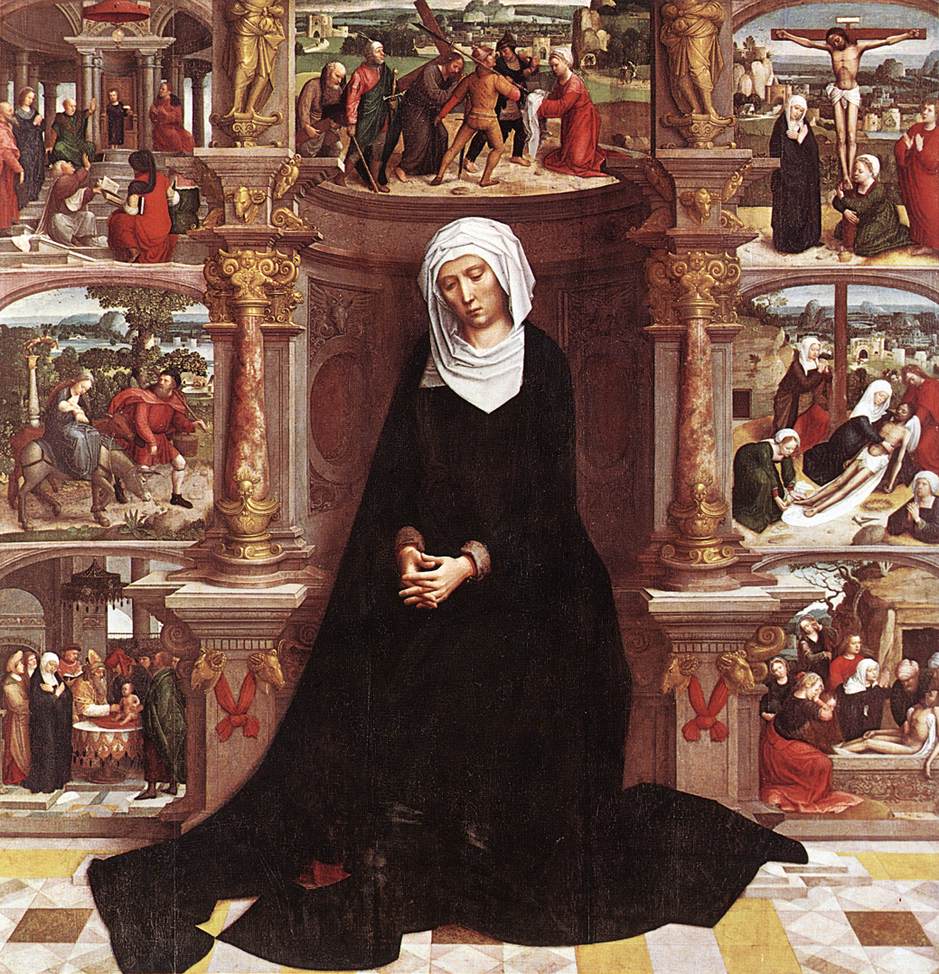
Here are the seven sorrows of Mary:

- The prophecy of Simeon (Luke 2:25-35)
- The flight into Egypt (Matthew 2:13-15)
- Loss of the Child Jesus for three days (Luke 2:41-50)
- Mary meets Jesus on his way to Calvary (Luke 23:27-31; John 19:17)
- Crucifixion and Death of Jesus (John 19:25-30)
- The body of Jesus being taken from the Cross (Psalm 130; Luke 23:50-54; John 19:31-37)
- The burial of Jesus (Isaiah 53:8; Luke 23:50-56; John 19:38-42; Mark 15:40-47)
Our Lady of Sorrows
|
Stabat Mater dolorosa
iuxta crucem lacrimosa,
dum pendebat Filius.
|
The grieving Mother stood
beside the cross weeping
where her Son was hanging.
|
|
Cuius animam gementem
contristatam et dolentem
pertransivit gladius.
|
Through her weeping soul,
compassionate and grieving,
a sword passed.
|
|
O quam tristis et afflicta
fuit illa benedicta
mater Unigeniti!
|
O how sad and afflicted
was that blessed
Mother of the Only-begotten!
|
|
Quae maerebat et dolebat
pia mater cum videbat
nati poenas incliti.
|
Who mourned and grieved,
the pious Mother, with seeing
the torment of her glorious Son.
|
|
Quis est homo qui non fleret,
matrem Christi si videret
in tanto supplicio?
|
Who is the man who would not weep
if seeing the Mother of Christ
in such agony?
|
|
Quis non posset contristari,
piam matrem contemplari
dolentum cum Filio?
|
Who would not be have compassion
on beholding the devout mother
suffering with her Son?
|
|
Pro peccatis suae gentis
vidit Iesum in tormentis
et flagellis subditum.
|
For the sins of His people
she saw Jesus in torment
and subjected to the scourge.
|
|
Vidit suum dulcem Natum
morientem, desolatum,
cum emisit spiritum.
|
She saw her sweet Son
dying, forsaken,
while He gave up His spirit.
|
|
Christe, cum sit hinc exire,
da per matrem me venire
ad palmam victoriae. Amen.
|
Christ, when it is henceforth in need to pass away,
grant that through your Mother I may come
to the palm of victory. Amen.
|
What am I doing for Christ right now?

Thinking about the life-saving cross of Jesus, I am
recalling what Saint Ignatius of Loyola taught in his Spiritual Exercises about God’s unconditional love for humanity: no talk of the mercy and love is reasonable without kneeling before the cross. This was evident to me as I walked into the chapel this morning for Lauds and forced to navigate in the
middle of the aisle a cross with relic of the True Cross before it. I knelt for a moment of prayer and kissed the relic. It is striking to do this pious gesture because it brings home to the heart, the Christian reality that the cross is so very central to our life of faith; it is the altar on which we are saved; and it is the cross that is the key which unlocks the door to the Father’s house; it is the love that kills and transcends all sin.
Loyola offers a meditation
Imagine Christ our Lord suspended on the cross before you, and converse with him in a colloquy: How is it that he, although he is the Creator, has come to make himself a human being? How is it that he has passed from eternal life to death here in time, and to die in this way for my sins?
In a similar way, reflect on yourself and ask: What have I done for Christ? What am I doing for Christ What ought I to do for Christ?
In this way, too, gazing on him in so pitiful a state as he hangs on the cross, speak out whatever comes to your mind.
A Colloquy is made, properly speaking, in the way one friend speaks to another, or a servant to one in authority – now begging for a favor, now accusing oneself of some misdeed, now telling one’s concerns and asking counsel about them. Close with an Our Father.
(Spiritual Exercises 53 and 54)
The cross is no failure
 In one respect the cross does have a terrible aspect
that we ought not to remove. To see that the purest of men, who was more than a
man, was executed in such a grisly way can make us frightened of ourselves. But
we also need to be frightened of ourselves and out of our self-complacency.
Here,
I think, Luther was right when he said that man must first be frightened of
himself so that he can then find the right way. However, the cross doesn’t stop
at being a horror; it is not merely a horror, because the one who looks down at
us from the cross is not a failure, a desperate man, not one of the horrible
victims of humanity.
I think, Luther was right when he said that man must first be frightened of
himself so that he can then find the right way. However, the cross doesn’t stop
at being a horror; it is not merely a horror, because the one who looks down at
us from the cross is not a failure, a desperate man, not one of the horrible
victims of humanity.
For this crucified man says something different from
Spartacus and his failed adherents, because, after all, what looks down at us
from the cross is a goodness that enables a new beginning in the midst of
life’s horror. The goodness of God himself looks on us, God who surrenders
himself into our hands, delivers himself to us, and bears the whole horror of
history with us.
Spartacus and his failed adherents, because, after all, what looks down at us
from the cross is a goodness that enables a new beginning in the midst of
life’s horror. The goodness of God himself looks on us, God who surrenders
himself into our hands, delivers himself to us, and bears the whole horror of
history with us.
Looked at more deeply this sign, which forces us to look at
the dangerousness of man and all his heinous deeds, at the same time makes us
look upon God, who is stronger, stronger in his weakness, and upon the fact
that we are loved by God.
the dangerousness of man and all his heinous deeds, at the same time makes us
look upon God, who is stronger, stronger in his weakness, and upon the fact
that we are loved by God.
It is in this sense a sign of forgiveness that also
brings hope into the abysses of history. God is crucified and says to us that
this God who is apparently so weak is the God who incomprehensibly forgives us
and who in his seeming absence is stronger.
brings hope into the abysses of history. God is crucified and says to us that
this God who is apparently so weak is the God who incomprehensibly forgives us
and who in his seeming absence is stronger.
Benedictus
Pope Benedict XVI
Exaltation of the Holy Cross

God the Father has exalted
Jesus Christ, the Lord of all,
Who has emptied self of glory,
Took our human nature’s thrall;
In obedience, He was humbled
Taking even cross and death;
Now creation shouts in wonder
“Christ is Lord” with ev’ry breath!
As the Cross is boldly
lifted
And the faithful now embrace
What was once a thing so shameful,
Now the hope of all our race,
Let us, marked with Cross, and
baptized,
Shout this news throughout the earth:
Through the Cross, our God has conquered!
Through it, come to His new birth!
87.87. D, no tune
suggested
James Michael Thompson, (c) 2009, World Library Publications