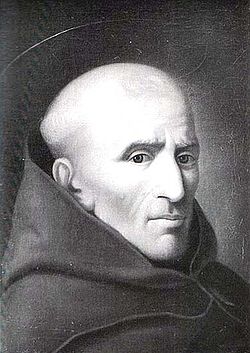
This article appeared in the 18 November 2009 issue of L’Osservatore Romano (weekly English edition). Thought it would do us well to consider one or two of the author’s points.
Even before the Holy Father had provided a title for the recently-published Apostolic Constitution, Anglicanorum Coetibus, providing for Personal Ordinariates for Anglicans entering into full communion with the See of Peter, many anticipated the numerous ways in which the incorporation of these new members would be beneficial to the Church.
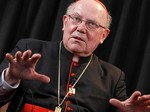 Cardinal Levada remarked: “It is the hope of the Holy Father, Pope Benedict XVI, that the Anglican clergy and faithful who desire union with the Catholic Church will find in this canonical structure the opportunity to preserve those Anglican traditions precious to them and consistent with the Catholic faith. Insofar as these traditions express in a distinctive way the faith that is held in common, they are a gift to be shared in the wider Church.”
One might well wonder what concrete form a sharing of those gifts with the wider Church could assume. Whereas it would be proleptic to attempt to catalogue the many and diverse blessing the arrival of these anticipated new members will bring to the Church, one thing is certain. Even the most “high church” among them will have been sufficiently influenced by the Protestant sensibilities of Anglicanism to bring with them a great reverence and a high standard for liturgical preaching. A profound attentiveness to biblical preaching is the undeniable patrimony in all of its forms, including Anglicanism, despite the ambiguity some of its members may experience over identifying themselves as Protestant.
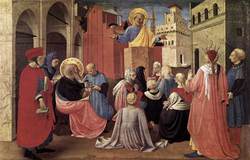 If anything, the Anglican Communion has been noted for its wide diversity. Accordingly, many Anglicans who might have answered to such labels as “high church” or “Anglo-Catholic,” could have been observed maintaining patterns of weekly (and even mid-weekly) Eucharist while simultaneously, so-called evangelical or “low-church” Anglicans might have typically attended non-eucharistic Morning Prayer most Sundays.” Broad” Anglicans would feel at home at any number of points between those two extremes.
One value shared in common among all Anglicans, however, has been their expectation of regular and good preaching. It can be reasonably well anticipated that most Anglicans who will take advantage of the accommodations extended in the Holy Father’s Apostolic Constitution will come from the ranks of the high churchmen, and to their love for preaching it is reasonable to add the expectation that the preaching will be theological, eloquent and sophisticated. The presence of this expectation in a great number of new Catholics is good news for the Church, since this strengthen the expectation placed upon priests to enhance the quality of their proclamation of the Word. Of course, former Anglican priests who become Catholic priests will bring their refined homiletic patterns with them.
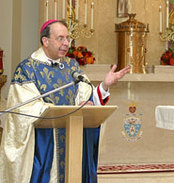 The renewal of preaching is perhaps of the most highly successful and least neuralgic of all the liturgical initiatives of Vatican II. After some decades of ambiguity, at least at the popular level, about the role of preaching in the liturgy, Sacrosanctum Concilium clarified that preaching is part of the liturgy itself (art. 52) and from that moment, a homiletic renewal unfolded. With little, if any resistance, preaching at the Mass (even at daily Mass), at the celebration of the Sacraments, at the Liturgy of the Hours and at numerous paraliturgical events has become normative and increasingly better quality. Seminaries around the world began paying better attention to the homiletic formation of seminarians, and on-going formation programs for priests are repeatedly asked to sponsor preaching workshops in their curricula.
There will undoubtedly be moments of joy as well as suffering as the presence of the former Anglicans entering the Church under conditions of Anglicanorum Coetibus begins to be felt. That joy and the suffering will be sustained by veteran and new Catholics alike. Much uncertainty lies in the near future. What is certain however, is that the former Anglicans’ heritage of good preaching and their expectation that this will be continued will only serve the Church well as these new expectations strengthen the impetus to the charge the Church has already embraced to refine and strengthen its ministry of the Word.
All of the pieces are in place for a win-win situation. Moreover, this expectation is quite realistic, since in Cardinal Newman we will recall that precedent has already been set.
Michael Monshau, O.P., professor of Liturgy, Homiletics and Spirituality at the Pontifical University of Saint Thomas Aquinas (The Angelicum) in Rome.