Turkey can’t be trusted

The same old problems can’t be resolved in Turkey between the Turkish government and the Orthodox Church. Since 1971 the Halki Orthodox School of Theology (which operated within the guidelines of the Turkish department of education in the running of a high school and college/seminary) has been closed under specious claims.

Asia News reports today that problems persist and reciprocity is not an adequate avenue for a peaceful end to the Muslim-Orthodox Christian problem.
The head of the Turkish government and his ministers can’t be trusted. Their words are not matched by their actions, and certainly they don’t perceive facts in the same way as reasonable do. In short, they are duplicitous. Why is religious freedom for Christians in a Muslim country such as Turkey or Saudi Arabia  is impossible and Muslim religious freedom in Christian countries (USA, Greece, Italy) is possible, even with the extraordinary fanaticism that exists in many Islamic quarters?

The search for God of all people, believers and non-believers concerns us, Pope said

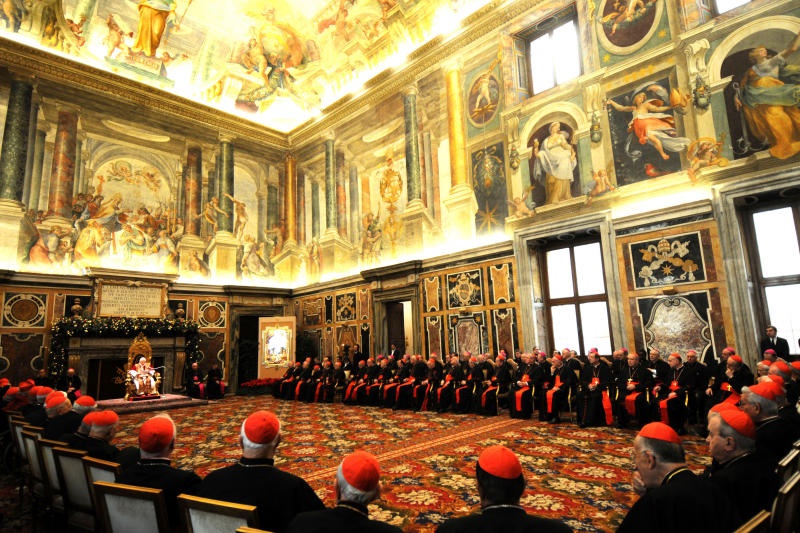
The Holy Father’s annual address to the Roman Curia -the
Cardinals and bishops resident in Rome and other officials of the Roman Curia who assist him in
his governance of the Universal Church– took place yesterday. In it the Pope points to some notable concerns that he thinks that ought to be the concern of all
of us who believe faith is central our lives. Namely, belief and unbelief,
doubt and certainty and freedom with regard to God and humanity’s search for God. In my humble opinion, this papal address should be an essential point in any diocesan, parish or ecclesial movement’s pastoral plan in 2010 and beyond. In part the Holy Father said,


Even the
people who describe themselves as agnostics or atheists must be very important
to us as believers. When we talk about a new evangelization, these people may
become afraid
. They do not want to see themselves as an object of mission, nor
do they want to renounce their freedom of thought or of will
. But the question
about God nonetheless remains present for them as well, even if they cannot
believe in the concrete nature of his attention to us. 


Benedict addresses Roman Curia 2009.jpg

In Paris, I talked
about the search for God as the fundamental motive from which Western
monasticism was born, and with it, Western culture. As the first step in
evangelization
, we must try to keep this search alive; we must take pains that
man not set aside the question of God as an essential question of his
existence
. Take pains that he accept this question and the longing concealed
within it.


Here I am reminded of the words that Jesus quoted from the prophet
Isaiah, that the temple should be a house of prayer for all peoples (cf. Isaiah
56:7; Mark 11:17). He was thinking about what was called the court of the
gentiles, which he cleansed of extraneous business so that it could be the
space available for the gentiles who wanted to pray to the one God there, even
if they could not take part in the mystery, for service of which the interior
of the temple was reserved.


A place of prayer for all peoples: by this was
meant the people who know God, so to speak, only from afar; who are
dissatisfied with their gods, rites, myths; who desire the Pure and the Great,
even if God remains for them the “unknown God” (cf. Acts 17:23). They
needed to be able to pray to the unknown God, and so be in relation with the
true God, although in the midst of obscurities of various kinds.


I think that
the Church should also open today a sort of “court of the gentiles”
where men can in some manner cling to God, without knowing him and before they
have found the entryway to his mystery, which the interior life of the Church
serves
. To the dialogue with the religions it must above all add today a
dialogue with those for whom religion is something foreign, to whom God is
unknown, and who nonetheless would not like simply to remain without God, but
at least to approach him as the Unknown.

Diggin’ in Nazareth

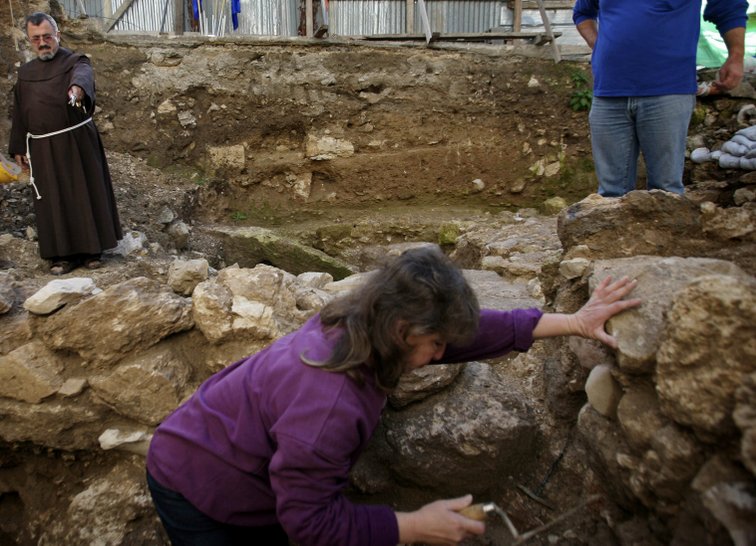
Nazareth Dwelling.jpgFranciscan Friar Jack Karam (left) stands near Israel
Antiquities Authority workers at the excavation site of the remains of the
first dwelling in Nazareth, Israel, that can be dated back to the time of
Jesus. Archaeologist Yardena Alexandre (unseen) says remains of a wall, a
hideout and a cistern were found after builders dug up an old convent courtyard
in the northern Israeli city. (AP Photos/Dan Balilty)

Christmas Novena, Seventh Oration

O You Who are One person but also have the Nature of
man; You Who have told us what You have heard from the Father; We beseech You,
through Your Pure Nativity and the intercession of Your Mother and Saint
Joseph, Your Chosen One, to grant us an ardent belief in Your teachings and
good acts to harmonize with them. Do not permit us to lose the reward of our
faith because of our own wrong doings. Rather, make our lives fruitful in
beliefs and good works. Amen.

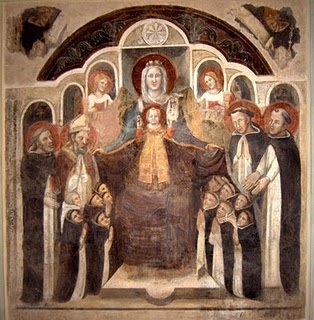
Feast of the Patronage of Our Lady of the Order of Friars Preachers


St Dominic & BVM.jpg

O God, who for the salvation of souls didst place the Order
of Preachers under the special protection of the most Blessed Virgin Mary, and
wast please to pour out upon it her constant benefits: grant unto thy
suppliants that we may be led unto the joy of heaven through the aid of that
same protectress whose memory we revere today. Through Christ our Lord. Amen.

Pray for the Friars Preachers on the anniversary of papal approval in 1216.

Bethlehem make ready…friends be alert

Adoration of the Magi SBotticelli.jpg

Bethlehem, make ready,

for Eden has been opened for all.

Ephrathah, be alert,

for the Tree of Life has blossomed forth

from the Virgin in the cave.

Her womb has become a spiritual paradise

wherein the Divine Fruit was planted,

and if we eat of it,

we shall live and not die like Adam.

Christ is coming forth to bring back to life

the likeness that had been lost in the beginning.

Bethlehem, make ready, for Eden has been opened for all!

(a Byzantine poetic text for the time before the Nativity of the Lord)

Christmas Novena, Sixth Oration

O Word of God, Who comes from the Mouth of God to be
the Life of all men; You Who became Living Bread and was born in Bethlehem,
“The House of Bread,” to satisfy our hunger; We beseech You, through Your Pure
Nativity and the intercession of Your Mother and Saint Joseph, Your Chosen One,
to grant us a piercing hunger for that Bread which is Your Pure Body and
Blood. May we ever approach Your
altar and receive Your Sacred Mysteries with fitting preparation so that our
Communion may be for us salvation and life everlasting. Amen.

The Eucharist is the actualization of God’s Kingdom today

St Jerome's last Communin SBotticelli.jpgThe way of peace leads to the altar and into the
mystery of the Eucharist, the actualization of the Kingdom here and now. From
the altar, the light of the Resurrection penetrates into all that, in our
lives, remains shadowy and locked. With the Virgin of the Annunciation, we have
only to believe in Love and, believing, say faith’s simple “Yes.” Our “little
strength” is of no consequence. Let us go in to the Eucharist to be
overshadowed by the power of Love. Love will do the rest for “God is love” (1
Jn 4:16 ) and ” no word shall be impossible with God” (Lk 1:37). (MDMK)

2 beating hearts, hidden but present in Mystery

Thumbnail image for Annunciation detail Angelico.jpgWe have all had the occasion by a moment to sense more
intensely the presence of Christ in the Eucharist during the celebration of the
Mass, during Eucharistic adoration, or even in the Tabernacle, when we walk
into a church. There is Christ. He is there whether we sense or experience His
presence
.  But precisely because this is the case, we are sometimes given
to experience that He is present. Such experience is not the source of faith,
but in some way it is its consequence.


But what about the experience of the
Blessed Virgin Mary during Advent? It is reasonable, like the Fathers of the
Church, to see Mary as the original tabernacle. The Word became flesh and
dwells among us.  This being hidden but present among us is first of all
realized during the time of Advent in the home of Nazareth, in the womb of
Mary, under the protection of Saint Joseph.  Mary meditated upon all these
things and kept them in her heart. We can reasonably speculate that she read
scripture during this time, in silence, most likely the words of Isaiah, his
prophesies, and found in them a sense of the meaning of what was happening to
her.


St. Augustine says that she conceived the Word in her heart before she
conceived the Word in her flesh. So that her maternity was accompanied by an
intensification and growth in faith, in contemplation, in the intelligent
perception of mystery
. The Second Vatican Council says that during the time of
her pregnancy the heart of the Incarnate Word beat gently below the heart of
Mary, her immaculate heart. Two immaculate hearts, beating silently and
prayerfully in the night of this world.

(Fr. Thomas J. White, OP, Dominican House of Studies, Washington, DC)

Christmas Novena, Fifth Oration

O Most High, by nature supreme and outranking all men and all things, Who has left the magnificence of Your Divinity and loved the lowliness of our humanity to become for us a model in humility and lowliness; We beseech You, through Your Pure Nativity and through the intercession of Your Mother and Saint Joseph, Your Chosen One, to grant us humility of heart and an accurate estimation of ourselves. Help us to conquer every show of false pride, which would have us choose our own whims rather than Your Will. 


May we realize that, compared to You, we are little indeed. Glory be to You, for You alone are holy and great is Your Name. To You be Glory, Magnificence and Power! Amen