I spent a few hours today at Saint Joseph’s Abbey in Spencer, MA, and then later in the day had lunch with a friend, Msgr. Robert Johnson in Worcester. It was beautifully sunny but incredibly cold.
Author: Paul Zalonski
Archbishop Job of the Orthodox Church in America: RIP at 63
Last week the Lord called to Himself Orthodox
Church of America’s Archbishop Job. After a serious of religious services in Illinois, Ohio and Pennsylvania, where he was buried. Since hearing of the archbishop’s sudden death of pulmonary embolism, I’ve kept +Job in prayer, and I urge you to do the same.
and a man of great humanity. His spiritual sons all testify to the beauty of
his person. Born of a bi-Church family (Catholic & Orthodox), young Richard John was baptized Catholic and later, for serious reasons, was received into the Orthodox Church. The Archbishop’s father rejected his son for many years but reconciled. Through the years he developed the skills of writing liturgical music and icons and was an acclaimed pastor of souls. Before returning to his home city of Chicago as bishop in 1992, Job served the Orthodox faithful of New England beginning in 1983 when he was ordained a bishop at 37 years old.
his death. The Archbishop’s bio can be read here and his obit here.
flesh, Who has trampled down death; You have overthrown the devil and have
given Life to Your world: now give rest, Lord, to the soul of Your departed
servant Archbishop Job, in a place of light, a place of refreshment and a place
of repose, where there is no sickness, sighing nor sorrow. As You are a
Good God, Who loves mankind, pardon every sin, which he has committed, whether
by word or by deed or by thought, for there is no man who lives and has not sinned.
You alone are sinless, Your Righteousness is Eternal and Your Word is
Truth. For You are the Resurrection, the Life and the Repose of your
newly presented servant, Archbishop Job, Christ our God and we give glory,
together with Your Father, Who is Eternal and Your All-Holy, Good and
Life-Creating Spirit, now and ever and unto the ages of ages. Amen!
Saint Thomas Becket
Read Butler’s life of Becket and/or the Catholic Encyclopedia article on the martyred archbishop.
Holy Innocents
Our soul has been rescued like a bird from the fowler’s snare.
Father, the Holy Innocents offered you praise by the death they suffered for Christ. May our lives bear witness to the faith we profess with our lips.
from the Directory of Popular Piety and the Liturgy: The Feast of the Holy Innocents
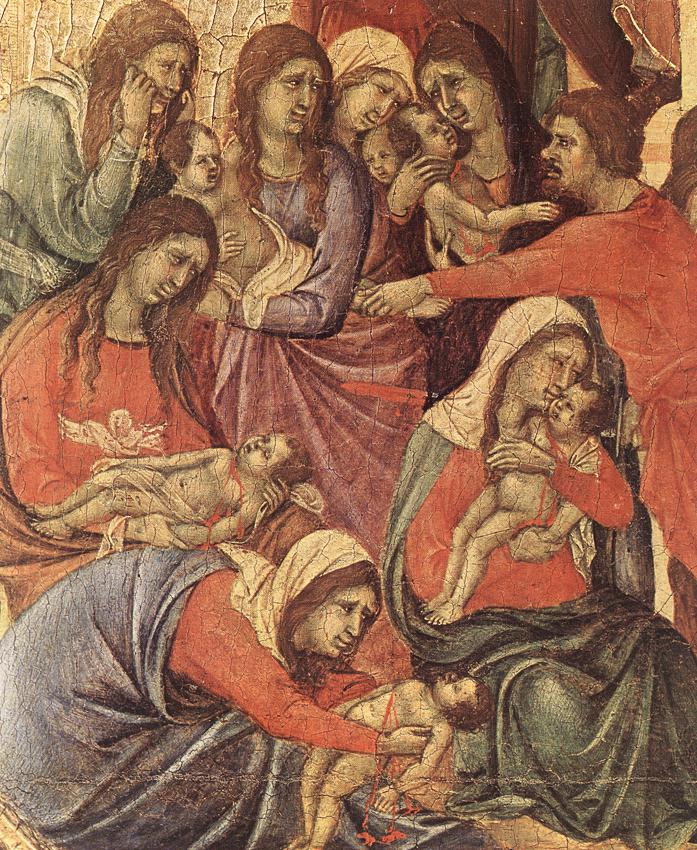
Since the sixth century, on December 28, the Church has celebrated the memory of those children killed because of Herod’s rage against Christ (cf. Mt 2:16-17). Liturgical tradition refers to them as the “Holy Innocents” and regards them as martyrs. Throughout the centuries Christian art, poetry and popular piety have enfolded the memory of the “tender flock of lambs” with sentiments of tenderness and sympathy. These sentiments are also accompanied by a note of indignation against the violence with which they were taken from their mothers’ arms and killed.
In our own times, children suffer innumerable forms of violence which threaten their lives, dignity and right to education. On this day, it is appropriate to recall the vast host of children not yet born who have been killed under the cover of laws permitting abortion, which is an abominable crime. Mindful of these specific problems, popular piety in many places has inspired acts of worship as well as displays of charity which provide assistance to pregnant mothers, encourage adoption and the promotion of the education of children.
As recorded in the gospel of Matthew, after the visit of the Magi, Herod, in rage and jealousy, slaughtered all the baby boys in Bethlehem and surrounding countryside in an attempt to destroy his perceived rival, the infant Messiah. These “innocents” are honored by the Church as martyrs.
In countries where our own innocents are daily being slaughtered by abortion, this feast day is a special time to remember the unborn, to pray for their cause, and perhaps to picket or pray at facilities where unborn babies are killed through abortion. (113)
On the Holy Family by Saint Bernard of Clairvaux
In Mary we praise that which places her above all others,
that is, fruitfulness of offspring together with virginity. For never has it
been known in this world that anyone was at the same time mother and virgin.
And see of Whom she is mother. Where does your astonishment at this so wondrous
dignity lead you? Is it not to this, that you may gaze in wonder yet never
sufficiently revere? Is she not in your veneration, no, in the esteem of Truth
itself, raised above choirs of angels? Does not Mary address the Lord and God
of all the angels as Son, saying: Son, why have you done so to us?
Who among the angels may thus presume? It is enough for
them, and for them their greatest honor, that while they are spirits by nature
they have become and are called angels, as David testifies: Who makes your
angels spirits. [Ps.103: 4] Mary, knowing herself a mother, with confidence
calls that Majesty Son Whom the angels in reverence serve. Nor does God disdain
to be called that which He disdained not to be. For the Evangelist adds a
little later: He was subject to them.
Who was subject to whom? A God to men.
God, I repeat, to Whom are the angels subject: Whom principalities and powers
obey: subject to Mary; and not alone to Mary, but to Joseph also, because
of Mary. Admire and revere both the one and the other, and choose which you
admire the more: the most sweet condescension of the Son, or the sublime
dignity of the Mother. For either am I at a loss for words: for both are
wondrous. For that God should obey a woman is humility without compare; and
that a woman should have rule over God dignity without equal. In praise of
virgins is it joyfully proclaimed: that they follow the lamb withersoever he
goes. [Rev. 14: 4] Of what praise shall you esteem her worthy who also goes
before Him?
Learn, O Man, to obey. Learn, O Earth, to be subject. Learn, O
Dust, to submit. The Evangelist in speaking of his Maker says: He was subject
to them; that is, without doubt, to Mary and to Joseph. Be you ashamed, vain
ashes that you are. God humbles Himself, and do you exalt yourself? God becomes
subject to men, and will you, eager to lord it over men, place yourself above
your Maker? O would that God might deign to make me, thinking such thoughts at
times in my own mind, such answer as He made, reproving him, to His apostle: Get behind me, Satan: because you savor not the things that are of God. [Mark 8:
33]
For as often as I desire to be foremost among men, so often
do I seek to take precedence of God; and so do I not truly savor the things
that are of God. For of Him was it said: And he was subject to them. If you
disdain, O Man, to follow the example of a Man, at least it will not lower thee
to imitate thy Maker. If perhaps you cannot follow Him wheresoever He goes, at
least follow in that wherein He has come down to you.
If you are unable to
follow Him on the sublime way of virginity, then follow God by that most sure
way of humility; from whose straightness should some even from among the
virgins go aside, then must I say what is true, that neither do they follow the
Lamb to wherever he goes. He that is humble, even though he be stained, he
follows the Lamb; so too does the proud virgin; but neither of the two
whithersoever He goes: because the one cannot ascend to the purity of the Lamb
that is without stain, nor will the other deign to come down to the meekness of
the Lamb, Who stood silent, not merely before the shearer, but before the one
that put Him to death. Yet the sinner [you and me] who follows Him in humility, has
chosen a more wholesome part than the one that is proud in his virtue; since
the humble repentance of the one washes away uncleanness, but the pride of the
other contaminates his own virtue.
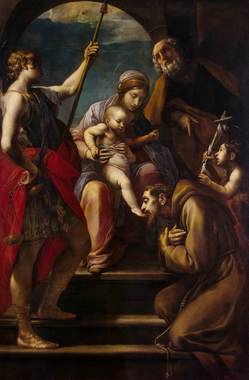
Truly blessed was Mary who possessed both
humility and virginity. And truly wondrous the virginity of those whose fruitfulness is not stained, but adorned her; and truly singular the humility, which this
fruitful virginity has not troubled, but rather exalted; and wholly
incomparable the fruitfulness which goes hand in hand with her humility and her
virginity. Which of these things is not wondrous? Which is not beyond all
comparison? Which that is not wholly singular? It would be strange if you did
not hesitate to decide which you regard as most worthy of praise: whether the
wonder of fruitfulness of offspring in virginity, or of virginal integrity in a
mother: sublimity of Offspring, or humility joined to such dignity: unless it
be that we place both together above each one singly: and it is truly beyond
any doubt more excellent and more joyful to have beheld these perfections
united in her, than to see but one part of them.
And can we wonder that God, of
Whom it is written that He is wonderful in his saints, [Ps. 67: 36] shows
Himself in His own Mother yet more wondrous still. Venerate then, Ye spouses,
this integrity of flesh in our corruptible flesh. Revere likewise, you virgins,
fruitfulness in virginity. Let all men imitate the humility of God’s Mother.
Honor, you angels, the Mother of your King, you who adore the Offspring of our
Virgin; Who is your King and our King, the Healer of our race, the Restorer of
our fatherland: Who among you is so sublime, yet among us was so lowly: to
Whose Majesty as well from you as from us let there be adoration and reverence:
to whose Perfection be there honor and glory and empire for ever and ever.
Amen.
What News This Bitter Night?
What news, what news this bitter night,
When all is
shuttered in the gloom?
No news except a baby born,
Who finds within an ox’s
stall his narrow room.
What men are these who hurry past?
What wonder do they
run to see?
Shepherds who heart the herald song,
Who haste in stable to adore
the mystery.
What child is this who, sleeping, makes
The manger throne his
resting place?
None but the King of heaven high,
Born into dying to redeem our
fallen race!
What shall I bring to honor Him?
What homage pay, what poor gift
give?
Naught but your heard which, dead in sin,
Finds in this Child redeeming
love—and strength to live!
The
poem is by the late Dr. Henry Letterman, longtime professor of English at
Concordia Teachers College, River Forest, IL. Dr. Richard Hillert, of the same institution, put this poem to music for Grace Lutheran Church, River Forest, IL. It was recorded by the Schola Cantorum of St. Peter’s in the Loop in 1992.
Holy Family, the Octave of Christmas
Father, help us to live as a holy family, united in
respect and love. Bring us to the joy and peace of your eternal home.
hidden life at Nazareth allows everyone to enter into fellowship with Jesus by
the most ordinary events of daily life:
where we begin to understand the life of Jesus – the school of the Gospel.
First, then, a lesson of silence. May esteem for silence, that admirable and
indispensable condition of mind, revive in us. . . A lesson on family life. May
Nazareth teach us what family life is, its communion of love, its austere and
simple beauty, and its sacred and inviolable character… A lesson of work.
Nazareth, home of the “Carpenter’s Son”, in you I would choose to
understand and proclaim the severe and redeeming law of human work. . . To
conclude, I want to greet all the workers of the world, holding up to them their
great pattern their brother who is God.
is the only event that breaks the silence of the Gospels about the hidden years
of Jesus. Here Jesus lets us catch a glimpse of the mystery of his total
consecration to a mission that flows from his divine sonship: “Did you not
know that I must be about my Father’s work?” Mary and Joseph did not
understand these words, but they accepted them in faith. Mary “kept all
these things in her heart” during the years Jesus remained hidden in the
silence of an ordinary life. (533-534)
Joseph (Sunday in the Christmas octave) is a festive occasion particularly
suitable for the celebration of rites or moments of prayer proper to the
Christian family. The recollection of Joseph, Mary and Jesus’ going up to
Jerusalem, together with other observant Jewish families, for the celebration
of the Passover (cf. Lk 2:41-42), should normally encourage a positive
acceptance of the pastoral suggestion that all members of the family attend
Mass on this day. This feast day also affords an opportunity for the renewal of
our entrustment to the patronage of the Holy Family of Nazareth; the
blessing of children as provided in the ritual; and where opportune, for
the renewal of marriage vows taken by the spouses on their wedding day, and
also for the exchange of promises between those engaged to be married in which
they formalize their desire to found a new Christian family.
the feast, the faithful have frequent recourse to the Holy Family of Nazareth
in many of life’s circumstances: joining the Association of the Holy Family so
as to model their own families on the Holy Family of Nazareth; frequent
prayers to entrust themselves to the patronage of the Holy Family and to obtain
assistance at the hour of death. (112)
Blessing of Wine on the Feast of St. John, Apostle and Evangelist
Priest: Our help is in the name of the Lord.
All: Who made heaven and earth.
Priest: The Lord be with you.
All: May He also be with you.
Let us pray. If it please you, Lord God, bless + and consecrate + this vessel of wine (or any other beverage) by the power of your right hand; and grant that, through the merits of Saint John, apostle and evangelist, all your faithful who drink of it may find it a help and a protection. As the blessed John drank the poisoned potion without any ill effects, so may all who today drink the blessed wine in his honor be delivered from poisoning and similar harmful things. And as they offer themselves body and soul to you, may they obtain pardon of all their sins. We ask this through Christ our Lord
All: Amen.
Lord, bless + this creature drink, so that it may be a health-giving medicine to all who use it; and grant by your grace that all who taste of it may enjoy bodily and spiritual health in calling on your holy name. We ask this through Christ our Lord.
All: Amen.
May the blessing of almighty God, Father, Son, + and Holy Spirit, come on this wine (or any other beverage) and remain always.
All: Amen.
At the end of the principal Mass on the feast of Saint John, Apostle and Evangelist, (after the last Gospel if during the praying the Missal of Blessed John XXIII), the priest, retaining all vestments except the maniple, blesses wine brought by the people. This is done in memory and in honor of Saint John, who drank without any ill effects the poisoned wine offered to him by his enemies. The wine is sprinkled with holy water. If the blessing is given privately outside of Mass, the priest is vested in surplice and stole and performs the ceremony as given above.
Thanks is due to St Francis of Assisi for the Nativity Scene
Just prior to Christmas Pope Benedict XVI reflected on
Saint Francis of Assisi’s gift to the Church in 1223 of the Nativity scene.
Then, as now we see Humility, Jesus, encountering the nihilism of the world, a
people who entranced with violence and anger now faced with the Prince of
Peace, the true king of the universe.
nativity, the defenseless love of God was shown, his humility and goodness,
which in the incarnation of the Word is manifested to man so as to teach a new
way to live and to love. He saw a little child lying still in a manger; the
child woke up because Francis approached… ‘This vision was not different than
real life, since through the work of his grace acting by way of his holy
servant Francis, the Child Jesus was resurrected in the hearts of many. Thanks
to St. Francis, the Christian people have been able to perceive that at
Christmas, God truly has become Emmanuel, God-with-us, from whom no barrier or
distance can separate us. In this Child, God has come so near to each one of
us, so close, that we can address him with confidence and maintain with him a
trusting relationship of deep affection, as we do with a newborn. In this
Child, in fact, God-Love is manifested: God comes without weapons, without
strength, because he does not aim to conquer, we could say, from without, but
rather wants to be welcomed by man in liberty. God becomes a defenseless Child to
conquer man’s pride, violence and desire to possess. In Jesus, God took up this
poor and defenseless condition to conquer with love and lead us to our true
identity … so that he concedes to our hearts this simplicity that recognizes
the Lord in this Child, precisely as Francis did in Greccio. Then, we too can
experience what […] happened to those present […] ‘Each one returned to his
house filled with an ineffable joy.
Saint Stephen
Stephen saw the heavens opened; he saw and entered; blessed is the man for whom the heavens were opened.
We beseech Thee, O Lord, grant us to imitate what we revere, so that we may learn to love also our enemies; for we celebrate the birth to immortality of him who interceded even for his persecutors with Thy So our Lord Jesus Christ.
Saint Stephen is known as a deacon and the Protomartyr (the first among all martyrs who witness to Christ). Chapters 6 and 7 of the Acts of the Apostles give us an understanding of Stephen. Saint Stephen is the patron of deacons, permanent and transitional, bricklayers and of Hungary.
A news item from the Pope on Saint Stephen and those those suffer for their faith.