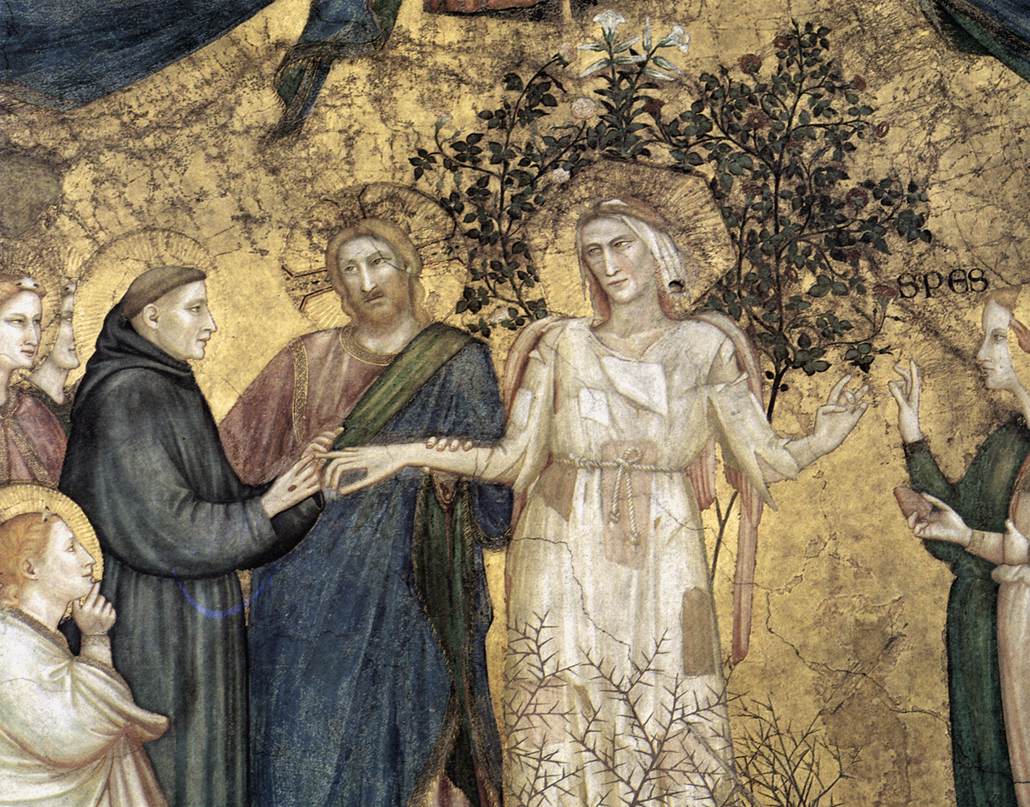
In a recent catechesis, I already illustrated the
providential role that the Order of Friars Minor and the Order of Preachers,
founded respectively by St. Francis of Assisi and St. Dominic Guzmán, had in
the renewal of the Church of their time. Today I would like to present to you
the figure of Francis, an authentic “giant” of holiness, who
continues to fascinate very many people of every age and every religion.

“A
son is born to the world.” With these words, in the Divine Comedy
(Paradiso, Canto XI), the greatest Italian poet, Dante Alighieri, alludes to
Francis’ birth, which occurred at the end of 1181 or the beginning of 1182, in
Assisi. Belonging to a wealthy family — his father was a textile merchant —
Francis enjoyed a carefree adolescence and youth, cultivating the chivalrous ideals
of the time. When he was 20 he took part in a military campaign, and was taken
prisoner. He became ill and was released. After his return to Assisi, a slow
process of spiritual conversion began in him, which led him to abandon
gradually the worldly lifestyle he had practiced until then.
Striking at this
time are the famous episodes of the meeting with the leper — to whom Francis,
getting off his horse, gave the kiss of peace; and the message of the Crucifix
in the little church of San Damiano. Three times the crucified Christ came to
life and said to him: “Go, Francis, and repair my Church in ruins.”
This simple event of the Word of the Lord heard in the church of San Damiano
hides a profound symbolism. Immediately, St. Francis is called to repair this
little church, but the ruinous state of this building is a symbol of the tragic
and disturbing situation of the Church itself at that time, with a superficial
faith that does not form and transform life, with a clergy lacking in zeal,
with the cooling off of love; an interior destruction of the Church that also
implied a decomposition of unity, with the birth of heretical movements.
However,
at the center of this Church in ruins is the Crucified and he speaks: he calls
to renewal, he calls Francis to manual labor to repair concretely the little
church of San Damiano, symbol of the more profound call to renew the Church of
Christ itself, with his radical faith and his enthusiastic love for Christ.

This
event, which probably occurred in 1205, makes one think of another similar
event that happened in 1207: the dream of Pope Innocent III. He saw in a dream
that the Basilica of St. John Lateran, the Mother Church of all churches, was
collapsing and a small and insignificant religious supported the church with
his shoulders so that it would not collapse. It is interesting to note, on one
hand, that it is not the Pope who helps so that the church will not collapse,
but a small and insignificant religious, whom the Pope recognizes in Francis
who visited him. Innocent III was a powerful Pope, of great theological
learning, as well as of great political power, yet it was not for him to renew
the Church, but for the small and insignificant religious: It is St. Francis,
called by God.
On the other hand, however, it is important to note that St.
Francis does not renew the Church without or against the Pope, but only in
communion with him. The two realities go together: the Successor of Peter, the
bishops, the Church founded on the succession of the Apostles and the new
charism that the Holy Spirit created at this moment to renew the Church. True
renewal grows together.
Let us return to St. Francis’ life. Because his father
Bernardone reproved him for excessive generosity to the poor, Francis, with a
symbolic gesture, and before the bishop of Assisi, stripped himself of his
clothes, thus intending to renounce his paternal inheritance: As at the moment
of creation, Francis had nothing, but only the life that God gave him, and into
whose hands he entrusted himself. Then he lived as a hermit until, in 1208,
another fundamental event took place in the journey of his conversion. Hearing
a passage of the Gospel of Matthew — Jesus’ discourse to the Apostles sent on
mission — Francis feels he is called to live in poverty and to dedicate
himself to preaching. Other companions associated themselves to him and, in
1209, he went to Rome, to submit to the Pope the project of a new form of
Christian life. He was given a paternal reception by the great Pontiff who,
enlightened by the Lord, intuited the divine origin of the movement awakened by
Francis. The Poverello of Assisi had understood that every charism given by the
Holy Spirit is placed at the service of the Body of Christ, which is the
Church; hence, he always acted in full communion with the ecclesiastical
authority. In the life of saints there is no opposition between a prophetic
charism and the charism of government and, if some tension is created, they
must wait patiently for the times of the Holy Spirit.
In reality, some
historians in the 19th century and also in the last century tried to create
behind the Francis of tradition, a so-called historical Francis, just as there
is a desire to create behind the Jesus of the Gospels, a so-called historical
Jesus. Such a historical Francis would not have been a man of the Church, but a
man linked immediately only to Christ, a man who wished to create a renewal of
the people of God, without canonical forms and without the hierarchy. The truth
is that St. Francis really had a very immediate relationship with Jesus and
with the Word of God, which he wished to follow sine glossa, exactly as it is,
in all its radicalism and truth. It is also true that initially he did not have
the intention of creating an order with the necessary canonical forms, but,
simply, with the Word of God and the presence of the Lord, he wished to renew
the people of God, to call them again to listening to the Word and to literal
obedience to Christ. Moreover, he knew that Christ never is “mine” but
always is “ours,” that “I” cannot have Christ and
“I” cannot reconstruct against the Church, his will and his teaching
— but only in communion with the Church, built on the succession of the
Apostles, is obedience to the Word of God also renewed.
It is also true that he
did not intend to create a new order, but only to renew the people of God for
the Lord who comes. But he understood with suffering and pain that everything
must have its order, that even the law of the Church is necessary to give shape
to renewal and thus he really inserted himself totally, with the heart, in the
communion of the Church, with the Pope and the bishops. He knew always that the
center of the Church is the Eucharist, where the Body and Blood of Christ are
made present. Through the priesthood, the Eucharist is the Church. Where
priesthood, and Christ and communion of the Church go together, only there does
the Word of God also dwell. The true historical Francis and the Francis of the
Church speaks precisely in this way also to non-believers, to believers of other
confessions and religions.
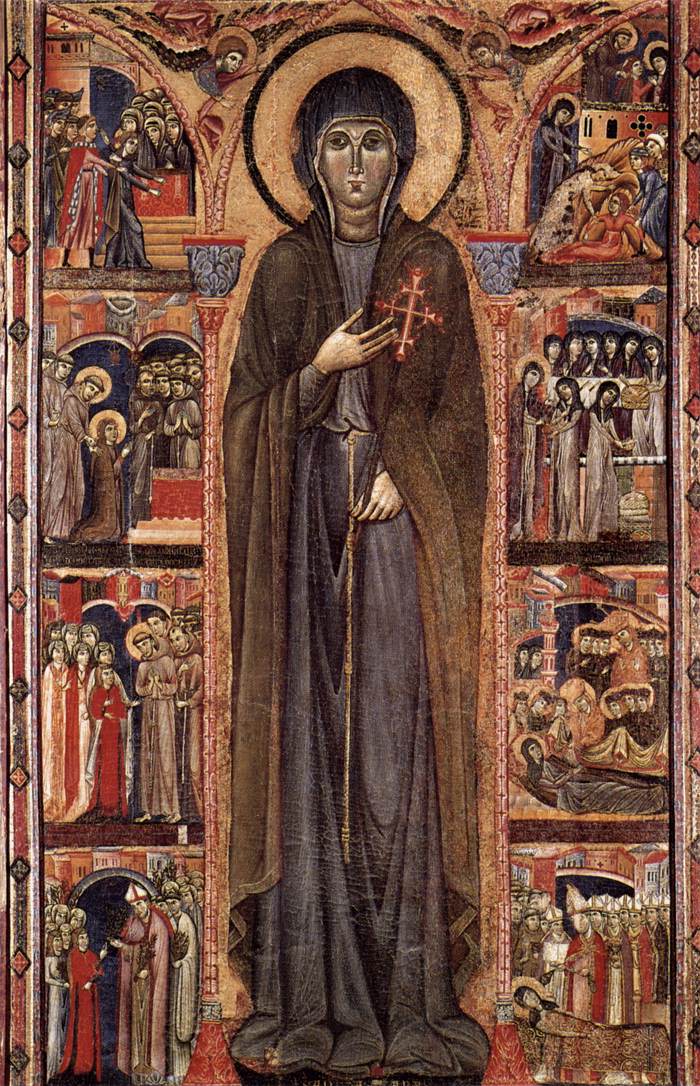
Francis and his friars, ever more numerous,
established themselves in the Porziuncola, or church of Saint Mary of the
Angels, sacred place par excellence of Franciscan spirituality. Also Clare, a
young lady of Assisi of a noble family, placed herself in Francis’ school. Thus
the Second Franciscan Order originated, that of the Poor Clares, another
experience destined to bear outstanding fruits of sanctity in the Church.
The
successor of Innocent III, Pope Honorius III, with his bull “Cum
dilecti” of 1218, also upheld the singular development of the first Friars
Minor, who were opening their missions in several countries of Europe, and even
in Morocco. In 1219 Francis obtained permission to go to speak with the Muslim
Sultan Melek-el-Kamel in Egypt, and also to preach the Gospel of Jesus there. I
want to underline this episode of the life of St. Francis, which is very
timely. At a time in which there was under way a clash between Christianity and
Islam, Francis, armed deliberately only with his faith and his personal
meekness, pursued with efficacy the way of dialogue. The chronicles tell us of
a benevolent and cordial reception by the Muslim Sultan. It is a model that
also today should inspire relations between Christians and Muslims: to promote
a dialogue in truth, in reciprocal respect and in mutual understanding (cf. Nostra
Aetate, 3).
It seems, then, that in 1220 Francis visited the Holy Land, thus
sowing a seed that was to bear much fruit: his spiritual sons, in fact, made of
the places in which Jesus lived a privileged realm of their mission. With
gratitude I think today of the great merits of the Franciscan Custody of the
Holy Land.
Returning to Italy, Francis entrusted the government of the order to
his vicar, Friar Pietro Cattani, while the Pope entrusted the order, which
continued gathering more followers, to the protection of Cardinal Ugolino, the
future Supreme Pontiff Gregory IX. For his part the founder, totally dedicated
to preaching, which he carried out with great success, wrote a Rule, later
approved by the Pope.

In 1224, in the hermitage of La Verna, Francis saw the
Crucified in the form of a seraphim and from the encounter with the crucified
seraphim, he received the stigmata; he thus became one with the crucified
Christ: a gift, hence, which expresses his profound identification with the
Lord.
Francis’ death — his transitus — occurred on the evening of Oct. 3,
1226, at the Porziuncola. After blessing his spiritual sons, he died, lying on
the naked earth. Two years later Pope Gregory IX inscribed him in the register
of saints. A short time later, a large basilica was raised in Assisi in his
honor, still today a destination for very many pilgrims, who can venerate the
tomb of the saint and enjoy Giotto’s frescoes, a painter who illustrated in a
magnificent way the life of Francis.
It has been said that Francis represents
an alter Christus, he was truly a living icon of Christ. He was even called
“Jesus’ brother.” Indeed, this was his ideal: to be like Jesus; to
contemplate the Christ of the Gospel, to love him intensely and to imitate his
virtues. In particular, he wished to give a fundamental value to interior and
exterior poverty, teaching it also to his spiritual sons. The first Beatitude
of the Sermon on the Mount — blessed are the poor in spirit for theirs is the
Kingdom of Heaven (Matthew 5:3) — found a luminous fulfillment in the life and
in the words of St. Francis.
Truly, dear friends, the saints are the best
interpreters of the Bible; they, incarnating in their lives the Word of God,
render it more than attractive, so that it really speaks to us. Francis’
witness, who loved poverty to follow Christ with dedication and total liberty,
continues to be also for us an invitation to cultivate interior poverty to grow
in trust of God, uniting also a sober lifestyle and detachment from material
goods.
In Francis, love for Christ is expressed in a special way in adoration
of the Most Blessed Sacrament of the Eucharist. In Franciscan sources one reads
moving expressions, such as this: “The whole of humanity fears, the whole
universe trembles and heaven exults, when on the altar, in the hand of the
priest, there is Christ, the Son of the living God. O wonderful favor! O
sublime humility, that the Lord of the universe, God and Son of God, so humbles
himself as to hide himself for our salvation, under the low form of bread”
(Francis of Assisi, Scritti, Editrici Francescane, Padua, 2002, 401).
In this
Year for Priests, it pleases me also to recall a recommendation addressed by
Francis to priests: “When you wish to celebrate Mass, certainly in a pure
way, carry out with reverence the true sacrifice of the most holy Body and
Blood of our Lord Jesus Christ” (Francis of Assisi, Scritti, 399).
Francis
always showed great deference to priests, and recommended that they always be
respected, even in the case when, at the personal level, they are not very
worthy. He cherished, as motivation for this profound respect, the fact that
they have received the gift of consecrating the Eucharist. Dear brothers in the
priesthood, let us never forget this teaching: the holiness of the Eucharist
asks us to be pure, to live in a consistent way with the mystery we celebrate.
From
the love of Christ is born love of people and also of all God’s creatures. Here
is another characteristic trait of Francis’ spirituality: the sense of
universal fraternity and love for Creation, which inspired his famous Canticle
of Creatures. It is a very timely message. As I reminded in my recent encyclical
Caritas in Veritate, the only sustainable development is one that respects
Creation and does not damage the environment (cf. No. 48-52), and in the
Message for the World Day of Peace of this year I underlined that also the
building of a solid peace is linked to respect for creation. Francis reminds us
that in creation is displayed the wisdom and benevolence of the Creator. In
fact, nature is understood by him as a language in which God speaks with us, in
which reality becomes transparent and we can speak of God and with God.
Dear
friends, Francis was a great saint and a joyful man. His simplicity, his
humility, his faith, his love of Christ, his kindness to every man and woman
made him happy in every situation. In fact, between sanctity and joy there
subsists a profound and indissoluble relation. A French writer said that there
is only one sadness in the world: that of not being saints, that is, of not
being close to God. Looking at St. Francis’ witness, we understand that this is
the secret of true happiness: to become saints, close to God!
May the Virgin,
tenderly loved by Francis, obtain this gift for us. We entrust ourselves to her
with the same words of the Poverello of Assisi: “Holy Virgin Mary, there
is no one like you born in the world among women, daughter and handmaid of the
Most High King and heavenly Father, Mother of our Most Holy Lord Jesus Christ,
spouse of the Holy Spirit: pray for us … to your most holy favorite Son, Lord
and Master” (Francis of Assisi, Scritti, 163).