Author: Paul Zalonski
Archbishop Dolan prays for Giussani, thanks Communion & Liberation, gives us the logic of Lent
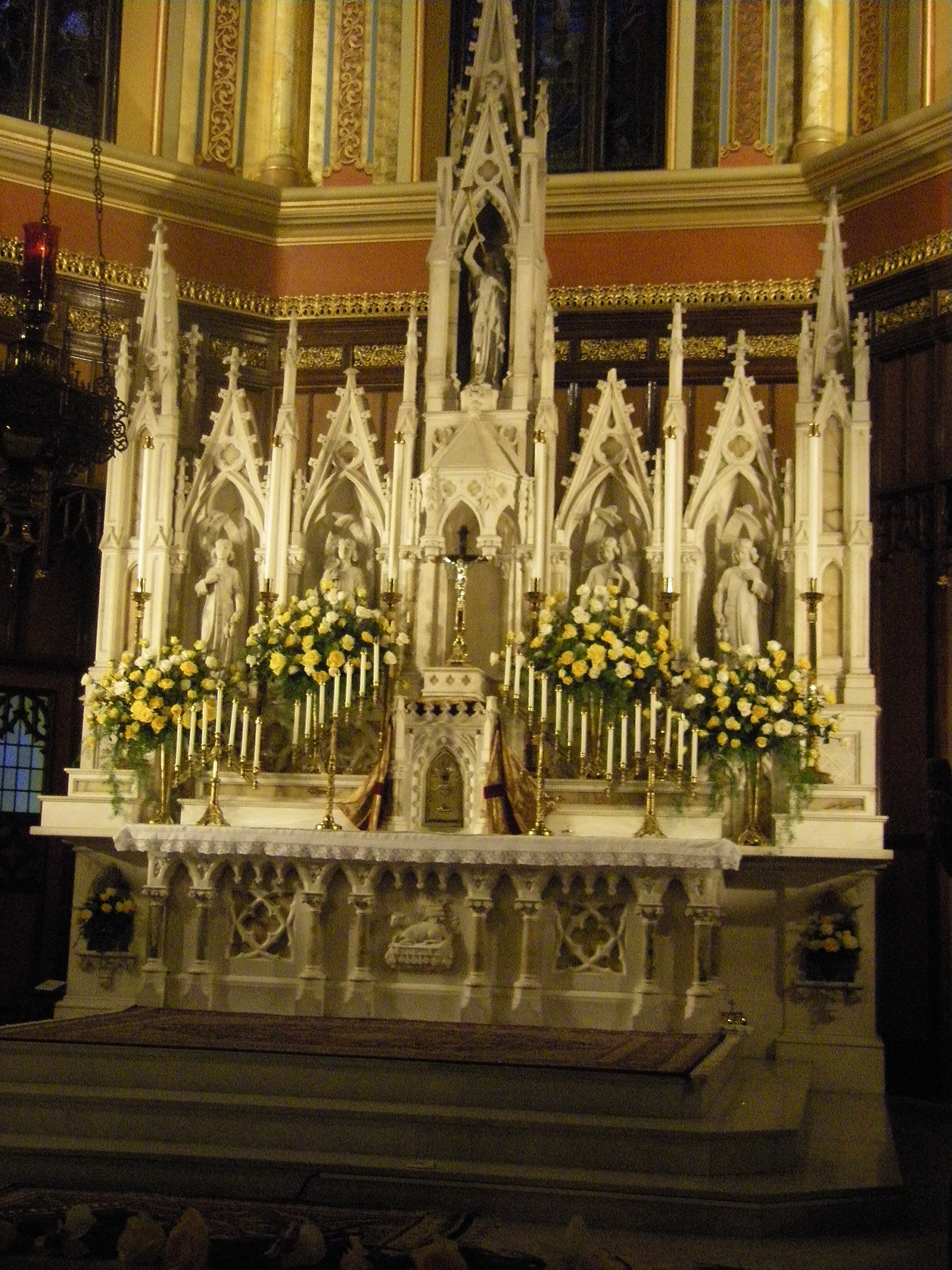
Tomorrow is the 5th anniversary of death of the great priest and founder of Communion & Liberation, Monsignor Luigi Giussani. More on that later. However, the NY community of Communion & Liberation gathered at Saint Patrick’s Cathedral for the Sacrifice of the Mass celebrated by the Archbishop, Timothy M. Dolan. Among those in the sanctuary were Bishop William McCormack (retired auxiliary bishop of NY celebrating 51 years a priest today) and Bishop Gerald Walsh (NY auxiliary bishop and rector of Saint Joseph’s Seminary), Msgr. Lorenzo Albacete, Carmelite Father Eugene and Father Daniel O’Reilly with the seminarians from Dunwoodie and the collegians from St John Neumann Seminary Residence.
Clarifications on Summorum Pontificum
The Pontifical Commission Ecclesia Dei which oversees various matters pertaining to the praying of the Missal of Blessed John XXIII, sometimes called the Missal of 1962, or simply, THE Mass, issued a few clarifications on what the Pope intends to happen as a result of the publication of the motu proprio Summorum Pontificum which liberated from ideologues the praying of the Missal of Blessed John.
Clericus Cup 2010: learning to work with athletes, seminarians take to the field
Today begins the 2010 Clericus Cup (soccer tournament) for Catholic seminarians and young priests studying in Rome teaching values of good sportsmanship. 16 international seminaries or religious houses participate in the Cup. The Pontifical North American College Martyrs represent the USA.
Blesseds Francisco & Jacintha
Unless you change and become like little children you will never enter the Kingdom of Heaven.
Lent lengthens our horizon, it orients us to eternal life, Pope tells us
I present to you most of the Pope’s homily for Ash Wednesday. Emphasis added to draw attention to some excellent ideas or turns of phrase.
Wisdom (cf 11:23-26), the liturgy introduces the Eucharistic celebration of Ash
Wednesday. They are words that, in some way, open the whole Lenten journey,
placing as their foundation the omnipotence of the love of God, his absolute
lordship over every creature, which is translated in infinite indulgence,
animated by a constant and universal will to live. In fact, to forgive someone
is equivalent to saying: I do not want you to die, but that you live; I always
and only want your good.
days transpired in the desert of Judea, after the baptism received from John in
the Jordan. This long time of silence and fasting was for him a complete
abandonment to the Father and to his plan of love; it was a
“baptism,” that is, an “immersion” in his will, and in this
sense, an anticipation of the Passion and the Cross. To go into the desert and
to stay there a long time, alone, meant to be willingly exposed to the assaults
of the enemy, the tempter who made Adam fall and through whose envy death
entered the world (cf Wisdom 2:24); it meant engaging in open battle with him,
defying him with no other weapons than limitless confidence in the omnipotent
love of the Father. Your love suffices me, my food is to do your will (cf John
4:34): This conviction dwelt in the mind and heart of Jesus during that
“Lent” of his. It was not an act of pride, a titanic enterprise, but
a decision of humility, consistent with the Incarnation and the Baptism in the
Jordan, in the same line of obedience to the merciful love of the Father, who
“so loved the world that he gave his only Son” (John 3:16).
did all this for us. He did it to save us and, at the same time, to show us the
way to follow him. Salvation, in fact, is a gift, it is God’s grace, but to
have effect in my existence it requires my consent, an acceptance demonstrated
in deeds, that is, in the will to live like Jesus, to walk after him. To follow
Jesus in the Lenten desert is, hence, the condition necessary to participate in
his Easter, in his “exodus.” Adam was expelled from the earthly
Paradise, symbol of communion with God; now, to return to that communion and,
therefore, to true life, it is necessary to traverse the desert, the test of
faith. Not alone, but with Jesus! He — as always — has preceded us and has
already conquered in the battle against the spirit of evil. This is the meaning
of Lent, liturgical time that every year invites us to renew the choice to follow
Christ on the path of humility to participate in his victory over sin and
death.
ashes, which are imposed on the head of those who begin with good will the
Lenten journey. It is essentially a gesture of humility, which means: I
recognize myself for what I am, a frail creature, made of earth and destined to
the earth, but also made in the image of God and destined to him. Dust, yes,
but loved, molded by love, animated by his vital breath, capable of recognizing
his voice and of responding to him; free and, because of this, also capable of
disobeying him, yielding to the temptation of pride and self-sufficiency. This
is sin, the mortal sickness that soon entered to contaminate the blessed earth
that is the human being. Created in the image of the Holy and Righteous One,
man lost his own innocence and he can now return to be righteous only thanks to
the righteousness of God, the righteousness of love that — as St. Paul writes
— was manifested “through faith in Jesus Christ” (Romans
3:22). From these words of the Apostle I took my inspiration for my Message,
addressed to all the faithful on the occasion of this Lent: a reflection on the
theme of righteousness in the light of the Sacred Scriptures and of its
fulfillment in Christ.
Wednesday is the theme of righteousness. First of all, the page of the prophet
Joel and the Responsorial Psalm — the Miserere — form a penitential diptych,
which manifests how at the origin of all material and social injustice is what
the Bible calls “iniquity,” that is, sin, which consists essentially
in a disobedience to God, namely, a lack of love. “For I know my
transgressions, / and my sin is ever before me. / Against thee, thee only, have
I sinned, / and done that which is evil in thy sight” (Psalm 51 (50):
3-4). The first act of righteousness, therefore, is to recognize one’s own
iniquity, it is to recognize that it is rooted in the “heart,” in the
very center of the human person. “Fasting,” “weeping”,
“mourning” (cf. Joel 2:12) and every penitential expression has value
in the eyes of God only if it is the sign of truly repentant hearts. Also the
Gospel, taken from the “Sermon on the Mount,” insists on the need to
practice proper “righteousness” — almsgiving, prayer and fasting —
not before men but only in the eyes of God, who “sees in secret” (cf
Matthew 6:1-6.16-18). The true “recompense” is not others’
admiration, but friendship with God and the grace that derives from it, a grace
that gives strength to do good, to love also the one who does not deserve it,
to forgive those who have offended us.
and sisters, Lent lengthens our horizon, it orients us to eternal life. On this
earth we are on pilgrimage, “[f]or here we have no lasting city, but we
seek the city which is to come,” says the Letter to the Hebrews (Hebrews
13:14). Lent makes us understand the relativity of the goods of this earth and
thus makes us capable of the necessary self-denials, free to do good. Let us
open the earth to the light of heaven, to the presence of God in our midst.
Amen.
Richard Proulx, RIP
Practice prayer … it’ll be the best thing you’ve ever done (as least lately)
Practice prayer from the beginning. Paint your house
with the colors of modesty and humility. Make it radiant with the light of
justice. Decorate it with the finest gold leaf of good deeds. Adorn it with the
walls and stones of faith and generosity. Crown it with the pinnacle of prayer.
In this way, you will make it a perfect dwelling place for the Lord. You will
be able to receive him as in a splendid palace, and through His grace you will
already possess Him, His image enthroned in the temple of your spirit.
Chrysostom, homily read at Office of Readings, Friday after Ash Wednesday
Saint Conrad of Piacenza
The teaching of truth was in his mouth, and no wrong was found on his lips. he walked with me in peace and justice, and turned many away from wickedness.
Matteo Ricci on tract for sainthood?
This is old news by now, but the Agenzia Fides reported back in late January that the cause for canonization for Father Matteo Ricci is again active. Ricci always held a special place in my imagination partly because he was (and continues to be) maligned by ideologues. I noted Ricci’s 400th anniversary on this blog back in May.
The sainthood cause for 16th-century Jesuit missionary Matteo Ricci was reopened on January 24, following Mass at the Cathedral of San Giuliano in the diocese of Diocese of Macerata-Tolentino-Recanati-Cingoli-Treia, where he was born.
The process of beatification originally launched in 1984 when he was named a Servant of God. Bishop Claudio Giuliodori of Macerata said that although the cause stalled soon after it was opened, “these 25 years have not passed in vain because the Lord has given us clear signs of a deeper understanding of the prophetic intuitions of Father Matteo Ricci.”
Father Matteo Ricci was born in 1552 in the Marche town of Macerata. He entered the Society of Jesus and was missioned by his superiors to study mathematics and astronomy before leaving for the Far East at the age of 26.
Ricci’s itinerary included four years in Goa (west coast of India) before traveling to China. On mainland China he settled in Zhao Qing in the southernmost Guangdong Province; he was proficient in studying Chinese. During his time there he produced his global “Great Map of Ten Thousand Countries,” which revolutionized the Chinese understanding of the rest of the world. A copy of the map is on display at the United States Library of Congress.
In 1589 Father Ricci moved to Zhao Zhou and began sharing European mathematical discoveries with Chinese scholars. He became known as “Li Madou” and was renowned for his extraordinary memory and knowledge of astronomy. He eventually became a member of the court of Ming Emperor Wanli.
In 1601 he was allowed into the Forbidden City of Beijing, where he worked until his death in 1610.
Ricci’s postulator (the person promoting the inquiry for the sainthood) is Jesuit Father Anthony Witwer, who is coordinating and supervising a historical commission that has been established to collect all the writings and documents attributed to Father Ricci, along with those that reference him in publication. The commission’s work will conclude with a critical study on the writings of Matteo Ricci along with a judgment as to the authenticity and value of documents on him.
In a message to the Diocese of Macerata inaugurating commemorations of the 400th anniversary of Father Ricci’s death in Beijing in 1610, Pope Benedict XVI wrote that Father Ricci was “gifted with profound faith and extraordinary cultural and academic genius.” He “dedicated long years of his life to weaving a profound dialogue between West and East, at the same time working incisively to root the Gospel in the culture of the great people of China. Even today, his example remains as a model of fruitful encounter between European and Chinese civilization. In considering his intense academic and spiritual activity, we cannot but remain favorably impressed by the innovative and unusual skill with which he, with full respect, approached Chinese cultural and spiritual traditions. It was, in fact, this approach that characterized his mission, which aimed to seek possible harmony between the noble and millennial Chinese civilization and the novelty of Christianity, which is for all societies a ferment of liberation and of true renewal from within, because the Gospel, universal message of salvation, is destined for all men and women whatever the cultural and religious context to which they belong.”
The Pope continued, “What made his apostolate original and, we could say, prophetic, was the profound sympathy he nourished for the Chinese, for their cultures and religious traditions.” Ricci was likewise “a model of dialogue and respect for the beliefs of others and made friendship the style of his apostolate during his twenty-eight years in China.”
History shows us that Ricci remained faithful to this style of evangelization to the end of his life. He made the gospel accessible to people, especially the intellectual classes by “using a scientific methodology and a pastoral strategy based, on the one hand, on respect for the wholesome customs of the place, which Chinese neophytes did not have to abandon when they embraced the Christian faith and, on the other, on his awareness that the Revelation could enhance and complete” those customs. As the Fathers of the Church did in the time of the encounter between the Gospel and Greco-Roman culture, the author of the “Treatise on Friendship” undertook his “farsighted work of inculturation of Christianity in China by seeking constant understanding with the wise men of that country.”
The concluded his anniversary remarks by saying that we, “Following his example, may our own communities, which accommodate people from different cultures and religions, grow in a spirit of acceptance and of reciprocal respect.”
Anthony E. Clark’s article “Weaving a Profound Dialogue between West and East”: On Matteo Ricci, S.J., for Ignatius Insight is helpful for a much broader perspective. Plus, Scranton University hosts a blog entry on Father Ricci that shows a bit his depth of character that you may find interesting.