Corpus Christi procession at St Mary’s New Haven

Eucharistic procession-b Corpus Christ 2010.jpgO sacred Banquet in which Christ is received, the memory of His Passion is recalled, the mind is filled with grace, and pledge of future glory is given to us.

At churches around the world today we’ll notice processions with the Blessed Sacrament in honor of the Feast of the Most Holy Body and Blood of Christ (also called Corpus Christi). New Haven, Connecticut is no different: Saint Mary’s Church served by the Dominican Friars celebrated the Mass and formed a procession around the block though a small portion of the Yale University neighborhood. The Very Reverend Father Joseph Allen, OP, prior and pastor of Saint Mary’s presided at Mass and led the procession. Allen reminded us of Christ’s gift of Presence to the Church and it is an extension of Christ’s sacred humanity and divinity now, and the fruit of that presence is unity of faith and service to neighbor. Also assisting Father Allen in carrying the Blessed Sacrament is the recently ordained Dominican student brother, Brother Austin, assigned for the summer to Saint Mary’s Priory and Church.

We took Christ to the streets where He is little known and if he is known there, He is often neglected. “Our faith in the God who took flesh in order to become our companion along the way needs to be everywhere proclaimed, especially in our streets and homes, as an expression of our grateful love and as an inexhaustible source of blessings” (John Paul II, Mane nobiscum Dominie, 2005)

Benediction Corpus Christi 2010.jpg

The Corpus Christi festival clearly echoes the Holy Thursday commemoration of the institution of the Eucharist. Benedict XVI’s words come to mind:
We must never forget that the Church is built around Christ and that, as St Augustine, St Thomas Aquinas and St Albert the Great have all said, following St Paul (cf. 1 Cor 10:17), the Eucharist is the Sacrament of the Church’s unity, because we all form one single body of which the Lord is the head. We must go back again and again to the Last Supper on Holy Thursday, where we were given a pledge of the mystery of our redemption on the Cross. The Last Supper is the locus of the nascent Church, the womb containing the Church of every age. In the Eucharist, Christ’s sacrifice is constantly renewed, Pentecost is constantly renewed. (Benedict XVI, homily closing the 49th Eucharistic Conference, Quebec, June 22, 2008)

faithful Corpus Christ 2010.jpg

You may recall that since the 14th century a custom formed in carrying the Blessed Sacrament around town following Mass. Popes encouraged this devotional practice –even giving indulgences to those who walked with the Blessed Sacrament– and by the 16th century, the Council of Trent approved a public demonstration of the faith in the Eucharistic Presence. Through the various periods of Church history extraordinary events and processions developed with every segment of civil society taking part. In some countries the faithful wrote “Plays of the Sacrament” or performed “Eucharistic dances” as they did in Seville (not the type done by Sister Mary Leotard) to express their faith in the enduring Presence of the Lord.

benediction in Church Corpus Christi 2010.jpg

Today’s Eucharistic procession stopped at stations, a typical Roman liturgical custom, for a moment of prayer with the Blessed Sacrament which included singing “Tantum ergo,” the a prayer, benediction and the recitation of the Divine Praises. For us two points were selected outside the church and one at the main altar calling to mind the practice of Pope Martin V.
Holy Mother Church teaches us that her observance of Corpus Christi is a response that’s both doctrinal and pertaining to Divine Worship in the face of wrong teaching on the place of the Eucharist in ecclesial life. In many places, either in CCD, preaching at Mass or in conversation among friends, the mystery of the real presence of Christ in the Eucharist is misrepresented or ignored. Looking at many examples of contemporary church architecture I’ve noticed the displacement of the Eucharist from being central to the margins of the Church (cathedrals and monastic churches excepted). This is especially crazy when pastors renovate their traditional churches and move the tabernacle to a side chapel based on a mis-reading of the church documents and a faulty eucharistic theology. If you are in the NYC area stop by at the Jesuit Church of St Francis Xavier on West 16th Street and you’ll see what I mean. There the Jesuits moved the tabernacle to a side altar and replaced the traditional place for the tabernacle with components of a baptistry (a review of the recent renovation later). The concern for the Eucharist as central to one’s life is obviously nothing new to us today –or in the 2000 year history of the Church– as it was a concern of Pope Urban in 1264 when he gave the Roman Church this feast.

Eucharistic procession-a Corpus Christi 2010.jpg

Let me conclude by giving two principles that articulate Catholic belief in the Eucharist and the reason why we take the Blessed Sacrament on the road:
1. the supreme reference point for Eucharistic devotion is the Lord’s Passover; the Pasch as understood by the Fathers, is the feast of Easter, while the Eucharist is before all else the celebration of the Paschal Mystery … the Passion, Death and Resurrection of Christ;
2. all forms of Eucharistic devotion must have an intrinsic reference to the Eucharistic Sacrifice, or dispose the faithful for its celebration, or prolong the worship which is essential to that Sacrifice (Directory of Popular Piety).
What we did today and what others around the world did, is to make a public profession of faith in the promise of Christ to be with us till the end of time in the enduring Presence of Christ in the Eucharist.

Saint Norbert of Xanten

“I myself shall lead my sheep,
Guarding them from danger;
They shall hear and follow me,
Not go with a stranger.
Into pastures rich and green–
God the Lord has spoken–
I shall bring my Israel,
With my love as token.”
Norbert, father of his flock,
Took to heart this warning,
And in all his works and words
Toiled from night to morning.
Guiding all within his cure,
He took time to nourish
With the love of Christ most fair,

Causing souls to flourish.

St Norbert.jpg

Father of the canon’s life,
Bishop of his city,
Prayed before the Eucharist,
Served the poor with pity.
Crowned a sacrificial life
With a death of glory;
Now we join with saints above
To retell his story!
Glory to the Father give,
Source of ev’ry blessing,
Glory to the Son we sing,
Who, our wrongs addressing,
Came to us as one of us!
To the Spirit, praises!
Hear the songs of thankfulness
Each believer raises!

J. Michael Thompson
Copyright © 2010, World Library Publications
76 76 D, ST. KEVIN, AVE VIRGO VIRGINUM

Corpus Christi

viterbo_procession.jpgOf the glorious Body telling,
O my tongue, its mystery sing,
and the Blood, all price excelling,
which the Gentiles’ Lord and King,
in a noble womb once dwelling,
shed for this world’s ransoming.

Given for us, for us descending
of a Virgin to proceed,
man with man in converse blending,
scattered He the gospel seed,
till His sojourn drew to ending,
which He closed in wondrous deed.

At the last great Supper lying,
circled by His brethren’s band,
meekly with the Law complying,
first He finished its command,
then, immortal Food supplying,
gave Himself with His own hand.

Word-made-flesh, by word He maketh
very bread, His Flesh to be;
man in wine Christ’s Blood partaketh,
and if senses fail to see,
faith alone the true heart waketh
to behold the mystery.

Therefore we, before Him bending,
this great Sacrament revere;
types and shadows have their ending,
for the newer Rite is here;
faith, our outward sense befriending,
makes the inward vision clear.

Glory let us give and blessing
to the Father and the Son;
honor, might, and praise addressing,
while eternal ages run,
ever too His love confession,
who from Both with Both is One.
Amen.


“Pange lingua gloriosi”
Saint Thomas Aquinas
trans. John Mason Neale, Edward Caswall, et al.
The English Hymnal, 1906

4 new priests ordained for the Diocese of Bridgeport

4 new priests Dio of Bport 2010.jpgThe Most Reverend William E. Lori ordained four deacons to the holy priesthood of Jesus Christ today at Mass celebrated at the Cathedral of Saint Augustine, Bridgeport, CT. The newly ordained priests, Fathers Jeffrey Couture, Karol Ksiazek, Jaime Marin-Cardona and Michael Novajosky will serve in the Diocese of Bridgeport.

Bishop Lori spoke eloquently about the need for the priest to be both disciple and shepherd of Jesus Christ. A “theme” of the Scriptures proclaimed at Mass, particularly Psalm 23, 1 Peter 5 and John 10.  I think one can argue that a failure to live with both dimensions of priesthood (the common & ministerial) constantly in heart and mind is a lack in understanding of the vocation given by the Lord which could lead to mistakes in the exercise of the priesthood. Sure, there may be times when the shepherd aspect of a priest’s life may be more evident but the sitting at the feet of the Lord is required of any good shepherd. That is, one can’t be a shepherd if one is not first a disciple! The bishop related a story from the experience of the late Cardinal James Hickey who quietly yet confidently tried to live his priesthood as both disciple of Jesus and to act as a good shepherd for the flock his was given to lead to heaven.
The bishop also exhorted the newly ordained and those present to practice what we say we believe. Integrity of life is so very needed for the witness to be credible. Those who despise the Church cannot assail the Church and her ministers (the faithful included) if how one lives is in accord with what one professes to be true.
One small and interesting item happened at the Litany Saints –when the Church kneels and those to be ordained lay prostrate on the floor in humility– asking the saints to intercede for us, the cantor invoked the intercession of Saint Oliver Plunkett, the sometime Primate of Ireland of the 17th century convicted of treason by England and killed for the faith at Tyburn. Plunkett was the last martyr to die in England; he was canonized by Pope Paul VI in 1975. And this is an example of something that can make you go “hmmmm” in the sacred Liturgy. Nevertheless, I was elated someone has a devotion to Plunkett!

At the conclusion of the Mass Bishop Lori announced to the congregation the assignments of the new priests:
Reverend Father Jeffrey W. Couture will be at the Saint Edward the Confessor, New Fairfield
Reverend Father Karol J. Ksiazek will be at Saint Therese, Trumbull
Reverend Father Jaime Marin-Cardona will be at Saint Joseph, South Norwalk
Reverend Father Michael P. Novajosky will be at Saint Jude for the summer before returning to Rome to complete his studies for the License in Sacred Theology (Patristics)

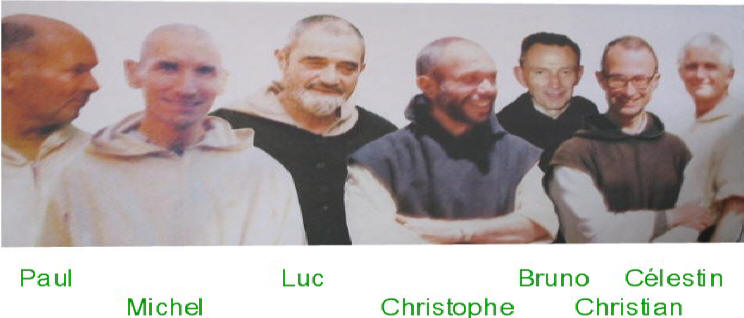
Film explores the witness of Trappist martyrs of Algeria

Atlas Trappists.jpgThe
recent Cannes Film Festival showed the film about the 1996 Trappist martyrs of Our Lady of
Atlas in Algeria. The film got rave reviews and awarded 2nd place. The film is in French and it will be
available on DVD with English subtitles. While we wait for the full film to be available here is
a clip on Youtube with subtitles at: Of Gods and Men.


More information on the 7 monks may be found here and here.

Catholic Apologetics Summer Camp sponsored by the Envoy Institute & Belmont Abbey College

Belmont Abbey College logo.jpg

Come enjoy deepening your faith and learning how to better defend it from some of America’s leading Catholic apologists, while having a blast in the great outdoors in a setting that’s close to heaven: nestled in the Pisgah National Forest in the Blue Ridge Mountains of North Carolina. (Go to www.2FunCamps.com to check out our gorgeous conference site. Boys and girls will sleep in separate camps, but will be together during the day.)


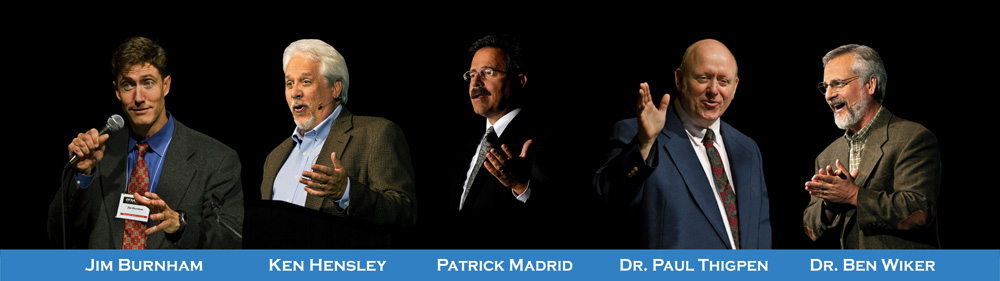
Our first-ever Envoy Institute Summer Apologetics Camp is open to students ages 16-19 and will be held August 15-21, 2010. Sessions will be led by Dr. Ben Wiker, Jim Burnham, Ken Hensley, Dr. Paul Thigpen, and your host Patrick Madrid, Director of the Envoy Institute of Belmont Abbey College. Other speakers will be finalized over the summer, and all reading materials, etc. will be supplied. And in between sessions you’ll have ample opportunities to enjoy fun activities like whitewater rafting, rock climbing, hiking, or just reading in the shade of a
tree.
Apologetics camp speaks.jpg
Early registration discounts are available, but space is very limited. So register online today!

Saint Peter of Verona, martyr

Let us rejoice in celebrating the victory of Saint
Peter Martyr. On earth he proclaimed St Peter Verona martyr.jpgChrist’s love for us. Now Christ leads him
to a place of honor before his Father in heaven.


Almighty God, you crowned our
brother Peter with martyrdom for confessing the true faith with perseverance.
Give to us, your people, that same faith that we too may receive the gift of
salvation.


From a Vita

“He [Saint Peter of Verona, martyr, 1206-1252] was marked
by great perfection as a Friar: so watchful was he over the purity of his body
and soul that he never felt himself defiled by a mortal sin. He chastened his
body by fasting and watching, and ennobled his soul by the contemplation of the
things of God. He was constantly busied in works for furthering the salvation
of souls; and had a peculiar gift of grace for clearly convincing heretics.
Such was his power as a preacher, that countless crowds were drawn together to
hear him, and many were moved to repentance.”

In the history of the Dominican order Saint Peter of Verona was among the first generation of followers of Saint Dominic. Peter’s own family were adherents to the Cathar heresy which prompted the founding of the Friars Preachers. While not the first martyr among the Dominicans he is the first saint of the Order. The working of God’s grace in men’s hearts saw the conversion of Peter’s murderer, Carino of Balsamo, and his admission to the Dominican Order as a lay brother. What beauty there is in the conversion of sinners and growth of grace to the point of fully dedicating one’s life to God under the evangelical counsels of poverty, chastity and obedience. Since we are all created for communion with God and others Peter’s killer was brought into that communion. One can say that Saint Peter of Verona’s was the condition of another’s full communion with God. Brother Carino recalled his crime but confessed his sin and did penance for the rest of his life; he is buried at the Cathedral of Forli. Brother Carino is a beatus of the Church; Blessed Carino’s liturgical memorial is April 28, the date of the translation of his relics.

Fr Ragheed Aziz Ganni: 3rd anniversary of death

ragheed.jpgJune 3rd is quickly becoming a date that most Christians will not forget too easily: 1) the liturgical memorial of Saint Charles Lwanga, 19th century African martyrs; 2) the death of Blessed Pope John XXIII; 3) the murder of Father Ragheed and his companions; and now 3) the murder of Bishop Luigi Padovese, OFM Cap.

Father Ragheed Aziz Ganni’s death with the three subdeacons is still a rather moving memory for me, not just on the anniversary but throughout the year when thinking of the plight of the Eastern churches. But why? Because he could’ve gone the other way, avoided the situation of his people and saved his life. Instead he confronted evil head-on with courage. Like other things one remembers, the deaths of people who unknowingly become incredible, beautiful witnesses to the Presence of Christ right now (not some time ago).
Father Ragheed was a Catholic priest of the Chaldean Church in the Diocese of Mosul. Ganni was ordained a priest October 13, 2001. He was 35 years old, a young priest, and a collaborator in Truth for the Kingdom of God. He was convinced in the beauty of God’s Word and His enduring Presence in the world and that we ought not to be scared away.
More on Father Ragheed can be read here.

Luigi Padovese murdered by Turk

Luigi Padovese.jpgBishop Luigi Padovese, OFM Cap, 63, was murdered today at about 1pm local time by his driver who it is claimed had psychological problems and history of violent outbreaks was supposedly a convert to Christianity but some news agencies are naming the driver a Muslim. At the moment no one is claiming political motivation for the murder.

Bishop Padovese was born at Milan, Italy and a member of the Capuchin Franciscan order. He was ordained a priest for nearly 37 years and a bishop for 5.5 years. He was the Vicar Apostolic in Anatolia.

Bishop Padovese was to meet Pope Benedict XVI with other Middle East bishops in Cyprus to receive the Instumentum laboris, the working document for the forthcoming Synod of Bishops, scheduled to meet in October.

The Minister General of the Capuchins posted this brief bio for Bishop Luigi.

The BBC story noted here and Spero News here.

May God grant mercy Bishop Luigi Padovese mercy and may his memory be eternal.

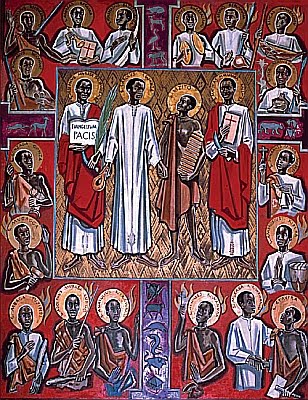
Saint Charles Lwanga & companions, Martyrs of Uganda

St Charles Lwanga.jpgToday’s the liturgical memorial of some of the most evocative witnesses to Jesus Christ who gave their lives for the Christian Faith of the 19th century. I pray that Saint Charles and companions intercede not only for Africa but for all who claim the Church as mother and family and who find it difficult to truly live their faith. More on Saint Charles here.

Saint Charles and his companions (22 of them) were killed in Namugongo, Uganda between 1885-1887. They ranged in age between 13 and 30. They were beatified in 1920 and canonized in 1964. At the revision of the Roman liturgical calendar Saint Charles’s feast day was added. The Church calls these saints the “Protomartyrs of Black Africa.”

In his 1964 homily at the canonization of Saint Charles and his companions, Pope Paul VI said:
“The African martyrs add another page to the Church’s roll of honor –an occasion both of mourning and joy. These African martyrs herald the dawn of a new age. If only the mind of man might be directed not toward persecutions and religious conflicts but toward a rebirth of Christianity and civilization! Africa has been washed by the blood of these latest martyrs, and the first of this new age (and, God willing, let them be the last, although such a holocaust is precious indeed). Africa is reborn free and independent.”