A long forgotten tradition on the Vigil of the Nativity of Saint John the Baptist is the Blessing of a Bonfire. Confusion exists because in some people’s minds the 1964 Roman Ritual was suppressed because it’s absent in the US Bishops’ Book of Blessings but it is advocated for in the Directory on Popular Piety.
Since it’s not seen often in the USA it will be seen as esoteric. But those of concerned with Catholic identity and the flourishing of the sacred Liturgy in parishes, monasteries and religious communities. This blessing is one of the most ancient blessings.
Since St Augustine was the one to establish the feast day of the Baptist’s birth, six months prior to the Savior’s and in the summer solstice after the longest day of the year and when daylight incrementally lessens, a celebration of “light of the World” manifested by the Forerunner, it is an appropriate liturgical observance. Plus, the liturgical catechesis is limitless in this rite.
Because St John the Baptist’s testimony to identity of Jesus as the true light which shines in the darkness of the world, the priest doing this rite can bring together several spiritual “themes” for expanding the heart. One can preach on John as the light-bearer before Christ; “he must increase, but I must decrease”; “I say to you, among those born of women there is not a greater prophet than John the Baptist.”
The Rite
Priest: Our help is in the name of the Lord.
All: Who made heaven and earth.
P: The Lord be with you.
All: May He also be with you.
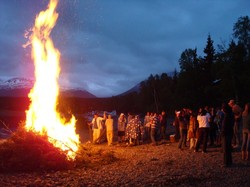
Let us pray. Lord God, almighty Father, the light that never fails and the source of all light, sanctify + this new fire, and grant that after the darkness of this life we may come unsullied to you who are light eternal; through Christ our Lord.
All: Amen.
The fire is sprinkled with holy water; after which the clergy
and the people sing the following hymn Hymn: Ut queant laxis
1. Ut queant laxis resonáre fibris Mira gestórum fámuli tuórum, Solve pollúti lábii reátum, Sancte Joánnes.
2. Núntius celso véniens Olympo Te patri magnum fore nascitúrum, Nomen, et vitae sériem geréndae Ordinae promit.
3. Ille promíssi dúbius supérni, Pérdidit promptae módulos loquélae: Sed reformásti genitus perémptae Organa vocis.
4. Ventris obstrúso récubans cubíli Sénseras Regem thálamo manéntem: Hinc parens nati méritis utérque Abdita pandit.
5. Sit decus Patri, genitaéque Proli et tibi, compare utriúsque virtus, Spíritus semper, Deus unus, omni Témporis aevo. Amen.
(the same in English)
1. O for your spirit, holy John, to chasten Lips sin-polluted, fettered tongues to loosen; So by your children might your deeds of wonder Meetly be chanted.
2. Lo! a swift herald, from the skies descending, Bears to your father promise of your greatness; How he shall name you, what your future story, Duly revealing.
3. Scarcely believing message so transcendent, Him for a season power of speech forsaketh, Till, at your wondrous birth, again returneth, Voice to the voiceless.
4. You, in your mother’s womb all darkly cradled, Knew your great Monarch, biding in His chamber, Whence the two parents, through their offspring’s merits, Mysteries uttered.
5. Praise to the Father, to the Son begotten, And to the Spirit, equal power possessing, One God whose glory, through the lapse of ages, Ever resounding. Amen.
P: There was a man sent from God.
All: Whose name was John.
Let us pray. God, who by reason of the birth of blessed John have made this day praiseworthy, give your people the grace of spiritual joy, and keep the hearts of your faithful fixed on the way that leads to everlasting salvation; through Christ our Lord.
All: Amen.
Philip T. Weller, The Roman Ritual (The Bruce Publishing Company, Milwaukee, WI, 1964).
 The Church celebrates as a solemnity the birth of the Savior’s cousin, Saint John the Baptist. It is John who points to Jesus as the “path to salvation” and he teaches us that the encounter with the Lord requires to put aside our sinfulness and to put on purity of heart. It is as Isaiah says in the first reading which is applied to John the Baptist and it ought to be true for us: “I have labored in vain, I have spent my strength for nothing and vanity; yet surely my rights is with the Lord, and my recompense with my God.”