What does it mean to love totally? How can we learn to love truly? –Catholic Action asks Pope for advice

Pope Benedict
XVI responded to a cross section of Italian Catholic Action, on Saturday,
October 31. Reportedly, there were 50,000 children, 30,000 youth and 10,000
educators of Catholic Action, who were in Rome meeting under the theme: “There
Is More. We Become Great Together.” WOW!!!! The Pope really takes humanity seriously; he really understands me and my desires and my limitations. One of the Q&A that I liked is the
following:

Your Holiness, our teachers in Catholic Action tell us that to grow
up it is necessary to learn to love, but often we fail and we suffer in our
relationships, in our friendships, in our first loves. But what does it mean to
love totally? How can we learn to love truly?

Bl Piergiorgio Frasati3.jpg

Benedict XVI: A great question.
It is very important, I would say fundamental, to learn to love, truly to love,
to learn the art of real love!
In adolescence we stop before the mirror and we
notice that we are changing. But if you continue to look at yourself, you will
never grow up! You grow up when you do no longer let the mirror be the only
truth about you but when you let your friends tell you. You will grow up if you
are able to make your life a gift to others, not to seek yourselves, but to
give yourselves to others: this is the school of love. This love, however, must
bring you into that “more” that today shout to everyone. “There
is more!” As I have already said, I too, in my youth wanted something more
than what the society and the mentality of the time presented to me. I wanted
to breathe pure air, above all I desired a beautiful and good world, like our
God, the Father of Jesus, wanted for everyone. And I understood more and more
that the world becomes beautiful and good if one knows this will of God and if
the world corresponds to this will of God, which is the true light, beauty,
love that gives the world meaning.

Bl Alberto Marvelli.jpg

It is quite true: You cannot and must not
adapt yourselves to a love reduced to a commodity to be consumed without
respect for oneself or for others, incapable of chastity and purity
. This is
not freedom
. Much of the “love” that is proposed by the media, on the
internet, is not love but egoism, closure, it gives you the illusion of a
moment, but it does not make you happy, it does not make you grow up, it binds
you like a chain that suffocates more beautiful thoughts and sentiments, the
true desires of the heart, that irrepressible power that is love and that has
its maximum expression in Jesus and strength and fire in the Holy Spirit, who
enflames your lives, your thoughts, your affections. Of course it demands
sacrifice to live love in the true wa
y — without renunciation one does not
find this road
— but I am certain that you are not afraid of the toil of a
challenging and authentic love. It is the only kind that, in the final
analysis, gives true joy! There is a test that tells you whether your love is
growing in a healthy way: If you do not exclude others from your life, above
all your friends who are suffering and alone, people in difficulty, and if you
open your heart to the great friend Jesus
.

Bl Pierina Morosini.jpg

Catholic Action also teaches you the
roads to take to learn authentic love: participation in the life of the Church,
of your Christian community, loving your friends in the Children’s Catholic
Action group, in Catholic Action, availability to those of your age at school,
in the parish or in other environments, the company of the Mother of Jesus,
Mary, who knows how to guide your heart and lead you along the way of good.
Moreover, in Catholic Action, you have many examples of genuine, beautiful,
true love
: Blessed Pier Giorgio Frassati, Blessed Alberto Marvelli; love that
also leads to the sacrifice of one’s life, like with Blessed Pierina Morosini
and Blessed Antonia Mesina.

Young people of Catholic Action, aspire to big
goals
, because God gives you the strength. “More” is being young
people and children who decide to love like Jesus does, to be the protagonists
of our own lives, protagonists in the Church, witnesses of the faith to those
who are your age. 
“More” is the 

Bl Antonia Mesina.jpghuman and Christian formation that
you experience in Catholic Action, which unites spiritual life, fraternity,
public witness to the faith, ecclesial communion, love for the Church,
collaboration with the bishops and priests, spiritual friendship
. “Growing
up together” speaks of the importance of being part of a group and a
community that helps you to grow, to discover your vocation and to learn true love.
Thank you.

The cross reveals God’s face of love giving us a sure hope of eternal life

The Pope celebrated Mass for the bishops and cardinals who died in the past year on Wednesday. In his homily he addressed what I believe –and the Church has consistently taught– are central themes of our Catholic faith which are too often misunderstood or not understood enough. The last line of this post is THE most important thought for us to contemplate on today. From the Vatican’s Press Office we read:


Thumbnail image for Salvador-Dali-Christ.jpg

The Pope remind his congregation that “eternal life” designates
the divine gift granted to humankind; i.e., communion with God in this
world and its fullness in the next
. Eternal life was opened to us by Christ’s
Paschal Mystery and faith is the way to attain it”. Referring then to
Jesus’ conversation with Nicodemus, as recounted in today’s Gospel, the Pope
explained how in this exchange Jesus “reveals the most profound meaning of
the event of salvation: … The Son of man must be raised on the wood of the
cross so that those who believe in Him might have life. … The cross,
paradoxically, from being a sign of condemnation, death and failure, becomes a
sign of redemption, life and victory in which, with the eyes of faith, we can
see the fruits of salvation.”

The salvific significance of the cross
“consists in the immense love of God and in the gift of His only-begotten
Son. … The verbs ‘to love’ and ‘to give’ indicate a decisive and definitive
action expressing the radical way in which God approached man in love, even
unto the total giving of self, … lowering Himself into the abyss of our utter
abandonment, and crossing the portal of death
. The object and beneficiary of
divine Love is the world, in other words humanity
. This completely cancels the
idea of a distant God divorced from man’s journey, and reveals His true
face.” God “loves without measure. He does not show His omnipotence
in punishment, but in mercy and forgiveness
.”

Day of Prayer & Healing for Teens who have experienced abortion – November 20th


Day of Prayer & Healing for teens.jpg

Many of you are in parishes with schools and/or youth groups
and have teens who are suffering from the effects of abortion. Please promote this
unique opportunity for them to come to a Day of Prayer and Healing for Teens –
November 20th
.

For confidential registration or more information, please call Theresa at Lumina Hope and Healing after Abortion at 718-881-8008 and visit the Lumina website.

Saint Charles Borromeo


St Carlo Borromeo OBorgianni.jpg

Saint Charles  Borromeo’s intercession is as much needed today as ever we needed it. He was an unexpected gift of God to his family and to the Church and we ask him to intercede for us. Some interesting points about the legacy of Saint Charles Borromeo, whose feast we celebrate today.


  • His nephew,
    Federico Borromeo (1564-1631), was archbishop of Milan from 1595 and,
    furthering Charles’ support for Catholic learning, in 1609 founded the
    Ambrosian Library in that city. He donated a tremendous collection of art and
    literature to the library.
  • Borromeo’s emblem is the Latin
    word humilitas (humility), which is a portion of the Borromeo shield.
    He is usually represented in art in his robes, barefoot, carrying the cross as archbishop; a rope round his neck, one hand raised in blessing, thus recalling his
    work during the plague.
  • Borromeo is one of only four people mentioned at the
    beginning of the Catechism of the Catholic Church, citing them as responsible
    for the Council of Trent, which gave way to the modern day catechism. The
    others mentioned are St. Peter Canisius, St. Turibius of Mongrovejo and St.
    Robert Bellarmine.
  • The city and county of St. Charles, Missouri are named for
    Borromeo.

Fr Allen P. Novotny, SJ RIP

Allen P Novotny SJ.jpegAt this moment, family, friends, and Jesuits are gathering for the Mass of Christian Burial for the Reverend Father Allen P. Novotny, SJ, 58, President of Gonzaga College High School, Washington, DC. I mention this because I had the privilege of living with Allen for a year and liked him very much. I’ve been saddened since hearing the news on October 27th that Allen died earlier that day from a mutual friend. I was unable to make the funeral Mass but have not ceased praying for Allen’s peace and God’s mercy upon Allen and the rest of us. Eternal rest, dear friend.

A fitting video tribute to Father Allen
Gonzaga’s The Aquilian paid this tribute to Father Allen.

Catholics don’t celebrate Jewish holy days, why?

Not long ago a friend asked me why Catholics don’t celebrate
the Jewish holy days. Good question.

A response to the question as to why we
don’t celebrate the Jewish holy days would be along these lines: the Paschal
Triduum is the Christian Passover, the true Pasch. Even the Greek and Latin
name for Easter tells us that (as also the derivation of the name for Easter in
Spanish, French, Italian from the same root).

In one sense, Jesus’ teaching was
in continuity with Judaism (Mt 5.17: “Think not that I have come to abolish
the Law”); but he also in Matthew 5 puts himself forward as a higher Lawgiver
than Moses (“you have heard it said, but I tell you…”). I suggest
reading Rabbi Jacob Neusner’s book, A Rabbi Talks with Jesus, which makes this
point very clear. The Pope himself said in Jesus of Nazareth that Neusner’s book is
an excellent example of honest and reasoned argument between a believing Jew
and the Jesus of the gospels.

Continue reading Catholics don’t celebrate Jewish holy days, why?

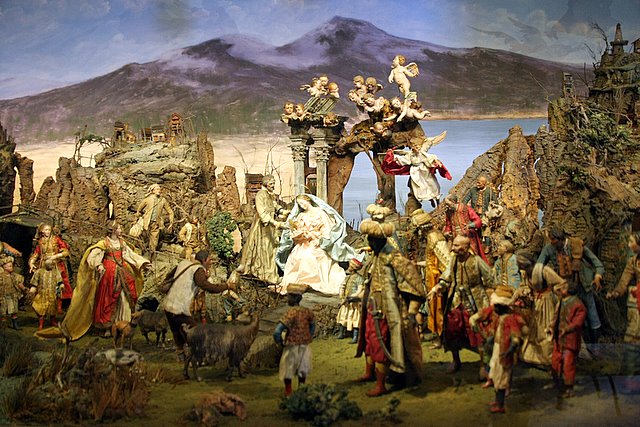
The Crèche at Regina Laudis: The Timeless story of a birth in Bethlehem …


crèche Regina Laudis.JPG

If the crèche at
the Abbey of
Regina Laudis
strikes you as a little out place, there’s a good
reason. The austere Yankee barn that houses it is a world away from its previous
home. Handcrafted by artisans in Naples, the intricate nativity scene was
presented as a coronation gift to Victor Amadeus II, king of Sardina, in 1720.
It remained among Italian nobility until it was purchased by Loretta Hines
Howard, an artist and collector, in 1949. She immediately donated it to what
was then a fledgling Benedictine Abbey in, fittingly, Bethlehem, Connecticut
(although the nuns insist the name is a coincidence). 

The crèche takes a few
liberties with the traditional nativity story. Instead of a Judean village,
Bethlehem appears here somewhere on the coast of Italy. The stable has been
replaced by Corinthian columns, and the traditional kings and shepherds are
joined by a whole host of other characters, who have shed their New Testament
robes for 18th-century knickers and coats. In one corner, some
peasants argue over the contents of a stem pot. In another, a noblewoman walks
her whippet on a leash. The crowd is puzzling at first, though it may
serve  a distinct purpose. “For as
many people as there are, there are attitudes toward the birth of Christ,” says
Sister Angèle Arbib, who helps care for the crèche. She points out some figures
who seems reverential, others who seem distracted or dis-believing: “It’s so
representative. When people come here to see the crèche, they identify with
someone in here.”

And people of all faiths do come to see it. The mass of
Christmas pilgrims has returned after a recent restoration had taken the crèche
out of public view for three years. Conservators from New York’s Metropolitan
Museum of Art painstakingly repaired each of the 68 figures and the tiny
hand-sewn outfits they wear. The results are stunning. The crèche now stands as
a testament to the continued support of the community of nuns,
preservationists, and believers that has formed around it. It’s fitting. After
all, what is a nativity other than a story of people coming together?

Justin
Shatwell

Yankee

November/December, Vol. 74, No. 6.

Abbey of Regina Laudis

273 Flanders Road

Bethlehem, CT

The crèche is open to the public daily 10-4 through Jan. 5 (closed Jan. 6-Apr. 24)

203.266.7727


Pope prays for Iraq’s true re-birth

Since Sunday how could our hearts not be moved by the dirty killing of 58 and wounding of countless others in Our Lady of Salvation Church (a Syrian Catholic Church in Baghdad)? How could we not have heavy hearts and mournful spirits at the news of villainous actions toward others, especially those at prayer? Our brothers and sisters in the faith, among them 2 priests –who brought Christ to us– were bruttally murdered by Muslim extremists.

We pray for the eternal rest of the dead, healing of the ill and forgiveness of the perpetrators. That’s what the Lord would do, I am convinced. This is what we are asked to do by the Pope. Indeed, we pray for peace and re-birth in Christ.

Let’s pray for Chaldean Cardinal and Patriarch Emmanuel III Delly, the other bishops of Iraq with the priests, deacons, sub-deacons and laity.

The Holy Father has spoken out in the last days and he does so again. Read his remarks here.

Vote: it’s necessary for Catholics

Just back from Mass for the Faithful Departed and from voting.

Have you prayed and voted???

Vote.jpg

Catholics vote because it is “… for the promotion of the common
good” (Benedict XVI) 

Voting is a “… serious moral obligation…” and Catholics “…
can never vote for someone who favors absolutely what’s called the ‘right to
choice'” (Abp R. Burke)

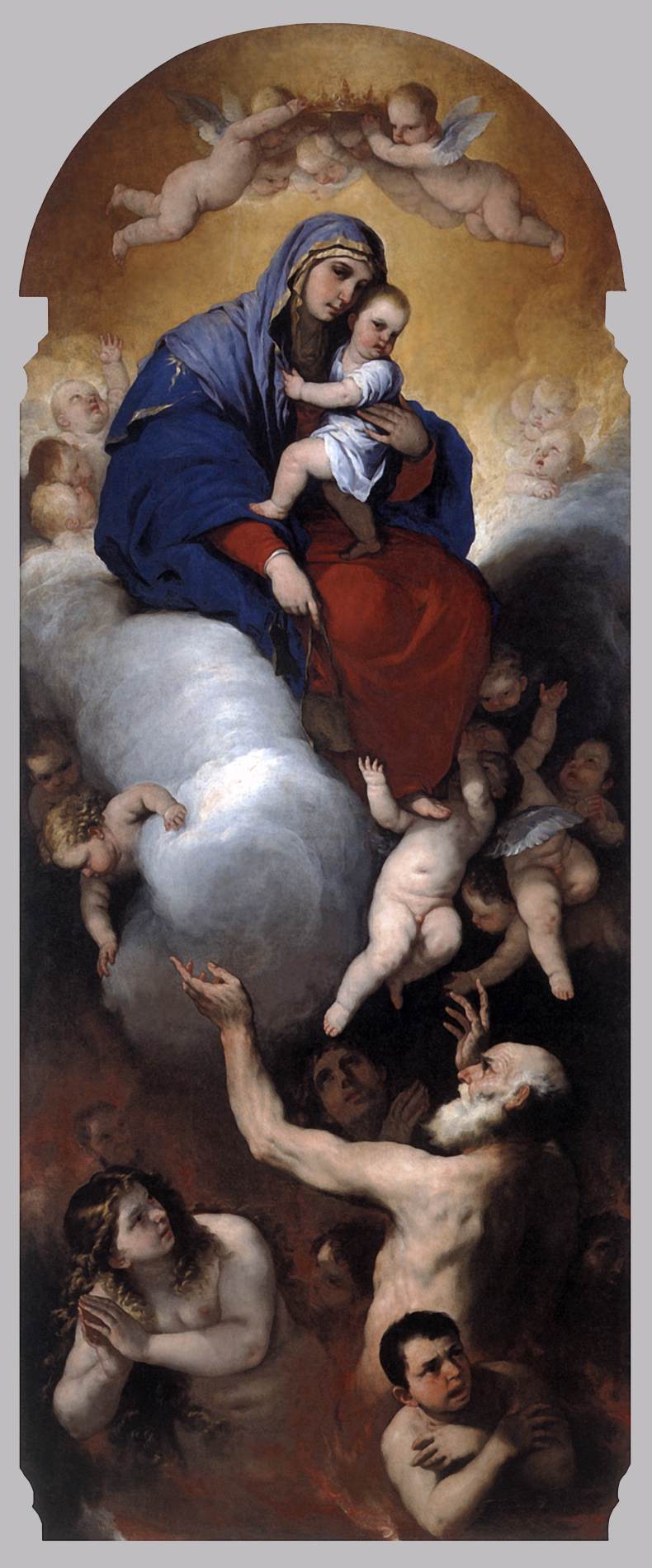
Give rest, O Christ to your servants

Virgin & child with souls in purgatory LGiordano.jpg

Give rest, O Christ, to your servants with your saints, where sorrow and pain are no more, neither sighing, but life everlasting.

You only are immortal, the creator and maker of mankind, and we are mortal, formed of the earth, and to earth shall we return. For so did you ordain when you created me, saying: “You are dust, and to dust you shall return.” All of us go down to the dust; yet even at the grave, we make our song: Alleluia, alleluia, alleluia!
Give rest, O Christ, to your servants with your saints, where sorrow and pain are no more, neither sighing, but life everlasting.