SSPX detente?

The religion editor for Reuters published an article “Catholic splinter group sees no Vatican accord” on the eve of Vatican-Society of St Pius X talks ending but with no resolution. Why this group of priests persists in living outside the Catholic Church and under the unity of Pope Benedict is beyond me. Hubris is a good word but the issues are complex. Certainly there are some legitimate doctrinal issues that have surfaced following the Second Vatican Council on which the SSPX adherents are correct in objecting to. But their manifest schism from the Church of Rome is not the way to renew doctrine and to have care for the salvation of souls. I think Bishop Bernard Fellay is too obstinate to accept any offer of Divine Grace from the Trinity.

Change in the College of Cardinals

Cardinal Jean-Louis Tauran of France proto deacon of the College of Cardinals Feb 21 2011.jpgWith the Cardinal Agostino Cacciavillan, 84, who requested to be made a cardinal-priest and because of his age, the College of Cardinals gets a new proto-deacon (that is, the first among the deacons of the College). 

Jean-Louis Pierre 
Cardinal Tauran, 67, from France, is currently the president of the Pontifical Council for Inter-religious Dialogue. His central duty as the proto deacon is to announce to the world that a new pope has been elected at a conclave. He will say:

Annuntio vobis gaudium magnum, habemus Papam: Eminentissimum ac Reverendissimum Dominum, Dominum N. (first name) Sanctaee Romanae Ecclesiae Cardinalem N. (the surname) qui sis nomen imposuit N. (the papal name).
The French born proto deacon was ordained a priest of Bordeaux in 1969 and was ordained a bishop in 1991. He has served as Secretary for Relations with States in the Secretariat of State till 2003 when he was created a cardinal and appointed the Church’s archivist and librarian. In 2007, Pope Benedict named Tauran the President of the Pontifical Council for Inter-religious Dialogue. 

3 new saints for the Church universal

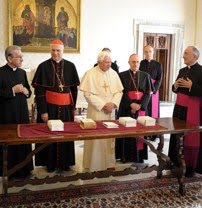
Consistory of Cardinals meet to canonize saints Feb 21 2011.jpgThe Pope called an ordinary consistory of cardinals to today to discuss and then announce that 3 new saints are to recognized. The new saints: Don Luigi Guanella, Don Guido Maria Conforti and Sister Bonifacia Rodriquez de Castro.

  • Blessed Luigi Guanella founded Congregation of the Servants of Charity and the Institute of the Daughters of Saint Mary of Providence
  • Blessed Guido Maria Conforti founded the Xavierian Missionaries
  • Blessed Bonifacia Rodriquez de Castro founded the Congregation of the Servants of Saint Joseph
The Sacrifice of the Mass and the Rite of Canonization will take place on October 23.

ExCons need Christian charity for conversion, new life

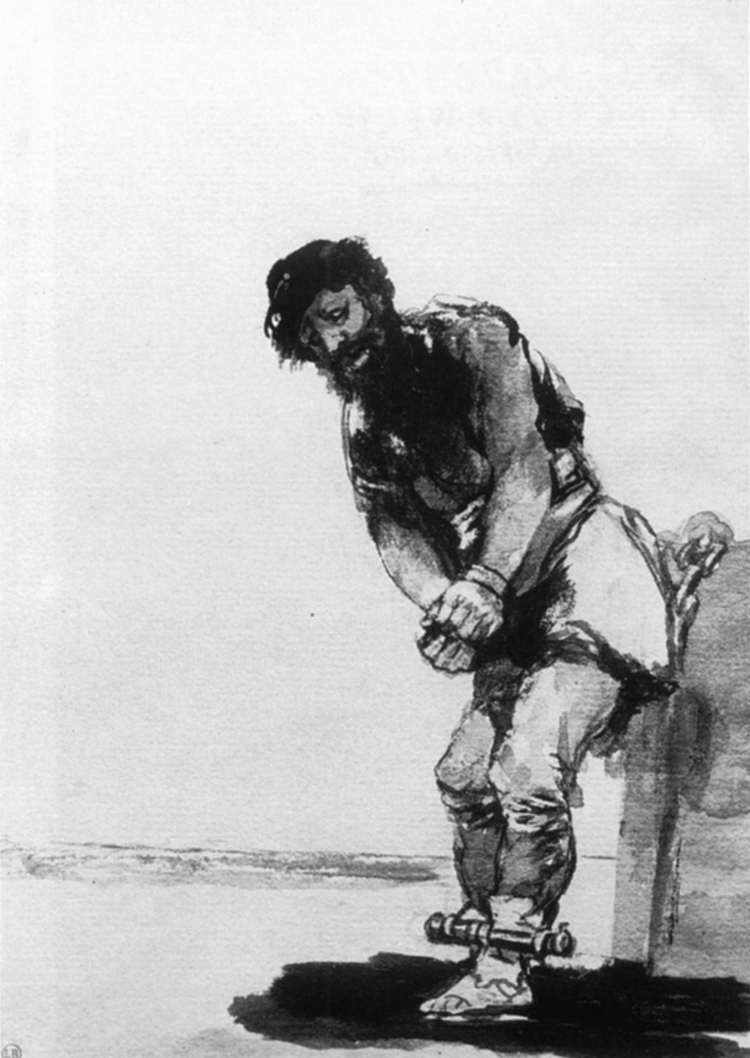
chained prisoner Goya.jpgPrograms for prisoner reentry into society is crucial in keeping people clean, working, and being a good citizens. “Do-good-ing” is not a Catholic principle. We have plenty of good people doing good all the time. In fact, my heart is really moved by those who don’t have a faith tradition to call their own and are motivated to act charitably toward those in need. Living a life of virtue and prayer are Catholic ways of proceeding. Showing mercy is what we are called to live in concrete ways. Helping the excon get on his or her feet again and walking with them is Jesus-inspired act.

Faith-based community projects, church-based communities of faith, Catholic groups like the Order of Malta and Catholic dioceses are among those who are doing good work to live the gospel of Jesus Christ. Faith-based communities have compassion as part of their mission and many are facing compassion fatigue. Money and red-tape are real obstacles to living the Spiritual and Corporal Works of Mercy.
“… I was in prison and visited me” (Matthew 25:36)

Continue reading ExCons need Christian charity for conversion, new life

Baptism in the Traditional Form

Baptismal and other rites.jpgIn the Latin Church there are several forms of celebrating the Sacrament of Baptism. Most Catholics today are familiar with the Rite of Baptism done according to the reforms of Pope Paul VI. Other Catholics follow the Traditional form according to the Rituale Romanum. This booklet follows this older form of the ritual.


The booklet is compiled by members of the Society of St Pius X (SSPX) who are not in full communion with the Roman Pontiff. Moreover, the booklet doesn’t carry an imprimatur of a bishop in communion with the Pope.

This is a handy booklet on Baptism is in print at Angelus Press. One booklet is $3.95, 10 for $26.00.

Maronites remember founder, Saint Maron

St Maron2.jpg1600 years is a long time. But the Church never forgets. She especially never forgets a sainted monk who called together others to live the Gospel and to pray. Maronite Church who traces her foundation to a monk is remembering his good work and his death of so long ago. Several celebrations around the US mark the anniversary.

Bishop Gregory J. Mansour celebrated the Divine Liturgy in honor of Saint Maron and prayed for peace in the Middle East at his cathedral, Our Lady of Lebanon, Brooklyn, NY.
Cardinal Leonardo Sandri, Prefect of the Congregation for Eastern Churches, presided at a celebration of the Liturgy in honor of Saint Maron and gave an address in which he reminded the Maronites to be custodians of the Christian gospel and tradition in the Middle East (and wherever they are. The celebration happened at the Maronite College in Rome.
Archbishop Henry J. Mansell recently presided at the Maronite Liturgy at Our Lady of Lebanon Church, Waterbury.
Bishop Earl Boyea of Lansing prays the Liturgy at Our Lady of Lebanon Church, Lansing, MI.

At the invitation of Chorbishop John Faris, His Eminence Daniel N. DiNardo with Bishop James Cunnigham of Syracuse presided during the Divine Liturgy at Saint Louis Gonzaga Church in Utica, NY.
A beautiful brief video “Saint Maron | 1600 years” is worth viewing even though it is narrated in Arabic.

The Catholic’s perpetual second chance


signs of love.jpg

I try to communicate to others, particularly the friends I teach about the Catholic faith, that to be authentically Catholic one has to fall in love with Jesus, and to do what He does. Mercy and love are constitutive parts of being called a Christian. This not always easy. It is a human struggle for many. But we are called by the Lord Himself to love and pray for your enemies; have mercy on the sinner; forgive injuries; feed the hungry. Not willing to do this, then it would be pretty hard to convince others that your proposed faith in Christ as Lord and Savior is true. The Pope’s Angelus address earlier today gives us a clue to my point: to be a Catholic means living in the mindset of having a perpetual second chance. Read the 2 papal paragraphs:

On this seventh
Sunday of Ordinary Time the biblical readings speak to us about God’s will to
make men participants in his life: “Be holy because I the Lord your God am
holy,” we read in the Book of Leviticus (19:1). With these words and the precepts
that follow from them, the Lord invited the Chosen People to be faithful to the
covenant with him, walking in his ways, and established the social legislation
on the commandment that says that “you will love your neighbor as yourself”
(Leviticus 19:18). If we listen, then, to Jesus in whom God took on a mortal
body to become every man’s neighbor and reveal his infinite love for us, we
hear again that same call, that same objective audacity
. The Lord, in fact,
says: “Be perfect as your Father in heaven is perfect” (Matthew 5:48). But who
can become perfect?
Our perfection is to live as children of God in humility
concretely doing his will
. St. Cyprian wrote that “to God’s paternity there
must correspond a conduct as children of God so that God might be glorified and
praised by man’s good conduct
” (De zelo et livore, 15: CCL 3a, 83).

In what way
can we imitate Jesus? Jesus himself says: “Love your enemies and pray for those
who persecute you so that you will be children of your Father who is in heaven”
(Matthew 5:44-45). He who welcomes the Lord in his life and loves him with all
of his heart can begin again
. He is able to do God’s will: to realize a new
form of existence
animated by love and destined for eternity
. Paul the Apostle
adds: “Do you not know that you are God’s temple and that God’s Spirit lives in
you?” (1 Corinthians 3:16). If we are truly aware of this reality and our life
is deeply formed by it, then our witness becomes clear, eloquent and
efficacious. An [early Christian] author wrote: “When the whole being of man is
mixed
, so to speak, with God’s love, then his soul’s splendor is also reflected
on the outside
” (John Climacus, Scala Paradisi, XXX: PG 88, 1157 B), in the
whole of his life. “Love is a great thing,” we read in “The Imitation of
Christ,” [it is] “a good that makes every heavy thing light and easily endures
every hardship. Love aspires to sail on high, not to be held back by any
earthly thing. It is born of God and only in God can it find rest” (III, V, 3).

Did God Correct Himself?

Today’s Gospel from Saint Matthew poses a crucial question for our following Christ: How do we do it? The line that is frequently often misunderstand:


Jesus said to his disciples: “You have heard that it
was said, An eye for an eye and a tooth for a tooth. But I say to you, offer no
resistance to one who is evil.


Several credible witnesses give a fruitful look at what it means to be a Christian today. Saint Basil the Great  (330-January 1, 379) wrote in Letter 2 that:

We must
try to keep the mind in quietness. For if the eye is constantly shifting its
gaze, one moment this way or that, then veering between upwards and down, it
cannot see clearly what lies directly in front of it
. It has to bring its
gaze to bear on this object so as to see it clearly in focus. In the same way a
mind distracted by thousands of worldly concerns cannot possibly bring a steady
gaze to bear
on the truth.

Continue reading Did God Correct Himself?

What is Septuagesima Sunday?

If you don’t pray the 1962 Missal at today’s Mass you would have missed the liturgical observance of Septuagesima Sunday. Those who prayed the Missal of Pope Paul VI heard the gospel of “an for an eye.” But what is Septuagesima Sunday and what would it mean to us today as Lent approaches? How does it relate to the overall liturgical life of the Church? There are several parts of the sacred Liturgy that face a startling change. There is a certain beauty and richness in the older liturgical tradition that seems to have been lost in the post Vatican II revisions…but that’s a theme for another time.

The famous Benedictine monk and writer of the 19th century, Dom Prosper Gueranger, gives perspective on the Season of Septuagesima:

The season upon which we are now entering is expressive of several profound mysteries. But these mysteries belong not only to the three weeks which are preparatory to Lent: they continue throughout the whole period of time which
separates us from the great feast of Easter.
The number seven is the basis of all these mysteries. We have already seen how the holy Church came to introduce
the season of Septuagesima into her calendar. Let us now meditate on the doctrine hidden under the symbols of her liturgy. And first, let us listen to St. Augustine, who thus gives is the clue to the whole of our season’s mysteries.
‘There are two times,’ says the holy Doctor: ‘one which is now, and is spent in the temptations and tribulations of this life; the other which shall by then, and shall be spent in eternal security and joy. In figure of these, we celebrate two periods: the time before Easter, and the time after Easter. That which is before Easter signifies the sorrow of this present life; that which is after Easter, the blessedness of our future state… Hence it is that we spend the first in fasting and prayer; and in the second we give up our fasting, and give ourselves to praise.’
The Church, the interpreter of the sacred Scriptures, often speaks to us of two places, which correspond with these two times of St. Augustine. These two places are Babylon and Jerusalem. Babylon is the image of this world of sin, in the midst whereof the Christian has to spend his years of probation; Jerusalem is the heavenly country, where he is to repose after all his trials. The people of Israel, whose whole history is but one great type of the human race, was banished from Jerusalem and kept in bondage in Babylon.
Now, this captivity, which kept the Israelites exiles from Sion, lasted seventy years; and it is to express this mystery, as Alcuin, Amalarius, Ivo of Chartres, and all the great liturgists tell us, that the Church fixed the number of seventy for the days of expiation. It is true, there are but sixty-three days between Septuagesima and Easter; but the Church, according to the style so continually used in the sacred Scriptures, uses the round number instead of the literal and precise one.
The duration of the world itself, according to the ancient Christian tradition, is divided into seven ages. The human race must pass through the seven ages before the dawning of the day of eternal life. The first age included the time from the creation of Adam to Noah; the second begins with Noah and the renovation of the earth by the deluge, and ends with this the vocation of Abraham; the third opens with this first formation of God’s chosen people, and continues as far as Moses, through whom God gave the Law; the fourth consists of the period between Moses and David, in whom the house of Judah received the kingly power; the fifth is formed of the years which passed between David’s reign and the captivity of Babylon, inclusively; the sixth dates from the return of the Jews to Jerusalem, and takes us on as far as the birth of our Saviour. Then, finally, comes the seventh age; it starts with the rising of this merciful Redeemer, the Sun of justice, and is to continue till the dread coming of the Judge of the living and the dead. These are the seven great divisions of time; after which, eternity.
In order to console us in the midst of the combats, which so thickly beset our path, the Church, like a beacon shining amidst the darkness of this our earthly abode, shows us another seven, which is to succeed the one we are now preparing to pass through. After the Septuagesima of mourning, we shall have the bright Easter with its seven weeks of gladness, foreshadowing the happiness and bliss of heaven. After having fasted with our Jesus, and suffered with Him, the day will come when we shall rise together with Him, and our hearts shall follow Him to the highest heavens; and then after a brief interval, we shall feel the Holy Ghost descending upon us, with His seven Gifts. The celebration of all these wondrous joys will take us seven weeks, as the great liturgists observe in their interpretation of the rites of the Church. The seven joyous weeks from Easter to Pentecost will not be too long for the future glad mysteries, which, after all, will be but figures of a still gladder future, the future of eternity.
Having heard these sweet whisperings of hope, let us now bravely face the realities brought before us by our dear mother the Church. We are sojourners upon this earth; we are exiles and captives in Babylon, that city which plots our ruin. If we love our country, if we long to return to it, we must be proof against the lying allurements of this strange land, and refuse the cup she proffers us, and with which she maddens so many of our fellow captives. She invites us to join in her feasts and her songs; but we must unstring our harps, and hang them on the willows that grow on her river’s bank, till the signal be given for our return to Jerusalem. She will ask us to sing to her the melodies of our dear Sion: but how shall we, who are so far from home, have heart to ‘sing the song of the Lord in a strange land’? No, there must be no sign that we are content to be in bondage, or we shall deserve to be slaves forever.
These are the sentiments wherewith the Church would inspire us during the penitential season which we are now beginning. She wishes us to reflect on the dangers that beset us; dangers which arise from ourselves and from creatures. During the rest of the year she loves to hear us chant the song of heaven, the sweet Alleluia; but now, she bids us close our lips to this word of joy, because we are in Babylon. We are pilgrims absent from our Lord, let us keep our glad hymn for the day of His return. We are sinners, and have but too often held fellowship with the world of God’s enemies; let us become purified by repentance, for it is written that ‘praise is unseemly in the mouth of a sinner.’
The leading feature, then, of Septuagesima, is the total suspension of the Alleluia, which is not to again be heard upon the earth until the arrival of that happy day, when having suffered death with our Jes
us, and having been buried together with Him, we shall rise again with Him to a new life.
The sweet hymn of the angels, Gloria in excelsis Deo, which we have sung every Sunday since the birth of our Saviour in Bethlehem, is also taken from us; it is only on the feasts of the saints which may by kept during the week that we shall be allowed to repeat it. The night Office of the Sunday is to lose also, from now till Easter, its magnificent Ambrosian hymn, the Te Deum; and at the end of the holy Sacrifice, the deacon will no longer dismiss the faithful with his solemn Ite, Missa est, but will simply invite them to continue their prayers in silence, and bless the Lord, the God of mercy, who bears with us, notwithstanding all our sins.
After the Gradual of the Mass, instead of the thrice repeated Alleluia, which prepared our hearts to listen to the voice of God in the holy Gospel, we shall hear but a mournful and protracted chant, called, on that account, the Tract.
That the eye, too, may teach us that the season we are entering on is one of mourning, the Church will vest her ministers (both on Sundays and on the days during the week which are not feasts of Saints) in the somber purple. Until Ash Wednesday, however, she permits the deacon to wear his dalmatic, and the subdeacon his tunic; but from that day forward, they must lay aside these vestments of joy, for Lent will then have begun and our holy mother will inspire us with the deep spirit of penance, but suppressing everything of that glad pomp, which she loves at other seasons, to bring into the sanctuary of her God.