In Wednesday’s edition of L’Osservatore Romano, Pope Benedict told the listeners of the Wednesday General Audience that the monastic life is an essential value for humanity and for the Church, today. The Pope’s emphasis on beauty and silence helps us to appreciate and to listen God’s promptings of the desires of the heart is important. Let’s pay attention to what the Pope has to say. You may also want to watch the Rome Reports news video.
The editor writes, “Monasteries are true and proper oases of the spirit in which God speaks to humanity. The Pope said this to faithful at the General Audience of Wednesday, 10 August, that was held in the courtyard of the Papal Residence at Castel Gandolfo.”
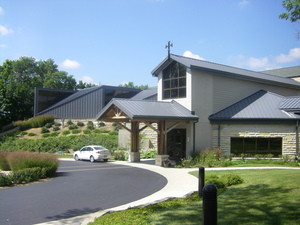 Dear Brothers and Sisters! In every age, men and women who have consecrated their lives to God in prayer – like monks and nuns – have established their communities in particularly beautiful places: in the countryside, on hilltops, in valleys, on the shores of lakes or the sea, or even on little islands. These places unite two elements which are very important for contemplative life: the beauty of creation, which recalls that of the Creator, and silence, which is guaranteed by living far from cities and the great means of communication. Silence is the environmental condition that most favors contemplation, listening to God and meditation. The very fact of experiencing silence and allowing ourselves to be “filled,” so to speak, with silence, disposes us to prayer. The great prophet, Elijah, on Mount Horeb – that is, Sinai – experienced strong winds, then an earthquake, and finally flashes of fire, but he did not recognize the voice of God in them; instead, he recognized it in a light breeze (cfr. 1 Rev 19:11-13). God speaks in silence, but we need to know how to listen. This is why monasteries are oases in which God speaks to humanity; and there we find the courtyard, a symbolic place because it is a closed space, but open toward the sky.
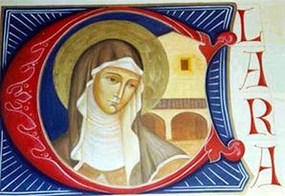 Tomorrow, dear friends, we will celebrate the memory of St. Clare of Assisi. So I would like to recall one of these “oases” of the spirit which is particularly dear to the Franciscan family and to all Christians: the little convent of San Damiano, situated just beneath the city of Assisi, among the olive groves that slope towards Santa Maria degli Angeli. In that little church, which Francis restored after his conversion, Chiara and her first companions established their community, living off prayer and little works. They were called the “Poor Sisters,” and their “form of life” was the same as the Frati Minori: “To observe the Holy Gospel of our Lord Jesus Christ” (Rule of St. Clare, I, 2), conserving the union of reciprocal charity (cfr ivi, X, 7) and observing in particular the poverty and humility of Jesus and his Most Holy Mother (cfr, ivi, XII, 13).
Benedict XVI at the General Audience stresses the value of monastic spirituality God speaks in silence Benedict XVI at the General Audience stresses the value of monastic spirituality God speaks in silence and beauty of the place in which the monastic community lives – simple and austere beauty – are like a reflection of the spiritual harmony which the community itself attempts to create. The world is filled with these oases of the spirit, some very ancient, particularly in Europe; others are more recent, while still others have been restored by new communities. Looking at things from a spiritual perspective, these places of the spirit are a load-bearing structure of the world! It is no accident that many people, especially in times of rest, visit these places and stop there for some days: even the soul, thanks be to God, has its needs! The Pope continues:
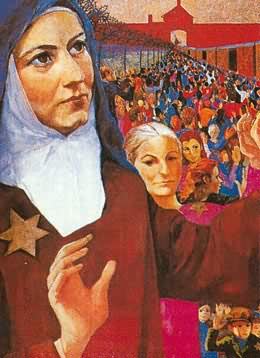
Let us remember, therefore, St. Clare. But let you also remember other Saints who remind us of the importance of turning our gaze to the “things of heaven,” like St. Edith Stein, Teresa Benedicta of the Cross, Carmelite, co-patron of Europe, whom we celebrated yesterday. And today, August 10, we cannot forget St. Lawrence, deacon and martyr, with a special wish for Romans who have always venerated him as one of their patrons. Finally, let us turn our gaze to the Virgin Mary, that she may teach us to love silence and prayer.